Is the Air in Your Home Actually Clean? What Greenville, IN Homeowners Need to Know
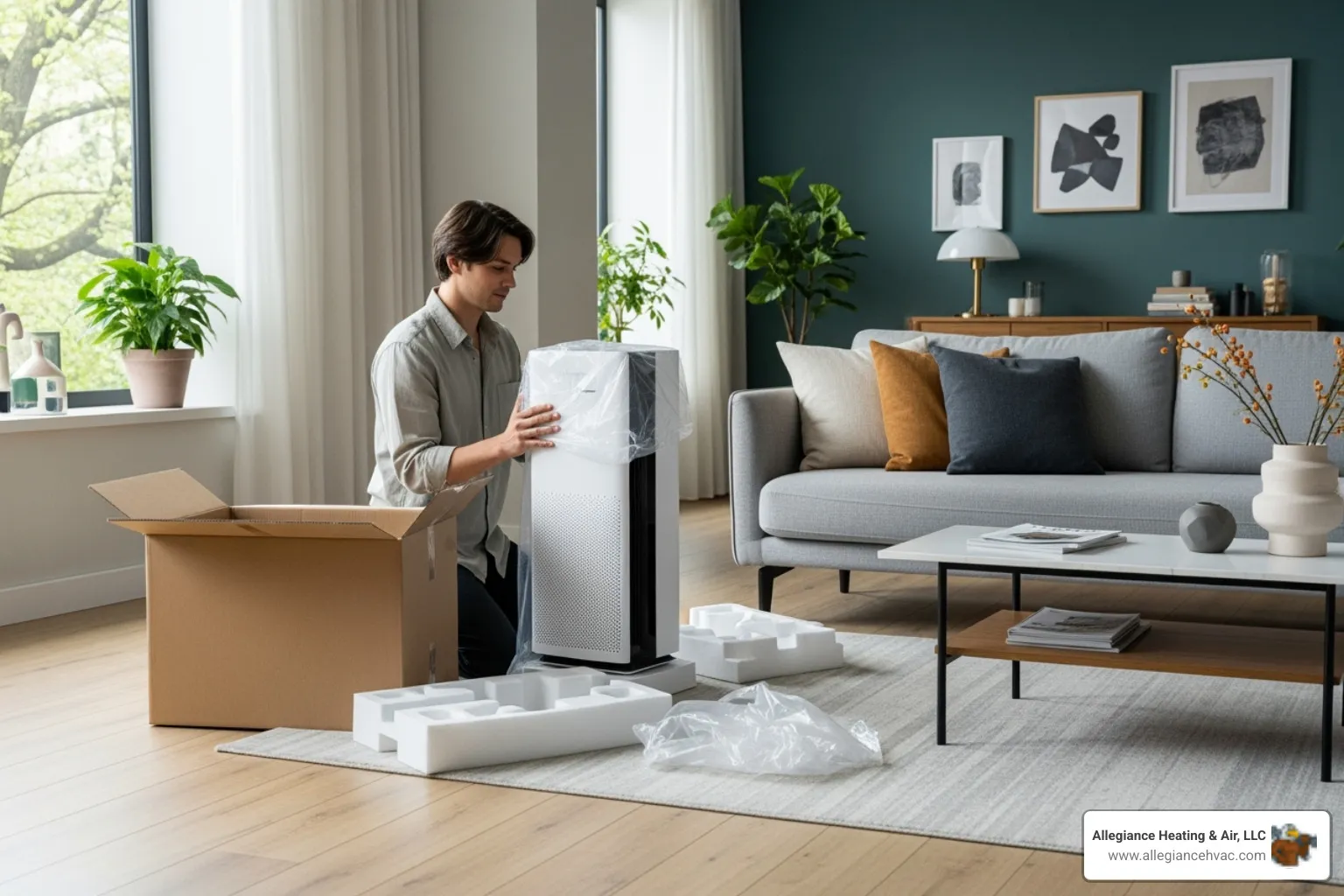
How do air purifiers work for your home comes down to one simple cycle: a built-in fan draws in room air, passes it through one or more filters that trap or neutralize pollutants, and then pushes cleaner air back out — repeating this process several times every hour.
Here's the quick version:
1. Air intake - A motor-driven fan pulls indoor air into the unit
2. Filtration - Air passes through filters (HEPA, activated carbon, or both) that capture particles, gases, and pathogens
3. Clean air return - Purified air is released back into the room
4. Continuous cycling - Most units repeat this 4-5 times per hour for ongoing protection
Most people are surprised to learn that the air inside their home can be 2 to 5 times more polluted than the air outside, according to the EPA. And since most of us spend roughly 90% of our time indoors, that's not a small problem. Dust, pet dander, mold spores, cooking fumes, and chemical vapors from furniture and cleaning products all build up in enclosed spaces — often without any visible sign that there's an issue.
As of April 2026, awareness of indoor air quality has grown significantly, driven by everything from wildfire smoke events to post-pandemic attention on airborne pathogens. More Greenville, IN homeowners are asking smart questions about how to actually improve the air their families breathe every day.
This guide breaks down exactly how air purifiers work, what they can and can't do, and how to choose the right setup for your home.

The Mechanics: How Do Air Purifiers Work for Your Home?
To understand how do air purifiers work for your home, think of them as the high-tech lungs of your living space. While a furnace filter is primarily there to protect your HVAC equipment from large dust bunnies, a dedicated air purifier is designed specifically to scrub the air for your health.
The system relies on a few core components working in harmony:
• The Internal Fan and Motor: This is the heart of the machine. The motor spins the fan blades, creating a pressure vacuum that pulls air through the intake vents.
• The Intake Vent: Usually located on the sides or back of the unit, these vents are the "entryway" for dirty air.
• The Filtration Stage: This is where the magic happens. As air is forced through dense filter media, pollutants are snagged and held captive.
• The Exhaust: Once cleaned, the air is pushed back out into your room, often through the top of the unit to encourage better circulation.
A critical concept we always discuss during Air Purifier Installation is the "Air Exchange Rate." This measures how many times the device can cycle the entire volume of air in a room within one hour. For someone with severe allergies or asthma, we typically look for a unit that provides 4 to 5 air cycles per hour (ACH). This ensures that as new pollutants—like a dog shaking off dander or someone cooking dinner—enter the air, they are removed before they can settle on surfaces or irritate your lungs.
Understanding Filtration Technologies and Their Functions
Not all air purifiers are created equal. Depending on whether you are fighting smells, dust, or germs, you might need different "tools" inside the box. Many modern systems use a multi-stage approach to cover all the bases.
• HEPA Filter — Best For: Dust, Pollen, Dander, Smoke — How It Works: Mechanical trapping of particles
• Activated Carbon — Best For: Odors, VOCs, Chemicals — How It Works: Adsorption (sticking gases to a surface)
• UV-C Light — Best For: Viruses, Bacteria, Mold — How It Works: Neutralizing DNA of pathogens
• Electrostatic — Best For: Fine Particulates — How It Works: Charging particles so they stick to plates
When exploring the Different Types of Air Cleaners and Their Benefits, it becomes clear that a "one-size-fits-all" approach rarely works. Most high-quality units we recommend for homes in the Louisville and Southern Indiana area combine at least two of these technologies.
Mechanical Filtration: How HEPA Air Purifiers Work for Your Home
The "gold standard" for air cleaning is the High-Efficiency Particulate Air (HEPA) filter. By definition, a True HEPA filter must remove at least 99.97% of airborne particles that are 0.3 micrometers in diameter. To give you some perspective, a human hair is about 70 micrometers wide—these filters are catching things you can't even see with a microscope!
HEPA filters don't just act like a kitchen strainer; they use three clever scientific principles to catch particles:
1. Impaction: Large particles crash directly into the fibers.
2. Interception: Mid-sized particles follow the airflow but get snagged as they pass close to a fiber.
3. Diffusion: The smallest particles zip around in a zig-zag pattern (Brownian motion), eventually bumping into a fiber and getting stuck.
This makes IAQ (Indoor Air Quality) significantly better for those suffering from respiratory issues, as it removes the microscopic triggers that cause flare-ups.
Gas-Phase Filtration: How Carbon Air Purifiers Work for Your Home
While HEPA is king of particles, it can't stop smells or chemical vapors. That’s where activated carbon comes in. This material is treated with oxygen to open up millions of tiny pores between the carbon atoms. This creates a massive surface area—one gram of activated carbon can have a surface area of over 3,000 square meters!
Through a process called adsorption, Volatile Organic Compounds (VOCs), formaldehyde from new furniture, and cooking odors literally stick to the carbon. If you’ve ever noticed a "stuffy" or "chemical" smell in your home, improving your Indoor Air Quality with a carbon-heavy filter is usually the answer.
Targeting Pollutants: From Pet Dander to Viruses
Living in places like Clarksville or New Albany means dealing with a variety of local pollutants. In the spring, pollen is the enemy. In the winter, when we seal our homes tight, it's dust mites and pet dander.
Air purifiers are specifically designed to target:
• Biological Allergens: Pet dander, pollen, and mold spores are easily captured by HEPA filters. Knowing How Air Purification Can Help with Allergies is the first step toward a sneeze-free spring.
• Pathogens: Airborne viruses (including SARS-CoV-2) and bacteria can be significantly reduced in a room using HEPA filtration. For an added layer of protection, Ultraviolet Air Cleaners Improved IAQ by using UV-C light to scramble the DNA of these germs, preventing them from reproducing.
• Smoke and VOCs: Whether it's from a nearby wildfire or just a burnt piece of toast, air purifiers with thick carbon layers can scrub the smoke particles and the lingering smell out of the air.
Choosing and Maintaining the Right System for Your Space
Buying an air purifier that is too small for your room is like trying to mow a football field with a pair of scissors—it just won't work. When shopping, look for the CADR (Clean Air Delivery Rate). This rating tells you how quickly the unit can clean the air of smoke, dust, and pollen. A good rule of thumb is that the CADR should be at least two-thirds of the room's square footage.
Maintenance is the "secret sauce" to long-term success. Even the best filter will eventually clog.
• HEPA Filters: Usually need replacement every 6 to 12 months.
• Carbon Filters: May need changing every 3 to 6 months since they "fill up" with odors.
• Pre-filters: These catch the big stuff like dog hair. Many are washable and should be cleaned every month.
If you aren't sure what's actually in your air, we recommend starting with Professional Home Air Quality Testing. For those looking for a "set it and forget it" solution, Whole House Air Filtration Jeffersonville IN systems can be integrated directly into your HVAC ductwork, cleaning the air in every room simultaneously.
Frequently Asked Questions about Home Air Purification
We hear a lot of questions from our neighbors in Floyds Knobs and Georgetown. Here are the most common things people want to know about how do air purifiers work for your home.
Should I run my air purifier overnight?
Yes! In fact, we recommend running it 24/7. Humans spend about one-third of their lives sleeping, and the bedroom is often where we spend the most continuous time. Running it overnight ensures you aren't breathing in dust mites and allergens while your body is trying to recover. Modern units have "Sleep Modes" that keep the fan whisper-quiet so it won't disturb your rest.
Where is the best place to position an air purifier?
Air purifiers need "breathing room." Don't tuck it behind a couch or inside a closet. For the best results, place it in the room where you spend the most time (usually the bedroom or living room), at least 3 feet away from walls or furniture. This allows the fan to draw in air from all directions.
Are air purifiers effective against COVID-19?
While no device can guarantee 100% protection, HEPA filters are highly effective at capturing the tiny respiratory droplets that carry viruses like SARS-CoV-2. Studies in hospital wards have shown that portable HEPA units significantly reduce the "viral load" in the air, making them a great supplemental tool for home safety.
One thing to watch out for: Avoid "Ozone Generators." Some devices claim to clean the air using ozone, but the EPA warns that ozone is a lung irritant that can actually make asthma and respiratory issues worse. Stick to mechanical HEPA and carbon filtration for the safest results. For more tips, check out our Solutions for Improving IAQ Year-Round.
Conclusion
Understanding how do air purifiers work for your home is a powerful step toward a healthier lifestyle. By combining the right technology with consistent maintenance and smart placement, you can transform your home into a true sanctuary of clean air.
At Allegiance Heating & Air, we’ve been "Taking Home Comfort Under Our Wing" since 2005. As a family-owned business based in Greenville, IN, we take pride in helping our neighbors breathe easier. Whether you need a portable unit for a nursery or a comprehensive Air Purification Systems Greenville IN for your entire house, our trusted technicians are here to help.
Don't let poor indoor air quality hold you back. If you're ready to see the difference professional-grade filtration can make, give us a call today. We serve communities across Southern Indiana and the Louisville area, ensuring your home remains a comfortable, healthy place for your family all year long.
Contact Us Or Schedule Expert Service
Other Blogs
ready to transform your home?
Discover our exceptional home services tailored to meet your needs and enhance your living space.
WHAT OUR CLIENTS HAVE TO SAY ABOUT US

We had a complete HVAC system and a hot water heater installed. The guys were professional, well mannered, and completed the work in a timely manner. Would definitely use them again.
I was nervous at first because my AC broke in the middle of 80 degree weather which is strange for April, but Allegiance Heating and Air was incredibly prompt and professional. The technician arrived within an hour, explained the problem clearly, and completed the repair. The technician , Mr. Garrett Moon was a very nice and courteous young man. He found the problem and fixed it within a timely manner. I highly recommend them for any heating or cooling needs. I’ll definitely give them a call again should I ever have another issue, but hopefully not. Knock on wood 😁. Give them a call… you won’t be disappointed!
From the moment I called to schedule a service, the team was quick to respond and arrived right on time. The technician was professional, friendly, and clearly knowledgeable about my heating system. He explained the repair options in plain language and completed the job efficiently. I appreciated the reliable service and the fact that the work was done the same day. I would definitely recommend Allegiance Heating and Air for any residential HVAC needs.
5/5 stars – I was very impressed with the efficient, affordable and timely service from Allegiance Heating and Air. The technician arrived on time, and performed the service quickly, no repairs needed at this time. Communication was clear and the whole experience felt hassle‑free. I would definitely recommend them for any residential HVAC needs.
Knowledgeable, experienced individual.
Explains Allegiance Heating and Air was incredibly reliable, professional and affordable. They arrived right on time, kept the work area clean and finished the furnace repair quickly. The technician explained everything clearly and the price was a great value. If happiness had a location on Google Maps, it would be here.
Gilbert had to go above and beyond because York is no longer making the part for my furnace. But he was able to find a way to construct a housing bracket for my furnace. Ingenuity, determination and integrity is what finally got my furnace fixed. Gilbert is truly a one of a kind technician.
Thank you for always going the extra mile. Gilbert is always respectful and helpful with any concerns.
"Great service, most knowledgeable and capable HVAC business in Kentuckiana!! Pete Flemming and Bryan the owner, are HVAC encyclopedias. They have the highest integrity of any HVAC business I have ever used. Allegiance has put numerous units in for me over the last 17 years. I will continue to use and trust them."
"Fast response from Allegiance when our heat was out on New Year’s day! Service technician was friendly and efficient. He took the time to explain the problem, tell us about the temporary fix and the plan for permanent repair. We were impressed!"
"Love Allegiance! Their technicians, in particular Benjamin, explain everything. Fast and thorough. A/C was out on a Sunday. Called Allegiance and within a few hours Benjamin arrived. Such a comfort as he was the one who last serviced our units. He quickly replaced part and cooling is restored!"
"My heat pump went out and I had to call after hours. The technician (Garrett) was outstanding and thorough. He got my system up and working until Monday and gave me several options of units. Also took the time to explain the issue to my Home warranty company. I highly recommend this company."
"Right on time :) respectful, fast, and polite. Even gave my fur babies some attention."
"Had Garrett out today to fix our AC. Fantastic tech. He showed up exactly when he said he would and kept us informed of what he was checking and what he found. Highly recommend!"
"Lucas with Allegiance showed up on time as promised, was professional and extremely patient and responsive with all my questions. He took care of the issue, and I feel he was trustworthy! He had us back to cool and comfortable on one of the hottest days of the year."
"Lucas did a great job! Very professional and expedient. Explained the process very well and represented Allegiance as a truly professional and reputable company."
"Arrived on time and work diligently to fix issue. These guy are great. Worked quickly to resolve my issues."
"Lucas was great - he spent a lot of time trying to figure out what was going on and explained everything he was doing. I trust Allegiance and wouldn’t want anyone else working on/in my house!!"

RELATED ARTICLES

The Impact of Geothermal HVAC Systems on Energy Efficiency

The Upstairs Bedroom Dilemma: Adding a Window Unit vs. Fixing Your Home's Air Balancing