Why Summer Energy Bills Hit Hard in the Ohio Valley
The best energy saving tips for summer in the Ohio Valley all share one thing in common: they work with your home's weaknesses, not against them. If you want the short version, here it is:
Top energy saving tips for summer in the Ohio Valley:
- Set your thermostat to 78°F when home, and raise it 7-8 degrees when away or asleep
- Run ceiling fans counterclockwise to push cool air down — and turn them off when you leave the room
- Close blinds and curtains on south- and west-facing windows during peak afternoon heat
- Run ovens, dryers, and dishwashers after sunset to reduce indoor heat load
- Change your AC filter monthly and schedule an annual tune-up before peak season
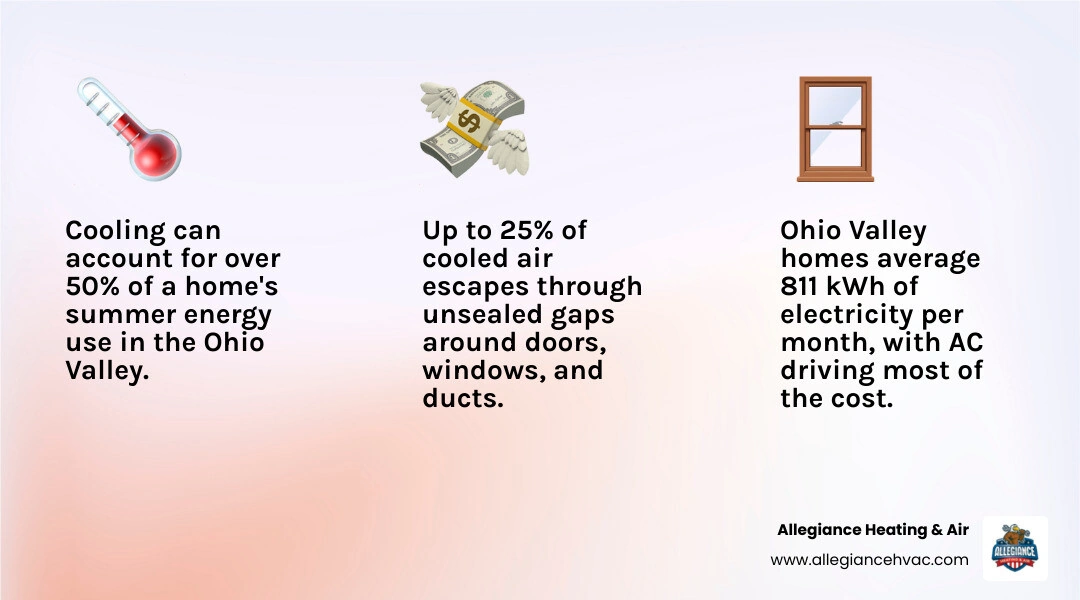
- Seal air leaks around doors, windows, and ducts — up to 25% of cooled air escapes through gaps
- Use a programmable or smart thermostat to automate setbacks and save up to $180 a year
- Manage indoor humidity — muggy Ohio Valley summers make your AC work much harder
- Sign up for budget billing through your utility to smooth out seasonal bill spikes
- Know where local cooling centers are before an extreme heat event hits
Summers in the Ohio Valley are no joke. If you live in or around Greenville, IN, you already know the combination of high heat and thick humidity that settles in from June through August. That one-two punch forces air conditioners to run longer and harder than in drier parts of the country — and your electric bill reflects it. In fact, cooling can account for more than half of a home's total energy use during summer months, and Ohio families average around 811 kilowatt-hours of electricity per month. When temperatures push into the upper 90s and the heat index climbs past 100°F, even a well-maintained system struggles to keep up.
The good news is that most of the biggest energy drains are fixable — many of them for little to no money. This guide from Allegiance Heating & Air walks you through the most effective strategies, from simple daily habits to smart maintenance steps, so you can stay comfortable without watching your electric meter spin out of control.
Smart Thermostat and Airflow Management
Managing how air moves and how your system is controlled is the easiest way to start chipping away at those high electric bills. Many homeowners assume keeping a home cool requires blasting the air conditioner 24/7, but smart airflow management tells a different story.

When you control your indoor climate strategically, you reduce the workload on your compressor while maximizing your home's comfort.
Optimizing Thermostat Settings and Ceiling Fans
One of the most persistent myths in home cooling is that setting your thermostat to a freezing temperature will cool the house down faster. In reality, your air conditioner runs at the exact same speed regardless of whether you set it to 72°F or 60°F. Setting it lower only ensures that it runs longer, wasting precious energy.
Instead, the U.S. Department of Energy recommends setting your thermostat to 78°F when you are at home and active. While 78°F might sound warm at first, you can easily bridge the comfort gap by using ceiling fans.
Ceiling fans create a "wind-chill" effect. They don’t actually cool the air in the room; instead, they blow air across your skin, accelerating the evaporation of sweat and making you feel up to four degrees cooler. Because of this, you must ensure your ceiling fans are rotating counterclockwise during the summer to push a cool breeze straight down.
Here are a few quick rules for fan and thermostat synergy:
- Turn them off when you leave: Since fans cool people and not rooms, running a fan in an empty room is just wasting electricity.
- The 8-Hour Rule: Raising your thermostat by five to seven degrees for eight hours a day (such as when you are at work or asleep) can lower your electric bill by up to 10% a year.
- Understand your climate: Our heavy regional humidity makes sweat evaporate slower, which is why understanding how Ohio Valley climate affects your HVAC system is key to setting realistic comfort goals.
Low-Cost Energy Saving Tips for Summer in the Ohio Valley
If you want to keep costs predictable, look beyond physical adjustments and take advantage of your utility provider's tools. Many families in Southern Indiana and the Kentuckiana area can benefit from simple, low-cost administrative steps.
First, invest in a smart or programmable thermostat. Proper use of a programmable or Wi-Fi-enabled thermostat can save you about $180 every year in energy costs by automating your temperature setbacks. Many local utilities offer rebates that cover a significant portion of the purchase price for these smart devices.
Second, sign up for budget billing. While this doesn't reduce your overall energy consumption, it averages your utility costs over a rolling 12-month period. This prevents the dreaded "bill shock" in July and August when your air conditioner is working overtime.
Finally, keep a close eye on your monthly utility statements. Most modern bills include a 12-month historical usage chart. By tracking this data, you can see exactly when your energy spikes occur and correlate them with regional heat waves, helping you plan better for the next season. For more tailored regional advice, check out our comprehensive list of HVAC tips for Kentuckiana homeowners.
Essential Energy Saving Tips for Summer in the Ohio Valley
Passive cooling techniques—steps that prevent heat from entering your home in the first place—are just as important as running an efficient air conditioner. If you can stop the sun from baking your living room, your AC won't have to work nearly as hard to keep things comfortable.
Up to 30% of unwanted heat gain in a home comes directly through the windows. By addressing these weak points, you can significantly lower your daily cooling load. This is especially true when trying to figure out how to keep your home cool during humid summers.
Managing Heat-Producing Appliances and Lighting
Your home is full of stealthy heat sources that fight against your air conditioner. Traditional incandescent light bulbs, for instance, release about 90% of their energy as heat rather than light. Swapping them out for energy-efficient LED bulbs keeps your rooms cooler and lowers your lighting energy consumption by up to 75%.
Your kitchen is another major culprit. Conventional ovens throw an immense amount of heat into your living spaces. During hot summer days, try these appliance adjustments:
- Time it right: Delay running your dishwasher, clothes dryer, and oven until after 8:00 PM when outdoor temperatures drop.
- Embrace alternative cooking: Use microwaves, slow cookers, air fryers, or step outside to the grill. Grilling keeps 100% of the cooking heat out of your kitchen.
- Skip the dry cycle: Turn off the heated dry cycle on your dishwasher and let your dishes air-dry instead.
- Mind the fridge: Avoid leaving the refrigerator door open while deciding on a snack. Careless fridge openings can waste up to 120 kWh of electricity over the course of a year!
Sealing Air Leaks and Improving Insulation
Did you know that up to 25% of the energy used to cool a home escapes through air leaks? That is the equivalent of leaving a window cracked open all summer long. Caulking and weatherstripping are incredibly inexpensive DIY projects that pay off almost immediately.
To find air leaks, wait for a windy day and hold a lit stick of incense near common trouble spots. If the smoke blows sideways, you have a leak. Focus your sealing efforts on these common areas:
- Around exterior door frames and window sashes
- Where plumbing pipes and electrical lines enter the home from the outside
- The attic hatch or pull-down stairs
- Around window air conditioning units (ensure they are tightly sealed with foam panels)
- The seal around your fireplace damper (keep the damper closed tightly when not in use)
Additionally, check your attic insulation. If you can see the wooden floor joists in your attic, you likely need to add more insulation. Proper insulation acts as a thermal barrier, keeping the intense heat of your attic from radiating down through your ceilings into your active living areas.
HVAC Maintenance and Humidity Control Strategies
Your cooling system is a mechanical workhorse. Just like a car, it requires regular maintenance to run at peak efficiency. Neglecting simple maintenance tasks can drop your system's efficiency by 5% to 15% in a single season.
When your system is clean and properly calibrated, it uses less electricity and does a much better job extracting the heavy moisture that characterizes our local summers. Taking these proactive steps is essential when preparing your AC for a humid Indiana summer.
Preparing Your AC and Heat Pump for Summer
The single most important maintenance task you can perform yourself is changing your air filter. A dirty, clogged filter restricts airflow, forcing your blower motor to work twice as hard to push air through your home. We recommend checking your filter every 30 to 60 days during peak summer use and replacing it if it looks gray or dusty.
Beyond the filter, you need to keep your outdoor condenser unit clear. The outdoor unit is responsible for releasing the heat collected from inside your home. If it is choked with grass clippings, fallen leaves, or overgrown weeds, it cannot shed heat efficiently. Keep a two-foot clearance zone around the entire unit, and gently spray the metal fins with a garden hose occasionally to wash away accumulated dirt.
While DIY care is great, nothing replaces a professional tune-up. An annual inspection by a certified technician ensures your refrigerant levels are correct, electrical connections are tight, and the condensate drain is clear of algae blockages. These simple steps are the best way to how to extend your HVAC lifespan and prevent costly mid-summer breakdowns.
Advanced Energy Saving Tips for Summer in the Ohio Valley
If your current cooling system is more than 10 to 15 years old, it may be time to consider an upgrade. Modern high-efficiency systems use significantly less energy than older models. When shopping for a new system, pay close attention to the SEER2 (Seasonal Energy Efficiency Ratio) rating.
To help you understand the difference, take a look at how standard-efficiency and high-efficiency systems compare:
| Feature | Standard Efficiency HVAC | High-Efficiency HVAC |
|---|---|---|
| Average SEER2 Rating | 13.4 to 15 | 16 to 22+ |
| Compressor Type | Single-stage (On/Off) | Two-stage or Variable-speed |
| Humidity Control | Basic | Exceptional (runs longer, gentler cycles) |
| Annual Energy Savings | Baseline | Up to 20% - 30% lower cooling costs |
| Lifespan Impact | Standard | Extended (due to fewer hard starts) |
To dig deeper into these differences, you can read our High SEER vs Standard SEER AC Comparison and see exactly how much does a high efficiency HVAC save over time.
Additionally, consider integrating a whole-house dehumidifier. Because high humidity makes the air feel warmer, keeping your indoor relative humidity between 30% and 50% allows you to set your thermostat higher while maintaining the exact same level of physical comfort.
Grid Stress, Power Outages, and Community Safety
During extreme heat waves, the local electrical grid experiences massive strain as millions of air conditioners run simultaneously. This grid stress can occasionally lead to brownouts or localized power outages. Being prepared is key to keeping your family safe and comfortable.
Staying Safe During Extreme Heat Waves
Your health must always come before your utility bill. During severe heat waves where temperatures exceed 95°F and humidity is high, take immediate personal safety precautions:
- Stay hydrated: Drink plenty of water throughout the day, even if you do not feel actively thirsty.
- Dress appropriately: Wear loose, lightweight, and light-colored clothing.
- Limit outdoor activities: Avoid heavy yard work or outdoor exercise during the hottest hours of the day (typically 11:00 AM to 5:00 PM).
- Check on others: Take a few minutes to check on elderly neighbors, families with young infants, and pets.
- Know your local resources: If your home lacks functioning air conditioning, identify local public spaces with cooling—such as libraries, community centers, or shopping malls—where you can spend the hottest hours of the afternoon.
What to Do During a Summer Power Outage
If a severe storm or grid overload knocks out your power, quick action can protect your home and your wallet:
- Report the outage immediately: Do not assume your utility provider already knows. Contact your local provider (such as Duke Energy or Harrison REMC) via their dedicated outage hotlines or mobile apps.
- Keep the fridge closed: An unopened refrigerator will keep food safe for about four hours, while a full freezer can maintain its temperature for up to 48 hours if the door stays shut.
- Unplug major appliances: When power is restored, a sudden electrical surge can damage sensitive compressors and control boards. Unplug your AC system or turn off its breaker until the grid stabilizes.
- Ventilate safely: Open windows on opposite sides of your home to encourage cross-ventilation if a gentle breeze is present, but close them immediately if the outdoor air is stiflingly hot and stagnant.
Frequently Asked Questions About Summer Energy Savings
What is the best thermostat setting for summer in the Ohio Valley?
The ideal setting for a balance of comfort and energy savings is 78°F when you are at home. When you are away or sleeping, raising the thermostat to 85°F can significantly reduce your monthly energy consumption without sacrificing comfort when it matters most.
How does humidity affect my air conditioning efficiency?
High humidity forces your air conditioner to spend a massive amount of energy performing "latent cooling"—which is the process of condensing water vapor out of the air rather than lowering the actual air temperature. To learn more about this process, read our detailed guide on how humidity and temperature swings affect your HVAC.
Can ceiling fans actually lower my energy bill?
Yes, but only if you raise your thermostat setting in tandem. Using a ceiling fan allows you to raise your thermostat by roughly four degrees without any loss of comfort, which can trim your cooling costs by up to 10% over the summer. Remember: fans cool people, not rooms, so turn them off when you leave!
Conclusion
Keeping your home cool during our muggy Ohio Valley summers doesn't have to require a small fortune. By combining smart habits—like adjusting your thermostat, utilizing ceiling fans correctly, and managing heat-producing appliances—with targeted home maintenance, you can enjoy a comfortable home all season long.
At Allegiance Heating & Air, LLC, we have been "Taking Home Comfort Under Our Wing" since 2005. As a family-owned business based in Greenville, IN, we are proud to serve our neighbors across Southern Indiana and the Kentuckiana area with trusted, professional HVAC services. Whether you need a quick system tune-up to boost your efficiency or are ready to explore a high-efficiency system upgrade, our experienced technicians are here to help.
Ready to take control of your summer utility bills? Schedule professional AC maintenance with Allegiance Heating & Air today and keep your home running efficiently all summer long!
Contact Us Or Schedule Expert Service
Other Blogs
ready to transform your home?
Discover our exceptional home services tailored to meet your needs and enhance your living space.
WHAT OUR CLIENTS HAVE TO SAY ABOUT US

We had a complete HVAC system and a hot water heater installed. The guys were professional, well mannered, and completed the work in a timely manner. Would definitely use them again.
I was nervous at first because my AC broke in the middle of 80 degree weather which is strange for April, but Allegiance Heating and Air was incredibly prompt and professional. The technician arrived within an hour, explained the problem clearly, and completed the repair. The technician , Mr. Garrett Moon was a very nice and courteous young man. He found the problem and fixed it within a timely manner. I highly recommend them for any heating or cooling needs. I’ll definitely give them a call again should I ever have another issue, but hopefully not. Knock on wood 😁. Give them a call… you won’t be disappointed!
From the moment I called to schedule a service, the team was quick to respond and arrived right on time. The technician was professional, friendly, and clearly knowledgeable about my heating system. He explained the repair options in plain language and completed the job efficiently. I appreciated the reliable service and the fact that the work was done the same day. I would definitely recommend Allegiance Heating and Air for any residential HVAC needs.
5/5 stars – I was very impressed with the efficient, affordable and timely service from Allegiance Heating and Air. The technician arrived on time, and performed the service quickly, no repairs needed at this time. Communication was clear and the whole experience felt hassle‑free. I would definitely recommend them for any residential HVAC needs.
Knowledgeable, experienced individual.
Explains Allegiance Heating and Air was incredibly reliable, professional and affordable. They arrived right on time, kept the work area clean and finished the furnace repair quickly. The technician explained everything clearly and the price was a great value. If happiness had a location on Google Maps, it would be here.
Gilbert had to go above and beyond because York is no longer making the part for my furnace. But he was able to find a way to construct a housing bracket for my furnace. Ingenuity, determination and integrity is what finally got my furnace fixed. Gilbert is truly a one of a kind technician.
Thank you for always going the extra mile. Gilbert is always respectful and helpful with any concerns.
"Great service, most knowledgeable and capable HVAC business in Kentuckiana!! Pete Flemming and Bryan the owner, are HVAC encyclopedias. They have the highest integrity of any HVAC business I have ever used. Allegiance has put numerous units in for me over the last 17 years. I will continue to use and trust them."
"Fast response from Allegiance when our heat was out on New Year’s day! Service technician was friendly and efficient. He took the time to explain the problem, tell us about the temporary fix and the plan for permanent repair. We were impressed!"
"Love Allegiance! Their technicians, in particular Benjamin, explain everything. Fast and thorough. A/C was out on a Sunday. Called Allegiance and within a few hours Benjamin arrived. Such a comfort as he was the one who last serviced our units. He quickly replaced part and cooling is restored!"
"My heat pump went out and I had to call after hours. The technician (Garrett) was outstanding and thorough. He got my system up and working until Monday and gave me several options of units. Also took the time to explain the issue to my Home warranty company. I highly recommend this company."
"Right on time :) respectful, fast, and polite. Even gave my fur babies some attention."
"Had Garrett out today to fix our AC. Fantastic tech. He showed up exactly when he said he would and kept us informed of what he was checking and what he found. Highly recommend!"
"Lucas with Allegiance showed up on time as promised, was professional and extremely patient and responsive with all my questions. He took care of the issue, and I feel he was trustworthy! He had us back to cool and comfortable on one of the hottest days of the year."
"Lucas did a great job! Very professional and expedient. Explained the process very well and represented Allegiance as a truly professional and reputable company."
"Arrived on time and work diligently to fix issue. These guy are great. Worked quickly to resolve my issues."
"Lucas was great - he spent a lot of time trying to figure out what was going on and explained everything he was doing. I trust Allegiance and wouldn’t want anyone else working on/in my house!!"

RELATED ARTICLES

Professional Home Air Quality Testing in Jeffersonville, IN
Ultimate Guide to Heat Pump Benefits and How They Work