
Why Preparing Your AC for a Humid Indiana Summer Matters More Than You Think
Preparing your AC for a humid Indiana summer is one of the most important things you can do as a homeowner before the heat arrives. Indiana summers are no joke — temperatures regularly climb into the 80s and 90s, and dew points frequently push past 65°F, sending indoor humidity levels soaring above 70–80%. That kind of sticky, heavy air doesn't just make you uncomfortable. It forces your air conditioner to work twice as hard, removing both heat and excess moisture from your home at the same time.
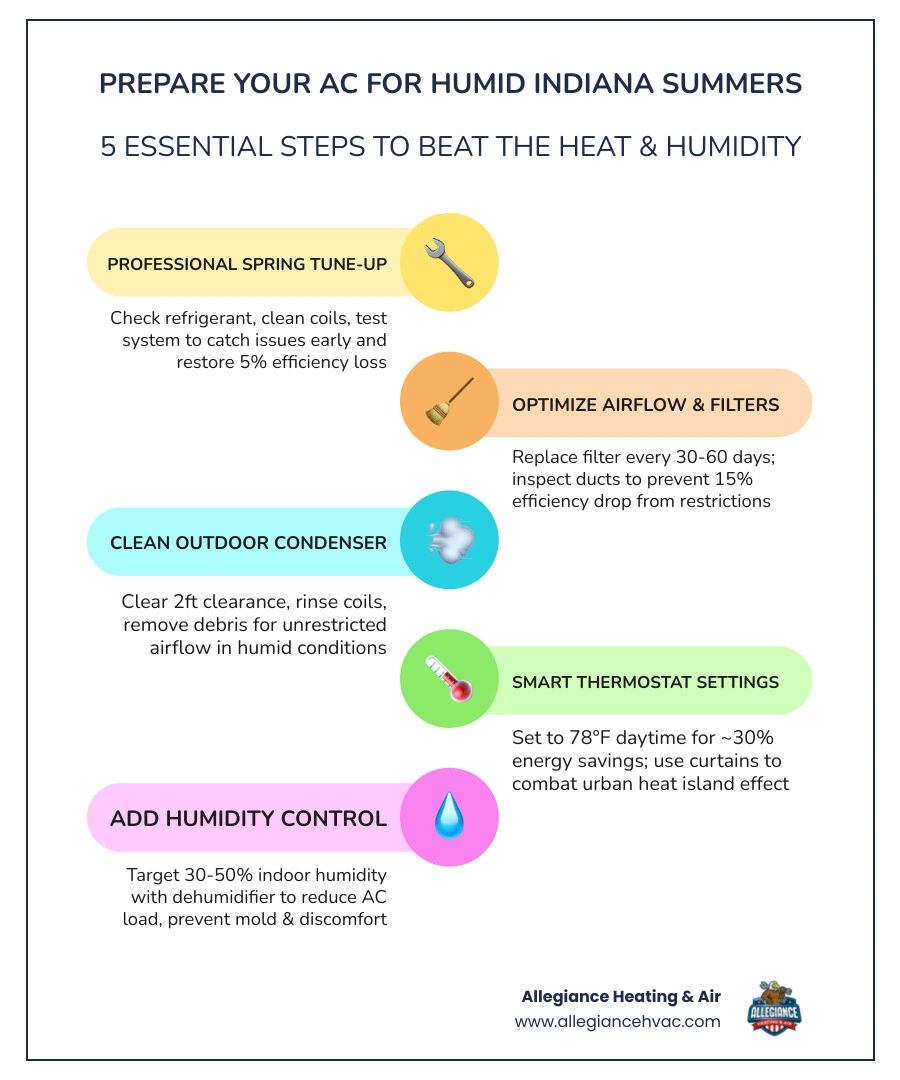
Here's a quick overview of how to get your AC ready before Indiana's humid summer hits:
1. Schedule a professional spring tune-up — catch refrigerant issues, dirty coils, and worn components early
2. Replace or clean your air filter — check every 30–60 days during peak summer months
3. Clean the outdoor condenser unit — clear at least 2 feet of space and rinse off debris
4. Set your thermostat strategically — 78°F during the day can cut cooling costs by nearly 30%
5. Add humidity control — a whole-home dehumidifier keeps indoor humidity in the ideal 30–50% range
And if you skip these steps? Neglected AC systems lose around 5% of their efficiency every single year. That means higher bills, more breakdowns, and a system that simply can't keep up when July hits and the air feels like a warm, wet blanket.
There's even a uniquely Indiana factor to keep in mind: corn sweat. Vast cornfields across the state release enormous amounts of water vapor during summer, making already-humid days feel even stickier — especially in rural areas like those around Greenville, IN. Your AC is fighting that moisture load every single day of summer.
The good news? A few proactive steps taken now, in spring 2026, can keep your home cool, dry, and comfortable all season long — without the stress of an emergency breakdown on the hottest day of the year.
Key terms for preparing your ac for a humid indiana summer:
• Fix a refrigerant leak in my AC unit in Lanesville, IN
• My air conditioner won't turn on. Reliable HVAC repair services in the Greenville, IN area
Step 1: Schedule a Professional Spring Tune-Up
The single most effective way to begin preparing your ac for a humid indiana summer is to call in the pros for a comprehensive inspection. Think of it like an oil change for your car; you wouldn't head out on a cross-country road trip with old oil and a shaky engine, and you shouldn't head into a 90-degree July without a system check.
During a professional visit, such as our Spring AC Tune-Up What to Expect service, we look at the technical details that homeowners often can't see. This includes checking refrigerant levels — because low refrigerant means your AC will blow lukewarm air and run indefinitely, spiking your bills. We also clean the evaporator coils, which are responsible for pulling the heat and moisture out of your indoor air. If these coils are dirty, they can't "grab" the humidity effectively, leaving your home feeling sticky even if the temperature is dropping.
According to our Annual HVAC Maintenance Complete Guide, a well-maintained system can operate at its original efficiency for 15 to 20 years. Conversely, a neglected system loses about 5% of its efficiency every year. By catching small issues now, you prevent the 80% spike in service calls that happen during the first major heatwave of the season.
Step 2: Optimize Airflow and Filtration
When the air is thick with humidity, your AC needs to move a lot of it through your system to strip out the moisture. If your airflow is restricted, your system will struggle, potentially leading to frozen coils or a burnt-out blower motor.
Air filters are your first line of defense. In a humid climate like Southern Indiana, we recommend checking your filter every 30 to 60 days. In May 2026, as the pollen counts rise and we start closing up our homes, a clean filter is vital for maintaining indoor air quality. For a deeper dive, check out our guide on Essential Air Conditioner Maintenance.
While you’re at it, consider the following:
• MERV Ratings: Use a filter with a high enough MERV rating to catch allergens, but not so high that it restricts airflow.
• Vent Cleaning: Ensure your supply and return vents aren't blocked by furniture, rugs, or curtains.
• Ductwork Inspection: Typical duct systems in older Indiana homes can lose 20-30% of conditioned air through gaps and leaks. Optimizing Indoor Air Quality During Summer starts with making sure that cold, dry air actually reaches your living spaces instead of leaking into your attic or crawlspace.
Step 3: Preparing Your AC for a Humid Indiana Summer by Cleaning the Condenser
Your outdoor unit (the condenser) is responsible for releasing the heat collected from inside your home. If it’s clogged with grass clippings, cottonwood seeds, or dirt, it can't "breathe," and the heat stays trapped in your system. This is a critical step in preparing your ac for a humid indiana summer.
Start by clearing a "buffer zone." We recommend maintaining at least a two-foot clearance around the unit. This means trimming back shrubs, pulling weeds, and ensuring no mulch is piled against the base. For more DIY tips, see our Air Conditioner Maintenance Guide.
Once the area is clear, you can gently rinse the condenser fins with a garden hose (don't use a pressure washer, as it can bend the delicate metal fins). Removing that layer of winter grime allows for maximum heat transfer. As we note in Regular Maintenance for AC Matters, a clean outdoor unit reduces the workload on your compressor, which is the most expensive part of your system to replace.
Step 4: Manage Thermostat Settings and Home Efficiency
Efficiency isn't just about the machine; it's about how you use it. In the Ohio Valley, the "urban heat island effect" can make neighborhoods in places like New Albany or Jeffersonville 5-9°F warmer at night than the surrounding countryside. This means your AC gets very little rest.
The Department of Energy recommends setting your thermostat to 78°F when you are home. While that might sound high, every degree you raise the temperature reduces AC runtime by 3 to 5 percent. Setting your thermostat to 78°F instead of 72°F can cut your cooling costs by nearly 30%!
• 72°F — Estimated Cooling Cost Savings: Baseline — Runtime Impact: Standard
• 75°F — Estimated Cooling Cost Savings: ~15% Savings — Runtime Impact: 10-15% Less Runtime
• 78°F — Estimated Cooling Cost Savings: ~30% Savings — Runtime Impact: 20-25% Less Runtime
To help your AC maintain these temperatures, follow the advice in Preparing Your HVAC for the Transition to Cooling:
• Blackout Curtains: Keep the sun out during the afternoon to prevent radiant heat gain.
• Seal Drafts: Use weatherstripping or caulk around windows and doors to keep the humid air out and the dry air in.
• Smart Thermostats: These devices can learn your schedule and automatically adjust when you're at work, ensuring you aren't paying to cool an empty house.
Step 5: Integrate Humidity Control Solutions
Sometimes, even a perfectly functioning AC isn't enough to combat Indiana's "corn sweat" humidity. This is because most AC units are designed to cool the air first; dehumidification is a secondary byproduct. If your AC is oversized, it might cool the room so quickly that it shuts off before it has a chance to remove the moisture, leaving you with a home that feels cold but "clammy."
The Proper Humidity Control Importance cannot be overstated. Ideally, your indoor humidity should stay between 30% and 50%. When it climbs above 60%, you start risking mold growth and dust mite infestations.
A whole-home dehumidifier works in tandem with your HVAC system to pull gallons of water out of the air every day. Not only does this protect your home's structure (preventing warped wood and peeling wallpaper), but it also allows you to feel comfortable at higher temperatures. When the air is dry, your sweat evaporates more easily, which is your body's natural cooling mechanism. For more on this, read Best Humidity Levels for Your Home and learn How Whole Home Humidifiers Help Homes.
Recognizing Signs Your AC is Struggling with Indiana Humidity
Even with the best preparation, parts can wear out. Knowing the warning signs of a struggling system can save you from a total breakdown in the middle of a June heatwave.
If you notice any of the following, refer to our AC Not Cooling Central KY Tips or give us a call:
• Window Condensation: If you see "fog" or water droplets on the inside of your windows, your indoor humidity is way too high.
• Short-Cycling: If the AC turns on and off every few minutes, it isn't running long enough to dehumidify.
• Musty Odors: This often indicates moisture buildup or mold within the ductwork or on the coils.
• Frozen Coils: Ironically, if your AC is working too hard or has restricted airflow, the coils can drop below freezing, turning into a block of ice.
• Weak Airflow: This could mean a failing blower motor or a major duct leak.
The How Ohio Valley Climate Affects Your HVAC System guide explains that our rapid seasonal transitions—where it might be 50°F on Monday and 85°F on Wednesday—put unique mechanical stress on compressors and motors. Constant monitoring is key.
Frequently Asked Questions
Why is Indiana's humidity so hard on my air conditioner?
In Indiana, your AC has to deal with "latent heat"—which is the energy held in water vapor. To cool your home, the AC first has to condense that vapor into liquid water on the evaporator coil and drain it away. This "double workload" is intensified by corn sweat and moisture blowing in from the Gulf, making the AC run longer and harder than it would in a dry climate like Arizona. You can find more HVAC Tips for Kentuckiana Homeowners on our blog.
How often should I change filters when preparing your ac for a humid indiana summer?
During peak summer (June through August), you should check your filter every 30 days. If you have pets, live near a dusty road, or have a large family, you may need to replace it monthly. A clogged filter is the #1 cause of system strain. Consistent changes are essential for Prolonging Your AC's Lifespan.
What are the benefits of preparing your ac for a humid indiana summer early?
Getting ahead of the heat in May 2026 means you avoid the "emergency rush" when everyone else's system breaks down in July. Early preparation leads to lower utility bills, better indoor air quality, and the peace of mind that your system won't quit during a family gathering or a holiday weekend. Use our Spring HVAC Maintenance Checklist to make sure you haven't missed a step.
Conclusion
Preparing your AC for a humid Indiana summer doesn't have to be a daunting task. By following these five steps—scheduling a tune-up, optimizing airflow, cleaning your condenser, managing your thermostat, and considering humidity control—you can ensure your home remains a cool, dry sanctuary all summer long.
At Allegiance Heating & Air, we’ve been "Taking Home Comfort Under Our Wing" since 2005. As a family-owned business based in Greenville, IN, we understand exactly what Southern Indiana summers demand from your HVAC system. Whether you're in Floyds Knobs, Clarksville, or Georgetown, our professional technicians are ready to provide the honest, transparent service you deserve.
Don't wait for the humidity to make your home feel like a sauna. Schedule your professional air conditioning service today and stay ahead of the heat!
Contact Us Or Schedule Expert Service
Other Blogs
ready to transform your home?
Discover our exceptional home services tailored to meet your needs and enhance your living space.
WHAT OUR CLIENTS HAVE TO SAY ABOUT US

We had a complete HVAC system and a hot water heater installed. The guys were professional, well mannered, and completed the work in a timely manner. Would definitely use them again.
I was nervous at first because my AC broke in the middle of 80 degree weather which is strange for April, but Allegiance Heating and Air was incredibly prompt and professional. The technician arrived within an hour, explained the problem clearly, and completed the repair. The technician , Mr. Garrett Moon was a very nice and courteous young man. He found the problem and fixed it within a timely manner. I highly recommend them for any heating or cooling needs. I’ll definitely give them a call again should I ever have another issue, but hopefully not. Knock on wood 😁. Give them a call… you won’t be disappointed!
From the moment I called to schedule a service, the team was quick to respond and arrived right on time. The technician was professional, friendly, and clearly knowledgeable about my heating system. He explained the repair options in plain language and completed the job efficiently. I appreciated the reliable service and the fact that the work was done the same day. I would definitely recommend Allegiance Heating and Air for any residential HVAC needs.
5/5 stars – I was very impressed with the efficient, affordable and timely service from Allegiance Heating and Air. The technician arrived on time, and performed the service quickly, no repairs needed at this time. Communication was clear and the whole experience felt hassle‑free. I would definitely recommend them for any residential HVAC needs.
Knowledgeable, experienced individual.
Explains Allegiance Heating and Air was incredibly reliable, professional and affordable. They arrived right on time, kept the work area clean and finished the furnace repair quickly. The technician explained everything clearly and the price was a great value. If happiness had a location on Google Maps, it would be here.
Gilbert had to go above and beyond because York is no longer making the part for my furnace. But he was able to find a way to construct a housing bracket for my furnace. Ingenuity, determination and integrity is what finally got my furnace fixed. Gilbert is truly a one of a kind technician.
Thank you for always going the extra mile. Gilbert is always respectful and helpful with any concerns.
"Great service, most knowledgeable and capable HVAC business in Kentuckiana!! Pete Flemming and Bryan the owner, are HVAC encyclopedias. They have the highest integrity of any HVAC business I have ever used. Allegiance has put numerous units in for me over the last 17 years. I will continue to use and trust them."
"Fast response from Allegiance when our heat was out on New Year’s day! Service technician was friendly and efficient. He took the time to explain the problem, tell us about the temporary fix and the plan for permanent repair. We were impressed!"
"Love Allegiance! Their technicians, in particular Benjamin, explain everything. Fast and thorough. A/C was out on a Sunday. Called Allegiance and within a few hours Benjamin arrived. Such a comfort as he was the one who last serviced our units. He quickly replaced part and cooling is restored!"
"My heat pump went out and I had to call after hours. The technician (Garrett) was outstanding and thorough. He got my system up and working until Monday and gave me several options of units. Also took the time to explain the issue to my Home warranty company. I highly recommend this company."
"Right on time :) respectful, fast, and polite. Even gave my fur babies some attention."
"Had Garrett out today to fix our AC. Fantastic tech. He showed up exactly when he said he would and kept us informed of what he was checking and what he found. Highly recommend!"
"Lucas with Allegiance showed up on time as promised, was professional and extremely patient and responsive with all my questions. He took care of the issue, and I feel he was trustworthy! He had us back to cool and comfortable on one of the hottest days of the year."
"Lucas did a great job! Very professional and expedient. Explained the process very well and represented Allegiance as a truly professional and reputable company."
"Arrived on time and work diligently to fix issue. These guy are great. Worked quickly to resolve my issues."
"Lucas was great - he spent a lot of time trying to figure out what was going on and explained everything he was doing. I trust Allegiance and wouldn’t want anyone else working on/in my house!!"

RELATED ARTICLES

Why Jeffersonville Residents Need an Emergency AC Service

AC Problems That Can't Wait in Sellersburg