Surviving the Swamp: When Cooling Isn't Enough
According to National Weather Service data, summer dew points in our region frequently surge into the mid-to-upper 70s, setting the stage for exactly how the Ohio River Valley humidity defeats undersized air conditioners. When the outdoor air reaches moisture levels that meteorologists officially classify as "oppressive," your home's cooling system faces a monumental task. Our team frequently meets homeowners trapped in a highly frustrating scenario: the air conditioner runs constantly, the vents blow cold air, but the living room still feels sticky, heavy, and deeply uncomfortable.
This cold-but-clammy phenomenon is a hallmark of the oppressive summer humidity that blankets the region. In our experience, it usually points to a critical failure in system sizing, forcing you to choose between a full equipment replacement or finding supplemental solutions to extract the moisture. If you are tired of shivering in a damp house, reaching out for professional HVAC services is the first step toward diagnosing the true cooling load of your home.
The Reality of Summer Dew Points
To understand why your home feels like a swamp, you have to look at the dew point rather than just the air temperature. The dew point measures the absolute amount of moisture in the air. When the dew point crosses 65 degrees, the air begins to feel sticky. When it pushes past 70 degrees, the air feels heavy and suffocating. In our region, July and August frequently deliver dew points well above 73 degrees. At these levels, human sweat cannot evaporate efficiently, which is why your skin feels clammy even if the indoor temperature is technically cool.
Your air conditioner is designed to act as a massive dehumidifier, but it can only do so if it is correctly sized for the specific climate challenges of your geographic area. When our technicians are called out because cooling isn't enough, it usually means your equipment is losing the battle against the sheer volume of water vapor infiltrating your home's envelope.
The Microclimate: A Heavy Moisture Trap
The geographic position of the Southern Indiana / Ohio River Valley creates a unique microclimate that demands far more from an HVAC system than a similarly sized home in a drier region. Standard sizing calculations often underestimate the sheer volume of water suspended in our regional air.
Topography and Moisture Retention
River valleys naturally act as moisture sinks. The surrounding elevated terrain can reduce wind speeds, preventing the heavy, humid air from dispersing. Meanwhile, the river itself, along with dense regional vegetation and agricultural evaporation, constantly feeds water vapor into the lower atmosphere. This creates a localized greenhouse effect where humidity levels remain stubbornly high, even after the sun goes down.
Air conditioning systems here must work exponentially harder to extract moisture compared to identical units operating in the plains or desert regions. A three-ton air conditioner in a dry climate might easily cool a 1,500-square-foot home because it only has to lower the air temperature. In a valley microclimate, that same three-ton unit might struggle to keep up because a massive percentage of its energy is spent wrestling with water vapor.
Standard Climates vs. Valley Microclimates
• Moisture Source — Standard Plains Climate: Occasional storm systems — Ohio River Valley Microclimate: Continuous river and agricultural evaporation
• Air Stagnation — Standard Plains Climate: High winds disperse humidity — Ohio River Valley Microclimate: Valley topography traps heavy, moist air
• Nighttime Relief — Standard Plains Climate: Significant humidity drops after sunset — Ohio River Valley Microclimate: Moisture levels remain elevated overnight
• HVAC Workload — Standard Plains Climate: Primarily focused on lowering temperature — Ohio River Valley Microclimate: Heavy focus on continuous moisture extraction
In our years of serving the local area, our team has learned that off-the-shelf sizing rules of thumb simply do not apply here. When we evaluate a struggling system, we consistently see that an undersized unit installed based on generic square-footage estimates will almost always fail to manage the heavy moisture trap of our specific microclimate.
Sensible vs. Latent Heat: The Hidden Load on Your AC
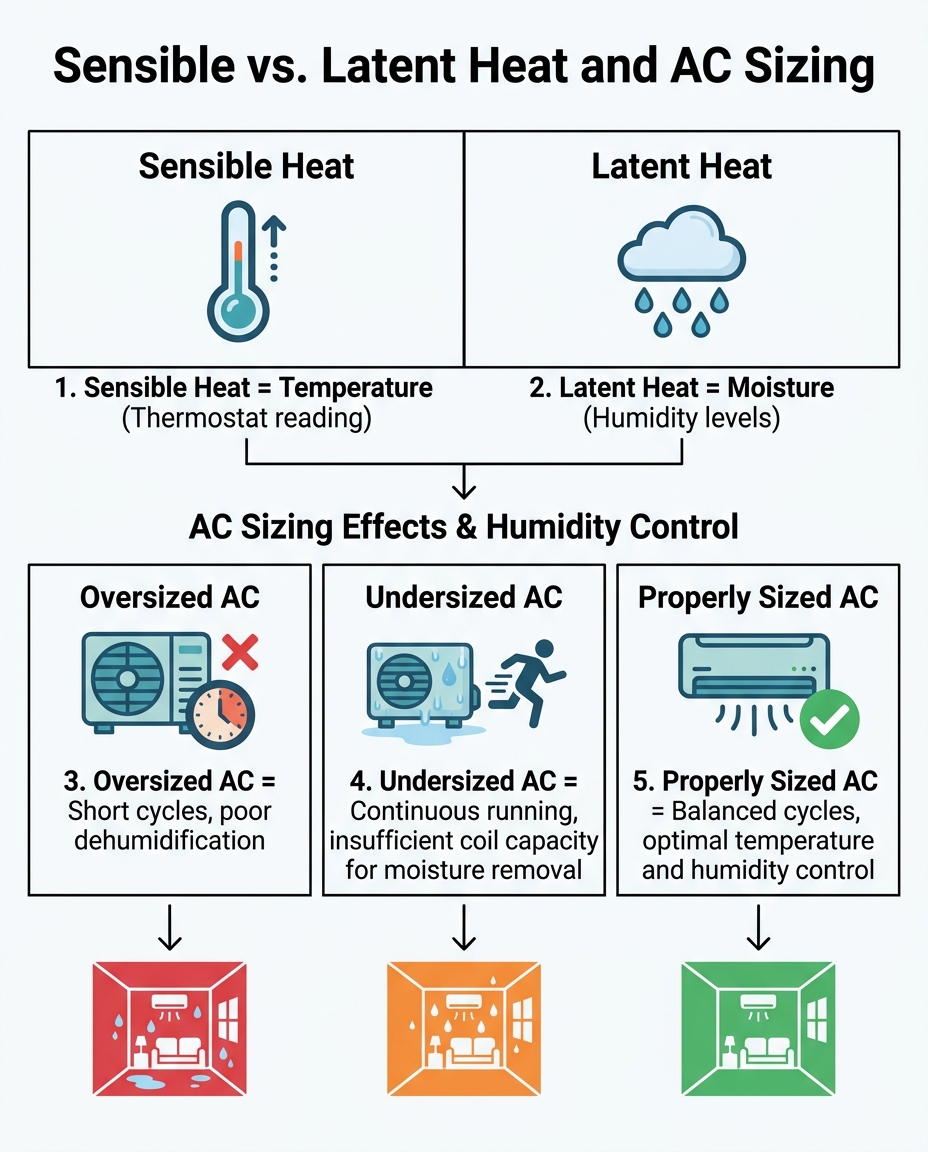
To understand why undersized systems fail, you have to look at the physics of HVAC cooling. Air conditioners do not actually "create" cold air; they remove heat from the indoor air and pump it outside. However, they have to handle two entirely distinct types of heat: sensible heat and latent heat.
Understanding Sensible Heat
Sensible heat is the heat you can actually feel and measure with a standard thermometer. When the weather forecast says it is 90 degrees outside, that is a measure of sensible heat. When you set your thermostat to 72 degrees, the thermostat is only reading the sensible heat inside your home. Lowering the sensible heat is what makes the air coming out of your vents feel cold.
Understanding Latent Heat
Latent heat is the hidden energy held by moisture or water vapor suspended in the air. According to ASHRAE fundamentals, latent heat requires significantly more energy and time to remove than sensible heat. Water vapor holds a massive amount of thermal energy. Before your air conditioner can effectively cool the air, it must first spend energy condensing that water vapor into liquid and draining it away.
This is where the oppressive summer humidity becomes a massive problem. Your thermostat is completely blind to latent heat. It does not know that the indoor humidity is sitting at 65%. It only knows that the room is 72 degrees. If the thermostat is satisfied, it shuts the system off—or, in the case of an undersized unit, it keeps running but focuses all its limited capacity on sensible cooling, leaving the heavy latent heat load untouched.
Why Undersized Systems Run Continuously But Fail
When discussing improper AC sizing, most of the focus is on oversized units. An oversized unit cools the house down so fast that it short-cycles, shutting off before it has time to dehumidify the air. However, a pattern we see often is that undersized units fail for the exact opposite reason: a fundamental lack of total capacity.
The Illusion of Continuous Cooling
An undersized air conditioner may run continuously, 24 hours a day during a heatwave. Because it never shuts off, it is constantly pushing cold air into the living space, effectively lowering the sensible temperature. You might walk into the house and feel a blast of cold air, giving the illusion that the system is working perfectly.
But despite this continuous operation, the system lacks the physical capacity to extract the massive volume of water present in the valley's air. The rate at which moisture infiltrates your home—through poorly sealed windows, opening doors, and natural vapor drive through the walls—exceeds the rate at which the undersized unit can remove it.
Why Capacity Matters More Than Runtime
For effective dehumidification, an air conditioner needs both runtime and capacity. While the undersized unit has plenty of runtime (because it never shuts off), its moisture-removal capacity is capped by its physical size. It is the equivalent of trying to bail water out of a sinking boat with a teaspoon: you are working constantly, but the volume of water entering the boat is simply too large for your tool to handle.
In the Southern Indiana / Ohio River Valley region, the latent heat load can account for a massive percentage of the total cooling requirement. If your system was sized purely based on sensible heat, it will run continuously, drive your utility bills through the roof, and still leave you sitting in a cold, clammy living room.
The Evaporator Coil Bottleneck: Physics of Moisture Removal
To truly grasp why an undersized unit fails at dehumidification, we have to look inside the indoor air handler at the evaporator coil. This is where the actual physics of moisture removal take place.
The Condensation Process
Moisture removal happens when warm, humid indoor air is blown over the freezing cold copper or aluminum tubes of the evaporator coil. Because the coil is colder than the dew point of the indoor air, condensation forms on the metal fins—exactly like water droplets forming on the outside of a cold glass of iced tea on a July afternoon. This condensation drips down into a drain pan and is carried out of your house.
Surface Area Deficits
Undersized systems inherently have smaller evaporator coils. A smaller coil means there is less physical surface area for the air to touch. Even if that small coil is freezing cold, and even if the fan is blowing air over it continuously, there is simply not enough metal surface to condense water fast enough to keep up with the extreme latent heat load infiltrating the home.
When the oppressive summer humidity hits its peak, a massive volume of air needs to be dehumidified. A properly sized evaporator coil has the vast surface area required to catch and condense that moisture rapidly. An undersized coil creates a bottleneck. The air passes over it, gets cooled down (lowering the sensible heat), but much of the moisture bypasses the small coil entirely and gets blown right back into your living room.
Diagnosing a 'Cold but Clammy' Home
Based on our team's daily field observations across the Southern Indiana / Ohio River Valley region, we've found that diagnosing an undersized unit requires looking past the thermostat. When we arrive on service calls, many homeowners assume that if the vents are blowing cold air, the AC is fine, and the humidity must be coming from somewhere else. In reality, our technicians often discover that the system itself is the bottleneck.
What We Look For in the Field
If you suspect your system is too small for your home's actual cooling load, there are several distinct warning signs to watch for. Identifying these symptoms early can save you from a miserable summer and exorbitant energy costs.
• Mismatched readings: Your air registers are blowing distinctly cold air, but indoor humidity monitors consistently read above 60%.
• Continuous operation: The outdoor compressor and indoor blower run for hours at a time, or even 24/7, without ever satisfying the thermostat setting during the hottest parts of the day.
• Exorbitant utility bills: Your energy costs are unusually high due to the system running continuously without ever achieving the true cooling load required to make the house comfortable.
• Sweaty windows or ductwork: You notice condensation forming on the inside of your windows or on exposed metal ductwork in the basement, indicating that the indoor dew point is far too high.
• Musty odors: A persistent damp or musty smell permeates the house, caused by high moisture levels allowing mold and mildew to thrive in hidden spaces.
If you notice these symptoms, it is critical to have an expert perform a Manual J load calculation. This is a highly specific mathematical formula that evaluates your home's square footage, insulation levels, window quality, and orientation to the sun. A Manual J calculation is the only way to verify if the unit is genuinely undersized for your home's envelope, or if there is another underlying issue at play.
The Fix: System Replacement or Supplemental Dehumidification?
Once our technicians confirm that your system lacks the capacity to handle the regional humidity, you face a major decision point. You cannot simply ignore the problem, as elevated indoor humidity leads to poor indoor air quality, potential mold growth, and structural damage over time. The right solution depends heavily on the age and condition of your current equipment.
When to Consider Full System Replacement
If your air conditioner is severely undersized, relies on outdated R-22 refrigerant, or is nearing the end of its 10-to-15-year lifespan, we typically recommend a full system replacement with properly matched equipment as the most effective solution. Investing in a properly sized, high-efficiency system ensures that both the sensible and latent heat loads are managed simultaneously. Modern variable-speed compressors are particularly adept at this, as they can run at lower speeds for longer periods, maximizing moisture removal over a massive evaporator coil without overcooling the house.
When to Add Supplemental Dehumidification
If your system is relatively new, in excellent mechanical condition, but slightly undersized for peak latent loads, replacing it might not make financial sense. In this scenario, installing a whole-home dehumidifier can bridge the gap. A whole-home dehumidifier ties directly into your existing HVAC ductwork. It works independently of the air conditioner to pull heavy moisture out of the air before it circulates through the house.
This allows your undersized AC to focus entirely on what it does best: lowering the sensible temperature. By removing the latent heat burden from the air conditioner, the AC can cycle normally, reducing wear and tear on the compressor. Taking proactive steps, like preparing your AC for a humid Indiana summer, ensures whatever equipment you have is operating at maximum efficiency when the worst weather hits.
Frequently Asked Questions About AC Sizing and Humidity
Why does my AC run constantly but my house is humid?
An undersized AC lacks the total capacity to remove latent heat (moisture), meaning it will run continuously to lower the temperature but leave the heavy moisture behind. Even though the system never shuts off, its evaporator coil is simply too small to condense water vapor at the rate it enters your home. This results in a living space that feels cold but distinctly clammy.
How does AC sizing affect humidity?
Proper sizing ensures the AC runs long enough to pull moisture over the evaporator coil without being so small that it lacks the surface area to condense the water effectively. If a unit is oversized, it short-cycles and shuts off before dehumidifying; if it is undersized, it runs constantly but lacks the physical capacity to extract the water. A perfectly sized unit balances runtime and coil surface area to manage both temperature and moisture.
Can an undersized AC cause high humidity?
Yes. While an undersized AC doesn't actively create humidity, its inability to extract moisture from the air at the same rate it enters the home leads to elevated indoor humidity levels. Because the unit cannot keep up with the natural infiltration of outdoor moisture, the water vapor builds up inside the living space, making the air feel heavy and damp.
What is the difference between latent heat and sensible heat?
Sensible heat refers to the measurable temperature of the air, while latent heat refers to the energy held by moisture or water vapor suspended in that air. Your thermostat only measures sensible heat, completely ignoring the latent heat load. Removing latent heat requires significantly more energy and time from your air conditioning system.
How do you fix a humid house with AC?
Solutions include ensuring the AC is properly sized for your home's total cooling load, keeping the blower fan set to 'auto' rather than 'on', or installing a whole-home dehumidifier to handle excess latent heat. If your current unit is drastically undersized, a full system replacement based on a strict Manual J load calculation is often the most permanent fix.
Restore True Comfort to Your Home
Surviving the oppressive summer humidity of the Southern Indiana / Ohio River Valley requires more than just a thermostat that reads 72 degrees. Dropping the temperature isn't enough; true comfort requires proper moisture removal, and an undersized air conditioner simply cannot win that battle. Don't settle for a cold but clammy living space that leaves you feeling uncomfortable in your own living room. Reach out to our team to evaluate your system's sizing, perform a proper load calculation, and find a permanent, efficient solution to your indoor humidity problems.
Contact Us Or Schedule Expert Service
Other Blogs
ready to transform your home?
Discover our exceptional home services tailored to meet your needs and enhance your living space.
WHAT OUR CLIENTS HAVE TO SAY ABOUT US

We had a complete HVAC system and a hot water heater installed. The guys were professional, well mannered, and completed the work in a timely manner. Would definitely use them again.
I was nervous at first because my AC broke in the middle of 80 degree weather which is strange for April, but Allegiance Heating and Air was incredibly prompt and professional. The technician arrived within an hour, explained the problem clearly, and completed the repair. The technician , Mr. Garrett Moon was a very nice and courteous young man. He found the problem and fixed it within a timely manner. I highly recommend them for any heating or cooling needs. I’ll definitely give them a call again should I ever have another issue, but hopefully not. Knock on wood 😁. Give them a call… you won’t be disappointed!
From the moment I called to schedule a service, the team was quick to respond and arrived right on time. The technician was professional, friendly, and clearly knowledgeable about my heating system. He explained the repair options in plain language and completed the job efficiently. I appreciated the reliable service and the fact that the work was done the same day. I would definitely recommend Allegiance Heating and Air for any residential HVAC needs.
5/5 stars – I was very impressed with the efficient, affordable and timely service from Allegiance Heating and Air. The technician arrived on time, and performed the service quickly, no repairs needed at this time. Communication was clear and the whole experience felt hassle‑free. I would definitely recommend them for any residential HVAC needs.
Knowledgeable, experienced individual.
Explains Allegiance Heating and Air was incredibly reliable, professional and affordable. They arrived right on time, kept the work area clean and finished the furnace repair quickly. The technician explained everything clearly and the price was a great value. If happiness had a location on Google Maps, it would be here.
Gilbert had to go above and beyond because York is no longer making the part for my furnace. But he was able to find a way to construct a housing bracket for my furnace. Ingenuity, determination and integrity is what finally got my furnace fixed. Gilbert is truly a one of a kind technician.
Thank you for always going the extra mile. Gilbert is always respectful and helpful with any concerns.
"Great service, most knowledgeable and capable HVAC business in Kentuckiana!! Pete Flemming and Bryan the owner, are HVAC encyclopedias. They have the highest integrity of any HVAC business I have ever used. Allegiance has put numerous units in for me over the last 17 years. I will continue to use and trust them."
"Fast response from Allegiance when our heat was out on New Year’s day! Service technician was friendly and efficient. He took the time to explain the problem, tell us about the temporary fix and the plan for permanent repair. We were impressed!"
"Love Allegiance! Their technicians, in particular Benjamin, explain everything. Fast and thorough. A/C was out on a Sunday. Called Allegiance and within a few hours Benjamin arrived. Such a comfort as he was the one who last serviced our units. He quickly replaced part and cooling is restored!"
"My heat pump went out and I had to call after hours. The technician (Garrett) was outstanding and thorough. He got my system up and working until Monday and gave me several options of units. Also took the time to explain the issue to my Home warranty company. I highly recommend this company."
"Right on time :) respectful, fast, and polite. Even gave my fur babies some attention."
"Had Garrett out today to fix our AC. Fantastic tech. He showed up exactly when he said he would and kept us informed of what he was checking and what he found. Highly recommend!"
"Lucas with Allegiance showed up on time as promised, was professional and extremely patient and responsive with all my questions. He took care of the issue, and I feel he was trustworthy! He had us back to cool and comfortable on one of the hottest days of the year."
"Lucas did a great job! Very professional and expedient. Explained the process very well and represented Allegiance as a truly professional and reputable company."
"Arrived on time and work diligently to fix issue. These guy are great. Worked quickly to resolve my issues."
"Lucas was great - he spent a lot of time trying to figure out what was going on and explained everything he was doing. I trust Allegiance and wouldn’t want anyone else working on/in my house!!"

RELATED ARTICLES
Understanding the Benefits Our Maintenance Plan Provides
Responding Effectively to HVAC Emergencies