Surviving the August Heat in Your Two-Story Home
As the Ohio River Valley braces for another wave of intense weather, our team at Allegiance Heating & Air frequently helps homeowners discover the attic insulation factor: why buying a bigger AC won't fix your hot second floor. The late-summer heat and humidity push residential cooling systems to their absolute limits just as families are gearing up for the back-to-school transition. If you live in a multi-level house, you likely know the specific misery of trying to sleep in a sweltering upstairs bedroom while the downstairs remains perfectly chilled. This stark temperature difference triggers a common homeowner reflex: assuming the current air conditioner is simply too small to handle the load.
To learn more about optimizing your air conditioning systems, schedule a free system estimate with our team.
A pattern we see often at Allegiance Heating & Air occurred when one local homeowner reached out during the hottest week in August. Their air conditioning system completely failed under the intense end-of-season heat wave. We promptly responded and replaced their old system to restore their comfort. However, emergency situations like this often highlight a widespread misconception. When a system struggles during the August end-of-summer heat and humidity, people immediately want a larger unit to overpower the warm air. The reality is that the building's thermal envelope—specifically the barrier between your living space and your roof—is usually the true culprit. Upgrading your equipment's capacity without addressing the structural heat gain is a recipe for continued discomfort and wasted energy.
The Physics of Radiant Heat: Why Your Upstairs is Baking
To understand why throwing more cooling capacity at your house will not solve the problem, you have to look at how heat enters the building. A hot second floor is rarely an air conditioning failure; it is almost always a thermal envelope failure. In our years of servicing Greenville, IN homes, our technicians typically find that upstairs bedrooms sit directly beneath a massive, under-insulated heat trap.
How Heat Permeates the Ceiling
During a clear summer day, the sun beats down on your roof for hours. The shingles absorb this solar energy and transfer it into the attic space. Without proper ventilation and heavy insulation, an attic can easily reach temperatures exceeding 130 to 150 degrees Fahrenheit. This creates a massive pocket of extreme heat pressing down on your second-floor ceilings.
The downward flow: Heat always moves toward cooler spaces. The intense heat trapped in your attic radiates downward through the ceiling drywall and the wooden joists. If the insulation on your attic floor is thin, compressed, or missing, there is no resistance to stop this radiant heat transfer. Your ceiling essentially becomes a giant radiant heater, constantly warming the air in the upstairs bedrooms.
The Limits of Standard Cooling Equipment
An air conditioner is designed to remove heat from the indoor air, but it cannot stop radiant heat from continuously entering the space. When your ceiling is radiating heat downward, the AC is fighting a losing battle against continuous thermal intrusion.
Furthermore, most standard HVAC systems have a single thermostat located on the first floor. Because cold air sinks and hot air rises, the downstairs cools off relatively quickly. Once the downstairs thermostat reads a comfortable temperature, it shuts the entire cooling system off. Meanwhile, the radiant heat from the attic continues to bake the second floor. Your air conditioner has no idea that the upstairs is still sweltering, leaving you miserable despite having a fully functional cooling system.
The Bigger AC Myth: Why Adding Tonnage Backfires
When faced with a hot second floor, the most common myth is that you need an air conditioner with more "tonnage." In the HVAC industry, tonnage refers to a system's cooling capacity—its ability to remove heat from the air within a specific timeframe. It does not mean the physical weight of the unit, and it does not mean the air will blow out of the vents any harder.
Throwing more capacity at a poorly insulated home is an expensive waste of energy. A higher-tonnage unit will simply cool the downstairs air even faster, causing the thermostat to shut the system down even sooner. The brief blast of cold air will not run long enough to counteract the radiant heat pushing through the upstairs ceiling.
The installation reality: One customer contacted us in the spring after a previous company installed an incorrectly sized new AC unit, leaving them with uneven temperatures and high utility bills. Our professionals took the time to evaluate their specific home layout, properly install the right-sized unit, and answer all their questions. This ensured they could feel confident in their system's performance before the August end-of-summer heat and humidity arrived. Proper sizing requires a careful calculation of the home's square footage, window placement, and thermal envelope—not just guessing that a bigger unit will fix a hot room.
Short-Cycling and the Humidity Trap
Installing an oversized air conditioner creates a cascade of entirely new comfort problems. The most severe consequence of an overly large unit is a mechanical issue known as short-cycling, which completely ruins your home's indoor air quality and humidity control.
The problem: An oversized unit blasts the house with a massive volume of cold air. The thermostat on the main floor registers the temperature drop almost immediately and signals the system to turn off after only five to ten minutes of operation.
The cause: Air conditioners do more than just lower the temperature; they are also responsible for dehumidifying your home. As warm indoor air passes over the freezing cold evaporator coil, moisture condenses on the coil and drains away. However, this dehumidification process takes time. The system needs to run in sustained cycles of 15 to 20 minutes to pull a meaningful amount of moisture out of the air. When an oversized system short-cycles, it shuts down before the dehumidification process can truly begin.
The solution: To survive the August end-of-summer heat and humidity, our team recommends a system that runs in proper, sustained cycles. If you want to dive deeper into why this matters, read our guide on how humidity affects your air conditioner's performance. An oversized, short-cycling unit leaves your home feeling cold but clammy. You might have to constantly adjust the thermostat to feel comfortable, and the frequent starting and stopping causes severe wear and tear on the compressor, drastically shortening the lifespan of the equipment.
The True Solution: Upgrading Your Attic's Thermal Barrier
If buying a bigger air conditioner is the wrong approach, what is the right one? The true solution lies in fixing the building envelope. By upgrading your attic's thermal barrier, you stop the radiant heat transfer before it ever reaches your living space.
Proper attic insulation acts as a thick, resistive blanket. When the roof heats the attic air to 140 degrees, high-quality insulation prevents that heat from pushing through the ceiling drywall. This immediately reduces the cooling load on your HVAC system. Instead of fighting a continuous wave of radiant heat, your air conditioner only has to cool the air inside the house.
The whole-home impact: A sealed thermal envelope significantly improves your overall comfort. The Environmental Protection Agency (EPA) estimates that homeowners can save an average of 15 percent on heating and cooling costs by properly air-sealing their homes and adding insulation in attics. In our experience working on Greenville, IN two-story homes, this upgrade transforms sweltering upstairs bedrooms into comfortable, usable spaces.
Furthermore, proper insulation allows your correctly sized air conditioner to run in the sustained cycles required for effective dehumidification. By blocking the intense heat from above, the system can focus on managing your indoor airflow and air quality, providing a consistent, comfortable environment throughout the entire house.
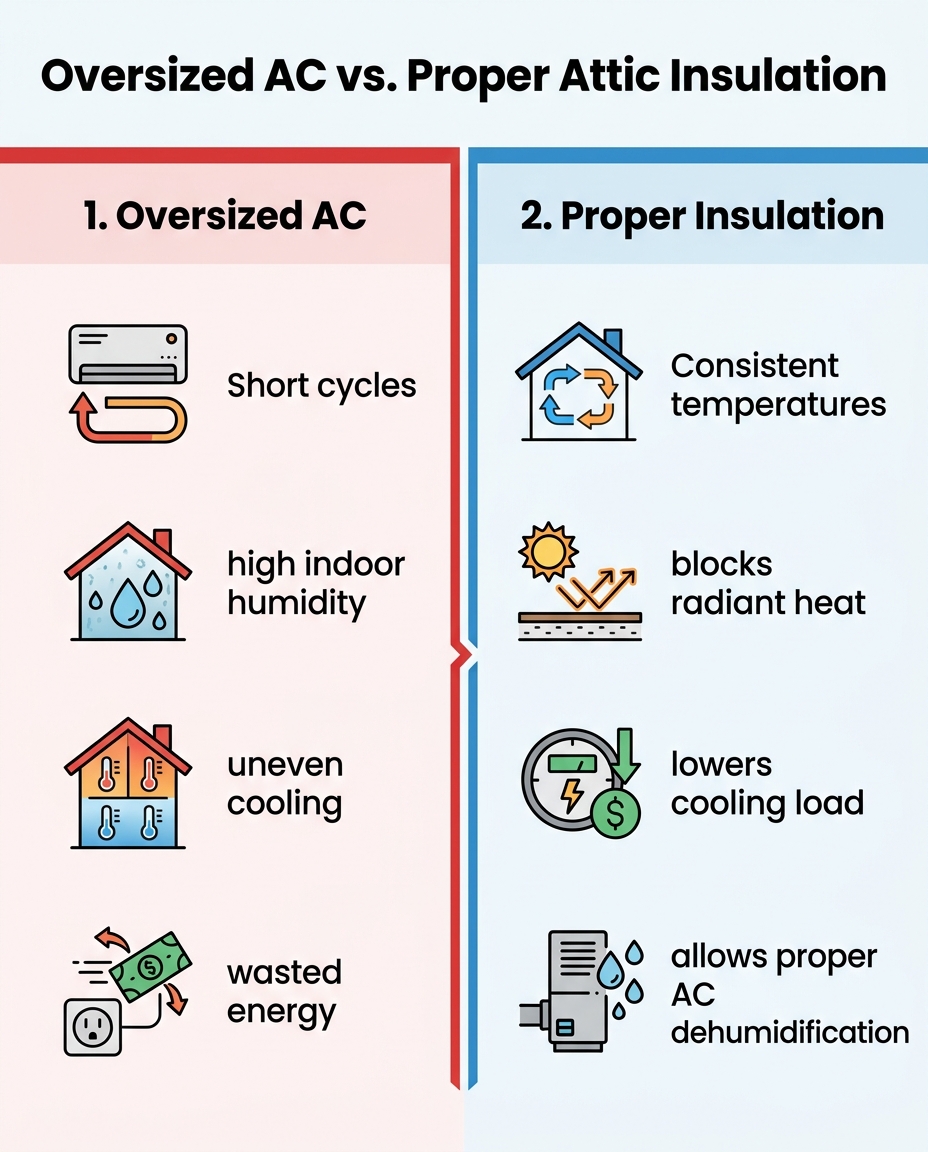
Side-by-Side: Oversized AC vs. Proper Insulation
When deciding how to allocate your home improvement budget, it helps to look at the direct outcomes of both approaches. Here is a clear comparison of what happens when you try to solve a hot second floor with an oversized AC versus addressing the root cause with proper insulation.
• Upstairs Temperature — Oversized Air Conditioner: Remains hot; system shuts off before cooling the second floor. — Proper Attic Insulation: Becomes comfortable; radiant heat from the roof is blocked.
• Humidity Control — Oversized Air Conditioner: Poor; short-cycling leaves the home feeling cold and clammy. — Proper Attic Insulation: Excellent; allows the AC to run long enough to dehumidify the air.
• Energy Waste — Oversized Air Conditioner: High; frequent starts and stops consume excessive electricity. — Proper Attic Insulation: Low; significantly reduces the overall cooling load on the home.
• Equipment Lifespan — Oversized Air Conditioner: Reduced; short-cycling causes premature compressor failure. — Proper Attic Insulation: Extended; less strain on the system means fewer breakdowns.
As the comparison shows, adding insulation is the superior, long-term solution. It addresses the fundamental laws of thermodynamics rather than trying to overpower them. If you are considering a major change to your equipment, understanding your system conversion and efficiency options is critical to avoid making a costly mistake in Greenville Indiana two-story homes.

Why Honest Diagnostics Matter More Than Equipment Sales
The HVAC industry is filled with companies that are eager to sell you new equipment. If you complain about a hot second floor, many technicians will gladly write up a quote for a larger, more expensive air conditioning unit without ever poking their head into your attic to check the insulation levels.
A true professional takes a different approach. They assess the entire thermal envelope to find the root cause of the discomfort. They look at ductwork sizing, return air pathways, window efficiency, and attic insulation before recommending a costly equipment upgrade. As a trusted local HVAC provider, Allegiance Heating & Air focuses on honest, consultative diagnostics. We won't just sell you a larger, more expensive AC unit if fixing your home's thermal envelope is the true solution.
The value of a thorough assessment: One customer called us during a summer home remodel to look at an air conditioner and heat pump that had been installed incorrectly by the previous homeowner six years prior. Instead of just pushing a brand-new system replacement, we diagnosed the root problem with the airflow and offered a fair-priced solution to fix it. We completed the repairs ahead of schedule, ensuring the home was comfortable without unnecessary expenses. In our daily work across Greenville, IN two-story homes, we've proven that this kind of honest evaluation is the only way to achieve true whole-home comfort.
Frequently Asked Questions About Second-Floor Cooling
Will a bigger AC cool my second floor better?
No, a bigger AC will likely cool the downstairs too fast, shut off prematurely, and leave the upstairs hot. An oversized unit satisfies the first-floor thermostat quickly, meaning the system never runs long enough to push cold air to the furthest reaches of the second floor. This results in extreme temperature imbalances and high indoor humidity during the August end-of-summer heat and humidity.
Why does my AC short cycle in high humidity?
An oversized unit satisfies the thermostat temperature too quickly, not allowing the necessary run-time to pull moisture from the air. Air conditioners need to run for 15 to 20 minutes to effectively condense and drain humidity from your indoor air. When a unit short-cycles in 5 to 10 minutes, the air gets cold, but the moisture remains, leaving your home feeling clammy.
How does attic insulation affect air conditioning?
It blocks radiant heat from the roof, lowering the overall temperature the AC has to fight, allowing it to run efficiently. Without insulation, the 140-degree heat from your attic radiates down through the ceiling. Insulation acts as a thermal barrier, significantly reducing the cooling load so your air conditioner can easily maintain a comfortable temperature.
Why is my second floor so hot even with the AC running?
Heat rises, and without proper insulation, radiant heat from the attic constantly pushes down into the second floor. Additionally, the single thermostat on the first floor often shuts the cooling system off before the upstairs has a chance to cool down. Upgrading insulation and ensuring proper return airflow are the best ways to solve this imbalance.
Can an AC be too big for a house?
Yes. An oversized AC is a major problem that causes short-cycling, high humidity, uneven cooling, and premature wear. A unit that is too large will blast cold air, shut off quickly, and fail to dehumidify the space. Proper HVAC sizing requires exact calculations based on your home's square footage, window layout, and thermal envelope.
Let's Evaluate Your Home's Complete Cooling Profile
Living with a sweltering upstairs bedroom is frustrating, but it is a highly solvable problem. Before you spend money on a larger air conditioning unit that might actually make your comfort worse, it is essential to have a professional evaluate your entire home. By looking at both your HVAC equipment and your thermal envelope, we can identify exactly why your second floor is retaining so much heat.
Don't let another season of poor cooling disrupt your sleep. If you are ready to fix the root cause of your hot upstairs rooms, schedule a free system estimate with our team today. We will provide the honest diagnostics you need to finally achieve consistent, whole-home comfort.
Contact Us Or Schedule Expert Service
Other Blogs
ready to transform your home?
Discover our exceptional home services tailored to meet your needs and enhance your living space.
WHAT OUR CLIENTS HAVE TO SAY ABOUT US

We had a complete HVAC system and a hot water heater installed. The guys were professional, well mannered, and completed the work in a timely manner. Would definitely use them again.
I was nervous at first because my AC broke in the middle of 80 degree weather which is strange for April, but Allegiance Heating and Air was incredibly prompt and professional. The technician arrived within an hour, explained the problem clearly, and completed the repair. The technician , Mr. Garrett Moon was a very nice and courteous young man. He found the problem and fixed it within a timely manner. I highly recommend them for any heating or cooling needs. I’ll definitely give them a call again should I ever have another issue, but hopefully not. Knock on wood 😁. Give them a call… you won’t be disappointed!
From the moment I called to schedule a service, the team was quick to respond and arrived right on time. The technician was professional, friendly, and clearly knowledgeable about my heating system. He explained the repair options in plain language and completed the job efficiently. I appreciated the reliable service and the fact that the work was done the same day. I would definitely recommend Allegiance Heating and Air for any residential HVAC needs.
5/5 stars – I was very impressed with the efficient, affordable and timely service from Allegiance Heating and Air. The technician arrived on time, and performed the service quickly, no repairs needed at this time. Communication was clear and the whole experience felt hassle‑free. I would definitely recommend them for any residential HVAC needs.
Knowledgeable, experienced individual.
Explains Allegiance Heating and Air was incredibly reliable, professional and affordable. They arrived right on time, kept the work area clean and finished the furnace repair quickly. The technician explained everything clearly and the price was a great value. If happiness had a location on Google Maps, it would be here.
Gilbert had to go above and beyond because York is no longer making the part for my furnace. But he was able to find a way to construct a housing bracket for my furnace. Ingenuity, determination and integrity is what finally got my furnace fixed. Gilbert is truly a one of a kind technician.
Thank you for always going the extra mile. Gilbert is always respectful and helpful with any concerns.
"Great service, most knowledgeable and capable HVAC business in Kentuckiana!! Pete Flemming and Bryan the owner, are HVAC encyclopedias. They have the highest integrity of any HVAC business I have ever used. Allegiance has put numerous units in for me over the last 17 years. I will continue to use and trust them."
"Fast response from Allegiance when our heat was out on New Year’s day! Service technician was friendly and efficient. He took the time to explain the problem, tell us about the temporary fix and the plan for permanent repair. We were impressed!"
"Love Allegiance! Their technicians, in particular Benjamin, explain everything. Fast and thorough. A/C was out on a Sunday. Called Allegiance and within a few hours Benjamin arrived. Such a comfort as he was the one who last serviced our units. He quickly replaced part and cooling is restored!"
"My heat pump went out and I had to call after hours. The technician (Garrett) was outstanding and thorough. He got my system up and working until Monday and gave me several options of units. Also took the time to explain the issue to my Home warranty company. I highly recommend this company."
"Right on time :) respectful, fast, and polite. Even gave my fur babies some attention."
"Had Garrett out today to fix our AC. Fantastic tech. He showed up exactly when he said he would and kept us informed of what he was checking and what he found. Highly recommend!"
"Lucas with Allegiance showed up on time as promised, was professional and extremely patient and responsive with all my questions. He took care of the issue, and I feel he was trustworthy! He had us back to cool and comfortable on one of the hottest days of the year."
"Lucas did a great job! Very professional and expedient. Explained the process very well and represented Allegiance as a truly professional and reputable company."
"Arrived on time and work diligently to fix issue. These guy are great. Worked quickly to resolve my issues."
"Lucas was great - he spent a lot of time trying to figure out what was going on and explained everything he was doing. I trust Allegiance and wouldn’t want anyone else working on/in my house!!"

RELATED ARTICLES
The Great Cooling Debate and Which System Wins for Your Home
Detecting Furnace Repair Needs Before They Escalate