The 65-Degree Fallacy: Why Cranking Your Thermostat Down Doesn't Cool Your House Faster
Coming home to a hot house makes dropping the AC to 65 degrees tempting. Understand the mechanical reality of why this habit overworks your system without actually cooling rooms any faster.
The Frustration of a Hot House in Late Summer
Your air conditioner is running nonstop, but the house still feels incredibly warm, leading many homeowners straight into the trap of The 65-Degree Fallacy: Why Cranking Your Thermostat Down Doesn't Cool Your House Faster. You walk through the front door after a long day in the late-summer heat, and the air inside your Greenville IN home feels heavier and hotter than the air outside. The thermostat on the hallway wall reads a stifling 80 degrees. Frustrated, sweaty, and exhausted, you walk straight over and punch the down arrow until the digital screen reads 65 degrees. The instinct is completely understandable—you want the house to cool down as quickly as possible, so you give the system a more aggressive target, assuming it will work harder to get there.
If you are struggling to keep your home comfortable, understanding the mechanics of your air conditioning system is the first step, and pairing that knowledge with a professional maintenance plan ensures your equipment survives the hottest months of the year.
This behavioral mistake is incredibly common, yet it is fundamentally flawed. Dropping your thermostat to an artificially low temperature does not cool your home any faster than setting it to a comfortable 72 degrees. In fact, this common misconception actively harms your residential cooling system. Standard residential air conditioning operates at a fixed, unyielding pace. By demanding an impossible temperature drop, you are not speeding up the cooling process; you are simply forcing the mechanical components to run continuously, driving up your utility bills and accelerating the wear and tear on your equipment right when it is most vulnerable to breaking down.
The Single-Speed Reality: How Your Compressor Actually Works
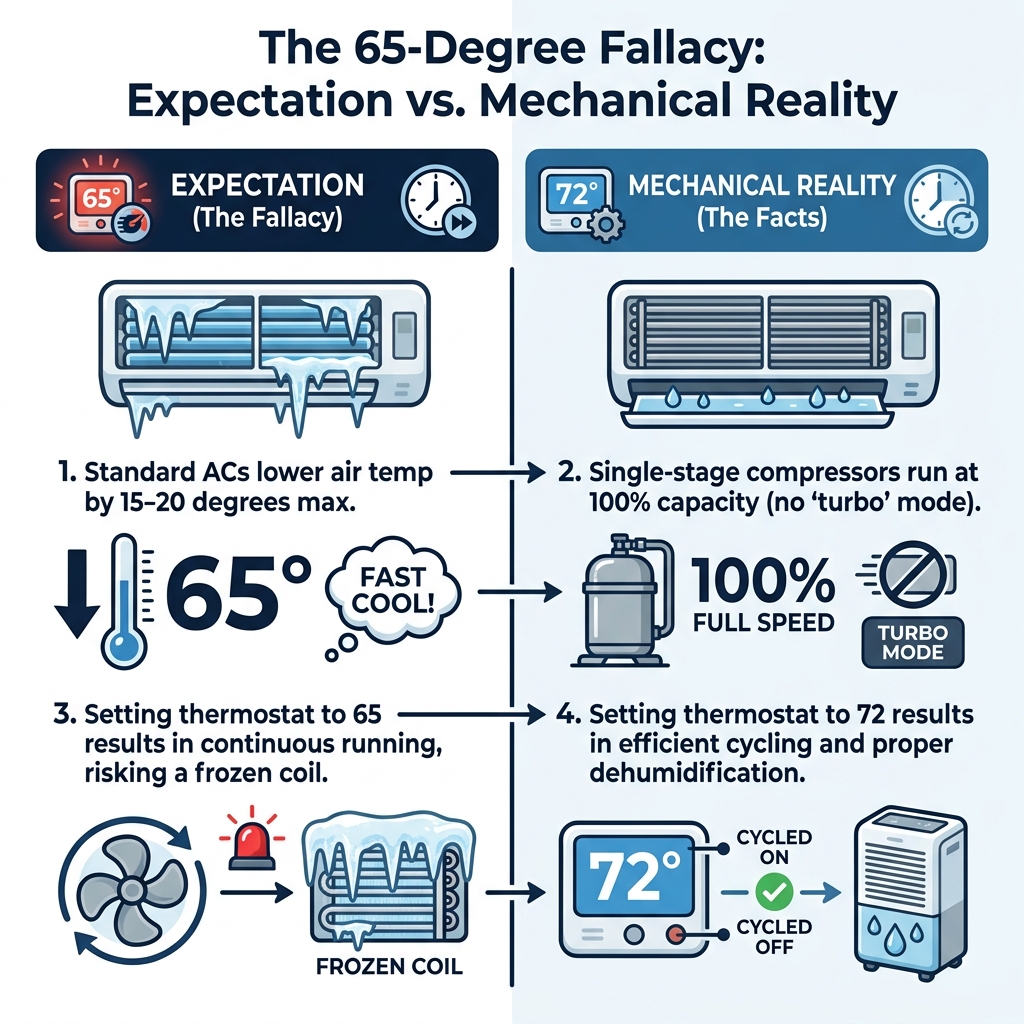
To definitively bust the myth of faster cooling, it helps to look at the mechanical reality of the equipment sitting outside your house. Most standard residential cooling systems utilize single-stage compressors. A single-stage compressor is a binary machine—it is either completely off, or it is running at exactly 100% of its designed capacity. There is no middle ground, no "high gear," and certainly no "turbo mode" that gets triggered when you drastically lower the set point on your wall.
When the system kicks on, it immediately begins moving a fixed volume of refrigerant through the lines, absorbing heat from inside your home and releasing it outside. Because the volume of refrigerant and the speed of the compressor are fixed, the rate of heat removal is also fixed. The system will cool the air at the exact same speed whether your thermostat is set to 75 degrees or 60 degrees.
The 15-to-20-Degree Rule
Air conditioners are designed around a specific temperature differential, commonly referred to as the 15-to-20-degree rule. This means your system generally cools the air by 15 to 20 degrees relative to the indoor return air temperature.
1. Air is pulled in: The blower motor pulls warm air from your hallways and rooms into the return vents. If your house is 80 degrees, the return air is 80 degrees.
2. Heat is absorbed: This warm air passes over the freezing-cold indoor evaporator coil, where heat is extracted.
3. Air is supplied back: The system pushes the newly cooled air out through your supply registers. Following the rule, this air will blow out at roughly 60 to 65 degrees.
This 20-degree drop is the absolute maximum cooling capacity of a standard system. Setting your thermostat to 65 simply tells the system to run continuously until the ambient room temperature hits that target. It does not command the equipment to pump colder air.
The Thermostat is a Switch, Not a Gas Pedal
Many homeowners subconsciously treat their thermostat like the accelerator pedal in a car—push it harder, and the machine goes faster. In reality, a standard thermostat functions exactly like a light switch. When you flip a light switch on, the bulb illuminates at full brightness. You cannot make the room brighter by flipping the switch harder. Similarly, your thermostat simply closes a low-voltage circuit that sends a signal to the outside unit to turn on. The compressor receives that signal and runs at its single, fixed speed until the thermostat senses the target temperature has been reached, at which point it breaks the circuit and turns the system off.

Sensible vs. Latent Cooling: The Humidity Factor
If the air conditioner is blowing 60-degree air, why does it feel like it takes hours for the house to cool down? The answer lies in the invisible moisture trapped inside your home. Living in Greenville IN means dealing with the notoriously high summer dew points of the Ohio River Valley. This heavy humidity load dramatically alters how your cooling system behaves during the first few hours of operation.
Air conditioning performs two distinct jobs simultaneously: sensible cooling and latent cooling. Sensible cooling is the process of lowering the actual temperature of the air—the number you see dropping on your thermometer. Latent cooling is the process of removing moisture from the air. In highly humid environments, these two processes compete for the system's energy.
When you turn on the AC in a sticky, humid house, the system must expend a massive amount of its cooling energy on latent cooling before the sensible temperature drops noticeably. As warm, moist air blows over the cold indoor coil, the water vapor condenses into liquid (much like water beads forming on the outside of a cold glass of iced tea). This phase change—from vapor to liquid—absorbs a tremendous amount of heat energy.
Because the system is working so hard to wring the water out of the air, the actual temperature in the room drops very slowly at first. High indoor humidity makes the air feel much warmer than it actually is, because your body cannot evaporate sweat effectively. This sticky, uncomfortable feeling drives the false urge to lower the thermostat even further. However, patience is the only real solution. The AC must be allowed to run its course, dehumidifying the space first. Once the latent heat (humidity) is removed, the sensible heat (temperature) will begin to fall rapidly. Cranking the dial down to 65 degrees does nothing to speed up this physical dehumidification process.
The Hidden Costs of the 65-Degree Fallacy
At Allegiance Heating & Air, our goal is to serve as a trusted local educator. We want to provide honest, transparent advice that prevents homeowners from incurring unnecessary repair bills and premature system replacements. We see the aftermath of the 65-degree fallacy every August late-summer, when systems that have been overworked for months finally give out under the strain of impossible thermostat settings.
The Risk of a Frozen Evaporator Coil: When you set your thermostat to 65 degrees in the heat of the afternoon, the system will likely never reach that target. It will run continuously for hours. As it runs, it pulls moisture out of the air. If the system runs non-stop without cycling off to rest, that condensation can begin to freeze on the indoor coil. Once a thin layer of ice forms, it acts as an insulator, preventing the refrigerant from absorbing heat. The coil gets colder and colder, building up a solid block of ice that completely stops airflow and halts the cooling process entirely.
Immense Energy Waste: Forcing a system to run non-stop to chase an impossible target is incredibly inefficient. Your outdoor compressor pulls a significant amount of electricity. Running it for six hours straight because the thermostat is set to 65, instead of letting it cycle normally at 72, will cause your monthly utility footprint to skyrocket with zero added comfort.
Cumulative Mechanical Wear and Tear: Every mechanical component has a finite lifespan. By August, your system has already endured hundreds of hours of operation. Forcing continuous operation accelerates wear on critical parts. The blower motor bearings degrade faster. The electrical capacitors overheat and fail. Most dangerously, liquid refrigerant can bypass the frozen indoor coil and return to the outdoor compressor, destroying the internal valves—a catastrophic failure that often requires a complete system replacement.
Single-Stage vs. Variable-Speed Systems
For readers wondering if there is any technology that actually adapts to extreme cooling demands, the answer is yes. While the vast majority of older homes utilize standard single-stage compressors, modern HVAC technology offers a far superior alternative: variable-speed, inverter-driven systems.
If you are tired of battling indoor humidity and temperature swings, exploring different HVAC services and equipment upgrades might be the permanent solution. Unlike a single-stage system that only knows "100% ON" or "100% OFF," a variable-speed compressor operates more like the accelerator in your car. It can ramp up its capacity to 100% during the hottest part of the day, and then dial itself back to 40% or 30% capacity to gently maintain the temperature once the sun goes down.
• Operating Speeds — Single-Stage Compressor: One speed (100% capacity only) — Variable-Speed Compressor: Multiple speeds (ramps from 25% to 100%)
• Humidity Control — Single-Stage Compressor: Basic (cycles off before heavy dehumidification) — Variable-Speed Compressor: Exceptional (runs longer at lower speeds to extract moisture)
• Energy Efficiency — Single-Stage Compressor: Standard (frequent hard starts draw more power) — Variable-Speed Compressor: High (continuous low-power operation saves electricity)
• Temperature Consistency — Single-Stage Compressor: Noticeable swings between cycles — Variable-Speed Compressor: Precise, even temperatures throughout the day
It is important to note that even variable-speed systems do not "flash cool" a house. They are designed for precision and efficiency, not speed. However, because they are vastly superior at managing humidity, the air inside your home will feel significantly cooler and more comfortable at a higher temperature, eliminating the urge to constantly adjust the thermostat.
Smarter Ways to Cool Your Home Efficiently
Instead of relying on the 65-degree fallacy, there are several actionable, highly efficient alternatives to cool your home down without overworking your mechanical equipment. For more comprehensive strategies, exploring the best thermostat settings for summer energy savings can significantly reduce your monthly utility footprint while keeping your family perfectly comfortable.
• Set it and forget it: Advise setting the thermostat to your actual desired comfort temperature—typically between 72 and 74 degrees—and leaving it there. The system will cool the house at its maximum safe speed and cycle off appropriately.
• Utilize ceiling fans: Ceiling fans do not lower the temperature of a room, but they do create a wind-chill effect on your skin. Moving air evaporates moisture from your body, making a 75-degree room feel like a 70-degree room without changing the AC's workload. Remember to turn fans off when you leave the room.
• Block solar heat gain: Keep blinds, shades, and curtains closed during peak afternoon sun, especially on south- and west-facing windows. Blocking radiant heat from entering the home reduces the thermal load the air conditioner has to fight against.
• Maintain maximum airflow: A system can only cool as well as it can breathe. Check your return air filters monthly. A dirty, clogged filter restricts airflow, which drops the temperature of the indoor coil, making the system run longer and increasing the risk of a freeze-up.
Frequently Asked Questions About Thermostat Settings and Cooling Speed
Does turning the AC lower make it cool faster?
No, turning the AC lower does not make it cool faster. Standard residential air conditioners operate at a single speed, meaning they pump out the same volume of cold air whether the thermostat is set to 75 degrees or 60 degrees. Lowering the setting simply forces the unit to run longer, not harder or faster.
How long should it take to cool a house?
A properly sized air conditioner typically drops the indoor temperature by about one degree every 30 to 45 minutes, depending on the outdoor heat and indoor humidity. If you are returning to an 80-degree house and want it to reach 72 degrees, you should expect the process to take several hours of continuous operation.
Why is my house not cooling down when the AC is on?
If your AC is running but the house isn't cooling, the system may be struggling with high indoor humidity, a dirty air filter restricting airflow, or a frozen evaporator coil. In extreme heat, the system might simply be maxed out, as standard ACs can only cool the air by 15 to 20 degrees compared to the air being pulled into the return vents.
What happens if I set my thermostat to 60?
Setting your thermostat to 60 degrees during the summer forces the compressor to run continuously without a break, as it is highly unlikely the system can actually achieve that temperature. This continuous operation wastes massive amounts of electricity, accelerates mechanical wear, and frequently leads to a frozen indoor coil that completely stops the cooling process.
Why does my AC struggle to cool on highly humid days?
On highly humid days, your air conditioner must spend a large portion of its energy removing moisture (latent heat) from the air before it can effectively lower the actual temperature (sensible heat). Until the excess humidity is drained away as condensation, the air in your home will continue to feel sticky and warm, making the cooling process feel much slower.
Protect Your System from End-of-Season Breakdowns
Patience and proper temperature settings are the absolute keys to efficient, reliable cooling. The 65-degree fallacy is a trap born out of frustration, but acting on it only guarantees higher utility bills and unnecessary mechanical strain. By August late-summer, your equipment has accumulated months of wear and tear, making it highly vulnerable to breakdown if misused or forced into non-stop operation.
Instead of fighting your thermostat, focus on proactive care to keep the system running efficiently without overworking it. Changing filters, utilizing ceiling fans, and scheduling professional check-ups will keep your home consistently comfortable. Protect your investment and secure your peace of mind by enrolling in a preventative maintenance plan today, ensuring your cooling system operates exactly as it was designed to—reliably and safely.
Contact Us Or Schedule Expert Service
Other Blogs
ready to transform your home?
Discover our exceptional home services tailored to meet your needs and enhance your living space.
WHAT OUR CLIENTS HAVE TO SAY ABOUT US

We had a complete HVAC system and a hot water heater installed. The guys were professional, well mannered, and completed the work in a timely manner. Would definitely use them again.
I was nervous at first because my AC broke in the middle of 80 degree weather which is strange for April, but Allegiance Heating and Air was incredibly prompt and professional. The technician arrived within an hour, explained the problem clearly, and completed the repair. The technician , Mr. Garrett Moon was a very nice and courteous young man. He found the problem and fixed it within a timely manner. I highly recommend them for any heating or cooling needs. I’ll definitely give them a call again should I ever have another issue, but hopefully not. Knock on wood 😁. Give them a call… you won’t be disappointed!
From the moment I called to schedule a service, the team was quick to respond and arrived right on time. The technician was professional, friendly, and clearly knowledgeable about my heating system. He explained the repair options in plain language and completed the job efficiently. I appreciated the reliable service and the fact that the work was done the same day. I would definitely recommend Allegiance Heating and Air for any residential HVAC needs.
5/5 stars – I was very impressed with the efficient, affordable and timely service from Allegiance Heating and Air. The technician arrived on time, and performed the service quickly, no repairs needed at this time. Communication was clear and the whole experience felt hassle‑free. I would definitely recommend them for any residential HVAC needs.
Knowledgeable, experienced individual.
Explains Allegiance Heating and Air was incredibly reliable, professional and affordable. They arrived right on time, kept the work area clean and finished the furnace repair quickly. The technician explained everything clearly and the price was a great value. If happiness had a location on Google Maps, it would be here.
Gilbert had to go above and beyond because York is no longer making the part for my furnace. But he was able to find a way to construct a housing bracket for my furnace. Ingenuity, determination and integrity is what finally got my furnace fixed. Gilbert is truly a one of a kind technician.
Thank you for always going the extra mile. Gilbert is always respectful and helpful with any concerns.
"Great service, most knowledgeable and capable HVAC business in Kentuckiana!! Pete Flemming and Bryan the owner, are HVAC encyclopedias. They have the highest integrity of any HVAC business I have ever used. Allegiance has put numerous units in for me over the last 17 years. I will continue to use and trust them."
"Fast response from Allegiance when our heat was out on New Year’s day! Service technician was friendly and efficient. He took the time to explain the problem, tell us about the temporary fix and the plan for permanent repair. We were impressed!"
"Love Allegiance! Their technicians, in particular Benjamin, explain everything. Fast and thorough. A/C was out on a Sunday. Called Allegiance and within a few hours Benjamin arrived. Such a comfort as he was the one who last serviced our units. He quickly replaced part and cooling is restored!"
"My heat pump went out and I had to call after hours. The technician (Garrett) was outstanding and thorough. He got my system up and working until Monday and gave me several options of units. Also took the time to explain the issue to my Home warranty company. I highly recommend this company."
"Right on time :) respectful, fast, and polite. Even gave my fur babies some attention."
"Had Garrett out today to fix our AC. Fantastic tech. He showed up exactly when he said he would and kept us informed of what he was checking and what he found. Highly recommend!"
"Lucas with Allegiance showed up on time as promised, was professional and extremely patient and responsive with all my questions. He took care of the issue, and I feel he was trustworthy! He had us back to cool and comfortable on one of the hottest days of the year."
"Lucas did a great job! Very professional and expedient. Explained the process very well and represented Allegiance as a truly professional and reputable company."
"Arrived on time and work diligently to fix issue. These guy are great. Worked quickly to resolve my issues."
"Lucas was great - he spent a lot of time trying to figure out what was going on and explained everything he was doing. I trust Allegiance and wouldn’t want anyone else working on/in my house!!"

RELATED ARTICLES
Why Your Ductless AC Heater Stops Working in Sellersburg

The Attic Insulation Factor: Why Buying a Bigger AC Won't Fix Your Hot Second Floor