Are You Leaving Money on the Table? The Inflation Reduction Act HVAC Benefits for Kentuckiana Homeowners Explained
The inflation reduction act hvac benefits for kentuckiana homeowners are real, significant, and — for many people — completely unclaimed. If you replaced or are considering replacing your heating or cooling system, federal tax credits and local utility rebates could meaningfully reduce what you pay out of pocket. Here is a quick summary of what is available:
Key IRA HVAC Benefits at a Glance:
- Air-source heat pumps — federal tax credit up to $2,000 (30% of installation cost)
- Geothermal heat pumps — 30% federal tax credit with no dollar cap
- Central air conditioners — federal tax credit up to $600
- Gas furnaces — federal tax credit up to $600
- Heat pump water heaters — federal tax credit up to $2,000
- Annual ceiling — $3,200 total across all qualifying improvements in one tax year
- 25C tax credit status — expired December 31, 2025; applies to qualifying installations completed before that date
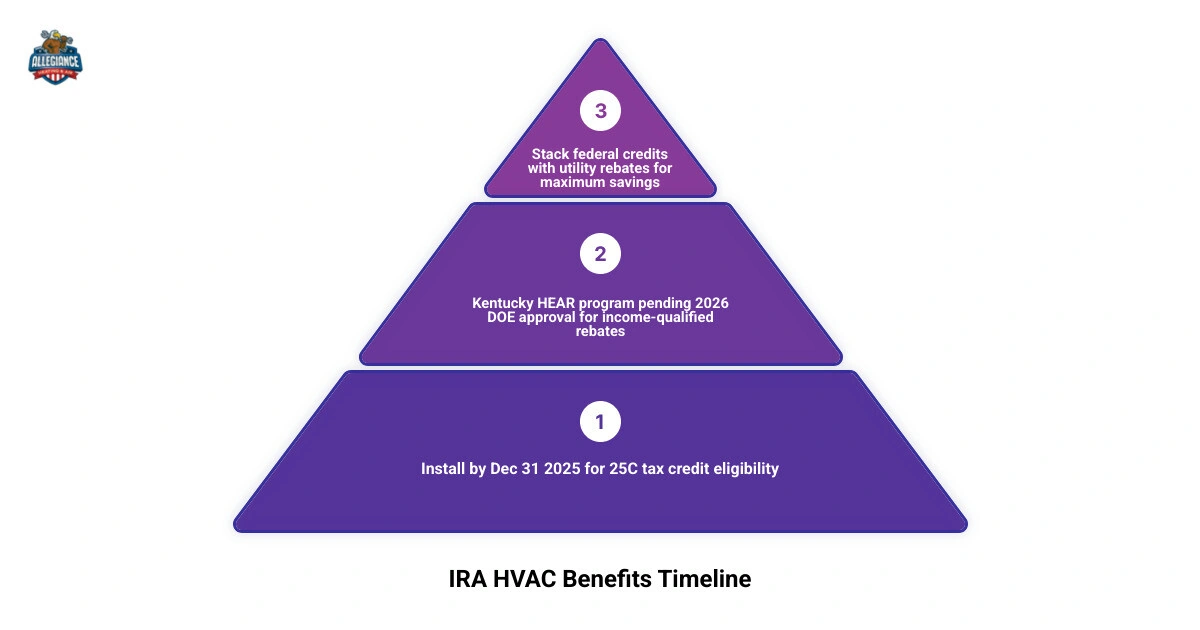
- Kentucky HEAR rebates — pending DOE approval; income-qualified households may receive up to $8,000 once the program launches
- Utility rebates — LG&E, KU, Duke Energy, and local cooperatives offer additional rebates that can be stacked on top of federal credits
Important note for 2026: The Energy Efficient Home Improvement Credit (§25C) was terminated effective December 31, 2025. If your system was installed before that deadline, you can still claim the credit when you file your taxes. Systems installed in 2026 do not qualify for the 25C credit unless Congress passes new legislation.
Most homeowners in the Louisville metro, southern Indiana, and surrounding Kentuckiana communities do not realize how many of these programs can be combined. Depending on your income, your utility provider, and the equipment you choose, your total savings stack could be substantial — but only if you know where to look and what paperwork to keep.
This guide breaks it all down in plain language so you can walk into your next HVAC decision fully informed.
Understanding the Inflation Reduction Act HVAC Benefits for Kentuckiana

To make sense of the inflation reduction act hvac benefits for kentuckiana, we first have to look at the timeline. The Inflation Reduction Act (IRA), signed into law in 2022, introduced historic funding to help Americans transition to cleaner, more efficient home heating and cooling. For homeowners in southern Indiana and the Louisville area, this opened up two primary pathways to savings: federal tax credits and state-administered instant rebates.
However, a major legislative shift occurred at the end of last year. The popular 25C Energy Efficient Home Improvement Credit program was terminated effective December 31, 2025.
What does this mean for you right now in July 2026?
- If you installed qualifying equipment in 2025: You can still claim those tax credits on your federal tax return filed in 2026. It is crucial to gather your documentation now so you do not miss out on this dollar-for-dollar reduction of your tax liability.
- If you are planning an upgrade in 2026: Your focus will shift away from the expired 25C federal tax credit and toward state-administered programs, local utility incentives, and manufacturer promotions.
Understanding how these rules apply across state lines is vital. Whether you live in Louisville, Prospect, or Mount Washington on the Kentucky side, or Floyds Knobs, Jeffersonville, and New Albany on the Indiana side, the rules for utility rebates and state programs differ. To learn more about how federal incentives historically structured these upgrades, you can read about the Federal Tax Credits for Furnace and AC Replacement.
Federal Tax Credits vs. State Rebates: What is Available in 2026?
When navigating home comfort incentives, it is easy to confuse tax credits with rebates.
A tax credit (like the expired 25C credit claimed via IRS Form 5695) reduces the total amount of income tax you owe to the federal government. If you owe taxes and claim a $2,000 credit, your tax bill drops by exactly $2,000.
A state rebate, on the other hand, is a point-of-sale discount or a direct cash-back payment. Under the IRA, the federal government allocated funds to states to create the Home Energy Rebates programs. This includes the Home Electrification and Appliance Rebates (HEAR) program (formerly known as HEEHR). These are designed to provide instant, point-of-sale discounts for high-efficiency upgrades, particularly for low-to-moderate-income families.
Choosing the right system level is key to unlocking these benefits. You can review our Standard Efficiency vs High Efficiency HVAC Comparison to understand how system tiers impact both your upfront incentives and your monthly energy bills.
| Incentive Program | Type of Benefit | Maximum Value | Target Equipment | Expiration / Status in 2026 |
|---|---|---|---|---|
| 25C Federal Tax Credit | Tax Liability Reduction | Up to $2,000 (Heat Pumps) / $600 (AC/Furnace) | Heat pumps, central AC, gas furnaces, water heaters | Expired Dec 31, 2025 (Claimable on 2025 tax returns filed in 2026) |
| Kentucky HEAR Rebates | Point-of-Sale Discount | Up to $8,000 (Income-dependent) | Heat pumps, electrical panels, insulation, wiring | Pending final launch by Kentucky Office of Energy Policy in 2026 |
| Indiana HEAR Rebates | Point-of-Sale Discount | Up to $8,000 (Income-dependent) | Heat pumps, electrical upgrades, insulation | Rollout active/progressing through Indiana Office of Energy Development |
| Utility Rebates (LG&E/KU/Duke) | Cash-back Rebate | Varies by utility | High-efficiency heat pumps, smart thermostats | Active and stackable |
How the Inflation Reduction Act HVAC Benefits for Kentuckiana Apply to Heat Pumps
Heat pumps are the crown jewel of the Inflation Reduction Act's electrification push. Because they move heat rather than generate it, they are incredibly efficient. For installations completed in 2025, the 25C tax credit covered 30% of the total installation cost, capped at $2,000.
Investing in this technology pays off over the long haul. To see how these savings compound month after month, check out our analysis on How Much Does a High Efficiency HVAC Save Over Time.
For those looking at the ultimate efficiency upgrade, geothermal heat pumps remain highly incentivized. Geothermal systems qualify for a 30% uncapped federal tax credit under a separate section of the tax code (Section 25D), which remains active. Because there is no cap, a high-end geothermal installation can yield thousands of dollars in direct federal tax savings, making it an incredibly attractive option for homeowners in larger properties across Louisville, Goshen, and Prospect.
Qualifying Air Conditioners, Furnaces, and Water Heaters
While heat pumps receive the largest incentives, traditional heating and cooling systems also qualified under the 2025 tax credit rules:
- Central Air Conditioners: Qualified for a tax credit of 30% of the cost, up to $600, provided they met strict energy efficiency criteria.
- Gas Furnaces: Qualified for up to $600 if they achieved an AFUE (Annual Fuel Utilization Efficiency) rating of 97% or higher.
- Heat Pump Water Heaters: These highly efficient units qualified for a tax credit of up to $2,000, helping families reduce their water heating bills substantially.
If you are trying to decide between a standard air conditioner and a high-efficiency model, our High SEER vs Standard SEER AC Comparison breaks down the performance differences and comfort benefits you can expect in our humid Ohio Valley summers.
Stacking Local Utility Rebates in Kentucky and Southern Indiana
One of the best ways to maximize your savings is by "stacking" incentives. Even if the federal tax credit program has shifted, our local utility companies in Kentuckiana offer robust rebate programs that remain fully active in 2026.
Your geographic location and utility service territory determine which rebates you can claim:
- Louisville Gas & Electric (LG&E) & Kentucky Utilities (KU): Serving Louisville, Jefferson County, and surrounding areas like Crestwood and Mount Washington, LG&E and KU offer direct rebates for installing high-efficiency heat pumps and smart thermostats.
- Duke Energy: Serving many customers in southern Indiana (including New Albany, Jeffersonville, and Franklin County areas), Duke Energy’s Smart $aver program provides substantial rebates for qualifying smart thermostats and heat pump upgrades.
- Clark REMC and Touchstone Energy Cooperatives: If you live in more rural or suburban parts of southern Indiana or Kentucky (such as Borden, Pekin, or Lanesville), your local electric cooperative likely offers specific heat pump incentives to help lower demand on the grid.
Utility rebates are excellent because they are paid directly to you or applied as a credit on your bill, and they can be combined with manufacturer rebates. During our hot, sticky summers, combining these upgrades with smart home habits can make a massive difference. For practical advice on keeping your bills low, read our Energy Saving Tips for Summer in the Ohio Valley.
Maximizing Savings with Inflation Reduction Act HVAC Benefits for Kentuckiana
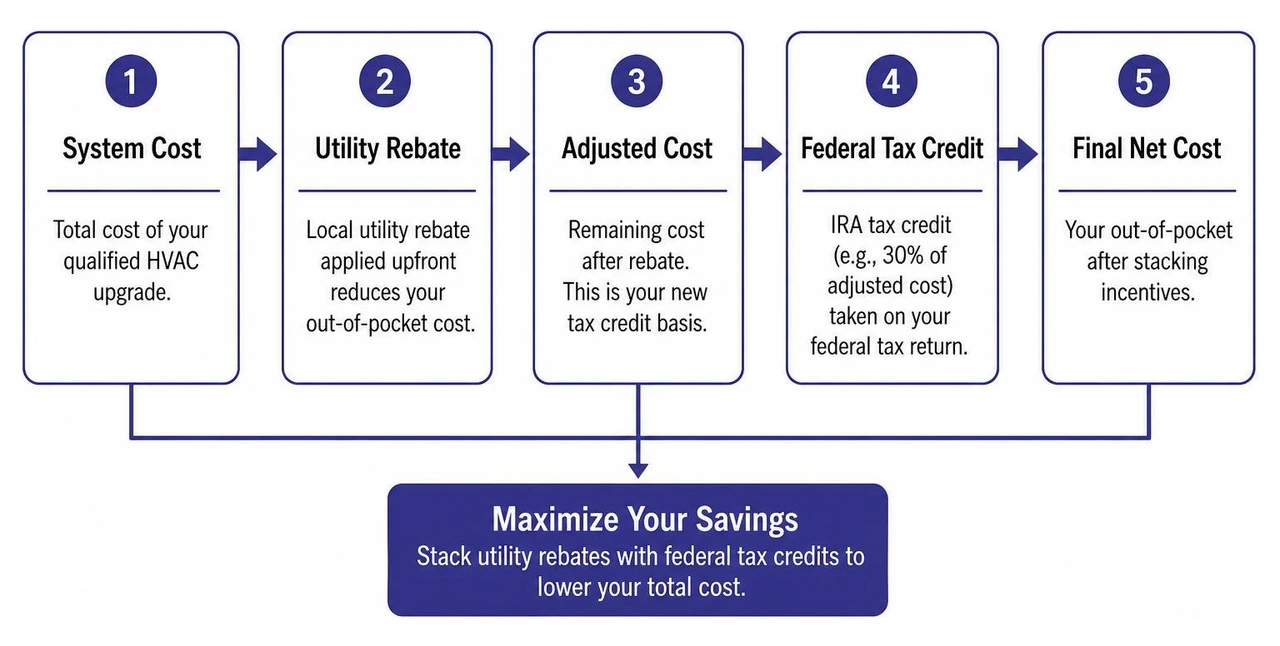
To get the most out of your investment, it helps to understand how these incentives interact. When you stack a utility rebate with a federal tax credit, the federal credit is calculated after the utility rebate is deducted from the total project cost.
For example, if your utility rebate reduces your out-of-pocket cost upfront, your tax credit basis will be adjusted accordingly, but your total net cost will still be significantly lower than if you used only one incentive.
Efficiency Standards and Documentation Requirements
To claim any federal tax credit or local utility rebate, your new system must meet strict efficiency standards. It is not enough to simply buy a "new" system; it must be certified to perform at specific high-efficiency thresholds.
These standards are measured using several key industry ratings:
- SEER2 (Seasonal Energy Efficiency Ratio 2): Measures cooling efficiency.
- HSPF2 (Heating Seasonal Performance Factor 2): Measures heating efficiency for heat pumps.
- ENERGY STAR Certification: A universally recognized blue label indicating the unit meets strict EPA guidelines.
- AHRI Certificate: Issued by the Air-Conditioning, Heating, and Refrigeration Institute, this certificate proves your specific outdoor condenser and indoor coil combination meet the rated efficiencies.
Understanding these ratings is essential to ensuring your equipment qualifies for financial incentives. For a deeper dive into why these metrics matter for your home's comfort and your wallet, read our guide on Energy Efficiency Standards for Your HVAC: Why Is This Important.
Additionally, the HVAC industry is transitioning to newer, more environmentally friendly refrigerants. To stay ahead of regulatory changes and ensure your new system is future-proof, you can read about the Benefits of R32 Refrigerant.
To successfully claim your incentives, you must work with a licensed contractor who can provide:
- An itemized invoice showing the exact model and serial numbers of the installed equipment.
- The official AHRI certificate for your system.
- The manufacturer’s Product Identification Number (PIN) or certification statement confirming the system meets the required efficiency thresholds.
Frequently Asked Questions About Kentuckiana HVAC Incentives
When will the Kentucky Home Energy Rebates (HEAR) program launch?
The Kentucky Energy and Environment Cabinet’s Office of Energy Policy is actively working with the U.S. Department of Energy (DOE) to launch the Home Energy Rebates program in 2026. Because the DOE required additional documentation and planning, the program's public launch portal is pending final federal approval. Once live, this program will offer point-of-sale rebates of up to $8,000 for qualifying heat pump installations for low-to-moderate-income households.
Can I claim the 25C tax credit for an installation completed in 2026?
No. The 25C federal tax credit expired on December 31, 2025. Unless Congress passes retroactive legislation to extend or reinstate the program, systems installed in 2026 are not eligible for this specific tax credit. However, if you had a qualifying system installed in 2025, you can still claim it on your tax return filed in 2026.
What is the difference between a tax credit and an instant rebate?
A tax credit is claimed when you file your annual federal tax return, reducing your overall tax liability dollar-for-dollar. An instant rebate is applied directly at the point of sale, immediately lowering the purchase price of the equipment. While tax credits are generally available to all homeowners regardless of income, the upcoming HEAR rebates are heavily dependent on your household income relative to the Area Median Income (AMI) of your county.
Conclusion
Navigating the shifting landscape of federal tax credits, state rebates, and local utility programs can feel overwhelming, but you do not have to figure it out alone. At Allegiance Heating & Air, we have been "Taking Home Comfort Under Our Wing" since 2005. As a family-owned business based in Greenville, IN, we are proud to serve our neighbors across southern Indiana and the greater Louisville area with honest, transparent, and professional HVAC service.
Our team of trusted technicians is fully trained on the latest high-efficiency systems, and we are committed to helping you find the perfect system for your home while maximizing every available local utility rebate. If you are concerned about the upfront cost of upgrading to a high-efficiency system, we can help walk you through your options. Learn How Financing Through Greensky and Synchrony Makes HVAC Replacement Accessible in Kentuckiana.
Ready to upgrade your home comfort and lower your monthly energy bills? Schedule your high-efficiency heat pump installation with Allegiance Heating & Air today and let our family take care of yours.
Contact Us Or Schedule Expert Service
Other Blogs
ready to transform your home?
Discover our exceptional home services tailored to meet your needs and enhance your living space.
WHAT OUR CLIENTS HAVE TO SAY ABOUT US

We had a complete HVAC system and a hot water heater installed. The guys were professional, well mannered, and completed the work in a timely manner. Would definitely use them again.
I was nervous at first because my AC broke in the middle of 80 degree weather which is strange for April, but Allegiance Heating and Air was incredibly prompt and professional. The technician arrived within an hour, explained the problem clearly, and completed the repair. The technician , Mr. Garrett Moon was a very nice and courteous young man. He found the problem and fixed it within a timely manner. I highly recommend them for any heating or cooling needs. I’ll definitely give them a call again should I ever have another issue, but hopefully not. Knock on wood 😁. Give them a call… you won’t be disappointed!
From the moment I called to schedule a service, the team was quick to respond and arrived right on time. The technician was professional, friendly, and clearly knowledgeable about my heating system. He explained the repair options in plain language and completed the job efficiently. I appreciated the reliable service and the fact that the work was done the same day. I would definitely recommend Allegiance Heating and Air for any residential HVAC needs.
5/5 stars – I was very impressed with the efficient, affordable and timely service from Allegiance Heating and Air. The technician arrived on time, and performed the service quickly, no repairs needed at this time. Communication was clear and the whole experience felt hassle‑free. I would definitely recommend them for any residential HVAC needs.
Knowledgeable, experienced individual.
Explains Allegiance Heating and Air was incredibly reliable, professional and affordable. They arrived right on time, kept the work area clean and finished the furnace repair quickly. The technician explained everything clearly and the price was a great value. If happiness had a location on Google Maps, it would be here.
Gilbert had to go above and beyond because York is no longer making the part for my furnace. But he was able to find a way to construct a housing bracket for my furnace. Ingenuity, determination and integrity is what finally got my furnace fixed. Gilbert is truly a one of a kind technician.
Thank you for always going the extra mile. Gilbert is always respectful and helpful with any concerns.
"Great service, most knowledgeable and capable HVAC business in Kentuckiana!! Pete Flemming and Bryan the owner, are HVAC encyclopedias. They have the highest integrity of any HVAC business I have ever used. Allegiance has put numerous units in for me over the last 17 years. I will continue to use and trust them."
"Fast response from Allegiance when our heat was out on New Year’s day! Service technician was friendly and efficient. He took the time to explain the problem, tell us about the temporary fix and the plan for permanent repair. We were impressed!"
"Love Allegiance! Their technicians, in particular Benjamin, explain everything. Fast and thorough. A/C was out on a Sunday. Called Allegiance and within a few hours Benjamin arrived. Such a comfort as he was the one who last serviced our units. He quickly replaced part and cooling is restored!"
"My heat pump went out and I had to call after hours. The technician (Garrett) was outstanding and thorough. He got my system up and working until Monday and gave me several options of units. Also took the time to explain the issue to my Home warranty company. I highly recommend this company."
"Right on time :) respectful, fast, and polite. Even gave my fur babies some attention."
"Had Garrett out today to fix our AC. Fantastic tech. He showed up exactly when he said he would and kept us informed of what he was checking and what he found. Highly recommend!"
"Lucas with Allegiance showed up on time as promised, was professional and extremely patient and responsive with all my questions. He took care of the issue, and I feel he was trustworthy! He had us back to cool and comfortable on one of the hottest days of the year."
"Lucas did a great job! Very professional and expedient. Explained the process very well and represented Allegiance as a truly professional and reputable company."
"Arrived on time and work diligently to fix issue. These guy are great. Worked quickly to resolve my issues."
"Lucas was great - he spent a lot of time trying to figure out what was going on and explained everything he was doing. I trust Allegiance and wouldn’t want anyone else working on/in my house!!"

RELATED ARTICLES
All About What NATE Certification Means for Your HVAC Service

DIY HVAC Maintenance Checklist Between Service Visits