
What the Standard Efficiency vs High Efficiency HVAC Comparison Really Means for Your Home
The standard efficiency vs high efficiency HVAC comparison comes down to one core question: how much of your energy dollar actually goes toward heating or cooling your home?
Here's a quick breakdown:
• Furnace AFUE — Standard Efficiency: ~80% — High Efficiency: 90–99%
• Cooling SEER2 — Standard Efficiency: 13.4–15 — High Efficiency: 16–21+
• Upfront Cost — Standard Efficiency: Lower — High Efficiency: Higher
• Monthly Energy Bills — Standard Efficiency: Higher — High Efficiency: Lower
• Payback Period — Standard Efficiency: N/A — High Efficiency: 5–12 years
• Technology — Standard Efficiency: Single-stage, basic — High Efficiency: Variable-speed, multi-stage
• Best For — Standard Efficiency: Mild climates, tight budgets — High Efficiency: Cold climates, long-term savings
Most homeowners in Greenville, IN deal with cold winters and warm summers — meaning your HVAC system runs hard for a good chunk of the year. That makes the efficiency gap between these two system types very real, and very visible on your utility bills.
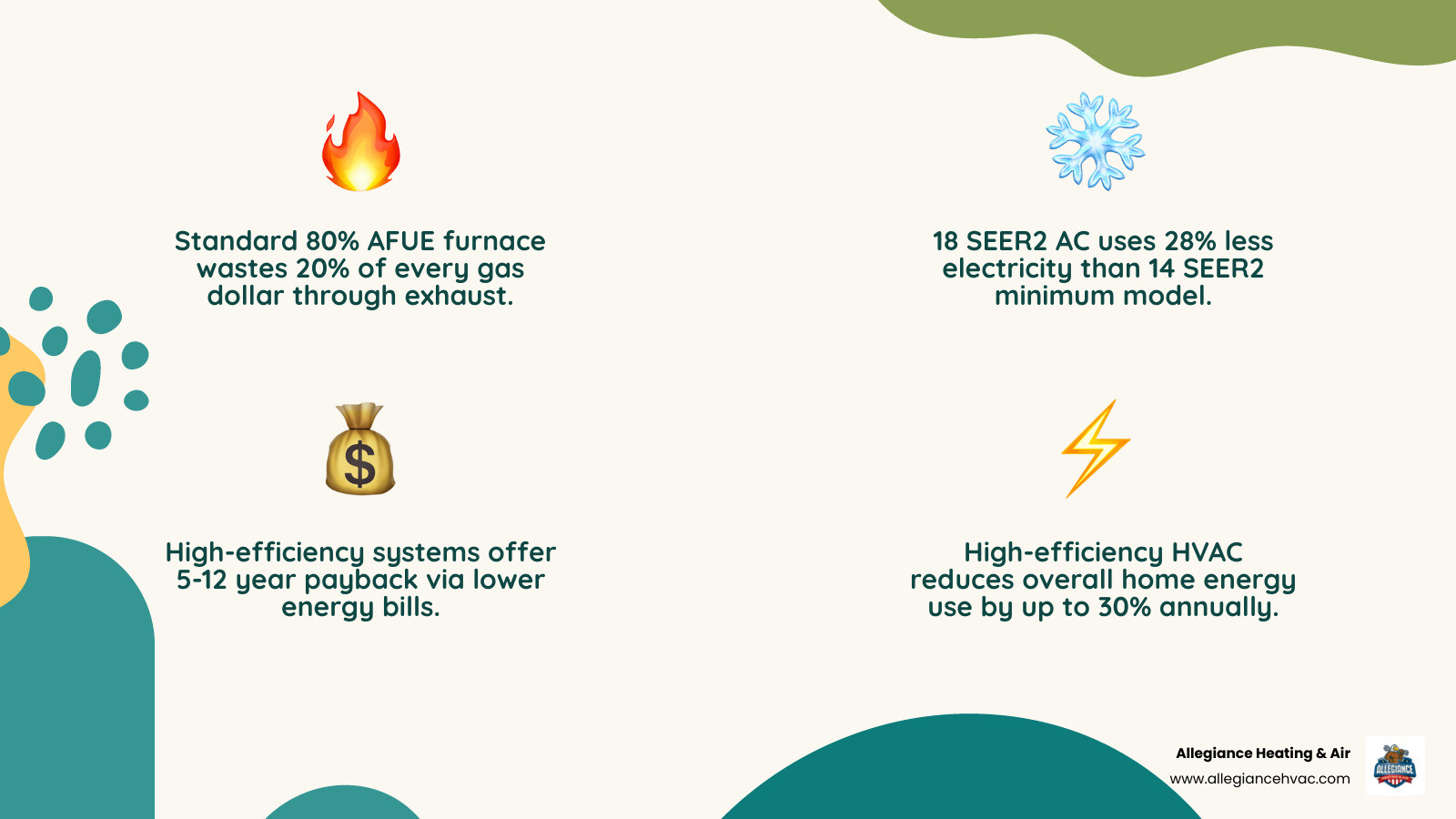
A standard 80% AFUE furnace wastes 20 cents of every gas dollar through exhaust. A high-efficiency unit at 96% AFUE cuts that waste to just 4 cents. For cooling, an 18 SEER2 air conditioner uses roughly 28% less electricity than a minimum 14 SEER2 model.
The right choice depends on your home, your budget, and how long you plan to stay. This guide walks you through everything you need to make that call with confidence.
A Comprehensive Standard Efficiency vs High Efficiency HVAC Comparison
When we sit down with families in Greenville or Floyds Knobs to discuss a new system, we often start by "decoding the alphabet soup" of HVAC metrics. Understanding these numbers is the first step in a true standard efficiency vs high efficiency hvac comparison. These ratings aren't just marketing jargon; they are standardized measurements required by the Department of Energy to tell you exactly how much energy a unit consumes.
The primary metrics you'll encounter include:
• SEER2 (Seasonal Energy Efficiency Ratio): This measures the cooling efficiency of your air conditioner or heat pump over an entire cooling season.
• AFUE (Annual Fuel Utilization Efficiency): This is for furnaces. It tells you what percentage of the fuel (like natural gas) is turned into heat versus what is lost as exhaust.
• HSPF2 (Heating Seasonal Performance Factor): This measures the heating efficiency of a heat pump specifically.
Staying informed on HVAC Energy Efficiency Standards is vital because the federal minimums recently changed. As of 2023, the Department of Energy raised the bar. In our region, the minimum SEER2 for a split-system air conditioner is 13.4 (roughly equivalent to the old 14 SEER).
While standard units meet these bare minimums, high-efficiency systems soar far beyond them. For example, while a standard furnace provides 80% AFUE, high-efficiency models frequently reach 95% to 98% AFUE. If you are looking for Air Conditioning Services or Heating Services, knowing these benchmarks helps you understand if you're buying a "base model" or a "high-performance" machine.
Decoding the standard efficiency vs high efficiency HVAC comparison for cooling
In the summer months in Indiana and Kentucky, your AC is often the biggest draw on your electric meter. When performing a standard efficiency vs high efficiency hvac comparison for cooling, the SEER2 rating is your guiding star.
Standard units typically hover around the 13.4 to 15 SEER2 range. These are reliable, single-stage machines. They are either 100% "on" or 100% "off." High-efficiency units, however, often boast ratings of 18, 20, or even 30 SEER2.
The secret to these high numbers is often found in Efficient Home Cooling Solutions like variable-speed compressors. Unlike standard units, these can adjust their cooling output to match the exact needs of your home. If it’s only 78 degrees outside, a high-efficiency unit might run at 30% capacity, sipping electricity while maintaining a perfect temperature. This results in a roughly 28% reduction in electricity use when moving from a 14 SEER2 to an 18 SEER2 model.
The role of heat pumps in a standard efficiency vs high efficiency HVAC comparison
Heat pumps are the "chameleons" of the HVAC world, providing both heating and cooling. In a standard efficiency vs high efficiency hvac comparison, heat pumps often come out on top because they don't create heat through combustion; they simply move it from one place to another.
How Does a Heat Pump Work? It uses a refrigerant cycle to extract heat from the outdoor air (even when it feels cold to us) and pumps it indoors. Our Heat Pump Services often involve installing high-efficiency models that can reduce site energy use by 20% to 40% compared to older air conditioner and gas furnace combos.
For homeowners in colder areas like Salem or Scottsburg, we often recommend "dual-fuel" systems. This pairs a high-efficiency heat pump with a gas furnace backup, giving you the best of both worlds: extreme efficiency in the fall and spring, and powerful gas heat for those sub-zero winter nights.
Operational Advantages and Enhanced Home Comfort
Beyond just the numbers on your utility bill, high-efficiency systems change how your home feels. Standard efficiency units are often "all or nothing." They blast hot or cold air until the thermostat is satisfied, then shut off, leading to "hot and cold spots" and temperature swings.
High-efficiency systems utilize advanced technology to solve this:
• Variable-Speed Blowers: These fans can run at many different speeds, circulating air more quietly and consistently.
• Modulating Gas Valves: Instead of just "high" and "low" flames, these furnaces can adjust the heat output in tiny increments.
• Secondary Heat Exchangers: This is a hallmark of high-efficiency condensing furnaces. They capture heat from the exhaust gases that standard units simply vent outside, allowing the system to reach 97%+ efficiency.
• Sealed Combustion: These units bring in fresh air from outside for combustion rather than using the air inside your home, which is safer and more efficient.
By focusing on System Conversion Efficiency, you aren't just saving money; you're investing in Climate Control Systems that manage humidity better and provide more consistent filtration for better indoor air quality.
Key Factors for Choosing the Right System in Greenville, IN
Choosing the right system isn't just about picking the highest number. It’s about matching the equipment to your specific environment. In Greenville, IN, we experience a "mixed-humid" climate. Our winters are cold enough to make high AFUE furnaces very attractive, but our summers are humid enough to make high-SEER2 cooling worth the investment.
Before deciding, consider these factors:
1. Ductwork Integrity: A high-efficiency unit won't do much good if 30% of your conditioned air is leaking into the crawlspace. We always recommend a duct inspection before upgrading.
2. Home Insulation: If your attic is under-insulated, your new HVAC will still have to work overtime.
3. Choosing the Right HVAC Size: An oversized high-efficiency unit is actually less efficient because it will "short cycle," turning on and off too frequently.
Standard vs. High-Efficiency Features at a Glance
• Heat Exchanger — Standard Efficiency: Single (Primary) — High Efficiency: Dual (Primary + Secondary)
• Venting — Standard Efficiency: Metal flue (hot exhaust) — High Efficiency: PVC pipe (cool, condensing exhaust)
• Blower Motor — Standard Efficiency: Permanent Split Capacitor (PSC) — High Efficiency: Variable-speed ECM
• Air Quality — Standard Efficiency: Basic filtration — High Efficiency: Enhanced filtration & humidity control
• Noise Levels — Standard Efficiency: Noticeable "whoosh" when starting — High Efficiency: Whisper-quiet operation
Frequently Asked Questions about HVAC Efficiency
We know that a new HVAC system is a major investment for any family in the Louisville or New Albany area. Here are some of the most common questions we hear regarding HVAC Services and efficiency.
When is a standard efficiency system the more practical option?
Believe it or not, high-efficiency isn't always the answer. A standard efficiency system might be the right move if:
• Budget is the primary concern: If an unexpected breakdown happens and you need a reliable system without a higher upfront investment.
• You're planning to move soon: If you expect to sell your home in the next 2–3 years, you likely won't see the "payback" from the energy savings.
• Smaller living spaces: In a very small, well-insulated home, the total energy use is already low enough that the savings from a high-efficiency unit may be negligible.
Do high-efficiency units require more maintenance?
High-efficiency units are more complex. They have more sensors, circuit boards, and components like secondary heat exchangers and condensate pumps. While they are built for durability, they do require specialized service from technicians who understand these advanced systems.
Because high-efficiency furnaces "condense" water out of the exhaust, they require proper drainage. Ensuring these drain lines stay clear is a vital part of annual maintenance. However, because these systems often run at lower speeds, they can actually experience less "wear and tear" from constant starting and stopping compared to standard units.
Are there incentives for upgrading to high-efficiency HVAC?
Yes! This is one of the best ways to bridge the gap in upfront costs. Many local utility companies offer rebates ranging from $100 to $1,500 for qualifying equipment. Furthermore, federal tax credits (like those under the Inflation Reduction Act) can provide significant savings for systems that meet certain high-efficiency benchmarks.
When you factor in these incentives, the "premium" for a high-efficiency system often drops significantly, making the long-term ROI much more attractive. We always encourage our customers to look into Energy-Efficient AC Installation options that qualify for these programs.
Conclusion
At the end of the day, the standard efficiency vs high efficiency hvac comparison isn't about which system is "better" in a vacuum—it's about which one is better for your home and your family's goals. Whether you prioritize lowest initial cost or the highest long-term energy savings and comfort, we are here to help.
Allegiance Heating & Air has been "Taking Home Comfort Under Our Wing" since 2005. As a family-owned business serving Greenville, IN, and the surrounding communities from Louisville to Sellersburg, we pride ourselves on providing honest, professional advice.
Ready to see which system fits your home? Our Services include comprehensive load calculations and efficiency consultations to ensure you get exactly what you need. Learn more about system conversion efficiency and how we can help you save on your next utility bill today.
Contact Us Or Schedule Expert Service
Other Blogs
ready to transform your home?
Discover our exceptional home services tailored to meet your needs and enhance your living space.
WHAT OUR CLIENTS HAVE TO SAY ABOUT US

We had a complete HVAC system and a hot water heater installed. The guys were professional, well mannered, and completed the work in a timely manner. Would definitely use them again.
I was nervous at first because my AC broke in the middle of 80 degree weather which is strange for April, but Allegiance Heating and Air was incredibly prompt and professional. The technician arrived within an hour, explained the problem clearly, and completed the repair. The technician , Mr. Garrett Moon was a very nice and courteous young man. He found the problem and fixed it within a timely manner. I highly recommend them for any heating or cooling needs. I’ll definitely give them a call again should I ever have another issue, but hopefully not. Knock on wood 😁. Give them a call… you won’t be disappointed!
From the moment I called to schedule a service, the team was quick to respond and arrived right on time. The technician was professional, friendly, and clearly knowledgeable about my heating system. He explained the repair options in plain language and completed the job efficiently. I appreciated the reliable service and the fact that the work was done the same day. I would definitely recommend Allegiance Heating and Air for any residential HVAC needs.
5/5 stars – I was very impressed with the efficient, affordable and timely service from Allegiance Heating and Air. The technician arrived on time, and performed the service quickly, no repairs needed at this time. Communication was clear and the whole experience felt hassle‑free. I would definitely recommend them for any residential HVAC needs.
Knowledgeable, experienced individual.
Explains Allegiance Heating and Air was incredibly reliable, professional and affordable. They arrived right on time, kept the work area clean and finished the furnace repair quickly. The technician explained everything clearly and the price was a great value. If happiness had a location on Google Maps, it would be here.
Gilbert had to go above and beyond because York is no longer making the part for my furnace. But he was able to find a way to construct a housing bracket for my furnace. Ingenuity, determination and integrity is what finally got my furnace fixed. Gilbert is truly a one of a kind technician.
Thank you for always going the extra mile. Gilbert is always respectful and helpful with any concerns.
"Great service, most knowledgeable and capable HVAC business in Kentuckiana!! Pete Flemming and Bryan the owner, are HVAC encyclopedias. They have the highest integrity of any HVAC business I have ever used. Allegiance has put numerous units in for me over the last 17 years. I will continue to use and trust them."
"Fast response from Allegiance when our heat was out on New Year’s day! Service technician was friendly and efficient. He took the time to explain the problem, tell us about the temporary fix and the plan for permanent repair. We were impressed!"
"Love Allegiance! Their technicians, in particular Benjamin, explain everything. Fast and thorough. A/C was out on a Sunday. Called Allegiance and within a few hours Benjamin arrived. Such a comfort as he was the one who last serviced our units. He quickly replaced part and cooling is restored!"
"My heat pump went out and I had to call after hours. The technician (Garrett) was outstanding and thorough. He got my system up and working until Monday and gave me several options of units. Also took the time to explain the issue to my Home warranty company. I highly recommend this company."
"Right on time :) respectful, fast, and polite. Even gave my fur babies some attention."
"Had Garrett out today to fix our AC. Fantastic tech. He showed up exactly when he said he would and kept us informed of what he was checking and what he found. Highly recommend!"
"Lucas with Allegiance showed up on time as promised, was professional and extremely patient and responsive with all my questions. He took care of the issue, and I feel he was trustworthy! He had us back to cool and comfortable on one of the hottest days of the year."
"Lucas did a great job! Very professional and expedient. Explained the process very well and represented Allegiance as a truly professional and reputable company."
"Arrived on time and work diligently to fix issue. These guy are great. Worked quickly to resolve my issues."
"Lucas was great - he spent a lot of time trying to figure out what was going on and explained everything he was doing. I trust Allegiance and wouldn’t want anyone else working on/in my house!!"

RELATED ARTICLES

Understanding the Signs That Your Air Conditioner Needs Repair in New Albany, IN
Help! My Heat Pump Is Blowing Cold Air in New Albany