



Why Knowing the Types of Air Filtration Systems for Your HVAC Matters
The types of air filtration systems for your HVAC break down into these main categories:
1. Mechanical filters (fiberglass, pleated, media) — trap particles physically using fiber layers; rated by MERV score
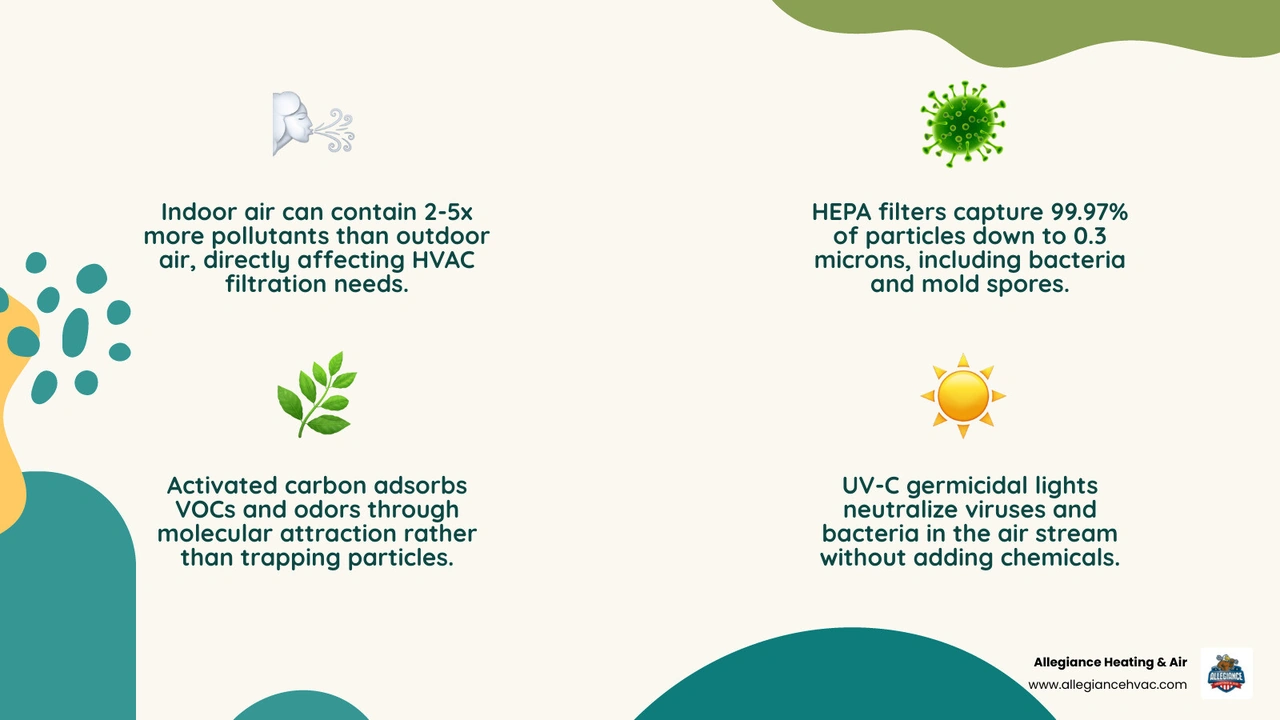
2. HEPA filters — capture 99.97% of particles as small as 0.3 microns; used in high-performance and medical settings
3. Activated carbon / adsorbent filters — remove odors, VOCs, and gaseous pollutants through adsorption
4. UV germicidal lights — use UV-C light to neutralize mold, bacteria, and viruses in the air stream
5. Electronic air cleaners / electrostatic precipitators — use an electrical charge to attract and capture particles
6. Ionic purifiers — release charged ions to cause particles to settle; note ozone production concerns
7. Photocatalytic oxidation (PCO) — breaks down VOCs and bioaerosols using light and a catalyst
Most homeowners in Greenville, IN don't think much about their HVAC filter until something goes wrong — a musty smell, a spike in allergy symptoms, or a sky-high energy bill. But what's happening inside your ductwork every day has a real impact on your family's health and comfort.
According to the EPA, indoor air can contain certain pollutants at concentrations two to five times higher than outdoor air. Your HVAC system runs through that air constantly, which means the filtration technology you choose directly affects what you and your family are breathing.
Not all filters are the same. Some catch dust and pollen. Others go after bacteria, smoke, or chemical vapors. And some technologies — if chosen poorly — can actually make indoor air worse by producing harmful byproducts like ozone.
This guide walks you through each type clearly, so you can make a confident, informed decision.
Types of air filtration systems for your hvac definitions:
• air purification options for allergy and asthma sufferers
• how do air purifiers and filtration systems work
• how do air purifiers work for your home
Understanding the Primary Types of Air Filtration Systems for Your HVAC
To find the perfect indoor air quality solution for your home, it helps to understand how different technologies target different types of pollution. Airborne contaminants are generally divided into three categories: particulate matter (like dust, pet dander, and pollen), gaseous pollutants (like odors, fumes, and Volatile Organic Compounds), and biological contaminants (such as mold spores, bacteria, and viruses).
No single technology is a magic bullet for all three. Instead, different systems use unique physical and chemical processes to clean your air:
• Mechanical Filtration: This is the most common method. It relies on a physical barrier made of fiberglass, synthetic fibers, or cotton. As air flows through the filter, particles get trapped in the dense maze of fibers.
• Electrostatic Filtration: These systems use static electricity to attract particles. They can be disposable or washable. As particles pass through, they receive a static charge that makes them cling to the filter fibers or metal plates.
• Gaseous Removal (Adsorption): Standard mechanical filters cannot trap gases because gas molecules are too small. Adsorbent systems use materials like activated carbon to capture vapors, chemicals, and odors on a molecular level.
• Biological Control: Rather than trapping living organisms, these systems use ultraviolet light or advanced catalytic reactions to neutralize or kill biological threats like viruses, bacteria, and mold.
By combining these methods, you can build a comprehensive defense system for your home. For a detailed breakdown of how these technologies compare, check out our guide on the Different Types of Air Cleaners and Their Benefits.
Mechanical Air Filters and MERV Ratings
Mechanical air filters are the backbone of residential heating and cooling. When you slide a standard cardboard-framed filter into your furnace or air handler, you are using mechanical filtration. These filters protect your expensive HVAC components from dust buildup while cleaning your breathing air.
The performance of mechanical filters is measured using the Minimum Efficiency Reporting Value (MERV) rating system, which was developed by the American Society of Heating, Refrigerating and Air-Conditioning Engineers (ASHRAE) under Standard 52.2. MERV ratings range from 1 to 20. The higher the rating, the better the filter is at capturing smaller particles:
• MERV 1 to 4: These are typically basic fiberglass filters. They are designed to capture large particles like lint, carpet fibers, and heavy dust. Their main job is protecting your heating and cooling equipment, not purifying your breathing air.
• MERV 5 to 8: These are usually pleated filters. They do a much better job of trapping mold spores, pet dander, and dust mite debris. For many homes, a MERV 8 filter provides a great balance of basic air cleaning without restricting airflow.
• MERV 9 to 12: These mid-to-high-efficiency pleated filters can capture finer particles, including pollen, automobile emissions, and lead dust. They are excellent for households with mild allergies.
• MERV 13 to 16: These high-efficiency filters are outstanding at capturing bacteria, smoke, and microscopic droplets. A MERV 13 filter is often recommended as the ideal upgrade for residential systems to combat airborne viruses, provided your HVAC system can handle the resistance.
• MERV 17 to 20: These are hospital-grade filters, including HEPA systems, which can capture viruses and carbon dust.
When upgrading your filter, it is crucial to remember that higher MERV ratings mean denser filter material. This density creates airflow resistance (static pressure). If your HVAC blower motor has to work too hard to pull air through a dense filter, your system's efficiency will drop, and you could risk damaging your compressor or heat exchanger.
To understand the difference between upgrading your standard filter and installing a dedicated system, read our comparison on Whole House Air Purifier vs Upgraded HVAC Filter.
High-Efficiency Particulate Air (HEPA) Filters
Originally developed during World War II and the Manhattan Project to capture radioactive particles, High-Efficiency Particulate Air (HEPA) filters represent the gold standard in mechanical filtration. To meet strict industry standards, a true HEPA filter must capture at least 99.97% of airborne particles as small as 0.3 microns.
To put that in perspective, a single strand of human hair is about 70 microns wide. A 0.3-micron particle is incredibly tiny, and it is actually the most difficult size for a filter to capture. HEPA filters trap these microscopic particles using three physical mechanisms:
1. Interception: Mid-sized particles follow the airflow stream but pass close enough to a fiber to get snagged.
2. Impaction: Larger, heavier particles cannot make the tight turns around the fibers due to inertia, so they crash directly into them and stick.
3. Diffusion: Microscopic particles (smaller than 0.1 microns) do not travel in straight lines. Instead, they bounce around in a zigzag pattern called Brownian motion. This erratic movement makes them highly likely to collide with and stick to the filter fibers.
Because HEPA filters are incredibly dense, they create massive airflow resistance. Standard residential HVAC systems are not designed to push air through a true HEPA filter; doing so would choke the system and cause it to overheat or freeze up.
For this reason, HEPA filtration is usually integrated into homes via a specialized "bypass" system. This system pulls a portion of air from your return duct, runs it through the HEPA filter using an independent blower motor, and sends the purified air back into the main stream. This provides hospital-grade filtration without putting any extra strain on your central heating and cooling equipment.
Advanced Purification Technologies for Whole-House Systems
While mechanical filters are fantastic at trapping solid particles, they cannot stop gases, chemical vapors, or living pathogens. To address these microscopic threats, we turn to advanced purification technologies that integrate directly into your central ductwork.
These systems run quietly behind the scenes, cleaning every cubic foot of air that circulates through your home. To learn more about the differences between active purification and passive filtration, explore our Air Purifier vs Air Filtration System Comparison.
Activated Carbon and Adsorbent Purifiers
If you struggle with cooking odors, pet smells, tobacco smoke, or chemical fumes from household cleaners, mechanical filters cannot help you. Instead, you need an adsorbent filter, which typically relies on activated carbon.
Activated carbon is carbon that has been treated with oxygen to open up millions of tiny pores between the carbon atoms. This process increases the surface area of the material dramatically—just one gram of activated carbon can have a surface area of over 1,000 square meters!
When gaseous pollutants pass through an activated carbon filter, they undergo a process called adsorption. During adsorption, gas and vapor molecules stick to the vast internal surface area of the carbon via weak intermolecular forces known as van der Waals forces. Some advanced systems also use chemisorption, where a chemical reaction permanently bonds the pollutants to the filter media (such as using permanganate to neutralize formaldehyde).
Because carbon filters do not capture physical particles like dust, they are almost always paired with a mechanical pre-filter. This pre-filter catches the large dust particles so the carbon's tiny pores do not get clogged, extending the life of your adsorbent system.
Ultraviolet (UV) Germicidal Lights
Ultraviolet Germicidal Irradiation (UVGI) is a technology that has been used in hospitals, water treatment plants, and laboratories for over a century. When integrated into your home's central HVAC system, UV lights target biological contaminants like mold spores, bacteria, and viruses.
These systems use a specific wavelength of ultraviolet light called UV-C (typically around 254 nanometers). When biological pathogens are exposed to UV-C light, the radiation penetrates their outer cell walls and disrupts their DNA or RNA. This process scrambles their genetic code, making it impossible for them to reproduce or cause infection. A virus or bacteria that cannot reproduce is effectively dead and harmless.
In residential HVAC systems, UV lights are typically installed in one of two configurations:
• Coil Disinfection: The light is mounted so it shines continuously on your indoor AC evaporator coil. Because evaporator coils are cold and damp, they are prime breeding grounds for mold and algae. Continuous UV exposure keeps the coil clean, improving both your air quality and your system's heat exchange efficiency.
• Air Stream Disinfection: The light is placed inside your return air duct to sanitize the air as it flies past. This requires high-intensity lamps because the air is moving quickly, and the pathogens need sufficient exposure time to be neutralized.
When choosing a UV system, it is vital to work with experienced professionals to ensure the lamps do not produce ozone as a byproduct. Safe, high-quality UV-C systems are designed to operate within wavelengths that neutralize germs without creating indoor air pollution.
Comparing Whole-House Systems vs. Portable Air Purifiers
If you are looking to improve your indoor air quality, you have probably wondered whether you should invest in a whole-house HVAC-integrated system or buy a few portable air purifiers for individual rooms. Both options have their place, but they work very differently.
• Coverage Area — Whole-House HVAC-Integrated Systems: Whole home (every room connected to ductwork) — Portable Air Purifiers: Single room or localized space
• Aesthetic Impact — Whole-House HVAC-Integrated Systems: Invisible (installed inside ducts or equipment closets) — Portable Air Purifiers: Visible floor units that take up space and require outlets
• Noise Levels — Whole-House HVAC-Integrated Systems: Silent (uses existing HVAC blower, often located in basement/attic) — Portable Air Purifiers: Variable (can be noisy on high fan settings)
• Airflow Requirements — Whole-House HVAC-Integrated Systems: Only filters air when the HVAC fan is running — Portable Air Purifiers: Operates independently of heating and cooling systems
• Maintenance — Whole-House HVAC-Integrated Systems: Low frequency (filters changed every 6 to 12 months) — Portable Air Purifiers: High frequency (filters cleaned/changed every 3 to 6 months)
• Contaminant Targeting — Whole-House HVAC-Integrated Systems: Highly customizable (can combine mechanical, carbon, and UV) — Portable Air Purifiers: Typically limited to mechanical and basic carbon sheets
For a deep dive into which approach is most effective for managing respiratory conditions, read our guide on Air Purification vs Filtration Which is Better for Allergies.
Choosing Whole-House Types of Air Filtration Systems for Your HVAC
For most families, a whole-house air filtration system is the most convenient and effective choice. Because these systems are integrated directly into your existing ductwork, they treat all the air in your home simultaneously. Every time your heating or cooling system kicks on, air is drawn through the filter, purified, and distributed evenly to every room.
This seamless integration offers several major advantages. First, it is completely out of sight and out of mind—there are no bulky plastic boxes sitting in your living room or bedroom, and no power cords to trip over. Second, whole-house systems are incredibly quiet because the filtration process happens deep within your ductwork, far away from your living spaces.
Finally, maintenance is simple. Instead of cleaning or replacing filters in four or five different portable units around your home, you only have to manage one central system. Many high-capacity media filters only need to be replaced once or twice a year.
If you are located in southern Indiana, you can explore specialized local options by checking out our page on Whole House Air Filtration Jeffersonville IN. For a closer look at how these systems transform daily life, read about the 8 Impressive Benefits of Having an In-Home Air Filtration System.
When to Use Portable Units Alongside Your HVAC
While whole-house systems are fantastic, portable air purifiers can be excellent supplemental tools. A portable unit is highly effective when you have a localized source of pollution that you want to address quickly without running your entire central heating and cooling system.
For example, if you have a family member with severe asthma, placing a portable HEPA purifier in their bedroom provides an extra layer of protection while they sleep. Similarly, if you have a home office where you spend eight hours a day, a portable unit can keep that specific room pristine. Portable units are also helpful in homes that do not have central ductwork (such as those using boiler systems or radiant heat).
However, relying solely on portable units to clean a large, multi-room home is rarely practical. You would need to purchase, power, and maintain a unit for almost every room, which quickly becomes noisy and inconvenient.
Selection, Installation, and Maintenance Best Practices
Choosing the right air filtration system is only half the battle. To get the most out of your investment, the system must be installed correctly and maintained regularly.
A poorly installed filter can allow air to bypass the filtration media entirely, rendering the system useless. For a comprehensive look at how professional systems are managed in larger facilities, you can read our Commercial Air Filtration Complete Guide.
Maintaining Different Types of Air Filtration Systems for Your HVAC
To keep your air clean and your utility bills low, follow these essential maintenance practices:
• Establish a Regular Inspection Schedule: Do not wait for your thermostat to remind you. Check your mechanical filters once a month, especially during peak heating and cooling seasons. If a filter looks gray and loaded with dust, replace it immediately.
• Prevent Air Bypass: Air will always take the path of least resistance. If your filter does not fit snugly in its slot, or if the cabinet door is not sealed properly, dirty air will slip around the edges of the filter. Always verify that your filter frame matches the nominal and actual dimensions required by your system.
• Look for MERV-A Ratings: If you are purchasing high-efficiency filters, check if they have a "MERV-A" rating (tested under ASHRAE 52.2 Appendix J). Some electrostatically charged filters lose their charge—and their efficiency—as they get dirty. A MERV-A rating tells you how the filter will perform over its entire lifespan, not just when it is brand new.
• Monitor System Pressure Drop: As mechanical filters capture dust, they become more efficient at trapping tiny particles, but they also restrict airflow more. If you notice weak airflow from your registers or hear your system whistling, your filter may be overloaded, causing a high pressure drop.
• Schedule Professional Maintenance: During your annual heating and cooling tune-ups, have a licensed technician inspect your air filtration cabinets, check the operation of UV germicidal lamps, and ensure your blower motor is calibrated to handle your filter's airflow resistance.
Frequently Asked Questions About HVAC Air Filtration
What is the best MERV rating for a standard home HVAC system?
For most residential homes, a pleated filter with a MERV 8 to 11 rating offers the perfect sweet spot. This range provides excellent filtration—catching pollen, mold spores, pet dander, and dust mites—without creating too much airflow resistance.
If you have family members with allergies or asthma, you might consider upgrading to a MERV 13 filter. However, before making this jump, you should consult with an HVAC professional to ensure your system's blower motor has the capacity to handle the increased resistance without overheating.
Do whole-house air purifiers produce harmful ozone?
It depends entirely on the technology you choose. Pure mechanical filters (like pleated and HEPA filters) and activated carbon systems do not produce any ozone.
However, some electronic air cleaners, ionizers, and older UV systems can produce ozone as a byproduct of their electrical charges or light wavelengths. Ground-level ozone is a known lung irritant that can worsen asthma and respiratory issues.
At Allegiance Heating & Air, we strongly advise against using ozone generators in occupied spaces. When we install UV germicidal lights or advanced air purifiers, we only use certified, zero-ozone systems that meet strict safety standards, ensuring your air is both clean and safe.
How often should I replace my HVAC media filter?
The replacement frequency depends on the thickness of your filter and your household environment:
• 1-inch fiberglass filters: Every 30 days.
• 1-inch to 2-inch pleated filters: Every 60 to 90 days.
• 4-inch to 5-inch deep media filters: Every 6 to 12 months.
That these are general guidelines. If you have multiple pets, smoke indoors, are remodeling your home, or live in an area with high outdoor pollen, you will need to replace your filters more frequently.
Conclusion
Your home should be a safe haven where you can breathe easily. Understanding the different types of air filtration systems for your HVAC is the first step toward creating a healthier, cleaner, and more comfortable indoor environment for your family.
At Allegiance Heating & Air, LLC, we have been "Taking Home Comfort Under Our Wing" as a family-owned business in Greenville, IN since 2005. Our trusted, professional technicians are dedicated to helping our neighbors throughout southern Indiana and the Louisville area find honest, reliable, and customized indoor air quality solutions. Whether you need a simple filter upgrade, a whole-house media cleaner, or advanced UV-C germicidal lights, we are here to provide expert guidance and outstanding customer satisfaction.
Ready to transform your home's air quality? Schedule an indoor air quality consultation with Allegiance Heating & Air today!
Contact Us Or Schedule Expert Service
Other Blogs
ready to transform your home?
Discover our exceptional home services tailored to meet your needs and enhance your living space.
WHAT OUR CLIENTS HAVE TO SAY ABOUT US

We had a complete HVAC system and a hot water heater installed. The guys were professional, well mannered, and completed the work in a timely manner. Would definitely use them again.
I was nervous at first because my AC broke in the middle of 80 degree weather which is strange for April, but Allegiance Heating and Air was incredibly prompt and professional. The technician arrived within an hour, explained the problem clearly, and completed the repair. The technician , Mr. Garrett Moon was a very nice and courteous young man. He found the problem and fixed it within a timely manner. I highly recommend them for any heating or cooling needs. I’ll definitely give them a call again should I ever have another issue, but hopefully not. Knock on wood 😁. Give them a call… you won’t be disappointed!
From the moment I called to schedule a service, the team was quick to respond and arrived right on time. The technician was professional, friendly, and clearly knowledgeable about my heating system. He explained the repair options in plain language and completed the job efficiently. I appreciated the reliable service and the fact that the work was done the same day. I would definitely recommend Allegiance Heating and Air for any residential HVAC needs.
5/5 stars – I was very impressed with the efficient, affordable and timely service from Allegiance Heating and Air. The technician arrived on time, and performed the service quickly, no repairs needed at this time. Communication was clear and the whole experience felt hassle‑free. I would definitely recommend them for any residential HVAC needs.
Knowledgeable, experienced individual.
Explains Allegiance Heating and Air was incredibly reliable, professional and affordable. They arrived right on time, kept the work area clean and finished the furnace repair quickly. The technician explained everything clearly and the price was a great value. If happiness had a location on Google Maps, it would be here.
Gilbert had to go above and beyond because York is no longer making the part for my furnace. But he was able to find a way to construct a housing bracket for my furnace. Ingenuity, determination and integrity is what finally got my furnace fixed. Gilbert is truly a one of a kind technician.
Thank you for always going the extra mile. Gilbert is always respectful and helpful with any concerns.
"Great service, most knowledgeable and capable HVAC business in Kentuckiana!! Pete Flemming and Bryan the owner, are HVAC encyclopedias. They have the highest integrity of any HVAC business I have ever used. Allegiance has put numerous units in for me over the last 17 years. I will continue to use and trust them."
"Fast response from Allegiance when our heat was out on New Year’s day! Service technician was friendly and efficient. He took the time to explain the problem, tell us about the temporary fix and the plan for permanent repair. We were impressed!"
"Love Allegiance! Their technicians, in particular Benjamin, explain everything. Fast and thorough. A/C was out on a Sunday. Called Allegiance and within a few hours Benjamin arrived. Such a comfort as he was the one who last serviced our units. He quickly replaced part and cooling is restored!"
"My heat pump went out and I had to call after hours. The technician (Garrett) was outstanding and thorough. He got my system up and working until Monday and gave me several options of units. Also took the time to explain the issue to my Home warranty company. I highly recommend this company."
"Right on time :) respectful, fast, and polite. Even gave my fur babies some attention."
"Had Garrett out today to fix our AC. Fantastic tech. He showed up exactly when he said he would and kept us informed of what he was checking and what he found. Highly recommend!"
"Lucas with Allegiance showed up on time as promised, was professional and extremely patient and responsive with all my questions. He took care of the issue, and I feel he was trustworthy! He had us back to cool and comfortable on one of the hottest days of the year."
"Lucas did a great job! Very professional and expedient. Explained the process very well and represented Allegiance as a truly professional and reputable company."
"Arrived on time and work diligently to fix issue. These guy are great. Worked quickly to resolve my issues."
"Lucas was great - he spent a lot of time trying to figure out what was going on and explained everything he was doing. I trust Allegiance and wouldn’t want anyone else working on/in my house!!"

RELATED ARTICLES
When to Call for HVAC Emergency Repair in Jeffersonville
Mastering Air Handler Installation: Tips from the Pros
