



How Often Should You Change Your Air Filter — and Why It Matters in Greenville, IN
Knowing how often should you change your air filter is one of the simplest things you can do to protect your HVAC system and keep the air in your Greenville, IN home clean and healthy. Most homeowners don't think about their filter until something goes wrong — a spike in the energy bill, weak airflow from the vents, or that tell-tale layer of dust settling on furniture faster than it should.
Here's a quick answer based on filter type:
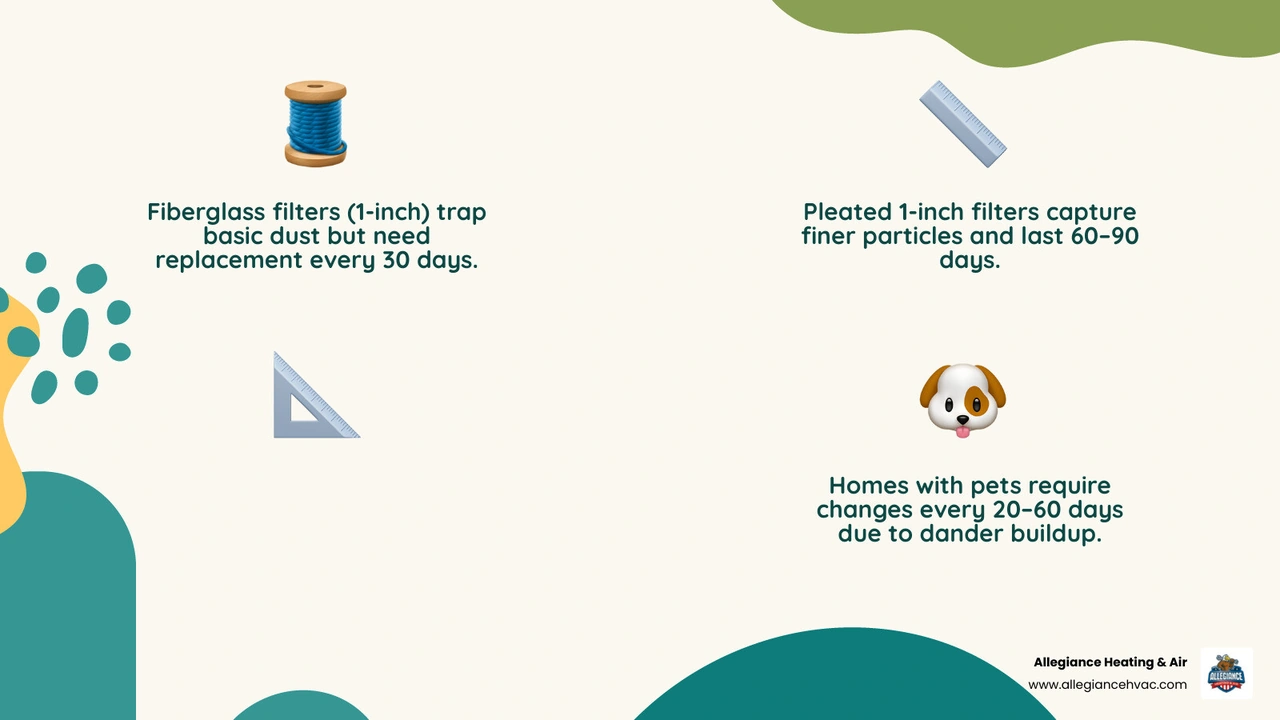
• Fiberglass (1-inch) — Recommended Replacement Frequency: Every 30 days or less
• Pleated (1-inch) — Recommended Replacement Frequency: Every 60–90 days
• Pleated (4-inch media) — Recommended Replacement Frequency: Every 6 months
• High-capacity / specialty — Recommended Replacement Frequency: Up to 12 months
• Homes with pets — Recommended Replacement Frequency: Every 20–60 days depending on number of pets
• Homes with allergies or asthma — Recommended Replacement Frequency: Every 30–60 days
• Vacation homes / low occupancy — Recommended Replacement Frequency: Up to 6 months
The truth is, there's no single right answer for every home. Your filter's lifespan depends on what type of filter you use, how many people and pets live in your home, how often your system runs, and what the air quality is like around your neighborhood. In Indiana, seasonal swings between hot summers and cold winters mean your HVAC system works hard year-round — and your filter takes the hit.
Replacing a clogged filter can improve your system's efficiency by 5–15%, according to the U.S. Department of Energy. That's real money saved on your monthly utility bills, just from a simple swap.
The sections below break down everything you need to know — from filter types and MERV ratings to signs your filter is overdue and how to replace it yourself.
Understanding Filter Types and MERV Ratings
When you walk down the HVAC aisle at a local hardware store in Greenville or New Albany, the variety of filters can be overwhelming. Choosing the right one is about finding the balance between air filtration and system performance.
• Material — Fiberglass Filters: Spun glass fibers — Pleated Filters: Folded synthetic/cotton blend
• Primary Goal — Fiberglass Filters: Protect HVAC components — Pleated Filters: Protect components + improve IAQ
• Lifespan — Fiberglass Filters: 30 days — Pleated Filters: 60–90 days
• Efficiency — Fiberglass Filters: Low (captures large debris only) — Pleated Filters: High (captures dust, pollen, dander)
• Cost — Fiberglass Filters: Budget-friendly — Pleated Filters: Mid-range to premium
Fiberglass Filters
These are the basic, often blue or white, thin filters. Their main job isn't to clean your air; it's to keep large "dust bunnies" from clogging your furnace's motor. Because they have very little surface area, they load up quickly. In a busy Indiana household, these almost always need to be changed every 30 days.
Pleated Filters
Pleated filters use an accordion-style design, which significantly increases the surface area available to trap particles. This design allows them to capture much smaller contaminants like mold spores and pet dander without immediately choking off your system's airflow. While they can last up to 90 days, we often recommend checking them at the 60-day mark if you use your AC or heater daily.
MERV Ratings and Thickness
MERV stands for Minimum Efficiency Reporting Value. Ratings range from 1 to 16 for residential systems:
• MERV 1–4: Basic fiberglass; traps large particles.
• MERV 8–11: The "sweet spot" for most homes, balancing excellent filtration with good airflow.
• MERV 13–16: High-efficiency; used for severe allergies but can strain older blower motors.
The thickness of the filter also matters. A standard 1-inch filter has much less "holding capacity" than a 4-inch media filter. If your system is equipped for a 4-inch filter, you may only need to change it twice a year. If you are debating between a standard upgrade and more advanced options, check out our guide on Whole House Air Purifier vs Upgraded HVAC Filter.
Key Factors: How Often Should You Change Your Air Filter?
The "average" home might change a filter every 90 days, but very few of us live in an average home. Several local factors in Southern Indiana play a role:
• Home Size: Larger homes in areas like Floyds Knobs or Georgetown circulate a massive volume of air. The more air that passes through the filter, the faster it collects debris.
• Occupancy Levels: A house with five people creates more dust, skin cells, and fabric fibers than a house with one person. More people equals more frequent filter swaps.
• Outdoor Air Quality: If you live near a gravel road, a construction site, or in a particularly pollen-heavy area, your filter is working overtime.
• Seasonal Usage: During our humid Indiana summers or freezing winters, your HVAC system runs almost constantly. We recommend monthly checks during these peak seasons. For a deeper dive into seasonal maintenance, see our Spring Air Filter Replacement Complete Guide.
How Often Should You Change Your Air Filter with Pets?
We often joke that pets are the number one "filter killers." Dogs and cats don't just shed fur; they also release dander and track in outdoor allergens. During shedding seasons in the spring and fall, a filter can become "carpeted" in fur in as little as three weeks. If you have multiple pets, you should perform a visual inspection every 20–30 days.
How Often Should You Change Your Air Filter for Allergies?
If anyone in your family suffers from asthma or seasonal allergies, the air filter is your first line of defense. Standard filters may not catch microscopic pollen or dust mites. For these households, we recommend using a higher MERV-rated pleated filter and replacing it every 30 to 45 days to ensure the air remains as crisp and irritant-free as possible. While HEPA filters are the gold standard for hospitals, they can be too restrictive for many residential HVAC units, so always consult with a professional before making that jump.
Signs, Consequences, and Replacement Steps
How do you know if you've waited too long? Your HVAC system usually tries to tell you through a few common symptoms.
Visual Inspection and the Light Test
The easiest way to check is the "light test." Remove your filter and hold it up to a bright light source or a window. If you can't see light passing through the fibers, the filter is clogged with microscopic debris and needs to be replaced immediately. A dirty filter will often look grey or ashy instead of its original white or blue.
Symptoms of a Dirty Filter
• Reduced Airflow: If the air coming out of your vents feels "weak," the filter is likely the bottleneck.
• Dusty Surfaces: If you find yourself dusting your coffee table every two days, your filter is no longer doing its job.
• Musty Odors: Clogged filters can trap moisture and organic matter, leading to a "dirty sock" smell.
• Higher Energy Bills: When the filter is clogged, the blower motor has to work much harder to pull air through, which spikes your electricity usage.
Neglecting your filter can lead to serious mechanical issues, such as frozen evaporator coils or a cracked heat exchanger due to overheating. For more warning signs, read our article on Signs Your Air Filter Needs Replaced.
Step-by-Step Filter Replacement
Replacing your filter is a quick DIY task that usually takes less than five minutes.
1. Turn Off the System: Set your thermostat to "Off" to ensure the fan doesn't kick on while the filter is out.
2. Locate the Filter: This is usually found in a slot next to the furnace/air handler or behind a return air grille in a wall or ceiling.
3. Note the Direction: Look for the "Airflow" arrow on the side of the old filter. It points toward the HVAC unit.
4. Check the Size: Ensure your new filter matches the dimensions (Length x Width x Thickness) printed on the old one.
5. Insert the New Filter: Slide it in with the arrow pointing in the correct direction.
6. Secure and Restart: Close the cover or grille and turn your system back on.
For a more detailed walkthrough, visit our guide on Replacing Your Air Filter.
Comparing Home HVAC and Vehicle Air Filters
While we focus on home comfort, it's worth noting that your vehicles also rely on air filtration. Just like your home HVAC system, your car has two types of filters that need attention.
• Engine Air Filters: These protect your engine from dust and road debris. Most manufacturers recommend a change every 12,000 to 15,000 miles, or roughly once a year. A dirty engine filter can reduce fuel economy and engine performance.
• Cabin Air Filters: This is essentially the "HVAC filter" for your car's interior. It cleans the air you breathe while driving. In dusty areas or during high-pollen seasons in Indiana, these can clog quickly, leading to weak AC flow and musty smells in the cabin.
Just as a clogged home filter strains your blower motor, a clogged cabin filter makes your car's ventilation system work harder. We recommend checking both during your annual vehicle maintenance.
Frequently Asked Questions
Can I wash and reuse a disposable air filter?
Unless the filter is specifically labeled as "washable" or "permanent," the answer is a firm no. Disposable filters are made of paper or specialized fibers that lose their structural integrity when wet. Washing them can lead to mold growth within the filter media and may actually damage your HVAC system by allowing fibers to break loose and enter the motor.
Does a larger home need more frequent filter changes?
Generally, yes. A 3,500-square-foot home in Clarksville or Jeffersonville moves significantly more air than a 1,200-square-foot cottage. Because the volume of air is higher, the filter captures more total debris in the same amount of time. If you have a large home with a single-stage system, consider checking your filter every 30 to 45 days.
What happens if I never change my air filter?
If left long enough, a filter will become almost entirely air-tight. This causes the system to "short cycle" (turning on and off rapidly), which can lead to a total system failure. In the winter, the furnace can overheat and shut down for safety; in the summer, the lack of airflow causes the indoor coils to drop below freezing, turning your AC unit into a block of ice.
Conclusion
At Allegiance Heating & Air, we’ve been "Taking Home Comfort Under Our Wing" since 2005. We know that life in Greenville, IN and the surrounding Southern Indiana communities keeps you busy, and it's easy for air filter maintenance to slip through the cracks. However, staying on top of how often should you change your air filter is the most cost-effective way to ensure your family breathes clean air and your HVAC system lives a long, efficient life.
If you find it hard to remember these dates, or if you want a professional to ensure your entire system is in peak condition, we are here to help. Our trusted technicians serve families from Louisville to Salem and everywhere in between with honest, transparent service.
For total peace of mind and to ensure your system is always ready for the next Indiana season, consider joining our Maintenance Plan. We’ll handle the inspections and tune-ups so you can focus on what matters most. Contact us today to schedule your next service!
Contact Us Or Schedule Expert Service
Other Blogs
ready to transform your home?
Discover our exceptional home services tailored to meet your needs and enhance your living space.
WHAT OUR CLIENTS HAVE TO SAY ABOUT US

We had a complete HVAC system and a hot water heater installed. The guys were professional, well mannered, and completed the work in a timely manner. Would definitely use them again.
I was nervous at first because my AC broke in the middle of 80 degree weather which is strange for April, but Allegiance Heating and Air was incredibly prompt and professional. The technician arrived within an hour, explained the problem clearly, and completed the repair. The technician , Mr. Garrett Moon was a very nice and courteous young man. He found the problem and fixed it within a timely manner. I highly recommend them for any heating or cooling needs. I’ll definitely give them a call again should I ever have another issue, but hopefully not. Knock on wood 😁. Give them a call… you won’t be disappointed!
From the moment I called to schedule a service, the team was quick to respond and arrived right on time. The technician was professional, friendly, and clearly knowledgeable about my heating system. He explained the repair options in plain language and completed the job efficiently. I appreciated the reliable service and the fact that the work was done the same day. I would definitely recommend Allegiance Heating and Air for any residential HVAC needs.
5/5 stars – I was very impressed with the efficient, affordable and timely service from Allegiance Heating and Air. The technician arrived on time, and performed the service quickly, no repairs needed at this time. Communication was clear and the whole experience felt hassle‑free. I would definitely recommend them for any residential HVAC needs.
Knowledgeable, experienced individual.
Explains Allegiance Heating and Air was incredibly reliable, professional and affordable. They arrived right on time, kept the work area clean and finished the furnace repair quickly. The technician explained everything clearly and the price was a great value. If happiness had a location on Google Maps, it would be here.
Gilbert had to go above and beyond because York is no longer making the part for my furnace. But he was able to find a way to construct a housing bracket for my furnace. Ingenuity, determination and integrity is what finally got my furnace fixed. Gilbert is truly a one of a kind technician.
Thank you for always going the extra mile. Gilbert is always respectful and helpful with any concerns.
"Great service, most knowledgeable and capable HVAC business in Kentuckiana!! Pete Flemming and Bryan the owner, are HVAC encyclopedias. They have the highest integrity of any HVAC business I have ever used. Allegiance has put numerous units in for me over the last 17 years. I will continue to use and trust them."
"Fast response from Allegiance when our heat was out on New Year’s day! Service technician was friendly and efficient. He took the time to explain the problem, tell us about the temporary fix and the plan for permanent repair. We were impressed!"
"Love Allegiance! Their technicians, in particular Benjamin, explain everything. Fast and thorough. A/C was out on a Sunday. Called Allegiance and within a few hours Benjamin arrived. Such a comfort as he was the one who last serviced our units. He quickly replaced part and cooling is restored!"
"My heat pump went out and I had to call after hours. The technician (Garrett) was outstanding and thorough. He got my system up and working until Monday and gave me several options of units. Also took the time to explain the issue to my Home warranty company. I highly recommend this company."
"Right on time :) respectful, fast, and polite. Even gave my fur babies some attention."
"Had Garrett out today to fix our AC. Fantastic tech. He showed up exactly when he said he would and kept us informed of what he was checking and what he found. Highly recommend!"
"Lucas with Allegiance showed up on time as promised, was professional and extremely patient and responsive with all my questions. He took care of the issue, and I feel he was trustworthy! He had us back to cool and comfortable on one of the hottest days of the year."
"Lucas did a great job! Very professional and expedient. Explained the process very well and represented Allegiance as a truly professional and reputable company."
"Arrived on time and work diligently to fix issue. These guy are great. Worked quickly to resolve my issues."
"Lucas was great - he spent a lot of time trying to figure out what was going on and explained everything he was doing. I trust Allegiance and wouldn’t want anyone else working on/in my house!!"

RELATED ARTICLES

Home Humidifiers: Key to Comfort and Health in Your Living Space

The A-List: Finding the Best Furnace Repair in Greenville
