
Why Controlling Indoor Humidity with Your HVAC Matters for Your Greenville, IN Home
Learning how to control indoor humidity with your hvac is one of the most practical things you can do for your home's comfort, health, and efficiency. Here's a quick overview of how to do it:
How to Control Indoor Humidity with Your HVAC — Quick Answer:
1. Set your thermostat fan to AUTO (not ON) so the blower only runs during cooling cycles, allowing moisture to drain off the coil.
2. Keep your AC properly sized and maintained — dirty coils, low refrigerant, or an oversized system all reduce moisture removal.
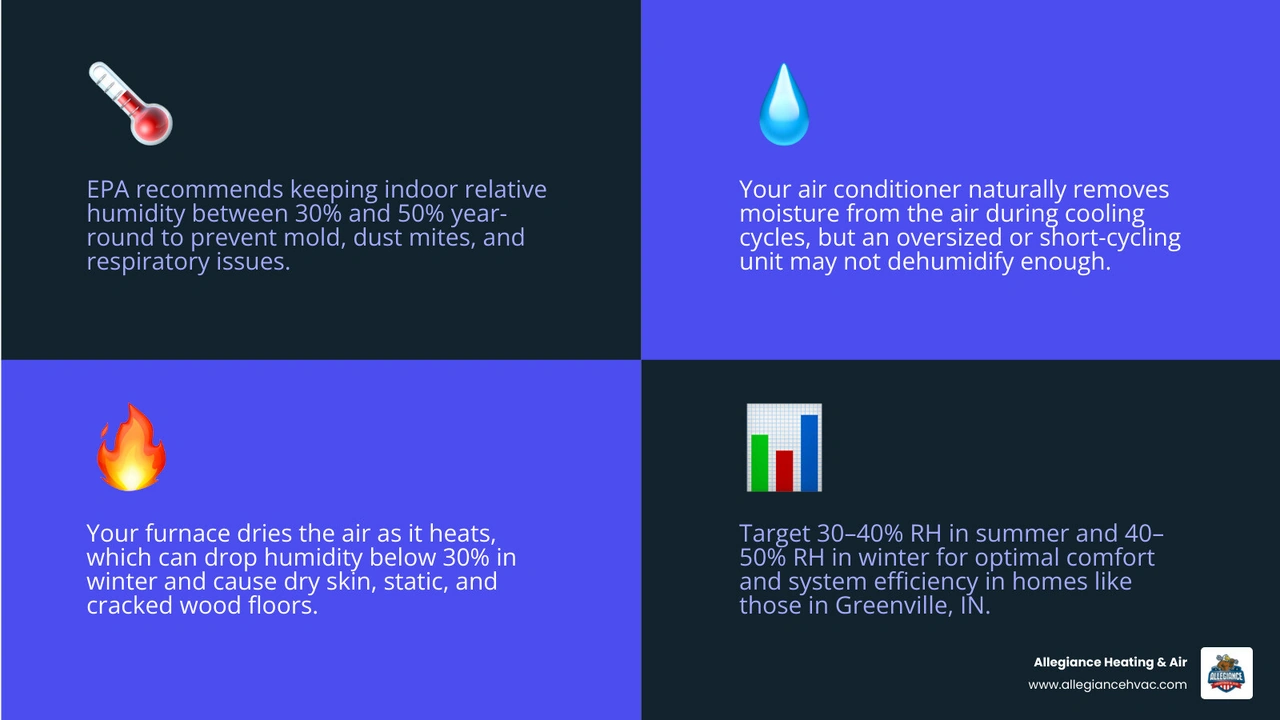
3. Target 30–50% relative humidity year-round (30–40% in summer, 40–50% in winter).
4. Add a whole-house dehumidifier or humidifier when your HVAC alone can't keep up.
5. Seal duct leaks and insulate properly to stop humid outdoor air from sneaking in.
6. Use exhaust fans in kitchens and bathrooms to remove moisture at the source.
7. Monitor with a hygrometer so you always know where your humidity stands.
Most homeowners in Greenville, IN think about their HVAC system in terms of temperature — cool in summer, warm in winter. But humidity is just as important. The EPA recommends keeping indoor relative humidity between 30% and 50% to prevent mold, dust mites, and respiratory issues. Go above 60%, and you're in uncomfortable — and potentially damaging — territory. Go below 30%, and dry air starts causing its own set of problems, from cracked wood floors to irritated sinuses.
Here's the thing: your HVAC system already does some of this work automatically. Your air conditioner removes moisture from the air as a natural byproduct of cooling. Your furnace dries the air out as it heats. But that's often not enough on its own — especially in a well-insulated, energy-efficient home or during mild weather when the system doesn't run long enough to pull out adequate moisture.
In this guide, we'll walk through exactly how your HVAC system manages humidity, what signs point to a problem, and what you can do — from simple thermostat adjustments to whole-house equipment upgrades — to keep your home comfortable all year long.
For a deeper look at how moisture and your system interact, check out our guide on How Humidity Affects Your HVAC and Comfort.
Understanding the Ideal Indoor Humidity Range for Your Home
To keep your home feeling like a sanctuary rather than a swamp or a desert, you need to understand relative humidity (RH). Relative humidity measures how much water vapor is in the air compared to the maximum amount the air can hold at that specific temperature. Because warm air holds more moisture than cold air, a 50% RH reading at 75°F feels very different from 50% RH at 35°F.
When indoor humidity climbs above 60%, health impacts quickly follow. High humidity creates a breeding ground for mold spores, mildew, and dust mites. For individuals with asthma or severe allergies, this can lead to frequent flare-ups and respiratory discomfort. Furthermore, high humidity prevents sweat from evaporating efficiently off your skin, which is why a humid 75°F room can feel like a sweltering 80°F.
On the flip side, when humidity drops below 30%, the air becomes aggressively dry. This environment acts like a sponge, pulling moisture from your skin, eyes, and nasal passages. You might experience itchy skin, sore throats, static shocks, and a higher susceptibility to winter colds.
To keep your home healthy and comfortable, we recommend keeping your humidity within the target ranges outlined below:
• Summer — Ideal Relative Humidity (RH) Range: 30% - 40% — Primary Comfort & Health Goals: Prevent mold growth, reduce "sticky" air feeling, and lower cooling costs.
• Winter — Ideal Relative Humidity (RH) Range: 40% - 50% — Primary Comfort & Health Goals: Prevent dry skin, stop static electricity, and protect wood floors from cracking.
• Extreme Cold (Winter) — Ideal Relative Humidity (RH) Range: 30% - 35% — Primary Comfort & Health Goals: Prevent condensation and frost buildup on window panes.
By maintaining these balanced levels, you can actually set your thermostat 2 to 3 degrees higher in the summer and lower in the winter without sacrificing comfort. This small adjustment can lead to noticeable savings on your monthly energy bills.
To explore more about setting the right targets for your home, take a look at our article on the Best Humidity Levels for Your Home.
How to Control Indoor Humidity with Your HVAC System Naturally
Before investing in supplemental equipment, it helps to understand how your standard heating and cooling systems naturally alter indoor humidity levels.
Your air conditioner is actually a highly effective dehumidifier. As your AC runs, the indoor blower draws warm, humid air from your living spaces and passes it over the freezing-cold evaporator coil. When this warm air hits the cold metal surface, it reaches its dew point. Moisture in the air condenses onto the coil—much like water droplets forming on a cold glass of iced tea on a hot July afternoon. This water drips down into a condensate pan and flows out of your home through a drain line.
In contrast, your heating system does not actively remove water from the air, but the heating cycle fundamentally changes how dry the air feels. When cold outdoor air leaks into your home during winter, your furnace heats it up. Heating this cold air dramatically increases its moisture-holding capacity. As a result, the relative humidity inside your home plummets, often dropping below 20% if left unmanaged.
To learn more about how seasonal weather patterns impact your system's operation, read our guide on How Weather Affects Your HVAC Unit.
How to Control Indoor Humidity with Your HVAC During Humid Summers
In hot-humid climates, your air conditioner must handle two types of heat: sensible heat (the actual temperature you read on a thermometer) and latent heat (the heat stored in airborne moisture).
For your air conditioner to remove latent heat effectively, it needs to run for long, steady cycles. When an AC system is properly sized, it will run long enough to thoroughly cool the evaporator coil, condense moisture, and drain it away. However, if your system is oversized, it will cool your home too quickly and shut off. This is known as "short-cycling." While your home might reach the target temperature, the system won't run long enough to pull moisture out of the air, leaving you with a cold, clammy, and sticky indoor environment.
For further tips on managing summer moisture, read our post on Optimizing Indoor Air Quality During Summer.
How to Control Indoor Humidity with Your HVAC During Dry Winters
In the winter, the challenge flips completely. Heating systems naturally dry out your indoor environment. As the furnace runs, the relative humidity falls, leading to dry nasal passages, static electricity shocks, and even gaps opening up between your hardwood floorboards.
To combat this, your HVAC system needs assistance. While natural methods like air-drying laundry or keeping houseplants can help slightly, they rarely provide enough moisture to offset a powerful central heating system. This is where whole-home humidification becomes essential to restore comfort.
If you are currently dealing with dry winter air, read our helpful tips on Dealing with Dry Air.
Recognizing the Signs of a Home Humidity Problem
How do you know if your home has a humidity imbalance? Your house and your body will always drop hints.
If you have a high humidity problem, you might notice:
• Condensation on windows: Water droplets or fog pooling on the glass inside your home.
• Musty odors: A damp, earthy smell in closets, basements, or crawlspaces.
• Warping wood: Wood floors that cup or bow, and interior doors that suddenly stick in their frames.
• Clammy skin: Feeling hot and sticky even when the thermostat says the room is cool.
• Visible mold or mildew: Dark spots appearing on bathroom ceilings, drywall, or window sills.
If you have a low humidity problem, the signs include:
• Physical irritation: Dry, itchy skin, chapped lips, frequent nosebleeds, and waking up with a scratchy throat.
• Static electricity: Constant static shocks when touching door knobs or petting family pets.
• Cracking materials: Gaps forming between hardwood floor planks, cracking crown molding, or peeling paint.
Paying attention to these warning signs can save you from costly structural repairs and health issues down the road. For more information on why keeping these levels in check is so vital, read about the Proper Humidity Control Importance.
Why Energy-Efficient Homes Require Supplemental Humidity Control
You might assume that a brand-new, highly energy-efficient home would have perfect humidity control. Surprisingly, the opposite is often true.
Modern homes are built with incredibly tight building envelopes. They feature advanced insulation, high-performance windows, and thorough air sealing. While this is fantastic for reducing your utility bills, it dramatically lowers the home's "sensible cooling load." Because heat cannot easily penetrate the walls, your air conditioner doesn't need to run very long to lower the indoor temperature.
However, your home's "latent load" (the moisture level) remains exactly the same. An average household of four generates roughly 25 pounds of moisture every single day just from normal activities like breathing, showering, and cooking.
Because the highly efficient AC system cools the home so quickly and shuts off, it doesn't run long enough to remove this daily moisture load. This mismatch leaves the air inside high-performance homes feeling humid and heavy. To maintain a healthy environment, these homes almost always require supplemental dehumidification and controlled mechanical ventilation to manage moisture without overcooling.
To learn more about the unique air quality challenges of modern homes, check out our guide on Improving Indoor Air Quality.
Supplemental Equipment Options for Whole-House Moisture Management
When your standard HVAC system cannot keep up with seasonal moisture demands, supplemental whole-home solutions are the most reliable and energy-efficient answer. Unlike noisy, high-maintenance portable units that only treat a single room, whole-house systems integrate directly with your ductwork to manage air quality throughout your entire home.
Whole-House Dehumidifiers
These systems are installed directly into your HVAC system's return ductwork. They pull in humid air, remove the moisture via a dedicated refrigeration cycle, and deliver dry, comfortable air back into your living spaces. They can remove up to 90 pints or more of water per day and drain automatically, meaning you never have to empty a plastic bucket.
Bypass Humidifiers
These units are installed between the supply and return plenums of your furnace. They divert a portion of the warm air coming out of your furnace through a water-saturated evaporative pad, naturally adding moisture to the air stream before it circulates through your home.
Fan-Powered Humidifiers
Similar to bypass systems, these units include an internal fan that actively pushes warm air through the humidification pad. This makes them highly efficient and ideal for homes without a basement or those with limited duct space.
Steam Humidifiers
The gold standard of humidification, these systems heat water electrically to create pure steam, which is then injected directly into your supply ducts. Steam humidifiers can add up to 34 gallons of moisture per day and operate independently of whether your heating system is actively running.
For a complete breakdown of year-round air quality upgrades, read our article on Solutions for Improving IAQ Year-Round.
Sizing and Integrating Systems with Your Existing Ductwork
Installing whole-house humidity equipment is not a one-size-fits-all project. Proper sizing requires an HVAC professional to perform a Manual J load calculation to determine your home's exact sensible and latent cooling loads.
Integrating a dehumidifier or humidifier involves connecting the equipment to either your supply plenum (the ductwork that distributes conditioned air) or your return plenum (the ductwork that pulls air back to the system). If the system is sized incorrectly or installed poorly, you risk restricted airflow, frozen coils, or water leaks inside your ductwork.
If you live in the Clarksville area and want to explore professional solutions, visit our Whole House Dehumidification Clarksville IN service page.
Thermostat Settings and HVAC Best Practices for Humidity Control
You can significantly improve your HVAC system's dehumidification performance simply by adjusting your thermostat and system settings.
• Set your fan to AUTO, not ON: This is the single most important setting for summer humidity control. When you set the fan to "ON," the blower fan runs continuously, even when the outdoor compressor cycles off. This blows warm air over the wet indoor evaporator coil, re-evaporating all the water that just condensed back into your home. Leaving the fan on "AUTO" ensures the blower stops when the cooling cycle ends, allowing the water to drain safely away.
• Utilize smart thermostats: Many modern smart thermostats feature built-in humidistats. They can monitor relative humidity in real time and can be configured to keep your AC running at a lower fan speed if the humidity rises above your set point, even if the target temperature has already been reached.
• Invest in variable-speed systems: Traditional single-stage HVAC systems run at 100% capacity or not at all. Variable-capacity systems, however, can run at lower speeds for longer periods. This continuous, low-speed operation is incredibly efficient and provides unmatched dehumidification because air is constantly passing over the cold coils.
To learn more about how temperature swings and system settings affect your comfort, read our guide on How Humidity and Temperature Swings Affect Your HVAC.
The Role of Ventilation, Duct Sealing, and Insulation
Controlling humidity isn't just about your HVAC equipment; it's also about your home's building envelope.
• Mechanical Ventilation: Using exhaust fans in your kitchen and bathrooms removes high concentrations of moisture right at the source before it can spread through your home.
• Duct Sealing: Leaky return ducts in unconditioned attics or crawlspaces can pull hot, humid air into your system, forcing your air conditioner to work twice as hard to dehumidify.
• Attic Insulation: Proper insulation keeps your attic heat from radiating down into your home, helping to maintain stable indoor temperatures and reducing the load on your AC.
For more information on sealing and insulating for clean air, read our guide on Enhancing Indoor Air Quality.
Frequently Asked Questions About HVAC Humidity Control
Why is my house still humid when the AC is running?
There are several common culprits behind this issue. Your AC system might be oversized, causing it to short-cycle and turn off before it can remove moisture. Alternatively, you might have dirty evaporator coils, low refrigerant levels, or leaky ductwork pulling in humid air from your crawlspace. Finally, ensure your thermostat fan is set to AUTO rather than ON to prevent moisture from re-evaporating into your home.
Can a smart thermostat automatically control my home's humidity?
Yes, if it is paired with the right equipment. Many smart thermostats feature a built-in humidistat that allows you to set a target humidity percentage (such as 45%). If your home has a whole-house humidifier or dehumidifier, the thermostat will cycle those systems on and off automatically. Even without supplemental equipment, some smart thermostats can command your AC to run on a lower fan speed to prioritize moisture removal.
How often does a whole-house humidifier or dehumidifier need maintenance?
To keep your systems running efficiently, you should perform maintenance at least once a year. For humidifiers, this involves replacing the evaporative pad (or canister) at the start of the heating season and cleaning out any mineral scale. For dehumidifiers, you should clean or replace the air filter every 3 to 6 months and inspect the condensate drain line annually to prevent clogs.
To learn more about the benefits of keeping these systems maintained, check out our article on How Whole Home Humidifiers Help Homes.
Conclusion
Understanding how to control indoor humidity with your hvac is the key to enjoying a healthy, comfortable, and energy-efficient home all year long. While simple changes like switching your fan to AUTO and running bathroom exhaust fans can help, persistent humidity issues often require professional expertise.
At Allegiance Heating & Air, LLC, we have been "Taking Home Comfort Under Our Wing" since 2005. As a family-owned business serving Greenville, IN, and surrounding southern Indiana communities, we are committed to providing honest, reliable, and expert service. Whether you need your current AC inspected, ductwork sealed, or a whole-house dehumidifier installed, our licensed and insured technicians are here to help.
Ready to transform your indoor comfort? Explore our Indoor Air Quality Greenville IN services, or contact us today to learn more about our Whole-House Dehumidification Services. Let us help you find the perfect balance for your home!
Contact Us Or Schedule Expert Service
Other Blogs
ready to transform your home?
Discover our exceptional home services tailored to meet your needs and enhance your living space.
WHAT OUR CLIENTS HAVE TO SAY ABOUT US

We had a complete HVAC system and a hot water heater installed. The guys were professional, well mannered, and completed the work in a timely manner. Would definitely use them again.
I was nervous at first because my AC broke in the middle of 80 degree weather which is strange for April, but Allegiance Heating and Air was incredibly prompt and professional. The technician arrived within an hour, explained the problem clearly, and completed the repair. The technician , Mr. Garrett Moon was a very nice and courteous young man. He found the problem and fixed it within a timely manner. I highly recommend them for any heating or cooling needs. I’ll definitely give them a call again should I ever have another issue, but hopefully not. Knock on wood 😁. Give them a call… you won’t be disappointed!
From the moment I called to schedule a service, the team was quick to respond and arrived right on time. The technician was professional, friendly, and clearly knowledgeable about my heating system. He explained the repair options in plain language and completed the job efficiently. I appreciated the reliable service and the fact that the work was done the same day. I would definitely recommend Allegiance Heating and Air for any residential HVAC needs.
5/5 stars – I was very impressed with the efficient, affordable and timely service from Allegiance Heating and Air. The technician arrived on time, and performed the service quickly, no repairs needed at this time. Communication was clear and the whole experience felt hassle‑free. I would definitely recommend them for any residential HVAC needs.
Knowledgeable, experienced individual.
Explains Allegiance Heating and Air was incredibly reliable, professional and affordable. They arrived right on time, kept the work area clean and finished the furnace repair quickly. The technician explained everything clearly and the price was a great value. If happiness had a location on Google Maps, it would be here.
Gilbert had to go above and beyond because York is no longer making the part for my furnace. But he was able to find a way to construct a housing bracket for my furnace. Ingenuity, determination and integrity is what finally got my furnace fixed. Gilbert is truly a one of a kind technician.
Thank you for always going the extra mile. Gilbert is always respectful and helpful with any concerns.
"Great service, most knowledgeable and capable HVAC business in Kentuckiana!! Pete Flemming and Bryan the owner, are HVAC encyclopedias. They have the highest integrity of any HVAC business I have ever used. Allegiance has put numerous units in for me over the last 17 years. I will continue to use and trust them."
"Fast response from Allegiance when our heat was out on New Year’s day! Service technician was friendly and efficient. He took the time to explain the problem, tell us about the temporary fix and the plan for permanent repair. We were impressed!"
"Love Allegiance! Their technicians, in particular Benjamin, explain everything. Fast and thorough. A/C was out on a Sunday. Called Allegiance and within a few hours Benjamin arrived. Such a comfort as he was the one who last serviced our units. He quickly replaced part and cooling is restored!"
"My heat pump went out and I had to call after hours. The technician (Garrett) was outstanding and thorough. He got my system up and working until Monday and gave me several options of units. Also took the time to explain the issue to my Home warranty company. I highly recommend this company."
"Right on time :) respectful, fast, and polite. Even gave my fur babies some attention."
"Had Garrett out today to fix our AC. Fantastic tech. He showed up exactly when he said he would and kept us informed of what he was checking and what he found. Highly recommend!"
"Lucas with Allegiance showed up on time as promised, was professional and extremely patient and responsive with all my questions. He took care of the issue, and I feel he was trustworthy! He had us back to cool and comfortable on one of the hottest days of the year."
"Lucas did a great job! Very professional and expedient. Explained the process very well and represented Allegiance as a truly professional and reputable company."
"Arrived on time and work diligently to fix issue. These guy are great. Worked quickly to resolve my issues."
"Lucas was great - he spent a lot of time trying to figure out what was going on and explained everything he was doing. I trust Allegiance and wouldn’t want anyone else working on/in my house!!"

RELATED ARTICLES
Don't Get Left in the Cold: Finding Top Furnace Installers in Greenville, IN

Investigating the Electrical Burning Smell When Your Air Conditioner Kicks On