Why Humidity and Temperature Swings Are Harder on Your HVAC Than You Think
How humidity and temperature swings affect your HVAC comes down to a few key mechanisms working against your system at the same time:
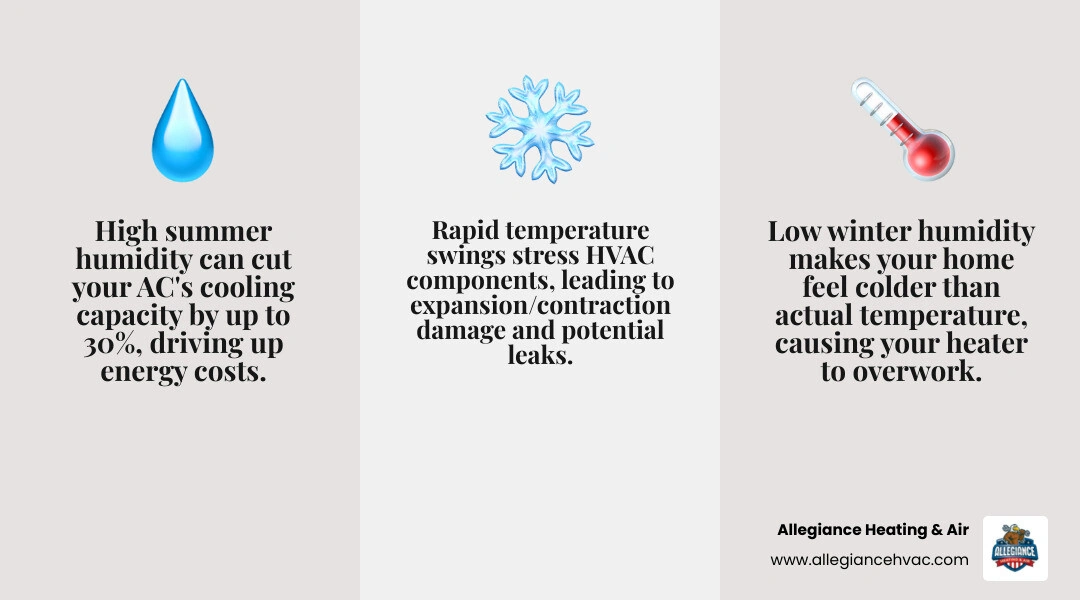
• High summer humidity forces your AC to remove moisture and heat, which can cut cooling capacity by up to 30% and drive up energy bills
• Low winter humidity makes your home feel colder than it actually is, pushing your heating system to work harder and wear out faster
• Rapid temperature swings cause metal components to expand and contract repeatedly, leading to cracked heat exchangers, loose connections, and refrigerant leaks
• Short cycling from oversized or stressed systems means humidity never gets fully removed, leaving your home feeling clammy even when the thermostat reads a comfortable number
• Mode switching — heating in the morning, cooling by afternoon — can increase energy use by 15–25% compared to steady operation
If you live in Greenville, IN, or anywhere in the Ohio Valley, you already know the weather rarely stays predictable. Summers bring thick, muggy air that makes your AC fight twice as hard. Winters can be dry and bitter, stressing your heating system in a different but equally damaging way. And in spring and fall, temperatures can swing 40–50 degrees in a single day, putting every component in your HVAC system under strain it was never designed to handle constantly.
Understanding how these conditions affect your system is the first step to protecting your comfort, your equipment, and your monthly energy bill.
Understanding How Humidity and Temperature Swings Affect Your HVAC

When we talk about home comfort, we usually focus on the number on the thermostat. But that number only tells half the story. The other half is moisture. In the HVAC world, we distinguish between "sensible heat" (the temperature you can feel and measure with a thermometer) and "latent heat" (the energy required to remove moisture from the air).
How humidity and temperature swings affect your HVAC is largely a battle of physics. To turn water vapor into liquid so it can be drained away, your air conditioner has to work incredibly hard. In fact, it takes approximately 1,050 BTUs of energy just to condense one single pound of moisture from the air. This is known as the latent heat of condensation. When the humidity in Greenville climbs, your AC spends a massive portion of its cooling capacity just "drying" the air before it can even begin to lower the temperature.
This is why Proper Humidity Control Importance cannot be overstated. If your system is struggling with high humidity, it isn’t just a comfort issue; it’s a workload issue. The more moisture in the air, the longer your system has to run to achieve the same perceived level of comfort. We often see How Weather Affects Your Hvac Unit manifest as a system that runs for hours without ever reaching the setpoint, simply because the latent heat load is too high for the unit to keep up with.
The Impact of High Summer Humidity on Cooling Efficiency
In southern Indiana, summer humidity is a constant companion. When the relative humidity outside climbs into the 70s or 80s, your air conditioner’s capacity can decrease by as much as 30%. This happens because the evaporator coil becomes so overwhelmed with condensing water that it can’t effectively absorb heat from the air passing over it.
This excess moisture doesn't just make you feel sticky; it creates a breeding ground for biological growth. High indoor humidity (anything consistently above 60%) promotes mold growth within your ductwork and on the AC coils. This significantly degrades your indoor air quality and can lead to musty odors that linger no matter how much you clean.
To combat this, many homeowners in our area are looking into Wholehouse Dehumidification Clarksville In or Whole House Dehumidification Jeffersonville In. By integrating a dehumidifier directly into your HVAC system, you allow the AC to focus on sensible cooling (lowering the temp) while the dehumidifier handles the latent load. This is a key strategy for Optimizing Indoor Air Quality During Summer.
Why high humidity and temperature swings affect your HVAC run times
You might think a bigger AC unit would solve the humidity problem, but the opposite is often true. This is one of the most common mistakes we see. An oversized unit will cool the house down so quickly that it "short cycles"—it turns off before it has had a chance to remove moisture.
It takes about 30 minutes of continuous operation for an AC coil to get cold and wet enough to start effectively draining water. If your unit only runs for 10 or 15 minutes because it’s too powerful for the space, the moisture stays in the air (or re-evaporates off the coil back into the house). This leads to energy consumption spikes and a home that feels like a cold, damp cave. Proper Whole House Air Filtration Sellersburg In can help keep those coils clean, ensuring they can condense moisture as efficiently as possible during those necessary long run times.
Winter Challenges: Low Humidity and Heating Performance
While summer is about too much moisture, winter in the Louisville area brings the opposite problem. As the temperature drops, the air’s ability to hold moisture plummets. When we pull that dry outdoor air into our homes and heat it up, the relative humidity can drop below 20%. For context, that’s drier than some parts of the Sahara Desert!
Low humidity causes a host of issues for your HVAC system and your home. Dealing With Dry Air is essential because dry air acts like a sponge, pulling moisture out of everything—including your skin and the wood in your home. This makes you feel much colder than you actually are. When you feel chilly, what’s the first thing you do? You turn up the thermostat. This forces your furnace to run more often, increasing wear and tear and your monthly bills.
Furthermore, extremely dry air can make rubber seals and gaskets within your HVAC system brittle. Over time, these components can crack or fail prematurely, leading to leaks or mechanical breakdowns. This is why Home Humidifiers Key To Comfort are so popular in our region. Learning How Whole Home Humidifiers Help Homes reveals that by adding just a bit of moisture back into the air, you can feel comfortable at 68 degrees instead of needing to crank the heat to 72.
Managing how humidity and temperature swings affect your HVAC in winter
To protect your system and your health, we recommend whole-home solutions. We provide specialized installations like Whole Home Humidifiers Clarksville In, Whole Home Humidifiers Jeffersonville In, and Whole Home Humidifiers Sellersburg In.
These systems ensure that Humidifiers Improve Sellersburg Comfort by maintaining a steady humidity level between 30% and 50%. This range is the "sweet spot" that prevents the air from feeling bone-dry while also protecting your furnace's heat exchanger from the stress of constant over-operation. When humidity stays below that 20% threshold, the static electricity buildup isn't just an annoyance for your cat—it can actually damage the sensitive electronic controls inside your modern HVAC unit.
Mechanical Wear: How Rapid Fluctuations Stress Components
In Indiana, we often experience "shoulder seasons" where it's 35 degrees at 6:00 AM and 75 degrees by 3:00 PM. These rapid temperature swings are arguably the hardest conditions for an HVAC system to endure.
The primary issue here is thermal cycling. Your HVAC system is made of various metals—steel heat exchangers, copper refrigerant lines, and aluminum fins. Every time your system turns on to heat or cool, these metals expand and contract. Rapid swings force the system to switch modes frequently, which is like bending a paperclip back and forth. Eventually, that stress can lead to microscopic cracks in the heat exchanger. A cracked heat exchanger is a serious safety risk, as it can allow carbon monoxide to leak into your home’s air stream.
Frequent mode-switching also puts immense strain on:
• The Compressor: The "heart" of your AC unit doesn't like starting and stopping repeatedly.
• Electrical Capacitors: These components provide the "jolt" needed to start motors. Frequent cycling wears them out faster.
• Refrigerant Lines: Pressure changes during rapid cycling can stress joints and valves, eventually leading to leaks.
Maintaining high-quality Whole House Air Filtration Jeffersonville In ensures that while your system deals with these mechanical stresses, it isn't also fighting restricted airflow from dust and debris.
Proactive Maintenance and System Upgrades for Indiana Weather
Managing how humidity and temperature swings affect your HVAC requires a combination of smart technology and consistent care. If you are still using an old-fashioned, single-stage HVAC system, you are likely feeling the brunt of these weather swings. Modern variable-speed systems are designed specifically to handle these fluctuations by running at lower, more consistent speeds rather than just "blasting" on and off.
• Humidity Control — Single-Stage System: Poor (Short cycles leave air damp) — Variable-Speed System: Excellent (Longer, slower runs remove more moisture)
• Energy Efficiency — Single-Stage System: Lower (Uses max power every time it starts) — Variable-Speed System: Higher (Adjusts power to match the exact need)
• Temperature Stability — Single-Stage System: Swings of 2-4 degrees — Variable-Speed System: Stays within 0.5 degrees of setpoint
• Mechanical Wear — Single-Stage System: High (Frequent on/off cycles) — Variable-Speed System: Low (Runs continuously at lower speeds)
Finding the Best Humidity Levels For Your Home is much easier with a smart thermostat. These devices can monitor outdoor trends and adjust your indoor settings before the temperature swing even hits. Furthermore, ensuring your home has proper insulation and air sealing prevents that humid Greenville air from "leaking" into your home in the first place, reducing the load on your AC.
Finally, never skip your seasonal tune-up. A professional technician can tighten electrical connections loosened by thermal expansion and check your refrigerant pressures to ensure the system is ready for the upcoming humidity. Keeping up with Whole House Air Filtration Sellersburg In is another simple step you can take to keep the air moving freely.
Frequently Asked Questions about HVAC Weather Stress
What are the signs that humidity is stressing my AC?
If your home feels "clammy" or "sticky" even when the air coming out of the vents is cold, your humidity levels are likely too high. Other red flags include musty odors (a sign of mold or mildew growth), foggy windows, or a system that cycles on and off every few minutes. These symptoms mean your unit isn't running long enough to perform its dehumidification duties. This is why Proper Humidity Control Importance is a top priority for indoor comfort.
How do temperature swings increase my energy bill?
Every time your system has to "recover" from a large temperature gap, it uses a surge of energy. If you are switching from heat to cool in the same day, your system is working to counteract the thermal mass of your home (the heat stored in your walls and furniture). This can increase your consumption by 15-25% compared to a day where the temperature stays steady. We often see this in How Weather Affects Your Hvac Unit reports during the spring and fall months in Indiana.
Should I use a whole-home humidifier or a portable unit?
While portable units can help a single room, they are often difficult to maintain and can lead to localized mold issues if not cleaned daily. A whole-home system integrates directly into your ductwork, providing consistent moisture levels throughout the entire house with much less maintenance. Understanding How Whole Home Humidifiers Help Homes shows they are the most efficient way to protect your woodwork, your health, and your HVAC components from the ravages of dry winter air.
Conclusion
At Allegiance Heating & Air, LLC, we’ve been "Taking Home Comfort Under Our Wing" since 2005. Being a family-owned business in Greenville, IN, we know exactly what the Ohio Valley climate can do to a heating and cooling system. From the muggy July afternoons in Jeffersonville to the dry, freezing January nights in Sellersburg, your HVAC system is under constant pressure.
Don't wait for a total system failure during a major temperature swing to give your unit the attention it needs. Whether you need a seasonal tune-up, a whole-home dehumidifier installation, or an upgrade to a high-efficiency variable-speed system, our professional technicians are here to help.
Protect your home with advanced climate control systems and ensure your family stays comfortable regardless of what the Indiana weather decides to do tomorrow. Give us a call today to schedule your comprehensive system evaluation!
Contact Us Or Schedule Expert Service
Other Blogs
ready to transform your home?
Discover our exceptional home services tailored to meet your needs and enhance your living space.
WHAT OUR CLIENTS HAVE TO SAY ABOUT US

We had a complete HVAC system and a hot water heater installed. The guys were professional, well mannered, and completed the work in a timely manner. Would definitely use them again.
I was nervous at first because my AC broke in the middle of 80 degree weather which is strange for April, but Allegiance Heating and Air was incredibly prompt and professional. The technician arrived within an hour, explained the problem clearly, and completed the repair. The technician , Mr. Garrett Moon was a very nice and courteous young man. He found the problem and fixed it within a timely manner. I highly recommend them for any heating or cooling needs. I’ll definitely give them a call again should I ever have another issue, but hopefully not. Knock on wood 😁. Give them a call… you won’t be disappointed!
From the moment I called to schedule a service, the team was quick to respond and arrived right on time. The technician was professional, friendly, and clearly knowledgeable about my heating system. He explained the repair options in plain language and completed the job efficiently. I appreciated the reliable service and the fact that the work was done the same day. I would definitely recommend Allegiance Heating and Air for any residential HVAC needs.
5/5 stars – I was very impressed with the efficient, affordable and timely service from Allegiance Heating and Air. The technician arrived on time, and performed the service quickly, no repairs needed at this time. Communication was clear and the whole experience felt hassle‑free. I would definitely recommend them for any residential HVAC needs.
Knowledgeable, experienced individual.
Explains Allegiance Heating and Air was incredibly reliable, professional and affordable. They arrived right on time, kept the work area clean and finished the furnace repair quickly. The technician explained everything clearly and the price was a great value. If happiness had a location on Google Maps, it would be here.
Gilbert had to go above and beyond because York is no longer making the part for my furnace. But he was able to find a way to construct a housing bracket for my furnace. Ingenuity, determination and integrity is what finally got my furnace fixed. Gilbert is truly a one of a kind technician.
Thank you for always going the extra mile. Gilbert is always respectful and helpful with any concerns.
"Great service, most knowledgeable and capable HVAC business in Kentuckiana!! Pete Flemming and Bryan the owner, are HVAC encyclopedias. They have the highest integrity of any HVAC business I have ever used. Allegiance has put numerous units in for me over the last 17 years. I will continue to use and trust them."
"Fast response from Allegiance when our heat was out on New Year’s day! Service technician was friendly and efficient. He took the time to explain the problem, tell us about the temporary fix and the plan for permanent repair. We were impressed!"
"Love Allegiance! Their technicians, in particular Benjamin, explain everything. Fast and thorough. A/C was out on a Sunday. Called Allegiance and within a few hours Benjamin arrived. Such a comfort as he was the one who last serviced our units. He quickly replaced part and cooling is restored!"
"My heat pump went out and I had to call after hours. The technician (Garrett) was outstanding and thorough. He got my system up and working until Monday and gave me several options of units. Also took the time to explain the issue to my Home warranty company. I highly recommend this company."
"Right on time :) respectful, fast, and polite. Even gave my fur babies some attention."
"Had Garrett out today to fix our AC. Fantastic tech. He showed up exactly when he said he would and kept us informed of what he was checking and what he found. Highly recommend!"
"Lucas with Allegiance showed up on time as promised, was professional and extremely patient and responsive with all my questions. He took care of the issue, and I feel he was trustworthy! He had us back to cool and comfortable on one of the hottest days of the year."
"Lucas did a great job! Very professional and expedient. Explained the process very well and represented Allegiance as a truly professional and reputable company."
"Arrived on time and work diligently to fix issue. These guy are great. Worked quickly to resolve my issues."
"Lucas was great - he spent a lot of time trying to figure out what was going on and explained everything he was doing. I trust Allegiance and wouldn’t want anyone else working on/in my house!!"

RELATED ARTICLES
Everything You Need to Know About Your Spring AC Tune Up

The Complete Guide to How Air Purifiers and Filtration Systems Work