



What "Single Stage vs Variable Speed AC Explained" Actually Means for Your Home Comfort
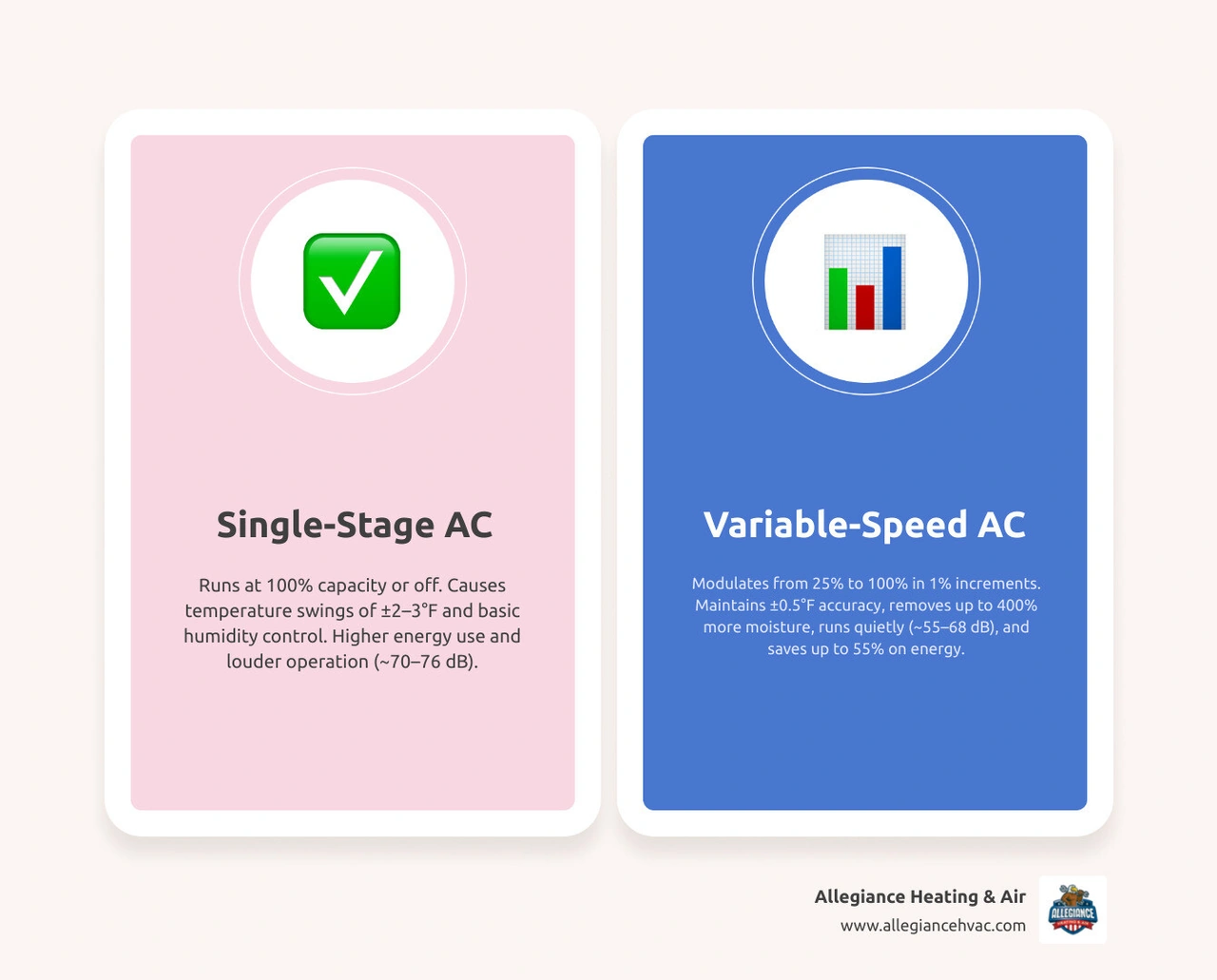
If you've been trying to get single stage vs variable speed AC explained in plain terms, here's the short answer: a single-stage AC runs at full power or shuts off completely, while a variable-speed AC adjusts its output continuously — anywhere from 25% to 100% capacity — to match exactly what your home needs at any given moment.
Quick Comparison:
| Feature | Single-Stage | Two-Stage | Variable-Speed |
|---|---|---|---|
| Capacity settings | 100% or off | ~65% or 100% | 25% to 100% (1% increments) |
| Temperature accuracy | ±2–3°F swings | ±1–2°F swings | ±0.5°F |
| Humidity control | Basic | Better | Best |
| Energy efficiency | Lowest (13–15 SEER2) | Mid (15–18 SEER2) | Highest (18–22+ SEER2) |
| Noise levels | Loudest (~70–76 dB) | Moderate (~65–72 dB) | Quietest (~55–68 dB) |
| Upfront cost | Lowest | Mid-range | Highest |
| Long-term savings | Least | Moderate | Most (up to 55%) |
For homeowners in Greenville, IN and the surrounding southern Indiana area, choosing between these systems is one of the most important decisions you'll make when replacing your AC — it directly affects how comfortable your home feels, how high your energy bills run, and how long the equipment lasts.
The difference comes down to how the compressor works. Think of a single-stage system like a light switch — it's either fully on or fully off. A variable-speed system is more like a dimmer, constantly fine-tuning to hit the right level. That one distinction ripples out into real differences in comfort, humidity, noise, and operating costs that you'll live with every day for the next 15 to 20 years.
In this guide, we'll walk through how each system works, what those differences mean in practice, and how to figure out which one makes the most sense for your home and budget.
Single Stage vs Variable Speed AC Explained: How Compressor Technology Works
To truly understand how these systems differ, we have to look inside the outdoor metal cabinet at the heart of the air conditioner: the compressor. The compressor is responsible for pumping refrigerant through your system, which absorbs heat from inside your home and releases it outdoors. How that compressor operates dictates your entire cooling experience.
Single-Stage AC: The Binary Workhorse
For decades, single-stage technology was the industry standard. It operates on a simple, binary on/off cycle. When your indoor temperature rises above your thermostat's set point, the system gets a signal to turn on. The compressor immediately jumps to 100% capacity, blasting cold air into your home at maximum speed. Once the thermostat registers that the target temperature has been reached, the system shuts completely off.
Because it only has one speed (full blast), a single-stage system has to cycle on and off frequently throughout the day. This is known as on/off cycling. During a typical southern Indiana summer day in places like New Albany or Clarksville, this means your system will turn on, run for 10 to 15 minutes, shut off, and then repeat the process a short while later. This constant starting and stopping is not only hard on the mechanical components, but it also leads to noticeable temperature swings as the house warms up between cycles.
Variable-Speed AC: The Smart Modulator
Variable-speed systems utilize advanced inverter technology to modulate the compressor’s output. Instead of being limited to 0% or 100%, a variable-speed compressor can operate anywhere from 25% to 100% capacity, adjusting its output in precise 1% increments.
When a variable-speed system turns on, it calculates exactly how much cooling is required to maintain your set temperature. On a mild June morning in Floyds Knobs, it might run at just 30% capacity. It will run almost continuously at this ultra-low, highly efficient speed, gently circulating cool air and making micro-adjustments as outdoor temperatures climb. By running for longer periods at lower speeds, it avoids the energy-intensive startup cycles that single-stage units rely on, keeping your indoor environment incredibly stable.
However, even the most advanced compressor can't do its job properly if the system isn't paired with the correct ductwork and home footprint. To ensure you get the maximum benefit from either technology, work with an experienced team that understands How to Choose the Right Size HVAC for Your Home.
The Two-Stage AC Middle Ground
For many homeowners, choosing between a basic single-stage system and a premium variable-speed system can feel like a massive leap. Fortunately, there is a middle ground: the two-stage air conditioner.
A two-stage system features a compressor that can operate at two distinct levels:
- Low Stage (roughly 65% capacity): The system runs at this lower capacity for the vast majority of the cooling season (often up to 80% of the time). This allows for longer, quieter, and more energy-efficient cycles on mild days.
- High Stage (100% capacity): When the summer heat peaks in July and August across Jeffersonville or Louisville, the system automatically steps up to full capacity to meet the heavy cooling load.
By spending most of its time in the low stage, a two-stage system provides significantly better temperature consistency and moisture control than a single-stage unit, without the higher upfront investment of a fully modulating variable-speed system. It represents an excellent compromise for families seeking a balance of comfort and value. To see how these different tiers stack up when looking at your household energy goals, you can explore our comprehensive Standard Efficiency vs High Efficiency HVAC Comparison.
Comparing Comfort, Humidity Control, and Noise Levels
While saving money on utility bills is a major factor, the daily experience of living with your air conditioner comes down to three things: temperature consistency, humidity control, and sound.
Temperature Consistency
Because single-stage systems operate at full blast and then shut down, they inherently create a "sawtooth" temperature pattern. Your home gets slightly too cold, the system shuts off, the home warms up by a few degrees, and the system kicks back on. This can lead to temperature swings of 2 to 3 degrees Fahrenheit.
A variable-speed system, by contrast, can maintain your desired temperature within a mere half a degree. Because it runs almost continuously, it eliminates hot and cold spots, ensuring that your living room, upstairs bedrooms, and basement stay at a perfectly uniform temperature.
Superior Humidity Control
In southern Indiana, humidity is a constant summer companion. Dehumidification only occurs when warm, moist indoor air passes over your air conditioner's cold evaporator coil.
- Single-Stage: Because these systems run in short, powerful bursts, they often turn off before they have had enough time to pull significant moisture out of the air. This can leave your home feeling damp or sticky, even if the thermometer says it is 72 degrees.
- Variable-Speed: Because a variable-speed unit runs for much longer cycles at a lower capacity, air is constantly moving across the cold coils. In fact, variable-speed AC units can remove up to 400% more moisture than standard single-stage systems in worst-case conditions. This superior dehumidification allows you to keep your thermostat set a couple of degrees higher while still feeling perfectly cool and dry.
Whisper-Quiet Operation
Noise is another area where the differences are night and day. Single-stage systems are loudest when they start up, often producing a noticeable "clunk" or vibration, followed by a loud hum as they run at 100% capacity (typically around 70 to 76 decibels).
Variable-speed systems utilize a "soft-start" process that gradually ramps up the compressor, eliminating that sudden startup noise. Because they spend most of their time running at low capacities, they operate at a whisper-quiet level — often between 55 and 68 decibels, which is quieter than a normal conversational tone.
To keep either system operating at these peak comfort and quiet levels, regular upkeep is essential. You can learn more about protecting your system's performance in our Air Conditioner Maintenance Guide.

Comparing Comfort, Noise, and Humidity Control
| Performance Metric | Single-Stage AC | Two-Stage AC | Variable-Speed AC |
|---|---|---|---|
| Temperature Variance | ±2°F to 3°F swings; common hot/cold spots | ±1°F to 2°F swings; improved consistency | ±0.5°F; virtually perfect temperature leveling |
| Humidity Extraction | Basic; limited by short cooling cycles | Good; longer run times on low stage remove more moisture | Outstanding; removes up to 400% more humidity than single-stage |
| Sound Levels (Decibels) | High (~70–76 dB); loud startup clunks and continuous high-speed hum | Moderate (~65–72 dB); quieter operation during low-stage cycles | Lowest (~55–68 dB); ultra-quiet ramp-up and continuous low-speed operation |
| Indoor Air Quality | Basic; air is only filtered when the system is actively running | Better; longer cycles mean more consistent air filtration | Best; continuous airflow ensures constant filtration and fresher air |
Energy Efficiency and Long-Term Performance Benefits
When evaluating single stage vs variable speed ac explained options, energy efficiency is often the deciding factor. Air conditioners are rated by their Seasonal Energy Efficiency Ratio (SEER2). The higher the SEER2 rating, the more efficiently the system converts electricity into cooling comfort.
- Single-Stage Systems: Typically fall on the lower end of the efficiency scale, ranging from 13.4 to 15.2 SEER2.
- Variable-Speed Systems: Frequently achieve ratings between 18 and 22+ SEER2.
Because variable-speed systems run at lower, highly efficient capacities for the majority of the day, they can achieve up to 55% savings on energy costs compared to older, standard single-stage systems.
Contact Us Or Schedule Expert Service
Other Blogs
ready to transform your home?
Discover our exceptional home services tailored to meet your needs and enhance your living space.
WHAT OUR CLIENTS HAVE TO SAY ABOUT US

We had a complete HVAC system and a hot water heater installed. The guys were professional, well mannered, and completed the work in a timely manner. Would definitely use them again.
I was nervous at first because my AC broke in the middle of 80 degree weather which is strange for April, but Allegiance Heating and Air was incredibly prompt and professional. The technician arrived within an hour, explained the problem clearly, and completed the repair. The technician , Mr. Garrett Moon was a very nice and courteous young man. He found the problem and fixed it within a timely manner. I highly recommend them for any heating or cooling needs. I’ll definitely give them a call again should I ever have another issue, but hopefully not. Knock on wood 😁. Give them a call… you won’t be disappointed!
From the moment I called to schedule a service, the team was quick to respond and arrived right on time. The technician was professional, friendly, and clearly knowledgeable about my heating system. He explained the repair options in plain language and completed the job efficiently. I appreciated the reliable service and the fact that the work was done the same day. I would definitely recommend Allegiance Heating and Air for any residential HVAC needs.
5/5 stars – I was very impressed with the efficient, affordable and timely service from Allegiance Heating and Air. The technician arrived on time, and performed the service quickly, no repairs needed at this time. Communication was clear and the whole experience felt hassle‑free. I would definitely recommend them for any residential HVAC needs.
Knowledgeable, experienced individual.
Explains Allegiance Heating and Air was incredibly reliable, professional and affordable. They arrived right on time, kept the work area clean and finished the furnace repair quickly. The technician explained everything clearly and the price was a great value. If happiness had a location on Google Maps, it would be here.
Gilbert had to go above and beyond because York is no longer making the part for my furnace. But he was able to find a way to construct a housing bracket for my furnace. Ingenuity, determination and integrity is what finally got my furnace fixed. Gilbert is truly a one of a kind technician.
Thank you for always going the extra mile. Gilbert is always respectful and helpful with any concerns.
"Great service, most knowledgeable and capable HVAC business in Kentuckiana!! Pete Flemming and Bryan the owner, are HVAC encyclopedias. They have the highest integrity of any HVAC business I have ever used. Allegiance has put numerous units in for me over the last 17 years. I will continue to use and trust them."
"Fast response from Allegiance when our heat was out on New Year’s day! Service technician was friendly and efficient. He took the time to explain the problem, tell us about the temporary fix and the plan for permanent repair. We were impressed!"
"Love Allegiance! Their technicians, in particular Benjamin, explain everything. Fast and thorough. A/C was out on a Sunday. Called Allegiance and within a few hours Benjamin arrived. Such a comfort as he was the one who last serviced our units. He quickly replaced part and cooling is restored!"
"My heat pump went out and I had to call after hours. The technician (Garrett) was outstanding and thorough. He got my system up and working until Monday and gave me several options of units. Also took the time to explain the issue to my Home warranty company. I highly recommend this company."
"Right on time :) respectful, fast, and polite. Even gave my fur babies some attention."
"Had Garrett out today to fix our AC. Fantastic tech. He showed up exactly when he said he would and kept us informed of what he was checking and what he found. Highly recommend!"
"Lucas with Allegiance showed up on time as promised, was professional and extremely patient and responsive with all my questions. He took care of the issue, and I feel he was trustworthy! He had us back to cool and comfortable on one of the hottest days of the year."
"Lucas did a great job! Very professional and expedient. Explained the process very well and represented Allegiance as a truly professional and reputable company."
"Arrived on time and work diligently to fix issue. These guy are great. Worked quickly to resolve my issues."
"Lucas was great - he spent a lot of time trying to figure out what was going on and explained everything he was doing. I trust Allegiance and wouldn’t want anyone else working on/in my house!!"

RELATED ARTICLES
CO Alarms: Don't Get Caught Off Guard!
Common Causes of AC Compressor Failure in Jeffersonville
