
Why Getting Your AC System Right Matters for Your Home Comfort
Knowing how to choose the right AC system for your home is one of the most important decisions you'll make as a homeowner — and getting it wrong can cost you years of high energy bills, uneven cooling, and frustrating repairs. With roughly 90% of U.S. households relying on air conditioning, and the average home using more than 2,000 kilowatt-hours of electricity per year just for cooling, the stakes are real.
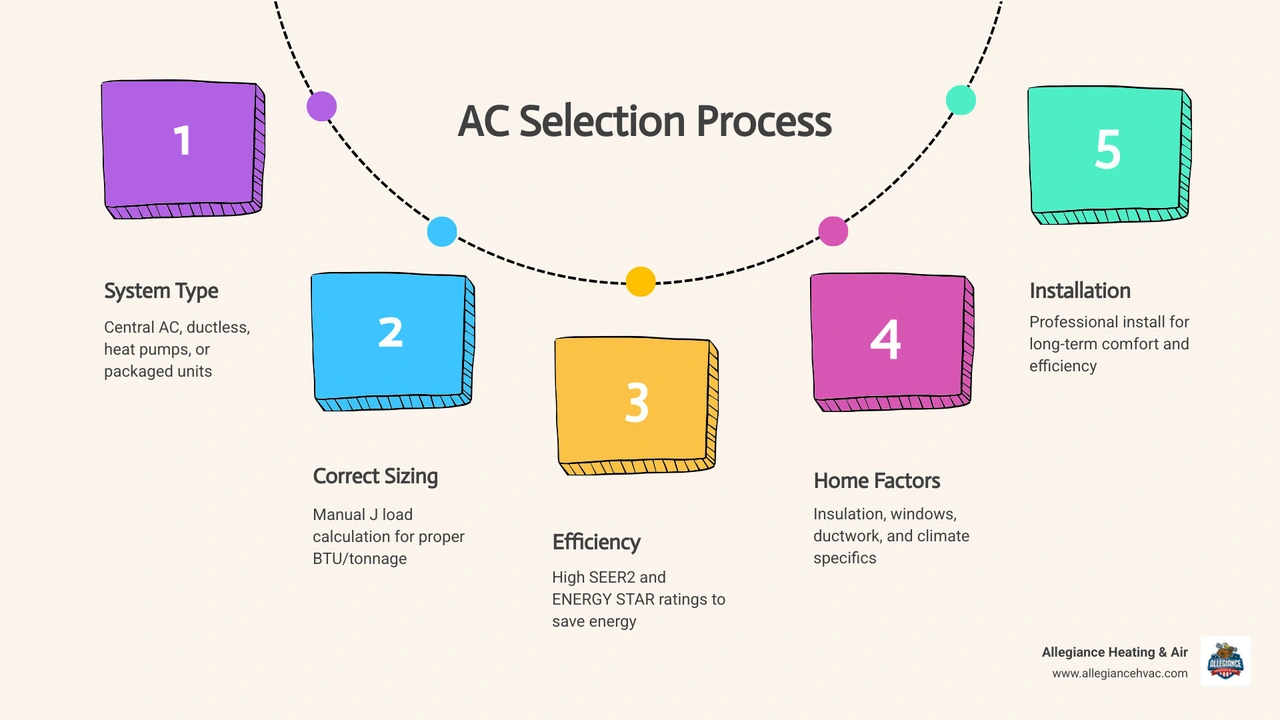
Here's a quick-reference checklist to help you choose the right AC system:
- Identify your system type — central AC, ductless mini-split, heat pump, or packaged unit
- Size it correctly — get a professional Manual J load calculation, not just a square footage estimate
- Check efficiency ratings — look for a high SEER2 rating and ENERGY STAR certification
- Assess your home's specifics — insulation quality, window placement, ceiling height, and ductwork condition all matter
- Consider modern features — variable-speed compressors, smart thermostats, and built-in dehumidification
- Factor in long-term costs — not just the upfront price, but energy savings and maintenance over time
- Hire a qualified installer — proper installation is just as critical as choosing the right equipment
For homeowners in Greenville, IN and the surrounding southern Indiana area, summer heat and humidity add another layer of complexity to this decision. An oversized unit might cool your home quickly but leave it feeling clammy. An undersized one will run nonstop and still fall short. Neither outcome is acceptable when Indiana summers are at their peak.
The good news? With the right guidance, choosing a system that fits your home, your comfort needs, and your budget is completely achievable.
What are the Main Types of AC Systems Available?

When it comes to cooling, one size — and one style — definitely does not fit all. The architecture of your home, whether you have existing ductwork, and your specific cooling goals will dictate which system is best. Here are the primary contenders you’ll encounter in May 2026:
- Central Air Conditioning: This is the most common setup for homes in our area. It uses a split system, where an outdoor condenser unit works with an indoor evaporator coil (usually sitting on top of your furnace). It distributes cool air through a network of ducts. It’s ideal for whole-home cooling if you already have a duct system in place.
- Heat Pumps: These are becoming increasingly popular in the Ohio Valley. A heat pump looks just like a central AC unit but has a "reversing valve" that allows it to both cool your home in the summer and heat it in the winter. They are incredibly efficient and can often replace both your AC and your furnace.
- Ductless Mini-Splits: If you have a historic home in New Albany without ducts, or you’ve added a new sunroom or finished basement, ductless is the way to go. These systems use small indoor air handlers mounted on the wall, connected to an outdoor unit by a small conduit.
- Packaged Units: Often found in homes with limited indoor space or those built on a crawlspace, these units house all components (compressor, coils, and fan) in one outdoor cabinet.
To dive deeper into the mechanics of these systems, check out our Air Conditioning Guide or compare the two heavy hitters in our Central AC vs Heat Pump for Your Home article.
Comparing Ducted vs. Ductless Performance
The choice between ducted and ductless often comes down to your home’s layout. Central AC is fantastic for maintaining a single, consistent temperature throughout the entire house. However, it relies heavily on the health of your ducts. Did you know that unsealed or leaky ductwork can waste 20% to 30% of your system's energy?
Ductless mini-splits, on the other hand, offer "zoning control." This means you can keep the master bedroom at 68 degrees while leaving the guest room at 74, saving significant energy. Because they don't use ducts, they eliminate the energy loss associated with leaky transitions. If you're looking for Air Conditioning Installation New Albany IN, we often recommend exploring ductless options for older homes to avoid the high cost of retrofitting ductwork.
How to Choose the Right AC System for Your Home Using Proper Sizing
If there is one "golden rule" for how to choose the right AC system for your home, it’s this: Sizing is everything. In the HVAC world, we measure cooling capacity in BTUs (British Thermal Units) and Tonnage.
- BTU: A measure of how much heat the unit can remove from your home in one hour.
- Tonnage: One "ton" of cooling equals 12,000 BTUs per hour. Most residential systems range from 1.5 to 5 tons.
While a rough rule of thumb is 20 BTUs per square foot, relying solely on that can lead to disaster. A professional will perform a Manual J load calculation. This is a scientific assessment that looks at your home’s unique "heat envelope" to determine the exact tonnage required. For a detailed breakdown of this process, see our guide on How to Choose the Right Size HVAC for Your Home.
Why Proper Sizing is Critical for how to choose the right ac system for your home
Many homeowners think "bigger is better," but an oversized AC unit is actually a nightmare. Because it’s so powerful, it cools the air in your home too quickly and then shuts off. This is called short-cycling.
Why is short-cycling bad?
- Humidity Control: Air conditioners don't just cool; they dehumidify. It takes about 10–15 minutes of running for the coils to get cold enough to pull moisture from the air. If your unit only runs for 5 minutes because it’s too big, your home will be cool but "clammy."
- Equipment Lifespan: The most wear and tear on a motor happens during startup. Frequent starting and stopping will burn out your compressor years earlier than expected.
- Uneven Temperatures: You'll have cold spots near the vents and warm pockets in the corners of rooms.
Conversely, an undersized unit will run 24/7, struggling to meet the thermostat setting, which leads to astronomical utility bills and a premature system failure.
Factors Beyond Square Footage: Insulation, Windows, and Climate
Square footage is just the starting point. When we visit a home in Floyds Knobs or Georgetown, we look at several variables that impact heat gain:
| Factor | Impact on AC Selection |
|---|---|
| Insulation (R-Value) | Better insulation keeps heat out, allowing for a smaller, more efficient unit. |
| Windows | Large, south-facing windows act like giant heaters. High-efficiency glass can reduce the load. |
| Airtightness | Leaks around doors and windows force the AC to work harder to cool "new" hot air. |
| Ceiling Height | A room with 12-foot vaulted ceilings has much more air volume to cool than an 8-foot room. |
| Occupancy | More people (and pets) in a home generate more body heat. |
In our region, the climate is a major player. We deal with high humidity and significant temperature swings. Choosing the Best HVAC Configuration for Ohio Valley Homes means selecting a system that can handle the "soup" of an Indiana July without breaking a sweat.
Which Efficiency Ratings and Modern Features Matter Most?
Efficiency isn't just about being "green"; it's about your bank account. As of 2023, the industry shifted to SEER2 (Seasonal Energy Efficiency Ratio 2) and EER2 ratings. These new standards use more rigorous testing to account for the real-world resistance of ductwork, giving you a more accurate picture of how the unit will perform.
- SEER2: Think of this like the "highway miles per gallon" for your AC. The higher the number, the less electricity it uses. Minimum ratings in our region are now 13.4, but high-efficiency units can reach 26.
- ENERGY STAR: Units with this label are at least 15% more efficient than standard models.
Understanding Energy Efficiency Standards for Your HVAC: Why Is This Important helps you see the long-term value. While a high-efficiency unit might have a higher entry point, the monthly savings often pay for the difference in just a few seasons. You can see the math for yourself in our Standard Efficiency vs High Efficiency HVAC Comparison.
Modern Features to Consider for how to choose the right ac system for your home
The technology inside AC units has exploded in recent years. Here are the features we recommend looking for in May 2026:
- Variable-Speed Compressors: Traditional units are either "on" or "off" (100% power or 0%). Variable-speed units can run at 30%, 50%, or 90% capacity. They stay on longer at lower speeds, providing incredibly consistent temperatures (usually within 0.5 degrees) and superior dehumidification.
- Smart Thermostats: These learn your schedule and can be controlled from your phone. Setting your thermostat correctly can save you 10% on cooling costs.
- Noise Levels: Standard units operate around 72-76 decibels. High-end models with insulated cabinets and variable fans can drop below 60 decibels — about the sound of a quiet conversation.
- Dehumidification Modes: Some systems have a dedicated "dry mode" to pull moisture from the air without significantly lowering the temperature, perfect for those rainy Indiana spring days.
To see how these features translate into dollars, read How Much Does a High Efficiency HVAC Save Over Time.
Should I Repair or Replace My Current AC System?
This is the million-dollar question. Most central AC systems have a lifespan of 10 to 15 years. If your system is approaching that 15-year mark, it’s likely using R-22 refrigerant, which has been phased out and is now extremely expensive to source for repairs.
We generally recommend replacement if:
- The system is over 12 years old.
- The cost of a single repair is more than 30-50% of the cost of a new unit.
- You’ve had more than two significant repairs in the last two years.
- Your utility bills are climbing despite regular maintenance.
Newer systems are at least 20% more efficient than those made just a decade ago, meaning a replacement often starts saving you money on day one. Learn more about making this choice in our guide: Choose the Right AC for Replacement.
Signs Your System is Failing
Sometimes the signs are subtle. Beyond a total breakdown, keep an ear and eye out for:
- Unusual Noises: Grinding, squealing, or banging usually points to a failing motor or compressor.
- Inconsistent Cooling: If the living room is a freezer but the upstairs bedrooms are sweltering, your system is struggling.
- Short-Cycling: If the unit turns on and off every few minutes, it’s a sign of a mechanical issue or improper sizing.
If you're noticing these issues, it might be time for Air Conditioning Installation Louisville KY to restore your home's comfort.
Conclusion
Choosing the right AC system is a journey, but you don't have to walk it alone. At Allegiance Heating & Air, we’ve been "Taking Home Comfort Under Our Wing" since 2005. Whether you are in Greenville, Jeffersonville, or Louisville, our family-owned team is dedicated to ensuring you get a system that is perfectly sized, expertly installed, and built to last.
The right choice today leads to a decade of worry-free, cool summers. If you're ready to upgrade your comfort, start with a professional Air Conditioning Installation New Albany IN assessment.
Frequently Asked Questions about AC Selection
What is the difference between SEER and SEER2?SEER2 is the new standard as of 2023. It uses a different testing procedure that better accounts for the real-world resistance of ductwork. Generally, a SEER2 rating will be slightly lower numerically than an old SEER rating for the same unit, but it is a more accurate representation of how the unit will perform in your home.
How much energy is lost through unsealed ducts?Roughly 20% to 30% of the air moving through your ductwork can be lost to leaks, holes, and poor connections. Sealing your ducts can keep you cooler and significantly lower your utility bills.
Why is a Manual J calculation better than a square footage estimate?A square footage estimate only considers floor space. A Manual J calculation considers your home’s orientation to the sun, the number of windows, insulation levels, ceiling height, and local climate. It is the only way to ensure your system isn't oversized or undersized.
Schedule your professional air conditioning consultation today
Contact Us Or Schedule Expert Service
Other Blogs
ready to transform your home?
Discover our exceptional home services tailored to meet your needs and enhance your living space.
WHAT OUR CLIENTS HAVE TO SAY ABOUT US

We had a complete HVAC system and a hot water heater installed. The guys were professional, well mannered, and completed the work in a timely manner. Would definitely use them again.
I was nervous at first because my AC broke in the middle of 80 degree weather which is strange for April, but Allegiance Heating and Air was incredibly prompt and professional. The technician arrived within an hour, explained the problem clearly, and completed the repair. The technician , Mr. Garrett Moon was a very nice and courteous young man. He found the problem and fixed it within a timely manner. I highly recommend them for any heating or cooling needs. I’ll definitely give them a call again should I ever have another issue, but hopefully not. Knock on wood 😁. Give them a call… you won’t be disappointed!
From the moment I called to schedule a service, the team was quick to respond and arrived right on time. The technician was professional, friendly, and clearly knowledgeable about my heating system. He explained the repair options in plain language and completed the job efficiently. I appreciated the reliable service and the fact that the work was done the same day. I would definitely recommend Allegiance Heating and Air for any residential HVAC needs.
5/5 stars – I was very impressed with the efficient, affordable and timely service from Allegiance Heating and Air. The technician arrived on time, and performed the service quickly, no repairs needed at this time. Communication was clear and the whole experience felt hassle‑free. I would definitely recommend them for any residential HVAC needs.
Knowledgeable, experienced individual.
Explains Allegiance Heating and Air was incredibly reliable, professional and affordable. They arrived right on time, kept the work area clean and finished the furnace repair quickly. The technician explained everything clearly and the price was a great value. If happiness had a location on Google Maps, it would be here.
Gilbert had to go above and beyond because York is no longer making the part for my furnace. But he was able to find a way to construct a housing bracket for my furnace. Ingenuity, determination and integrity is what finally got my furnace fixed. Gilbert is truly a one of a kind technician.
Thank you for always going the extra mile. Gilbert is always respectful and helpful with any concerns.
"Great service, most knowledgeable and capable HVAC business in Kentuckiana!! Pete Flemming and Bryan the owner, are HVAC encyclopedias. They have the highest integrity of any HVAC business I have ever used. Allegiance has put numerous units in for me over the last 17 years. I will continue to use and trust them."
"Fast response from Allegiance when our heat was out on New Year’s day! Service technician was friendly and efficient. He took the time to explain the problem, tell us about the temporary fix and the plan for permanent repair. We were impressed!"
"Love Allegiance! Their technicians, in particular Benjamin, explain everything. Fast and thorough. A/C was out on a Sunday. Called Allegiance and within a few hours Benjamin arrived. Such a comfort as he was the one who last serviced our units. He quickly replaced part and cooling is restored!"
"My heat pump went out and I had to call after hours. The technician (Garrett) was outstanding and thorough. He got my system up and working until Monday and gave me several options of units. Also took the time to explain the issue to my Home warranty company. I highly recommend this company."
"Right on time :) respectful, fast, and polite. Even gave my fur babies some attention."
"Had Garrett out today to fix our AC. Fantastic tech. He showed up exactly when he said he would and kept us informed of what he was checking and what he found. Highly recommend!"
"Lucas with Allegiance showed up on time as promised, was professional and extremely patient and responsive with all my questions. He took care of the issue, and I feel he was trustworthy! He had us back to cool and comfortable on one of the hottest days of the year."
"Lucas did a great job! Very professional and expedient. Explained the process very well and represented Allegiance as a truly professional and reputable company."
"Arrived on time and work diligently to fix issue. These guy are great. Worked quickly to resolve my issues."
"Lucas was great - he spent a lot of time trying to figure out what was going on and explained everything he was doing. I trust Allegiance and wouldn’t want anyone else working on/in my house!!"

RELATED ARTICLES

Louisville’s Commercial Edge: Expert Heat Pump Installation for Your Enterprise

X Costly HVAC Maintenance Mistakes to Avoid