



The Real Difference Between Central AC vs Heat Pump for Your Home
Central ac vs heat pump for your home is one of the most common questions homeowners face when it's time to replace or upgrade their HVAC system — and the answer genuinely affects your comfort, your energy bills, and your long-term budget.
Here's a quick breakdown to help you decide:
• Cools your home — Central AC: Yes — Heat Pump: Yes
• Heats your home — Central AC: No (needs separate furnace) — Heat Pump: Yes
• Works in extreme cold — Central AC: N/A — Heat Pump: May need backup heat below 0°F
• Energy efficiency (cooling) — Central AC: High (SEER2 rated) — Heat Pump: High (SEER2 rated)
• Energy efficiency (heating) — Central AC: N/A — Heat Pump: Up to 300% efficient
• Best climate fit — Central AC: Any climate with separate heat source — Heat Pump: Mild to moderate winters
• Federal incentives available — Central AC: Limited — Heat Pump: Yes — up to $2,000 tax credit
• Typical lifespan — Central AC: 12–15 years — Heat Pump: 10–15 years
Here's the short version: a central AC only cools your home and relies on a separate furnace for heat. A heat pump does both — cooling in summer and heating in winter — using the same system. Heating and cooling together account for nearly 50% of your home's total energy use, so choosing the right setup matters more than most people realize.
For Greenville, IN homeowners, where summers can be humid and winters can get genuinely cold, this decision deserves more than a quick guess. The right system depends on your existing setup, how cold your winters actually get, and what you want to spend now versus over time.
The sections below walk you through everything you need to know — how each system works, how they compare on efficiency and cost, and which one makes the most sense for your home.
Understanding the Mechanics: Central AC vs Heat Pump for Your Home
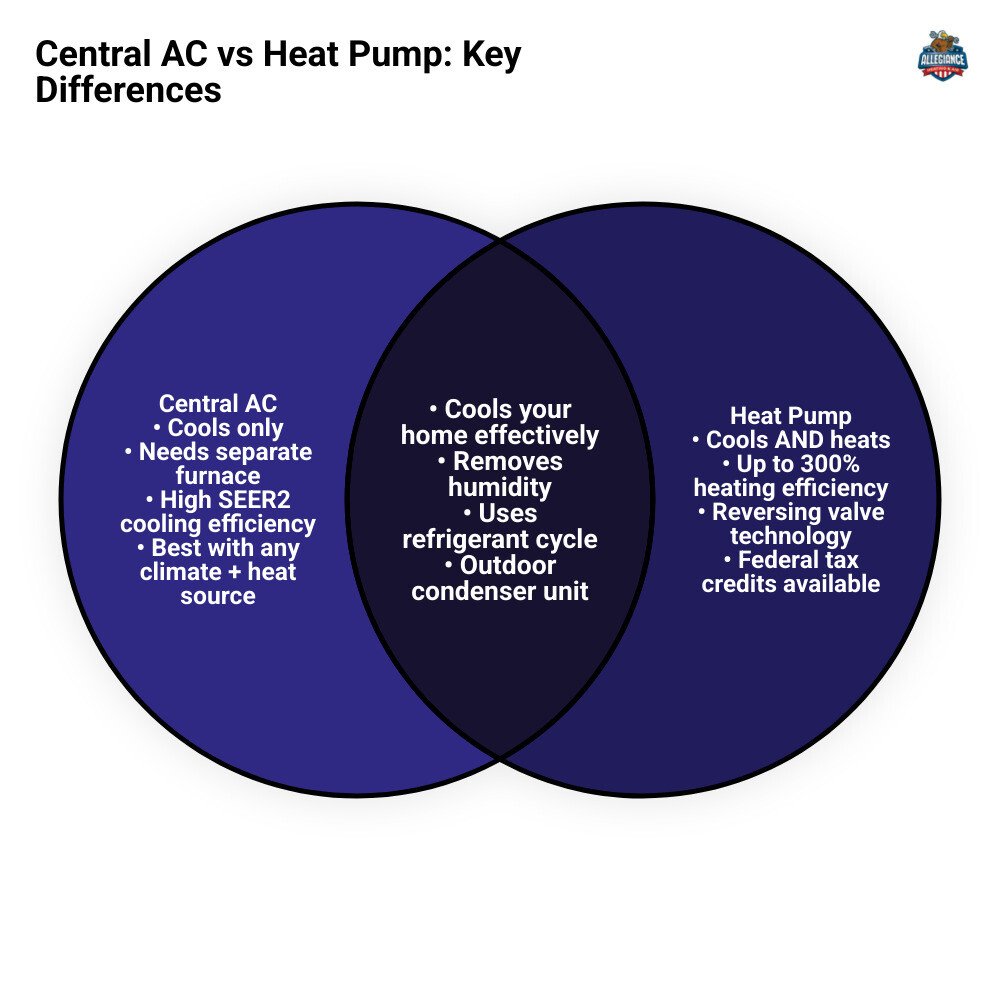
To the untrained eye, an outdoor Air Conditioning unit and a Heat Pump look almost identical. They both feature a large metal box with a fan on top, sitting on a pad outside your home. However, the magic lies in a small but mighty component found only in the heat pump: the reversing valve.
Both systems operate on the principle of heat transfer rather than heat generation. They use a refrigerant cycle to move thermal energy from one place to another. In the summer, both units act as "heat exporters." They soak up the heat inside your living room and "dump" it into the outdoor air.
The difference arises when the leaves start to fall in Floyds Knobs or Georgetown. A central AC unit simply retires for the season, leaving the heavy lifting to your furnace. A heat pump, however, uses that reversing valve to flip the flow of refrigerant. This allows it to extract ambient heat from the cold outdoor air and pump it into your home. Even when it feels chilly to us, there is still thermal energy present in the air that a heat pump can harvest.
• Cooling Mechanism — Central Air Conditioner: Refrigerant Heat Transfer — Heat Pump: Refrigerant Heat Transfer
• Heating Mechanism — Central Air Conditioner: None (Requires Furnace) — Heat Pump: Reversible Refrigerant Cycle
• Primary Component — Central Air Conditioner: Compressor & Condenser — Heat Pump: Compressor & Reversing Valve
• Energy Source — Central Air Conditioner: Electricity — Heat Pump: Electricity
How These Systems Keep Greenville Homes Cool
When the Indiana humidity settles in across New Albany and Clarksville, we all want the same thing: crisp, dry air. In cooling mode, both systems are remarkably effective. They don't actually "create" cold; they remove heat.
As indoor air is pulled through your return vents, it passes over cold evaporator coils. The refrigerant inside these coils absorbs the heat from your air. A secondary benefit of this process is dehumidification. As the warm air hits the cold coils, moisture condenses and is drained away, which is a lifesaver during our muggy Ohio Valley summers. Check out our Air Conditioning Guide for a deeper look at this process.
Whether you choose a dedicated AC or a heat pump, the HVAC system's goal is to maintain a consistent, comfortable temperature throughout your property.
Cooling Efficiency and Central AC vs Heat Pump for Your Home
Efficiency is measured by the SEER2 (Seasonal Energy Efficiency Ratio 2) rating. The higher the number, the less electricity the unit uses to provide the same amount of cooling. Modern units, like those we install in Sellersburg and Jeffersonville, often feature variable-speed compressors.
Unlike older "single-stage" units that are either 100% on or 100% off, variable-speed systems can throttle down to 25% or 50% capacity. This allows them to run longer at lower speeds, providing better humidity control and more even temperatures. If your current system is struggling to keep up, it might be time to look into a Guide to Air Conditioner Repair or consider an upgrade to a more efficient model.
Beyond Cooling: The Heating Advantage of Heat Pumps
The most significant "pro" in the central ac vs heat pump for your home debate is the heat pump's ability to provide Heating. Because it moves heat rather than burning fuel to create it, a heat pump can be incredibly efficient—up to 300% in some cases. This means for every one unit of electricity used, it delivers three units of heat.
So, How Does Heat Pump Work when it's freezing outside? It extracts heat from the outdoor air and compresses the refrigerant to increase its temperature, then releases that warmth indoors. However, when temperatures in places like Salem or Scottsburg drop well below freezing, the heat pump may struggle to find enough ambient heat.
This is where "auxiliary heat" or "emergency heat" comes in. Most systems use electric resistance heat strips as a backup. While effective, these strips use a lot of electricity. For our region, we often recommend a "dual-fuel" or "hybrid" system. This pairs a heat pump with a high-efficiency gas furnace. The heat pump handles the mild days, and the furnace kicks in when the Indiana winter gets serious.
Year-Round Versatility of a Central AC vs Heat Pump for Your Home
A heat pump is essentially a two-in-one system. By choosing one, you are investing in a piece of equipment that works for you 365 days a year. This versatility is making Heat Pump Systems for Your Property increasingly popular in Southern Indiana.
Beyond the convenience, heat pumps help reduce reliance on fossil fuels. If you’re looking to "green" your home in Corydon or Charlestown, a heat pump is a major step forward. Modern variable-speed heat pumps provide incredibly consistent temperatures, eliminating the "blast of hot air followed by a chill" cycle common with older furnaces. To find the right fit, you can Choose the Best Heat Pump based on your home's square footage and insulation levels.
Performance, Lifespan, and Maintenance Considerations
When comparing central ac vs heat pump for your home, longevity is a key factor. A central AC unit typically lasts 12 to 15 years. Because it only runs for a few months out of the year, its components face less wear and tear. A heat pump, working year-round, typically lasts 10 to 15 years.
Maintenance is non-negotiable for both. For a central AC, a spring tune-up is usually sufficient. For a heat pump, we recommend bi-annual service: once in the spring for cooling and once in the fall for heating. During these visits, we check refrigerant levels, clean coils, and ensure the reversing valve is functioning perfectly.
Efficiency for heating is measured by HSPF2 (Heating Seasonal Performance Factor 2). Just like SEER2, a higher number means lower monthly bills. If you are curious about the transition, we can explain What to Expect Heat Pump Installation so there are no surprises on install day.
Maximizing Your Investment with Incentives and Rebates
One of the best reasons to consider a heat pump right now is the financial support available through the Inflation Reduction Act of 2022. Homeowners in our service area, from Louisville to Madison, may be eligible for federal tax credits of 30% of the project cost, up to $2,000 annually for heat pumps.
ENERGY STAR certified units often qualify for additional state-level rebates or utility incentives. While we don't handle the tax paperwork, we can certainly point you toward the most efficient models that meet these requirements. Over the 15-year lifespan of the unit, the energy savings combined with these upfront incentives often make the heat pump the more financially savvy choice, even if the initial equipment cost is slightly higher than a standard AC.
Frequently Asked Questions about Home Cooling Systems
Can a heat pump completely replace my existing air conditioner and furnace?
Yes, it can. In many homes across Borden and Pekin, a heat pump paired with an electric air handler replaces the AC/furnace combo entirely. However, in our climate, we often suggest keeping a gas furnace as a backup (hybrid system) to ensure you stay toasty when the temperature drops into the negatives.
How do modern heat pumps perform during cold Indiana winters?
Modern "cold climate" heat pumps have come a long way. Many can now operate efficiently down to -5°F or even -13°F. While they work harder in extreme cold, they are far more capable than the models from twenty years ago. For Greenville residents, they are a very reliable primary heat source for about 85-90% of the winter.
What are the primary maintenance differences between these two systems?
The biggest difference is frequency. Because a heat pump is your primary heater and cooler, it needs to be checked twice a year. You'll also want to be more diligent about changing filters and keeping the outdoor unit clear of snow and ice during the winter to ensure proper airflow.
Conclusion: Choosing the Right System for Your Greenville Property
Deciding between central ac vs heat pump for your home doesn't have to be a headache. If you already have a relatively new, high-efficiency gas furnace, adding a central AC might be the most logical step. However, if you are looking to replace both units at once, or if you want to lower your carbon footprint and take advantage of significant tax credits, a heat pump is an excellent investment for Southern Indiana homes.
At Allegiance Heating & Air, we’ve been "Taking Home Comfort Under Our Wing" since 2005. As a family-owned business, we understand the specific needs of homeowners in Greenville, Floyds Knobs, and the surrounding communities. We don't believe in one-size-fits-all solutions; we believe in finding the system that fits your lifestyle and your home's unique footprint.
Ready to see which system wins for your home? Schedule your expert HVAC service today and let our professional technicians provide a custom consultation.
Contact Us Or Schedule Expert Service
Other Blogs
ready to transform your home?
Discover our exceptional home services tailored to meet your needs and enhance your living space.
WHAT OUR CLIENTS HAVE TO SAY ABOUT US

We had a complete HVAC system and a hot water heater installed. The guys were professional, well mannered, and completed the work in a timely manner. Would definitely use them again.
I was nervous at first because my AC broke in the middle of 80 degree weather which is strange for April, but Allegiance Heating and Air was incredibly prompt and professional. The technician arrived within an hour, explained the problem clearly, and completed the repair. The technician , Mr. Garrett Moon was a very nice and courteous young man. He found the problem and fixed it within a timely manner. I highly recommend them for any heating or cooling needs. I’ll definitely give them a call again should I ever have another issue, but hopefully not. Knock on wood 😁. Give them a call… you won’t be disappointed!
From the moment I called to schedule a service, the team was quick to respond and arrived right on time. The technician was professional, friendly, and clearly knowledgeable about my heating system. He explained the repair options in plain language and completed the job efficiently. I appreciated the reliable service and the fact that the work was done the same day. I would definitely recommend Allegiance Heating and Air for any residential HVAC needs.
5/5 stars – I was very impressed with the efficient, affordable and timely service from Allegiance Heating and Air. The technician arrived on time, and performed the service quickly, no repairs needed at this time. Communication was clear and the whole experience felt hassle‑free. I would definitely recommend them for any residential HVAC needs.
Knowledgeable, experienced individual.
Explains Allegiance Heating and Air was incredibly reliable, professional and affordable. They arrived right on time, kept the work area clean and finished the furnace repair quickly. The technician explained everything clearly and the price was a great value. If happiness had a location on Google Maps, it would be here.
Gilbert had to go above and beyond because York is no longer making the part for my furnace. But he was able to find a way to construct a housing bracket for my furnace. Ingenuity, determination and integrity is what finally got my furnace fixed. Gilbert is truly a one of a kind technician.
Thank you for always going the extra mile. Gilbert is always respectful and helpful with any concerns.
"Great service, most knowledgeable and capable HVAC business in Kentuckiana!! Pete Flemming and Bryan the owner, are HVAC encyclopedias. They have the highest integrity of any HVAC business I have ever used. Allegiance has put numerous units in for me over the last 17 years. I will continue to use and trust them."
"Fast response from Allegiance when our heat was out on New Year’s day! Service technician was friendly and efficient. He took the time to explain the problem, tell us about the temporary fix and the plan for permanent repair. We were impressed!"
"Love Allegiance! Their technicians, in particular Benjamin, explain everything. Fast and thorough. A/C was out on a Sunday. Called Allegiance and within a few hours Benjamin arrived. Such a comfort as he was the one who last serviced our units. He quickly replaced part and cooling is restored!"
"My heat pump went out and I had to call after hours. The technician (Garrett) was outstanding and thorough. He got my system up and working until Monday and gave me several options of units. Also took the time to explain the issue to my Home warranty company. I highly recommend this company."
"Right on time :) respectful, fast, and polite. Even gave my fur babies some attention."
"Had Garrett out today to fix our AC. Fantastic tech. He showed up exactly when he said he would and kept us informed of what he was checking and what he found. Highly recommend!"
"Lucas with Allegiance showed up on time as promised, was professional and extremely patient and responsive with all my questions. He took care of the issue, and I feel he was trustworthy! He had us back to cool and comfortable on one of the hottest days of the year."
"Lucas did a great job! Very professional and expedient. Explained the process very well and represented Allegiance as a truly professional and reputable company."
"Arrived on time and work diligently to fix issue. These guy are great. Worked quickly to resolve my issues."
"Lucas was great - he spent a lot of time trying to figure out what was going on and explained everything he was doing. I trust Allegiance and wouldn’t want anyone else working on/in my house!!"

RELATED ARTICLES
Why Your Ductless AC Heater Stops Working in Sellersburg
Avoiding Furnace Installation Errors to Maximize Efficiency
