Why Knowing How to Choose the Right Air Purification System Matters for Your Home
Knowing how to choose the right air purification system can make a real difference in the health and comfort of your home — especially when indoor air can be two to five times more polluted than the air outside, according to the EPA. For homeowners in Greenville, IN, where homes stay sealed up tight through cold winters and humid summers, that pollution builds up fast. Dust, pet dander, cooking fumes, VOCs from furniture and cleaning products, mold spores — it all circulates through your living space every day.
Most people don't realize there's a problem until someone in the house starts sneezing more, sleeping worse, or dealing with unexplained headaches. The air looks clean. But looks can be deceiving.
Choosing the right system doesn't have to be complicated. Here's a quick breakdown to get you pointed in the right direction:
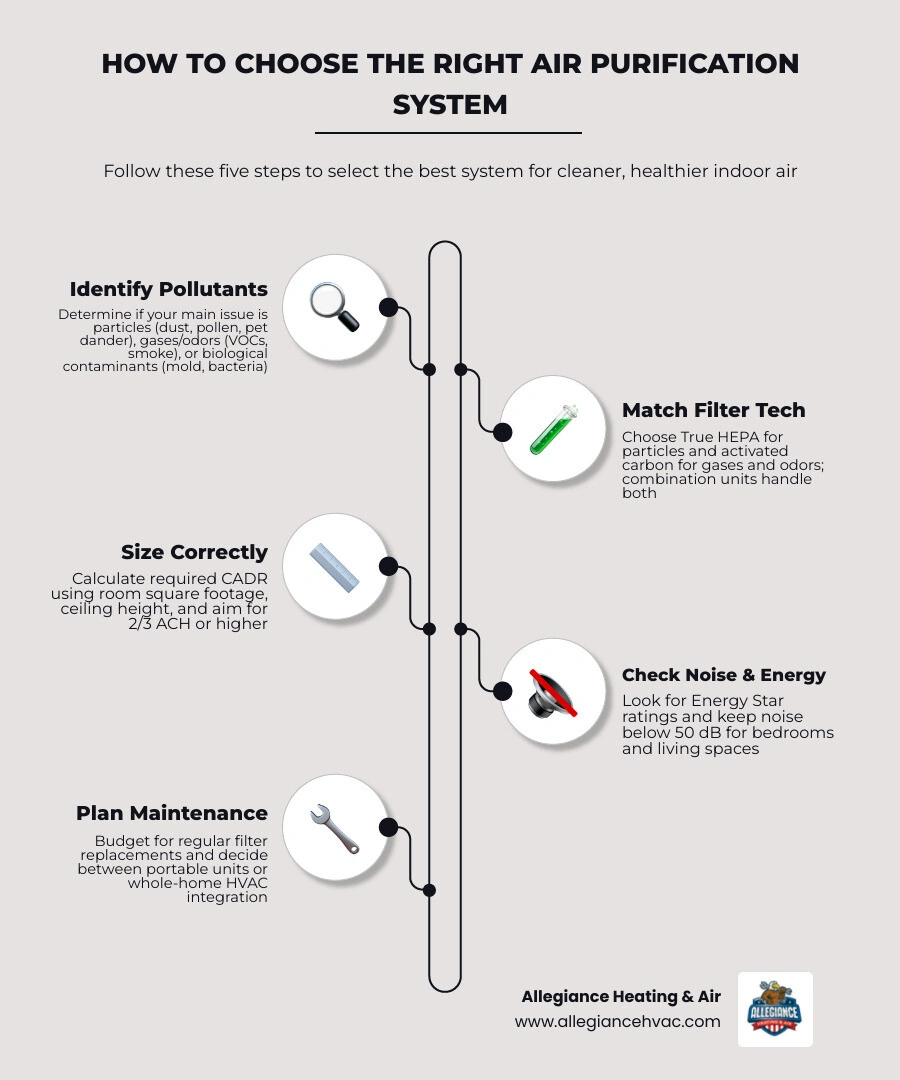
How to choose the right air purification system — quick steps:
1. Identify your main pollutant — particles (dust, pollen, pet dander), gases/odors (VOCs, smoke, cooking fumes), or biological contaminants (mold, bacteria)
2. Match the filter technology — True HEPA for particles, activated carbon for gases and odors, combination units for both
3. Size it correctly — use your room's square footage and ceiling height to calculate the CADR (Clean Air Delivery Rate) you need
4. Check noise and energy use — look for Energy Star certification and decibel ratings below 50 dB for rooms where you spend a lot of time
5. Avoid harmful technologies — skip ozone generators and unverified ionizers
6. Plan for maintenance — budget for regular filter replacements and decide between a portable unit or a whole-home system integrated with your HVAC
This guide walks through each of those steps in detail so you can make a confident, informed decision.
How to choose the right air purification system helpful reading:
• how do air purifiers and filtration systems work
• how do air purifiers work for your home
Understanding Indoor Pollutants and How to Choose the Right Air Purification System
To understand how to choose the right air purification system, we first have to look at what is actually floating around in your home's air. Indoor air pollutants generally fall into three distinct categories. If you do not match your purification technology to the specific pollutants you are facing, you will end up with a system that runs constantly but fails to solve your problem.
The three main types of indoor air pollutants are:
• Particulate Matter (PM): This includes physical particles like dust mites, seasonal pollen, pet dander, ash, and fine smoke. These particles are measured in microns. For scale, a single strand of human hair is about 70 microns wide, while the particles that cause the most respiratory irritation (known as PM2.5) are 2.5 microns or smaller.
• Volatile Organic Compounds (VOCs) and Gaseous Pollutants: These are chemical vapors and gases rather than physical particles. They come from cooking fumes, household cleaning sprays, paints, and new carpets or furniture, which can off-gas chemicals for up to two years.
• Biological Contaminants: This category includes living or once-living organisms such as mold spores, bacteria, and airborne viruses.
Different technologies are engineered to target different threats. For example, a filter designed to trap dust won't do anything to stop cooking odors or chemical fumes. To learn more about how these technologies function side-by-side, you can read our guide on how do air purifiers and filtration systems work.
Understanding these differences is the foundation of choosing a system that actually improves your home's indoor air quality. For a closer look at the options available on the market in 2026, check out our breakdown of the different types of air cleaners and their benefits.
Particle Filtration: HEPA vs. MERV Filters
When dealing with physical particles like dust, pollen, and pet dander, mechanical filtration is your primary line of defense. The two terms you will see most often are HEPA and MERV.
A True HEPA (High-Efficiency Particulate Air) filter is the gold standard for residential particle filtration. To carry the "True HEPA" certification, a filter must be laboratory-tested to remove at least 99.97% of airborne particles as small as 0.3 microns in a single pass. This includes fine dust, pollen, mold spores, and PM2.5. Be cautious of marketing terms like "HEPA-type" or "HEPA-like" — these filters are not officially certified and often capture only 85% to 90% of particles, letting the smallest and most irritating particles pass right back into your room.
MERV (Minimum Efficiency Reporting Value) ratings, on the other hand, are typically used for the filters installed in your central heating and cooling system. MERV ratings range from 1 to 16:
• MERV 1–4: Standard fiberglass filters designed to protect your HVAC equipment from large dust bunnies, but they do almost nothing to clean your air.
• MERV 8–11: Better residential pleated filters that capture pet dander and pollen.
• MERV 13: The minimum rating recommended for capturing fine PM2.5 particles, including virus droplets and smoke. Most residential HVAC systems can accommodate a MERV 13 filter, provided it is replaced regularly to prevent airflow restriction.
If you are trying to decide between a dedicated room purifier and upgrading your central system's filter, our air purifier vs air filtration system comparison outlines the pros and cons of each approach.
Gas and Odor Control: Activated Carbon and Pre-Filters
Because gaseous pollutants and VOCs are too small to be trapped by a HEPA filter, they pass straight through mechanical filters. To capture gases, you need an activated carbon filter.
Activated carbon is treated with oxygen to open up millions of tiny pores between the carbon atoms. This process creates an incredibly large surface area that traps gas molecules through a process called adsorption (where gases chemically stick to the carbon pores).
When evaluating an air purifier for odors or chemical sensitivities, look closely at how the carbon filter is constructed:
• Impregnated fabric filters: Many budget purifiers use a thin, carbon-coated mesh. These contain very little actual carbon and saturate quickly, often becoming useless within a few weeks.
• Pelleted carbon filters: Premium systems use thick canisters or beds packed with physical carbon pellets. For heavy odors, tobacco smoke, or chemical off-gassing, look for a system that contains several pounds of actual carbon pellets.
Additionally, a high-quality purification system should always include a washable pre-filter. The pre-filter is the outer layer that catches large hair, dust clumps, and pet fur before they can clog the delicate, more expensive HEPA or carbon filters. By vacuuming or washing the pre-filter every few weeks, you significantly extend the lifespan of your main filters. You can discover more about these inner workings in our article on how do air purifiers work for your home.
Sizing Your System: CADR, ACH, and Room Calculations
An air purifier can only clean the air that actually passes through it. If you place an undersized unit in a large room, the air will remain dirty because the machine cannot circulate the room's total volume fast enough. To size a system correctly, you must understand two key metrics: CADR and ACH.
• Clean Air Delivery Rate (CADR): This rating, developed by the Association of Home Appliance Manufacturers (AHAM), measures the volume of filtered air a unit delivers in cubic feet per minute (CFM). A purifier will typically have three separate CADR ratings: one for smoke (the smallest particles), one for dust (medium particles), and one for pollen (large particles). Always look at the smoke CADR when evaluating performance against fine, health-threatening particles.
• Air Changes per Hour (ACH): This indicates how many times the purifier can cycle the entire volume of air in a room through its filters in one hour. For general air cleaning, a rate of 4 to 5 ACH is recommended. For households with severe asthma, allergies, or wildfire smoke exposure, aiming for 5 to 8 ACH is highly beneficial.

• Up to 150 sq. ft. — Target Smoke CADR (CFM): 100+ — Recommended Room Type: Small Bedroom, Home Office
• 150 to 300 sq. ft. — Target Smoke CADR (CFM): 150–250 — Recommended Room Type: Master Bedroom, Medium Kitchen
• 300 to 500 sq. ft. — Target Smoke CADR (CFM): 250–400 — Recommended Room Type: Large Living Room, Open-Concept Area
• 500+ sq. ft. — Target Smoke CADR (CFM): 400+ — Recommended Room Type: Very Large Spaces, Commercial Offices
Sizing Calculations for how to choose the right air purification system
To perform a precise sizing calculation, you need to calculate the volume of your room. While many manufacturers list room coverage based on standard 8-foot ceilings, homes in our Southern Indiana service area often feature vaulted or high ceilings that require more powerful systems.
To calculate your target CADR, use this simple formula:
$$text{Target CADR (CFM)} = frac{text{Room Volume (Cubic Feet)} times text{Desired ACH}}{60}$$
For example, if you have a living room in New Albany, IN, that is 20 feet long by 15 feet wide, with a 10-foot ceiling:
1. Calculate Square Footage: $20 times 15 = 300text{ sq. ft.}$
2. Calculate Volume: $300 times 10 = 3,000text{ cubic feet}$.
3. Calculate Target CADR for 5 ACH: $(3,000 times 5) div 60 = 250text{ CFM}$.
If you don't want to do the volume math, you can use the 2/3 rule recommended by AHAM: choose a purifier with a smoke CADR rating that is at least two-thirds of your room's total square footage. For a 300-square-foot room, you would want a CADR of at least 200 CFM.
To ensure the performance claims are accurate, look for the AHAM Verifide seal on the packaging, which guarantees the unit has been independently tested and verified.
Noise Levels and Energy Efficiency Considerations
Because air purifiers are most effective when left running on a nearly constant basis, you must consider how much noise the unit makes and how much electricity it consumes.
Noise Levels (Decibels):An air purifier's noise level is directly tied to its fan speed. If you buy an undersized unit, you will have to run it on its highest speed to clean the air, which can sound like a loud hair dryer. By buying a unit rated for a slightly larger space, you can run it on a lower, quieter speed while still achieving your target ACH.
• 17 to 25 dB: Whisper-quiet, ideal for bedrooms at night.
• 35 to 45 dB: Similar to a quiet refrigerator hum, perfect for living spaces or offices.
• 50+ dB: Noticeable rushing air, which can make it hard to sleep or hold a conversation nearby.
Energy Consumption:Running a purifier 24/7 can impact your utility bills if the unit is inefficient. Look for Energy Star certified purifiers, which are 40 percent more energy-efficient than standard models. A typical Energy Star certified unit uses less electricity than a standard light bulb when running on low speeds, making continuous operation highly affordable.
Technologies to Avoid and Smart Features to Consider
The air purification market is filled with advanced-sounding jargon. However, several popular technologies are not only ineffective but can actually be hazardous to your health.
• Ozone Generators: These machines are marketed as "activated oxygen" or "pure air" systems, but they intentionally produce ozone gas to neutralize pollutants. Ozone is a known lung irritant that can trigger severe asthma attacks, scar lung tissue, and worsen respiratory conditions. The EPA strongly warns against using ozone generators in occupied spaces.
• Ionizers and Electrostatic Precipitators: These systems charge airborne particles so they stick to nearby walls, furniture, or internal metal plates. While they can reduce dust, many ionizers produce ozone as a byproduct. Furthermore, the charged particles often settle on your floors and furniture instead of being removed from the room, meaning they can easily be kicked back up into the air.
• UV-C Light and PCO (Photocatalytic Oxidation): Many consumer purifiers include small UV-C bulbs, claiming they kill airborne viruses and bacteria. However, for UV light to deactivate a pathogen, the air must be exposed to the light for several seconds. In a fast-moving air purifier, the air passes the bulb in a fraction of a second, rendering the UV light largely decorative. If you are interested in how professional-grade UV systems improve whole-home air quality, read our detailed guide on how ultraviolet air cleaners improved IAQ.
Smart Features and Verification for how to choose the right air purification system
When deciding how to choose the right air purification system, you will encounter many "smart" features. Some are genuinely useful, while others are simply marketing gimmicks designed to inflate the price:
• Air Quality Sensors (Onboard PM2.5 Monitors): Very useful. These sensors constantly measure the particle levels in your room. In Auto Mode, the purifier will automatically ramp up its fan speed when it detects a spike in pollution (such as from cooking or vacuuming) and drop back down to a quiet, energy-saving speed once the air is clean. Laser-based sensors are far more accurate and long-lasting than cheaper infrared sensors.
• Wi-Fi and App Integration: Convenient, but not essential. Apps allow you to monitor your indoor air quality remotely, set operation schedules, and receive alerts when it is time to change the filter. However, you should avoid paying a steep premium for Wi-Fi if the underlying filtration quality is subpar.
• Filter Replacement Indicators: Crucial. These indicators track actual run time or airflow resistance to tell you precisely when to change your filters, preventing you from running a clogged, ineffective machine or throwing away a perfectly good filter too early.
Placement, Maintenance, and Whole-Home Integration
Once you have selected your air purifier, proper placement and regular maintenance are critical to keeping it running effectively.
Placement Strategy:
• Avoid corners and walls: Air purifiers need room to breathe. Keep at least 12 to 24 inches of clear space around the intake and outlet grilles. Placing a unit directly against a wall or behind a couch will choke its airflow, reducing its efficiency by up to 20%.
• Place near the source: Position the unit close to known pollution sources, such as near pet beds, litter boxes, or in the kitchen to catch cooking fumes.
• Elevate small units: For smaller portable units, placing them 3 to 5 feet off the ground on a table or nightstand can help them capture floating particles more effectively than placing them on the floor.
Filter Replacement Schedules:
• Pre-filters: Vacuum or wash every 2 to 4 weeks.
• True HEPA filters: Replace every 6 to 12 months, depending on your indoor air quality and pet situation.
• Activated carbon filters: Replace every 3 to 6 months, as carbon pores saturate and lose their ability to adsorb gases over time.
While portable units are excellent for target areas like bedrooms, they are limited to single-room filtration. For comprehensive protection, a whole-home system integrated directly into your central HVAC system is the most effective solution.
To understand how a whole-home system compares to simply using a thicker filter in your existing furnace, you can read our breakdown of a whole house air purifier vs upgraded HVAC filter. For the absolute best results, many homeowners choose a hybrid approach, which we discuss in our guide on combining air purification and filtration for best results.
Frequently Asked Questions about Air Purification
How often do air purifier filters need to be replaced?
The lifespan of your filters depends heavily on how often the unit runs and the level of pollution in your home. Under normal operating conditions, a True HEPA filter will last between 6 and 12 months. However, if you have multiple pets, smoke indoors, or live in an area prone to seasonal dust or agricultural activity, you may need to replace it more frequently.
Activated carbon filters saturate faster than mechanical HEPA filters and typically need to be replaced every 3 to 6 months to maintain their odor-eliminating capabilities. Washable pre-filters should never be replaced unless they become physically damaged; simply rinse or vacuum them once a month to keep airflow unrestricted.
Can an air purifier help with seasonal allergies and asthma?
Yes, a properly sized air purifier with a True HEPA filter is highly effective at reducing allergy and asthma triggers. By capturing 99.97% of airborne particles down to 0.3 microns, these systems remove pollen, mold spores, dust mite debris, and pet dander before they can settle on your furniture or be inhaled.
For a deeper dive into how these systems can help you find relief during peak pollen seasons, take a look at our article on how air purification can help with allergies. If you are trying to decide which type of system is best suited for your specific respiratory needs, our guide on air purification vs filtration which is better for allergies provides a clear, side-by-side comparison.
Is a portable air purifier better than a whole-house system?
It depends on your goals and your budget. Portable air purifiers are excellent for localized filtration — such as keeping your bedroom air clean while you sleep or clearing out odors in a busy kitchen. They are easy to set up and can be moved from room to room as needed.
However, portable units cannot clean the air in your entire home. A whole-house air purification system is installed directly into your central HVAC ductwork, cleaning all the air that circulates through your home every time your heating or cooling system runs. This provides consistent, silent, and comprehensive filtration for every room simultaneously. To explore the full range of advantages a central system offers, check out our article on the 8 impressive benefits of having an in-home air filtration system.
Conclusion
Finding the right balance between portable purifiers and whole-home systems doesn't have to be a guessing game. At Allegiance Heating & Air, we have been "Taking Home Comfort Under Our Wing" since 2005. As a family-owned business, we are dedicated to helping our neighbors in Greenville, IN, and surrounding Southern Indiana communities breathe easier year-round with professional indoor air quality assessments and tailored system installations.
If you are ready to upgrade your home's air quality with a system that fits your lifestyle and your home's layout, we are here to help. Contact us today to schedule a consultation or learn more about our professional air purifier installation services. You can also explore our specialized indoor air quality air purification systems in Greenville, IN to find the perfect fit for your home.
Contact Us Or Schedule Expert Service
Other Blogs
ready to transform your home?
Discover our exceptional home services tailored to meet your needs and enhance your living space.
WHAT OUR CLIENTS HAVE TO SAY ABOUT US

We had a complete HVAC system and a hot water heater installed. The guys were professional, well mannered, and completed the work in a timely manner. Would definitely use them again.
I was nervous at first because my AC broke in the middle of 80 degree weather which is strange for April, but Allegiance Heating and Air was incredibly prompt and professional. The technician arrived within an hour, explained the problem clearly, and completed the repair. The technician , Mr. Garrett Moon was a very nice and courteous young man. He found the problem and fixed it within a timely manner. I highly recommend them for any heating or cooling needs. I’ll definitely give them a call again should I ever have another issue, but hopefully not. Knock on wood 😁. Give them a call… you won’t be disappointed!
From the moment I called to schedule a service, the team was quick to respond and arrived right on time. The technician was professional, friendly, and clearly knowledgeable about my heating system. He explained the repair options in plain language and completed the job efficiently. I appreciated the reliable service and the fact that the work was done the same day. I would definitely recommend Allegiance Heating and Air for any residential HVAC needs.
5/5 stars – I was very impressed with the efficient, affordable and timely service from Allegiance Heating and Air. The technician arrived on time, and performed the service quickly, no repairs needed at this time. Communication was clear and the whole experience felt hassle‑free. I would definitely recommend them for any residential HVAC needs.
Knowledgeable, experienced individual.
Explains Allegiance Heating and Air was incredibly reliable, professional and affordable. They arrived right on time, kept the work area clean and finished the furnace repair quickly. The technician explained everything clearly and the price was a great value. If happiness had a location on Google Maps, it would be here.
Gilbert had to go above and beyond because York is no longer making the part for my furnace. But he was able to find a way to construct a housing bracket for my furnace. Ingenuity, determination and integrity is what finally got my furnace fixed. Gilbert is truly a one of a kind technician.
Thank you for always going the extra mile. Gilbert is always respectful and helpful with any concerns.
"Great service, most knowledgeable and capable HVAC business in Kentuckiana!! Pete Flemming and Bryan the owner, are HVAC encyclopedias. They have the highest integrity of any HVAC business I have ever used. Allegiance has put numerous units in for me over the last 17 years. I will continue to use and trust them."
"Fast response from Allegiance when our heat was out on New Year’s day! Service technician was friendly and efficient. He took the time to explain the problem, tell us about the temporary fix and the plan for permanent repair. We were impressed!"
"Love Allegiance! Their technicians, in particular Benjamin, explain everything. Fast and thorough. A/C was out on a Sunday. Called Allegiance and within a few hours Benjamin arrived. Such a comfort as he was the one who last serviced our units. He quickly replaced part and cooling is restored!"
"My heat pump went out and I had to call after hours. The technician (Garrett) was outstanding and thorough. He got my system up and working until Monday and gave me several options of units. Also took the time to explain the issue to my Home warranty company. I highly recommend this company."
"Right on time :) respectful, fast, and polite. Even gave my fur babies some attention."
"Had Garrett out today to fix our AC. Fantastic tech. He showed up exactly when he said he would and kept us informed of what he was checking and what he found. Highly recommend!"
"Lucas with Allegiance showed up on time as promised, was professional and extremely patient and responsive with all my questions. He took care of the issue, and I feel he was trustworthy! He had us back to cool and comfortable on one of the hottest days of the year."
"Lucas did a great job! Very professional and expedient. Explained the process very well and represented Allegiance as a truly professional and reputable company."
"Arrived on time and work diligently to fix issue. These guy are great. Worked quickly to resolve my issues."
"Lucas was great - he spent a lot of time trying to figure out what was going on and explained everything he was doing. I trust Allegiance and wouldn’t want anyone else working on/in my house!!"

RELATED ARTICLES
Don't Wait for the Smoke to Schedule Your HVAC Service

HVAC Tips for Kentuckiana Homeowners