Why Your Home Still Feels Sticky Even With the AC On
High humidity inside house even with AC running is one of the most common comfort complaints homeowners in Greenville, IN deal with — especially during the thick, muggy summers that hit southern Indiana hard. The thermostat reads a cool 72°F, but the air still feels heavy, clammy, and hard to breathe. You're not imagining it.
Here's a quick look at the most common reasons this happens:
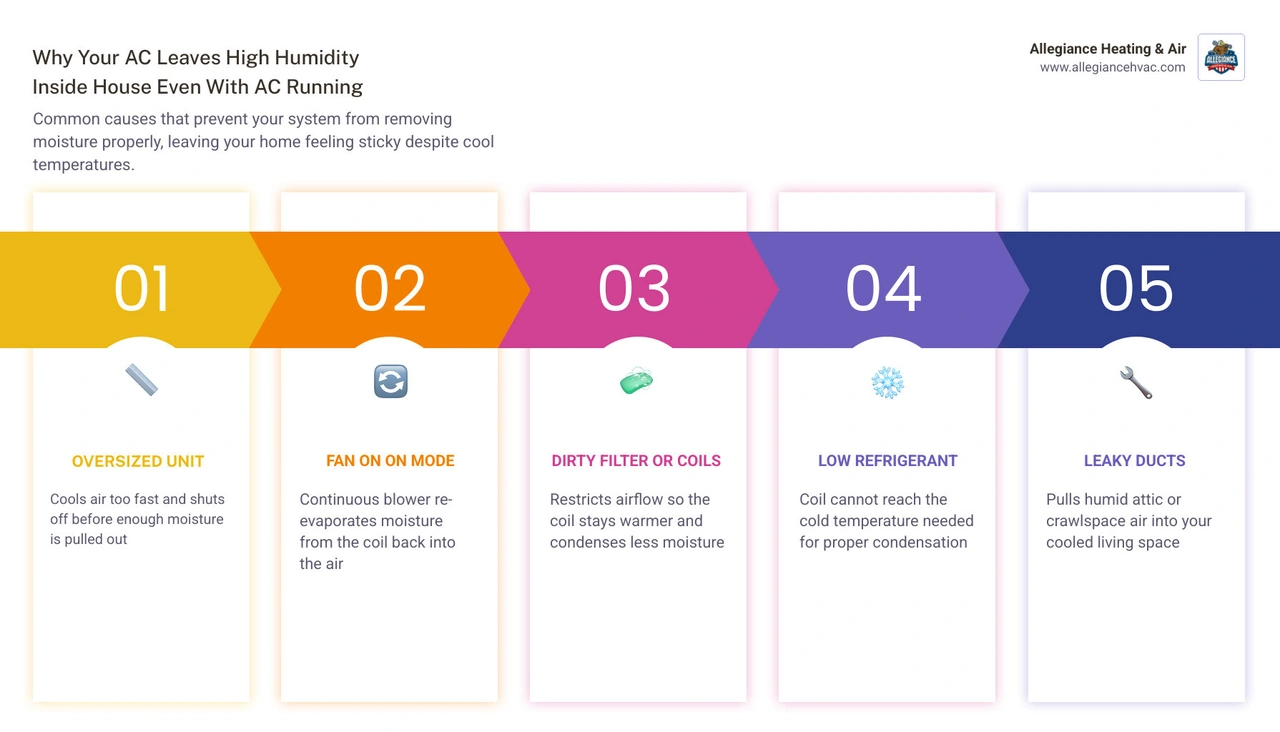
• Oversized AC unit — What's Going Wrong: Cools too fast, shuts off before removing moisture
• Thermostat fan set to "ON" — What's Going Wrong: Blower runs between cycles, pushing moisture back into the air
• Dirty air filter or coils — What's Going Wrong: Restricts airflow, reduces the AC's ability to dehumidify
• Low refrigerant — What's Going Wrong: Coil can't get cold enough to condense moisture effectively
• Leaky ductwork — What's Going Wrong: Humid air from attics or crawlspaces enters the system
• Frozen evaporator coil — What's Going Wrong: Stops moisture removal entirely
• High outdoor humidity — What's Going Wrong: Overwhelms the AC's dehumidification capacity
Your AC does two jobs at once: it cools the air (removing heat) and dehumidifies it (removing moisture). When something goes wrong with either function, your home can feel cool and sticky at the same time. The good news is that most causes are diagnosable and fixable — and some you can address yourself today.
Ideal indoor relative humidity should stay between 30% and 50%. Above 60%, you're in mold-risk territory, and the air will feel noticeably warmer than the thermometer suggests. That's because high humidity slows down how quickly sweat evaporates from your skin — the same reason a humid 75°F day feels far worse than a dry one.
In the sections below, we'll walk you through exactly why your AC may be cooling without dehumidifying, and what you can do about it.
Understanding the Science: How Your AC Controls Moisture
To understand why you have high humidity inside house even with AC running, it helps to look at how an air conditioner manages moisture. Many homeowners assume that an AC only blows cold air into a room. In reality, the cooling process is actually a heat and moisture removal process.
Inside your indoor HVAC unit sits the evaporator coil. As your system runs, cold chemical refrigerant flows through this coil. The blower fan draws warm, humid air from your living spaces and pushes it directly across these cold metal fins.
When that warm, moist air hits the freezing evaporator coil, it undergoes a rapid temperature drop. If the surface temperature of the coil is below the "dew point" of the indoor air, the water vapor in the air condenses into liquid water on the coil. Think of it like a cold glass of iced sweet tea sitting on a porch in Southern Indiana on a hot afternoon; moisture from the surrounding air clings to the outside of the glass.
This liquid condensation drips off the coil, falls into a drain pan, and flows safely out of your home through a condensate drain line. By removing this water vapor, your system performs "latent cooling" (lowering the moisture content), while simultaneously performing "sensible cooling" (lowering the actual temperature).
Understanding the balance of Proper Humidity Control Importance is essential because cooling the temperature without removing the water vapor leaves you with cold, clammy air.
• Primary Goal — Sensible Cooling: Lowers the actual air temperature — Latent Cooling: Lowers the moisture (humidity) in the air
• How It's Measured — Sensible Cooling: Thermometer degrees Fahrenheit (°F) — Latent Cooling: Relative Humidity percentage (% RH)
• Physical Process — Sensible Cooling: Heat exchange across the evaporator coil — Latent Cooling: Condensation of water vapor on the cold coil
• Comfort Impact — Sensible Cooling: Stops you from feeling hot — Latent Cooling: Stops the air from feeling sticky and muggy
• System Requirement — Sensible Cooling: Requires cold refrigerant and basic airflow — Latent Cooling: Requires sustained runtimes to reach the dew point
If your system is only performing sensible cooling but failing at latent cooling, you end up with high relative humidity. For proper moisture removal, your AC must meet three specific conditions: the coil must get cold enough, the air must stay in contact with the coil long enough, and the condensed water must drain away properly.
Why is There High Humidity Inside House Even With AC Running?
When your air conditioner runs but fails to bring the indoor relative humidity down to a comfortable level, it is usually because of a mechanical imbalance, an airflow restriction, or a system design flaw.
Here are the primary culprits we look for during an inspection:
• Short Cycling: An air conditioner needs to run continuously for at least 10 to 15 minutes to get the evaporator coil cold enough to start condensing water vapor. If your system turns on, runs for 5 minutes, and shuts off, it only cools the air temperature without ever reaching the dehumidification phase.
• Dirty Air Filters: A clogged filter restricts the amount of air flowing across your evaporator coil. Without enough warm air passing over it, the coil can get too cold and freeze over, or the system simply won't process enough air volume to pull out the moisture.
• Frozen Evaporator Coils: When airflow is restricted or refrigerant is low, the moisture on your evaporator coil can freeze into a solid block of ice. Once the coil is iced over, it can no longer absorb heat or condense water vapor, leaving your home muggy and warm.
• Low Refrigerant: Refrigerant does not get used up over time; if it is low, you have a leak. Low refrigerant levels prevent the evaporator coil from reaching the correct temperature to condense moisture efficiently.
• Duct Leaks: If your ductwork has cracks or disconnected seams in unconditioned spaces like your attic or crawlspace, the system can pull highly humid outdoor air directly into your home's air stream, overwhelming the AC.
To understand how outdoor conditions and system performance interact, read more about How Humidity and Temperature Swings Affect Your HVAC.
How an Oversized AC Unit Causes High Humidity Inside House Even With AC Running
In the HVAC industry, bigger is not always better. Many homeowners assume that a larger air conditioner will cool their home faster and keep them more comfortable. In reality, an oversized system is one of the most common causes of indoor humidity issues.
When we design a home comfort system, we use a detailed calculation called a Manual J load calculation. This takes into account your home's square footage, insulation levels, window placement, and local climate to determine the exact size system you need.
If an AC is oversized, it will cool your home incredibly fast. A system that should run for a steady 20 minutes might reach your thermostat's target temperature in just 5 to 8 minutes. This rapid cooling cycle is called short cycling.
Because the system shuts off so quickly, it never runs long enough to pull significant moisture out of the air. It satisfies the thermostat's temperature setting, but leaves the air thick and muggy. If you are experiencing this, exploring how we approach Optimizing Indoor Air Quality During Summer can help you understand the dynamics of proper system runtimes.
Thermostat Settings That Lead to High Humidity Inside House Even With AC Running
Sometimes, the cause of your home's sticky air isn't a mechanical failure at all, but a simple setting on your thermostat.
Most thermostats have a fan setting that can be toggled between AUTO and ON:
• The "ON" Setting: This tells your indoor blower fan to run continuously, 24 hours a day, regardless of whether the outdoor compressor is actually cooling the air.
• The "AUTO" Setting: This tells the blower fan to run only when the system is actively cooling the air.
If you set your fan to ON in a humid climate like southern Indiana, you will likely experience high indoor humidity. When your AC finishes a cooling cycle, the compressor shuts off, but the evaporator coil is still dripping wet with condensed water.
If the blower fan keeps running, it blows dry air over that wet coil, re-evaporating all that moisture back into your ductwork and pushing it right back into your living spaces. Within minutes, your indoor relative humidity will spike. Keeping your fan set to AUTO allows that moisture to drain away safely before the next cooling cycle begins.
For more information on setting up your thermostat for comfort, check out our guide on the Best Humidity Levels for Your Home.
Practical Solutions and When to Call a Professional
If you are dealing with a sticky, clammy house, there are several troubleshooting steps you can take before calling in our team:
1. Check Your Thermostat Fan Setting: Ensure the fan is set to AUTO, not ON.
2. Inspect and Replace Your Air Filter: A dirty filter should be replaced immediately. We recommend checking your filter every 30 days during peak cooling season.
3. Ensure Vents Are Open and Clear: Make sure supply registers and return grilles are not blocked by furniture, drapes, or rugs, as this restricts vital airflow.
4. Check the Condensate Drain: Look at your outdoor condensate drain line to ensure water is dripping out when the AC runs. If the line is dry during a long run, or if you notice water pooling around your indoor unit, you may have a clogged drain line.
5. Seal Air Leaks: Use caulk and weatherstripping around doors and windows to prevent humid outdoor air from seeping into your home.
If you've completed these basic steps and your home still feels muggy, it's time to seek professional help. If you live in Clarksville or Jeffersonville, we recommend scheduling a professional assessment:
• Home Air Quality Test Clarksville IN
• Home Air Quality Test Jeffersonville IN
Our professional technicians can perform detailed static pressure tests, measure refrigerant charge, and inspect your ductwork for leaks to find the exact root cause of your humidity issues.
Long-Term Solutions for Persistent Moisture
For homes in areas prone to heavy summer humidity, standard air conditioners sometimes need a little extra help to keep indoor air comfortable.
Here are two highly effective, long-term upgrades to consider:
• Whole-House Dehumidifiers: Unlike noisy portable dehumidifiers that only treat a single room and require constant emptying, a whole-house dehumidifier is installed directly into your existing HVAC ductwork. It works in tandem with your air conditioner, pulling moisture from the air before it is distributed throughout your home.
• Variable-Speed AC Systems: Traditional single-stage air conditioners are either 100% on or 100% off. Variable-speed systems can run at lower capacities (like 40% or 50%) for longer, continuous periods. This allows them to maintain a highly stable indoor temperature while maximizing the time air spends passing over the cold evaporator coil, resulting in outstanding dehumidification.
If you struggle with seasonal moisture imbalances where your home is too humid in the summer but dry in the winter, learning about Dealing with Dry Air can help you understand year-round indoor air quality management.
We also offer specialized humidity control solutions across our southern Indiana service areas:
• Whole Home Humidifiers Sellersburg IN
• Whole Home Humidifiers Clarksville IN
• Whole Home Humidifiers Jeffersonville IN
Frequently Asked Questions About Indoor Humidity
What is the ideal indoor humidity level for a home?
For optimal comfort, health, and structural protection, you should maintain your indoor relative humidity between 30% and 50%.
When humidity levels rise above 55% or 60%:
• Mold and Mildew: Spores find ideal conditions to grow on drywall, carpet, and in closets.
• Dust Mites: These common allergens thrive in humid environments.
• Structural Damage: High moisture can cause wood furniture to warp, hardwood floors to cup, and paint to peel.
• Perceived Temperature: Damp air prevents sweat evaporation, making a 72°F room feel like 76°F.
Can a dirty air filter cause high indoor humidity?
Yes, absolutely. A dirty air filter restricts the volume of air flowing through your HVAC system. When airflow is choked, the air spends too much time sitting against the evaporator coil, which can cause the moisture on the coil to freeze.
Once ice forms, the cooling and dehumidification process stops entirely. Even if the coil doesn't freeze, reduced airflow means your system is processing less total air volume, meaning it cannot remove enough gallons of water from your home's air during its run cycle.
Will lowering my thermostat temperature reduce humidity?
Generally, no. Trying to fix a humid home by cranking the thermostat down to 68°F is inefficient and usually unsuccessful. While it might force your system to run a bit longer, it also wastes energy.
If your system is oversized, lowering the thermostat will still result in short run cycles that fail to dehumidify properly, leaving you with a cold, clammy house. The key to moisture removal is runtime duration, not colder temperatures.
Conclusion
Dealing with high humidity inside house even with AC running can make your home feel uncomfortable and put your indoor air quality at risk. Whether your issue is caused by a simple thermostat setting, a dirty evaporator coil, or an oversized system that is short cycling, finding the right solution is essential for your family's comfort.
At Allegiance Heating & Air, LLC, we have been "Taking Home Comfort Under Our Wing" as a family-owned business since 2005. Serving our neighbors in Greenville, IN, and surrounding southern Indiana communities, our trusted professional technicians are dedicated to honest, transparent service and total customer satisfaction.
If you are ready to get rid of that sticky indoor air once and for all, contact us to explore our professional solutions, including Whole-House Dehumidification Clarksville IN. Let us help you breathe easier and enjoy true, crisp comfort all summer long!
Contact Us Or Schedule Expert Service
Other Blogs
ready to transform your home?
Discover our exceptional home services tailored to meet your needs and enhance your living space.
WHAT OUR CLIENTS HAVE TO SAY ABOUT US

We had a complete HVAC system and a hot water heater installed. The guys were professional, well mannered, and completed the work in a timely manner. Would definitely use them again.
I was nervous at first because my AC broke in the middle of 80 degree weather which is strange for April, but Allegiance Heating and Air was incredibly prompt and professional. The technician arrived within an hour, explained the problem clearly, and completed the repair. The technician , Mr. Garrett Moon was a very nice and courteous young man. He found the problem and fixed it within a timely manner. I highly recommend them for any heating or cooling needs. I’ll definitely give them a call again should I ever have another issue, but hopefully not. Knock on wood 😁. Give them a call… you won’t be disappointed!
From the moment I called to schedule a service, the team was quick to respond and arrived right on time. The technician was professional, friendly, and clearly knowledgeable about my heating system. He explained the repair options in plain language and completed the job efficiently. I appreciated the reliable service and the fact that the work was done the same day. I would definitely recommend Allegiance Heating and Air for any residential HVAC needs.
5/5 stars – I was very impressed with the efficient, affordable and timely service from Allegiance Heating and Air. The technician arrived on time, and performed the service quickly, no repairs needed at this time. Communication was clear and the whole experience felt hassle‑free. I would definitely recommend them for any residential HVAC needs.
Knowledgeable, experienced individual.
Explains Allegiance Heating and Air was incredibly reliable, professional and affordable. They arrived right on time, kept the work area clean and finished the furnace repair quickly. The technician explained everything clearly and the price was a great value. If happiness had a location on Google Maps, it would be here.
Gilbert had to go above and beyond because York is no longer making the part for my furnace. But he was able to find a way to construct a housing bracket for my furnace. Ingenuity, determination and integrity is what finally got my furnace fixed. Gilbert is truly a one of a kind technician.
Thank you for always going the extra mile. Gilbert is always respectful and helpful with any concerns.
"Great service, most knowledgeable and capable HVAC business in Kentuckiana!! Pete Flemming and Bryan the owner, are HVAC encyclopedias. They have the highest integrity of any HVAC business I have ever used. Allegiance has put numerous units in for me over the last 17 years. I will continue to use and trust them."
"Fast response from Allegiance when our heat was out on New Year’s day! Service technician was friendly and efficient. He took the time to explain the problem, tell us about the temporary fix and the plan for permanent repair. We were impressed!"
"Love Allegiance! Their technicians, in particular Benjamin, explain everything. Fast and thorough. A/C was out on a Sunday. Called Allegiance and within a few hours Benjamin arrived. Such a comfort as he was the one who last serviced our units. He quickly replaced part and cooling is restored!"
"My heat pump went out and I had to call after hours. The technician (Garrett) was outstanding and thorough. He got my system up and working until Monday and gave me several options of units. Also took the time to explain the issue to my Home warranty company. I highly recommend this company."
"Right on time :) respectful, fast, and polite. Even gave my fur babies some attention."
"Had Garrett out today to fix our AC. Fantastic tech. He showed up exactly when he said he would and kept us informed of what he was checking and what he found. Highly recommend!"
"Lucas with Allegiance showed up on time as promised, was professional and extremely patient and responsive with all my questions. He took care of the issue, and I feel he was trustworthy! He had us back to cool and comfortable on one of the hottest days of the year."
"Lucas did a great job! Very professional and expedient. Explained the process very well and represented Allegiance as a truly professional and reputable company."
"Arrived on time and work diligently to fix issue. These guy are great. Worked quickly to resolve my issues."
"Lucas was great - he spent a lot of time trying to figure out what was going on and explained everything he was doing. I trust Allegiance and wouldn’t want anyone else working on/in my house!!"

RELATED ARTICLES
Comprehensive Guide to Air Conditioner Repair, Replacement, and Maintenance

Home Humidifiers: Key to Comfort and Health in Your Living Space