
Why Every Homeowner Needs a Summer AC Maintenance Checklist Before the Heat Hits
A summer AC maintenance checklist for homeowners is the most straightforward way to keep your cooling system running reliably when Indiana temperatures climb and humidity makes every degree count.
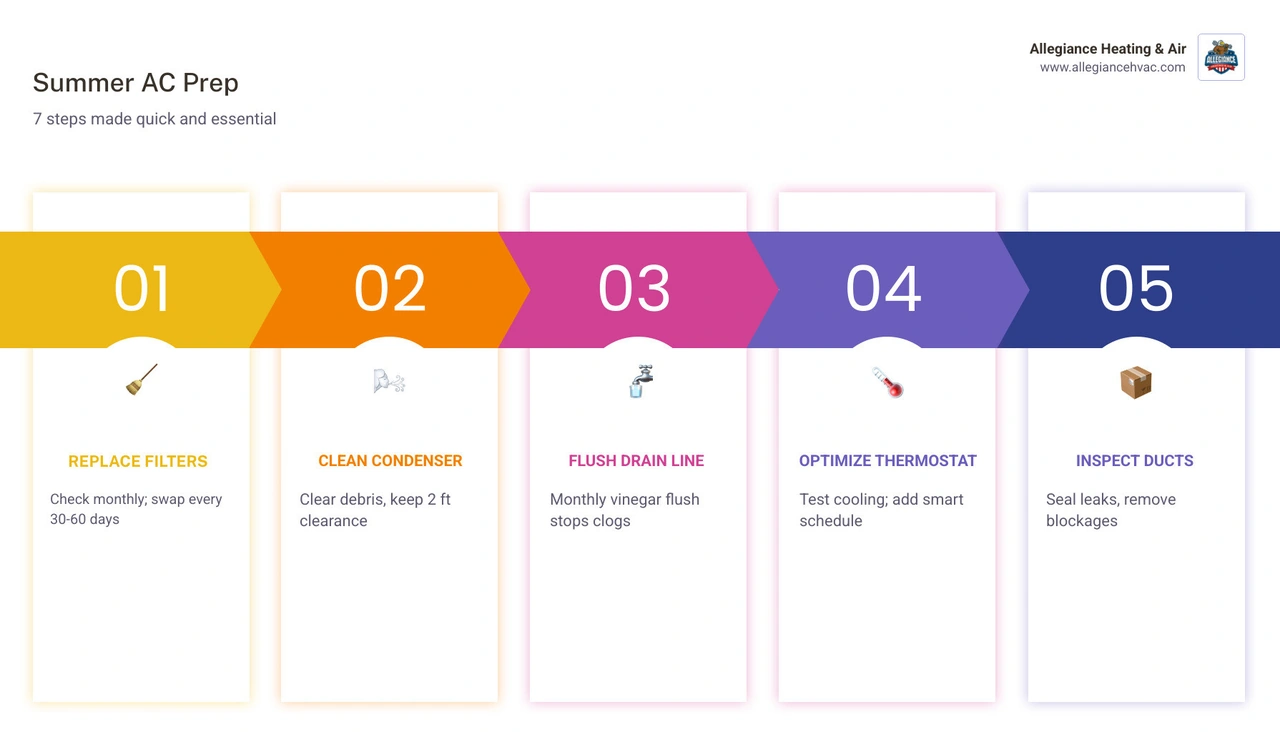
Here are the 7 key steps to prepare your AC for summer:
1. Replace or clean air filters - Check monthly during peak season; replace every 30-60 days
2. Clear and clean the outdoor condenser unit - Remove debris and maintain 2 feet of clearance on all sides
3. Inspect and clear the condensate drain line - Flush monthly with diluted white vinegar to prevent clogs
4. Optimize thermostat settings - Test cooling mode and consider upgrading to a smart thermostat
5. Check vents, registers, and ductwork - Look for blockages and seal any visible duct leaks
6. Inspect refrigerant lines and insulation - Look for cracked or missing insulation on suction lines
7. Run a full system test - Complete a full cooling cycle before peak heat arrives and listen for unusual sounds
If your AC has been sitting mostly idle since last summer, it needs attention before the first real heat wave hits. Small problems that go unnoticed in May have a habit of turning into expensive emergencies in July. A neglected system doesn't just risk breaking down — it quietly loses efficiency, drives up your energy bills, and shortens the life of equipment that should last 12 to 15 years with proper care.
For Greenville, IN homeowners and the surrounding southern Indiana communities, humid summers put real stress on cooling systems. That combination of heat and moisture accelerates wear, promotes algae growth in drain lines, and pushes systems that are already underperforming right to the edge.
The good news is that most of the work on a summer AC maintenance checklist is simple, quick, and completely doable before the hottest months arrive.
Essential summer ac maintenance checklist for homeowners terms:
• Find air conditioning service providers in Marysville, IN.
• I need someone to fix a refrigerant leak in my AC unit in Lanesville, IN.
Why a Summer AC Maintenance Checklist for Homeowners is Essential
Taking care of your air conditioning system isn't a luxury; it's a fundamental part of responsible homeownership. When you follow a consistent routine, you directly protect one of the largest financial investments in your home. Understanding that Regular Maintenance for AC Matters can save you from a world of mid-summer frustration.
There are three major areas where seasonal maintenance makes a massive impact:
• System Lifespan: A typical central air conditioning unit is engineered to last between 12 and 15 years. However, without regular check-ups, that lifespan can easily be cut short. By reducing wear and tear, you are actively Prolonging Your AC's Lifespan to get the most out of your investment.
• Energy Bills: When dust, dirt, and mechanical strain force your AC to work harder, it consumes significantly more electricity. A well-maintained system runs lean and clean, keeping your monthly utility bills manageable.
• Indoor Air Quality (IAQ): Your HVAC system doesn't just cool your air; it circulates and filters it. Neglecting maintenance allows dust, pollen, and mold spores to settle in the system and blow right back into your living spaces.
By spending a little time on preventative care as we head into the peak cooling season of June 2026, you ensure your home remains a cool, healthy sanctuary.
DIY vs. Professional Tasks on Your Summer AC Maintenance Checklist for Homeowners
While homeowners can easily handle several essential maintenance tasks, other complex procedures require specialized tools and expert training. Attempting to perform advanced mechanical or electrical work yourself can void your manufacturer's warranty, damage your system, or even pose a safety hazard.
To help you navigate what you can safely do yourself and when you should call in our experienced team, we have put together this quick-reference table:
• Inspecting and replacing air filters — Professional Technician Tasks: Checking and recharging refrigerant levels
• Clearing debris around the outdoor unit — Professional Technician Tasks: Testing capacitors and electrical relays
• Flushing the condensate drain line with vinegar — Professional Technician Tasks: Cleaning and sanitizing the indoor evaporator coil
• Wiping down supply vents and return grilles — Professional Technician Tasks: Measuring airflow and testing electrical draw
• Checking and adjusting thermostat settings — Professional Technician Tasks: Inspecting the heat exchanger and blower motor
• Visually inspecting visible ductwork for leaks — Professional Technician Tasks: Deep-cleaning condenser coils with specialized solutions
7 Steps to Prepare Your AC for a Humid Indiana Summer

When the summer sun beats down on southern Indiana, your outdoor condenser unit becomes the unsung hero of your home comfort. It is responsible for releasing the heat collected from inside your house to the outdoors. If it is clogged with dirt, grass clippings, or overgrown bushes, that heat gets trapped, forcing your system to run longer and hotter.
Reviewing Ways to Make Sure Your HVAC System is Ready for Summer is the first step toward achieving uninterrupted summer comfort.
How to Use This Summer AC Maintenance Checklist for Homeowners
To get the best results, treat this checklist as a seasonal transition guide. Ideally, you should perform the major cleanup and inspection tasks in late spring, around April or May. Once the summer heat officially arrives in June, transition to a monthly monitoring routine. Checking your air filter and drain lines once every 30 days throughout the peak cooling season will keep your system running smoothly without any unexpected surprises.
1. Replace or Clean Air Filters Regularly
The single most important DIY task on your checklist is maintaining your air filter. When an air filter becomes clogged with dust, pet hair, and airborne particles, it restricts airflow. Airflow problems can reduce your system's efficiency by up to 15 percent and put immense strain on your blower motor.
When choosing a filter, pay attention to the Minimum Efficiency Reporting Value (MERV) rating:
• MERV 1 to 4: Standard fiberglass filters that capture large particles but offer minimal protection against smaller allergens.
• MERV 8 to 11: The ideal "sweet spot" for most residential homes. These filters efficiently capture dust, pollen, and pet dander without restricting airflow.
• MERV 13 and above: High-efficiency filters that can capture microscopic particles. However, if your HVAC system isn't specifically designed for them, they can actually restrict airflow too much, causing your system to work harder.
During peak summer usage, check your filter every 30 days. If you have pets, allergies, or live in a dusty area, be prepared to replace standard 1-inch filters every 30 to 45 days to keep your indoor air fresh and your energy bills low.
2. Clear and Clean the Outdoor Condenser Unit
Your outdoor unit needs room to breathe. Over the fall and winter, leaves, twigs, and dirt accumulate around the base of the condenser. Additionally, spring weeds and shrubs can quickly grow too close to the unit.
Follow these steps to safely clean your outdoor condenser:
1. Turn off the power: For safety, shut off the power to your AC at the outdoor disconnect box or your home's main electrical panel.
2. Clear a buffer zone: Maintain at least 2 feet of clear space on all sides of the unit. Trim back bushes, weeds, and low-hanging tree branches.
3. Remove debris: Gently clear away leaves, grass clippings, and twigs from the top and sides of the metal cabinet.
4. Rinse the coils: Using a standard garden hose with a gentle spray nozzle, rinse the outdoor coils from the top down. Never use a pressure washer, as the high-pressure stream will instantly bend the delicate aluminum fins, permanently restricting airflow.
3. Inspect and Clear the Condensate Drain Line
As your AC cools your home, it also removes moisture from the humid Indiana air. This moisture collects in a drain pan and flows out of your home through a PVC condensate drain line. Because this line is constantly warm and wet, it is a prime breeding ground for algae, mold, and slime.
If the drain line becomes clogged, water will back up into the drain pan, which can overflow and cause severe water damage to your drywall, ceilings, and floors.
To prevent this, perform a simple monthly flush:
• Locate the condensate drain T-pipe (usually near your indoor air handler).
• Remove the cap and pour about 1/4 to 1/2 cup of distilled white vinegar down the line.
• Let it sit for 30 minutes, then flush it with warm water to clear out any lingering buildup.
If you notice standing water in your drain pan, your line is likely already clogged. You can use a wet/dry vacuum attached to the outdoor end of the drain line to help pull the blockage through.
4. Optimize Thermostat Settings and Upgrades
Your thermostat is the brain of your cooling system. Setting it correctly can lead to massive energy savings without sacrificing your comfort.
According to energy experts, setting your thermostat back 10 to 15 degrees for 8 hours a day (such as when you are at work) can save you about 1% on your cooling bills per degree. For optimal efficiency during the summer, aim for 78°F when you are at home, and set it higher when you are away.
If you are still using an old manual thermostat, upgrading to a smart or programmable model is one of the smartest investments you can make. Smart thermostats can reduce cooling costs by 10% to 12% annually. They learn your daily schedule, allow you to control your home's temperature from your smartphone, and use geofencing to automatically save energy whenever you leave the house.
5. Check Vents, Registers, and Ductwork
For your AC to cool your home evenly, air must circulate freely. Walk through your home and inspect all supply vents and return air grilles to ensure they are completely open and unobstructed by furniture, curtains, or rugs.
Note: A common misconception is that closing vents in unused rooms saves energy. In reality, closing vents increases pressure within your ductwork, forcing your AC to work harder and potentially causing the evaporator coil to freeze. Never close more than 20% of your home's vents.
Additionally, keep an eye on your visible ductwork in unconditioned spaces like your basement, attic, or crawlspace. The average forced-air system loses 20 to 30 percent of conditioned air to duct leakage. If you find loose joints or small gaps, sealing them with high-quality duct mastic or foil tape can improve your system's overall performance.
6. Inspect Refrigerant Lines and Insulation
Your air conditioner relies on chemical refrigerant to move heat out of your home. This refrigerant flows through two copper lines that connect your indoor evaporator coil to your outdoor condenser.
The larger copper line—often called the suction line—carries cold refrigerant and should be wrapped in a thick sleeve of black foam insulation. This insulation prevents the line from absorbing heat from the outdoor air and stops condensation from dripping inside your walls or attic.
Take a moment to inspect this foam sleeve. If you notice the insulation is cracked, crumbling, or missing entirely due to weather and UV exposure, it should be replaced. You can find replacement foam sleeves at any local hardware store; simply cut them to size and secure them with zip ties or weather-resistant tape.
7. Test Run the System Before Peak Heat
Don't wait for the first 90-degree day in June to find out if your air conditioner is working properly. Run a test cycle early in the season while temperatures are still mild:
1. Set your thermostat to "Cool" and lower the temperature setting to about 5°F below the current room temperature.
2. Listen closely as the indoor blower motor and the outdoor condenser turn on.
3. Let the system run for 15 to 20 minutes.
4. Hold your hand up to your supply vents. The air coming out should feel consistently cold. (A properly functioning system should produce a temperature differential of 15°F to 20°F between the air entering the return grille and the air exiting the supply vents).
5. Walk around your home to check for even airflow and listen for any unusual rattling, squealing, or clicking sounds.
When to Call a Professional for Your Summer AC Maintenance Checklist for Homeowners
While DIY maintenance keeps your system clean on the outside, a professional eye is required to ensure the internal, high-voltage, and chemical components are operating safely and efficiently. Refer to our Air Conditioner Maintenance Guide to understand the deeper technical aspects of your cooling system.
Warning Signs Your AC Needs Professional Repair
If you notice any of the following warning signs during your DIY inspection or test run, turn your system off and call for professional service immediately:
• Warm Air: If your AC runs continuously but only blows lukewarm or warm air, you could be dealing with a failed compressor, a refrigerant leak, or a broken return duct.
• Short-Cycling: When an AC turns on and off rapidly every few minutes, it puts extreme stress on the compressor and fan motors. This is often caused by a faulty sensor, electrical issues, or a severely restricted system.
• Strange Noises: Squealing, grinding, clanking, or loud buzzing noises indicate mechanical wear, such as failing motor bearings or a loose blower wheel.
• Frozen Coils: If you see ice forming on your outdoor refrigerant lines or your indoor evaporator coil, turn the system off immediately. Running an AC with frozen coils can destroy the compressor.
• Frequent Breaker Trips: If your AC trips your home's circuit breaker, do not keep resetting it. This is a sign of an electrical short or an overworked compressor drawing too much current.
What is Included in a Professional AC Tune-Up?
When our certified technicians perform a professional tune-up, we go far beyond basic cleaning. We conduct a rigorous, multi-point inspection designed to maximize efficiency and catch minor issues before they cause major breakdowns.
Our professional service includes:
• Checking refrigerant charge levels and testing for leaks.
• Testing electrical connections, measuring voltage, and checking motor amp draw.
• Testing and inspecting critical capacitors (the most common cause of sudden system failures).
• Deep-cleaning the indoor evaporator and outdoor condenser coils to restore optimal heat transfer.
• Inspecting the condensate drain pan, testing safety float switches, and clearing the entire drain line.
• Calibrating the thermostat to ensure accurate temperature control.
• Cleaning and adjusting blower motor components to optimize airflow.
Scheduling this service in the spring is highly recommended. For more details on what to expect, check out our HVAC Spring Checklist and read our guide on Essential Air Conditioner Maintenance.
Frequently Asked Questions About Summer AC Maintenance
How often should I change my AC filter during peak summer?
During peak summer usage (June through August), you should check your air filter every 30 days. For standard 1-inch pleated filters, replace them every 30 to 60 days. If you have multiple pets, suffer from severe allergies, or live in an area with high pollen or construction dust, you will likely need to change your filter every 30 days to maintain healthy airflow and clean indoor air.
Can a dirty AC coil increase my energy bills?
Absolutely. Dirty coils can reduce your AC's efficiency by 20% to 30%. When your outdoor condenser coil is coated in dirt, dust, or grass clippings, it acts as an insulating blanket, trapping heat inside the system. Your compressor has to run much longer and consume significantly more electricity to achieve the same cooling effect inside your home, leading to a noticeable spike in your monthly utility bills.
What is the best temperature setting for summer energy savings?
The U.S. Department of Energy recommends setting your thermostat to 78°F when you are at home during the summer. This setting provides a comfortable balance between cooling and energy conservation. When you are away from home for more than 4 hours, consider raising the thermostat to 82°F or 85°F to prevent your system from cooling an empty house.
Conclusion
As a family-owned business serving our southern Indiana neighbors since 2005, Allegiance Heating & Air, LLC is dedicated to "Taking Home Comfort Under Our Wing." We know exactly how intense our local summer humidity can get, and we want to help you make sure your cooling system is fully prepared to handle the heat.
Whether you need a hand with a stubborn condensate clog or want the peace of mind that comes with a comprehensive professional tune-up, our licensed and experienced technicians are ready to help. We are proud to provide honest, transparent, and customer-centric professional air conditioning services to keep your home perfectly comfortable all year long.
We proudly serve homeowners throughout our local communities. Contact us today to schedule your seasonal tune-up:
• AC Maintenance Clarksville IN
• AC Maintenance Sellersburg IN
Contact Us Or Schedule Expert Service
Other Blogs
ready to transform your home?
Discover our exceptional home services tailored to meet your needs and enhance your living space.
WHAT OUR CLIENTS HAVE TO SAY ABOUT US

We had a complete HVAC system and a hot water heater installed. The guys were professional, well mannered, and completed the work in a timely manner. Would definitely use them again.
I was nervous at first because my AC broke in the middle of 80 degree weather which is strange for April, but Allegiance Heating and Air was incredibly prompt and professional. The technician arrived within an hour, explained the problem clearly, and completed the repair. The technician , Mr. Garrett Moon was a very nice and courteous young man. He found the problem and fixed it within a timely manner. I highly recommend them for any heating or cooling needs. I’ll definitely give them a call again should I ever have another issue, but hopefully not. Knock on wood 😁. Give them a call… you won’t be disappointed!
From the moment I called to schedule a service, the team was quick to respond and arrived right on time. The technician was professional, friendly, and clearly knowledgeable about my heating system. He explained the repair options in plain language and completed the job efficiently. I appreciated the reliable service and the fact that the work was done the same day. I would definitely recommend Allegiance Heating and Air for any residential HVAC needs.
5/5 stars – I was very impressed with the efficient, affordable and timely service from Allegiance Heating and Air. The technician arrived on time, and performed the service quickly, no repairs needed at this time. Communication was clear and the whole experience felt hassle‑free. I would definitely recommend them for any residential HVAC needs.
Knowledgeable, experienced individual.
Explains Allegiance Heating and Air was incredibly reliable, professional and affordable. They arrived right on time, kept the work area clean and finished the furnace repair quickly. The technician explained everything clearly and the price was a great value. If happiness had a location on Google Maps, it would be here.
Gilbert had to go above and beyond because York is no longer making the part for my furnace. But he was able to find a way to construct a housing bracket for my furnace. Ingenuity, determination and integrity is what finally got my furnace fixed. Gilbert is truly a one of a kind technician.
Thank you for always going the extra mile. Gilbert is always respectful and helpful with any concerns.
"Great service, most knowledgeable and capable HVAC business in Kentuckiana!! Pete Flemming and Bryan the owner, are HVAC encyclopedias. They have the highest integrity of any HVAC business I have ever used. Allegiance has put numerous units in for me over the last 17 years. I will continue to use and trust them."
"Fast response from Allegiance when our heat was out on New Year’s day! Service technician was friendly and efficient. He took the time to explain the problem, tell us about the temporary fix and the plan for permanent repair. We were impressed!"
"Love Allegiance! Their technicians, in particular Benjamin, explain everything. Fast and thorough. A/C was out on a Sunday. Called Allegiance and within a few hours Benjamin arrived. Such a comfort as he was the one who last serviced our units. He quickly replaced part and cooling is restored!"
"My heat pump went out and I had to call after hours. The technician (Garrett) was outstanding and thorough. He got my system up and working until Monday and gave me several options of units. Also took the time to explain the issue to my Home warranty company. I highly recommend this company."
"Right on time :) respectful, fast, and polite. Even gave my fur babies some attention."
"Had Garrett out today to fix our AC. Fantastic tech. He showed up exactly when he said he would and kept us informed of what he was checking and what he found. Highly recommend!"
"Lucas with Allegiance showed up on time as promised, was professional and extremely patient and responsive with all my questions. He took care of the issue, and I feel he was trustworthy! He had us back to cool and comfortable on one of the hottest days of the year."
"Lucas did a great job! Very professional and expedient. Explained the process very well and represented Allegiance as a truly professional and reputable company."
"Arrived on time and work diligently to fix issue. These guy are great. Worked quickly to resolve my issues."
"Lucas was great - he spent a lot of time trying to figure out what was going on and explained everything he was doing. I trust Allegiance and wouldn’t want anyone else working on/in my house!!"

RELATED ARTICLES

The Golden Retriever Effect: Why Pet Owners Need a Different Air Filter Strategy in August
No Waiting: Get Your Furnace Fixed Today in New Albany