


Why Humidity Is the Hidden Factor Behind Your Home's Comfort and HVAC Performance
How humidity affects your HVAC and comfort is something most homeowners in Greenville, IN don't think about until something feels off — the air is sticky, the house won't cool down properly, or the heating bill spikes for no obvious reason. Temperature gets all the attention, but humidity is quietly running the show in the background.
Here's the short answer:
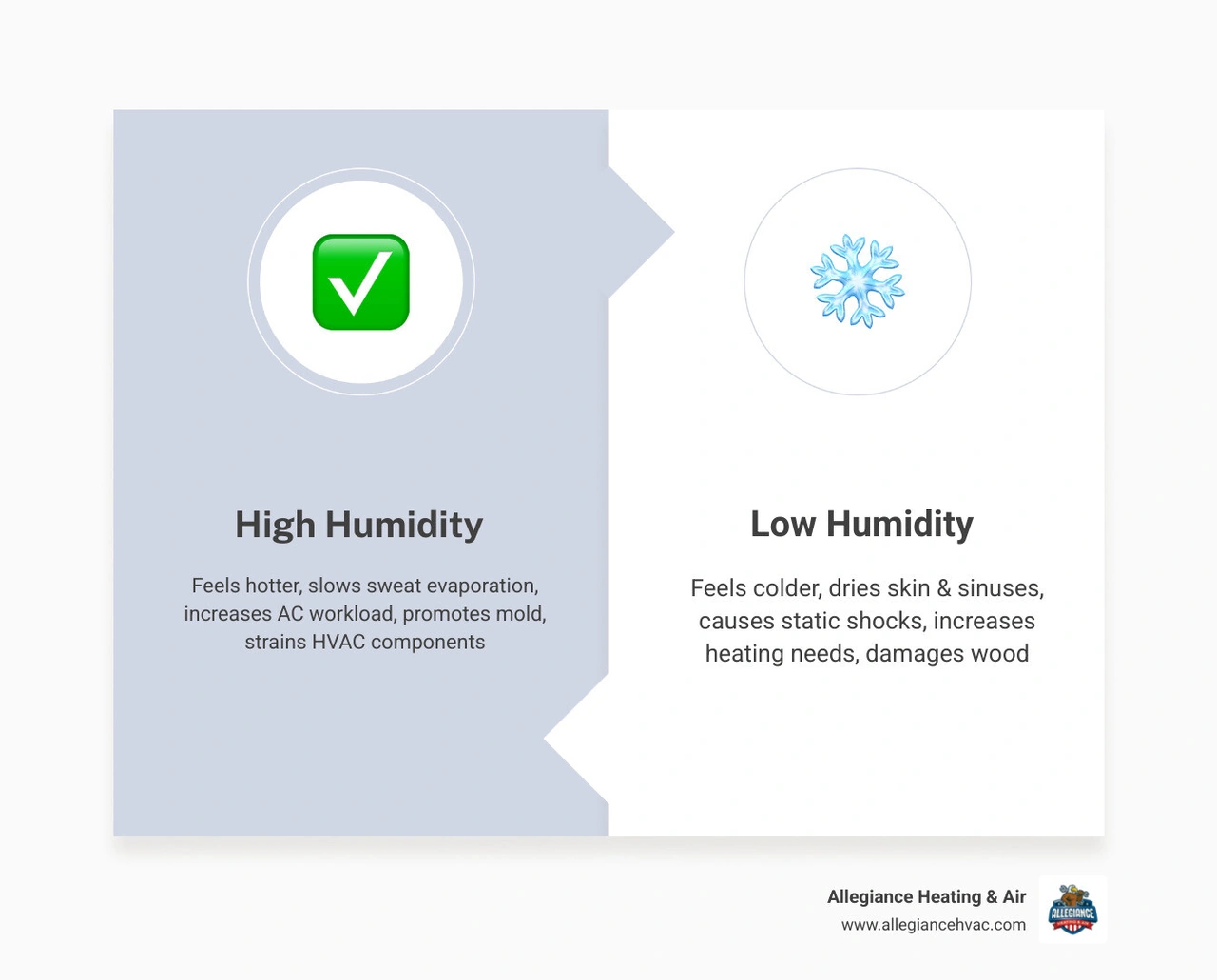
• Too much humidity makes your home feel hotter than it actually is, forces your AC to work harder, promotes mold growth, and wears out your system faster
• Too little humidity makes your home feel colder, dries out skin and sinuses, causes static electricity, and can crack wood floors and furniture
• The sweet spot is between 30% and 50% relative humidity indoors, year-round — a range recommended by the EPA for both health and system efficiency
• Your HVAC system manages both temperature and moisture, and when humidity is out of balance, the whole system pays the price
Think of it this way: on a muggy summer day, 75°F can feel unbearable. On a dry day at the same temperature, it feels perfectly comfortable. That difference is humidity at work — specifically, how moisture in the air slows down your body's natural cooling process through sweat evaporation.
The same principle applies inside your home. When indoor humidity is too high, your air conditioner has to remove moisture and cool the air at the same time — a dual challenge that increases energy use, extends run cycles, and strains critical components like the compressor and evaporator coil. When humidity is too low in winter, your heating system can't make the air feel warm enough, so you crank the thermostat higher than you need to.
In this guide, we'll break down exactly what's happening — season by season, system by system — and what you can do about it.
Understanding How Humidity Affects Your HVAC and Comfort
To truly master your home’s environment, we have to look at the science of "psychrometrics." This is just a fancy term for the study of gas-vapor mixtures—specifically, how air and water vapor interact. In our industry, we focus on relative humidity, which is the percentage of water vapor actually in the air compared to the maximum amount that air could hold at that specific temperature.
When we talk about heat, we deal with two types: sensible heat (what you see on the thermostat) and latent heat (the energy stored in water vapor). Your HVAC system has to manage both. If the air reaches its "dew point"—the temperature at which it can no longer hold all its water vapor—moisture starts to condense into liquid. This is why you see water dripping from your AC unit or fogging up your windows.
Understanding how humidity affects your HVAC and comfort starts with recognizing the symptoms of an imbalance.
• Physical Feeling — High Humidity (>60%): Sticky, "heavy" air, sweaty skin — Low Humidity (<30%): Dry skin, scratchy throat, bloody noses
• Home Signs — High Humidity (>60%): Musty odors, fogged windows, mold — Low Humidity (<30%): Static shocks, cracking wood, gaps in flooring
• HVAC Impact — High Humidity (>60%): Long cycles, clammy air, high bills — Low Humidity (<30%): Overworked furnace, thermostat battles
• Health Impact — High Humidity (>60%): Allergy flare-ups, dust mites — Low Humidity (<30%): Increased susceptibility to colds/flu
By maintaining proper humidity control importance, you aren't just protecting your equipment; you are managing the "heat index" inside your own living room. When the air is humid, your body's natural evaporative cooling (sweating) slows down. This makes the perceived temperature much higher than the actual number on the wall.
How Humidity Affects Your HVAC and Comfort During Summer
In Southern Indiana, our May 2026 summers can get notoriously muggy. When vapor pressure is high outside, that moisture tries to find its way into your cooler, lower-pressure home. This creates a massive "latent load" for your air conditioner.
Instead of just dropping the air temperature, your AC has to spend a significant portion of its energy turning water vapor into liquid on the evaporator coil. If the humidity is too high, you might notice your skin feels clammy even if the air is 72°F. This often leads homeowners to "thermostat chasing"—lowering the temperature to 68°F just to feel dry. This doesn't solve the moisture problem; it just makes your bills skyrocket.
In areas like Jeffersonville, we often recommend whole house dehumidification Jeffersonville IN to strip that moisture out before it enters your ductwork. This allows you to keep your thermostat at a higher, more efficient setting while still feeling crisp and cool.
How Humidity Affects Your HVAC and Comfort in the Winter
Winter brings the opposite problem. Cold air naturally holds very little moisture. When we take that dry outdoor air and heat it up with a furnace, the relative humidity drops even further—sometimes as low as 10-15%, which is drier than the Sahara Desert!
This parched air acts like a sponge, sucking moisture out of everything it touches: your skin, your mucus membranes, and even your wooden furniture. Dealing with dry air is essential for thermal comfort because dry air causes moisture to evaporate off your skin rapidly, which makes you feel chilled even if the room is 70°F. You’ll find yourself turning up the heat just to stop shivering, leading to unnecessary energy consumption and heat loss through the home’s envelope.
The Impact of High Moisture on System Performance and Efficiency

High humidity is an invisible weight on your HVAC system. When your air conditioner has to process air with high moisture content, it has to run much longer cycles to reach the desired comfort level. This leads to several technical issues:
1. Component Strain: The compressor and fan motor have to work overtime. Over years of use, this extra runtime can shave years off your system's lifespan.
2. Short Cycling: If your system is powerful but the humidity is high, it might cool the room quickly and shut off before it has had enough time to pull moisture out of the air. This leaves you in a "cold and clammy" environment.
3. Airflow Resistance: A constantly soaking wet evaporator coil can actually restrict airflow if it’s not draining properly, or worse, become a breeding ground for biological growth.
4. Efficiency Drops: High humidity can reduce the effective "temperature drop" across your cooling coil. While a healthy system usually sees a 18-22°F difference between the intake and the vent, high humidity can cut that in half because the system is too busy dealing with latent heat (moisture) to focus on sensible heat (temperature).
Following the best humidity levels for your home is the best way to ensure your SEER2-rated equipment actually delivers the savings it promised. In fact, lowering indoor humidity by just a small margin can allow you to raise your thermostat by 2°F with no loss in comfort, which can trim your cooling costs by 6-10%.
Why Proper HVAC Sizing Matters for Moisture Control
One of the most common mistakes we see is the "bigger is better" mentality. If an HVAC unit is oversized for the home, it will reach the temperature setpoint far too quickly. Because dehumidification only happens while the system is running, a unit that only runs for 10 minutes at a time won't remove enough water.
We use a "Manual J" calculation to ensure every system we install in places like Clarksville is perfectly sized. A properly sized unit will run longer, steadier cycles that effectively "squeeze" the moisture out of the air. Modern technologies like variable-speed air handlers and inverter compressors are game-changers here. They can slow down to a "trickle" speed, providing constant dehumidification without overcooling the house. For those in particularly humid spots, whole house dehumidification Clarksville IN provides that extra layer of control that a standard AC simply can't match.
Health Risks and Indoor Air Quality Issues Caused by Imbalance
Your health is directly tied to the moisture in your air. When humidity stays above 50%, your home becomes a playground for dust mites and mold. Dust mites, the leading cause of indoor allergies, cannot survive in air that is kept below 50% relative humidity.
High moisture also leads to the proliferation of bacteria and can increase the "off-gassing" of Volatile Organic Compounds (VOCs) from carpets and furniture. This creates a "stuffy" atmosphere that can trigger asthma and other respiratory issues. Conversely, air that is too dry compromises your body's first line of defense: the mucus membranes in your nose and throat. When these dry out, you are more likely to catch seasonal colds or sinus infections.
Integrating whole house air filtration Sellersburg IN with your humidity control system ensures that even when the air is at the right moisture level, it is also free of the pathogens that thrive in imbalanced environments.
Concerned about the air quality in my house. Can anyone recommend advanced air purification services in Sellersburg?
If you're noticing musty smells or frequent allergy flare-ups in Sellersburg, it’s time to look beyond just a standard 1-inch filter. Advanced air purification involves a multi-step approach. While humidity control stops mold from growing, HEPA filtration and UV light systems capture and neutralize the airborne allergens and pathogens already present.
When comparing a whole house air purifier vs upgraded HVAC filter, the purifier offers a much more comprehensive solution for IAQ monitoring and pathogen reduction. It works in tandem with your dehumidifier to ensure your indoor environment is both dry and sterile.
Modern Solutions for Precision Humidity Management
Gone are the days of clunky portable units that you have to empty every four hours. Today’s whole-home solutions are integrated directly into your HVAC system.
• Smart Thermostats: Modern units now include built-in hygrometers. They can sense when the humidity is rising and tell your AC to run at a lower fan speed to maximize moisture removal.
• Humidistats: These act like a thermostat but for moisture, triggering your humidifier or dehumidifier independently of the temperature.
• Whole-Home Humidifiers: During the dry months, these add a controlled amount of water vapor directly into the heated air leaving your furnace. You can learn more about how whole home humidifiers help homes by preventing the structural and health issues caused by dry winter air.
I'm looking to upgrade my home's heating and moisture control. Who in Jeffersonville specializes in energy-efficient systems?
For our neighbors in Jeffersonville, we specialize in "system integration." This means we don't just swap out a furnace; we look at the whole picture. By installing whole home humidifiers Jeffersonville IN alongside high-efficiency heating systems, we create a climate that stays comfortable at lower temperatures, saving you money all winter long. We focus on Energy Star-certified equipment that qualifies for modern efficiency standards, ensuring your home is ready for the years ahead.
Frequently Asked Questions about Humidity and HVAC
What is the ideal indoor humidity level for comfort and health?
The EPA and industry experts generally recommend a range of 30% to 50%. However, this can be fine-tuned by season. In the summer, aiming for 45-50% keeps the air feeling dry and prevents mold. In the winter, you might drop this to 30-40% to prevent condensation on cold windows while still protecting your skin and woodwork.
Can a standard air conditioner handle high humidity on its own?
Yes, but only to a point. Dehumidification is a "by-product" of the cooling process. As warm air passes over the cold coils, moisture condenses. However, standard single-speed systems often don't run long enough to handle extreme Southern Indiana humidity. If your home feels "clammy" even when the AC is running, a supplemental whole-home dehumidifier is usually the best fix.
What are the signs that my home has a humidity problem?
• High Humidity: Foggy windows, musty "basement" smells, damp feeling on fabrics, and visible mold in corners or bathrooms.
• Low Humidity: Frequent static electricity shocks, chapped lips, "shrinking" or cracking wood floors, and feeling cold even when the heat is on.
Conclusion
Managing how humidity affects your HVAC and comfort is the secret to a truly happy home. At Allegiance Heating & Air, LLC, we’ve been "Taking Home Comfort Under Our Wing" since 2005. Based right here in Greenville, IN, our family-owned business understands the unique climate challenges of the Southern Indiana and Louisville areas.
Whether you need a routine maintenance check to ensure your coils are clean for the summer rush or you’re interested in whole house dehumidification Clarksville IN, our trusted, professional technicians are here to help. Don't let the moisture in the air dictate your comfort or your energy bills. Give us a call today and let us help you find your home's perfect balance.
Contact Us Or Schedule Expert Service
Other Blogs
ready to transform your home?
Discover our exceptional home services tailored to meet your needs and enhance your living space.
WHAT OUR CLIENTS HAVE TO SAY ABOUT US

We had a complete HVAC system and a hot water heater installed. The guys were professional, well mannered, and completed the work in a timely manner. Would definitely use them again.
I was nervous at first because my AC broke in the middle of 80 degree weather which is strange for April, but Allegiance Heating and Air was incredibly prompt and professional. The technician arrived within an hour, explained the problem clearly, and completed the repair. The technician , Mr. Garrett Moon was a very nice and courteous young man. He found the problem and fixed it within a timely manner. I highly recommend them for any heating or cooling needs. I’ll definitely give them a call again should I ever have another issue, but hopefully not. Knock on wood 😁. Give them a call… you won’t be disappointed!
From the moment I called to schedule a service, the team was quick to respond and arrived right on time. The technician was professional, friendly, and clearly knowledgeable about my heating system. He explained the repair options in plain language and completed the job efficiently. I appreciated the reliable service and the fact that the work was done the same day. I would definitely recommend Allegiance Heating and Air for any residential HVAC needs.
5/5 stars – I was very impressed with the efficient, affordable and timely service from Allegiance Heating and Air. The technician arrived on time, and performed the service quickly, no repairs needed at this time. Communication was clear and the whole experience felt hassle‑free. I would definitely recommend them for any residential HVAC needs.
Knowledgeable, experienced individual.
Explains Allegiance Heating and Air was incredibly reliable, professional and affordable. They arrived right on time, kept the work area clean and finished the furnace repair quickly. The technician explained everything clearly and the price was a great value. If happiness had a location on Google Maps, it would be here.
Gilbert had to go above and beyond because York is no longer making the part for my furnace. But he was able to find a way to construct a housing bracket for my furnace. Ingenuity, determination and integrity is what finally got my furnace fixed. Gilbert is truly a one of a kind technician.
Thank you for always going the extra mile. Gilbert is always respectful and helpful with any concerns.
"Great service, most knowledgeable and capable HVAC business in Kentuckiana!! Pete Flemming and Bryan the owner, are HVAC encyclopedias. They have the highest integrity of any HVAC business I have ever used. Allegiance has put numerous units in for me over the last 17 years. I will continue to use and trust them."
"Fast response from Allegiance when our heat was out on New Year’s day! Service technician was friendly and efficient. He took the time to explain the problem, tell us about the temporary fix and the plan for permanent repair. We were impressed!"
"Love Allegiance! Their technicians, in particular Benjamin, explain everything. Fast and thorough. A/C was out on a Sunday. Called Allegiance and within a few hours Benjamin arrived. Such a comfort as he was the one who last serviced our units. He quickly replaced part and cooling is restored!"
"My heat pump went out and I had to call after hours. The technician (Garrett) was outstanding and thorough. He got my system up and working until Monday and gave me several options of units. Also took the time to explain the issue to my Home warranty company. I highly recommend this company."
"Right on time :) respectful, fast, and polite. Even gave my fur babies some attention."
"Had Garrett out today to fix our AC. Fantastic tech. He showed up exactly when he said he would and kept us informed of what he was checking and what he found. Highly recommend!"
"Lucas with Allegiance showed up on time as promised, was professional and extremely patient and responsive with all my questions. He took care of the issue, and I feel he was trustworthy! He had us back to cool and comfortable on one of the hottest days of the year."
"Lucas did a great job! Very professional and expedient. Explained the process very well and represented Allegiance as a truly professional and reputable company."
"Arrived on time and work diligently to fix issue. These guy are great. Worked quickly to resolve my issues."
"Lucas was great - he spent a lot of time trying to figure out what was going on and explained everything he was doing. I trust Allegiance and wouldn’t want anyone else working on/in my house!!"

RELATED ARTICLES

The Importance of Air Conditioner Replacement in New Albany, IN: Signs It's Time for an Upgrade
The Silent Dangers of Carbon Monoxide Poisoning: Know the Signs and Symptoms
