
Why Knowing What SEER2 Rating Should I Look For Can Save You Real Money in Greenville, IN
If you're wondering what SEER2 rating should i look for when replacing your air conditioner or heat pump, here's a quick answer based on your situation:
| Your Situation | Recommended SEER2 Rating |
|---|---|
| Budget-focused, mild use, short-term ownership | 13.4 – 15.1 SEER2 |
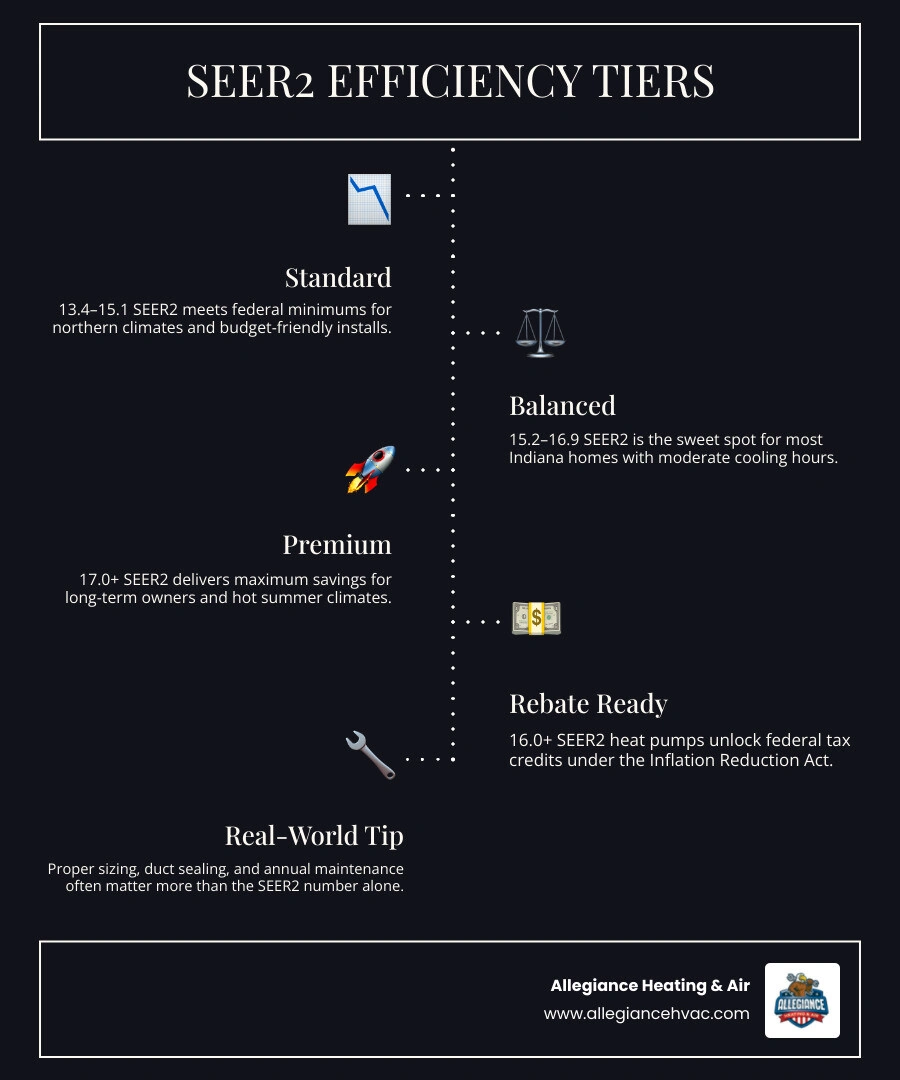
| Most Indiana homeowners (best balance) | 15.2 – 16.9 SEER2 |
| Long-term owners, hot summers, max savings | 17.0+ SEER2 |
| Qualify for federal rebates (heat pumps) | 16.0+ SEER2 minimum |
For most homeowners in Greenville, IN, a 15.2 to 16.9 SEER2 system hits the sweet spot — solid energy savings without an excessive upfront cost.
Replacing a central air conditioner or heat pump is one of the bigger decisions a homeowner makes. The efficiency rating on the unit — now measured as SEER2 since January 1, 2023 — directly affects how much you pay to cool your home every summer. Choose too low, and you leave long-term savings on the table. Chase the highest number without considering your climate and how long you'll own your home, and the payback period may never arrive.
The good news is that picking the right SEER2 rating doesn't have to be complicated. A few key factors — your local climate, how many hours your system runs each year, your electricity rates, and whether you plan to stay in your home long-term — narrow things down quickly.
Understanding the Basics: SEER vs. SEER2 in 2026
If you have purchased an air conditioner in the past, you are likely familiar with the term SEER. However, as of 2023, the Department of Energy officially transitioned to a new testing standard known as SEER2. If you are shopping for a system in 2026, understanding this shift is crucial to making an informed decision.
The transition to SEER2 was not just a minor update; it represented a fundamental change in how heating and cooling systems are tested and certified. For years, the original SEER testing guidelines failed to account for the actual, real-world conditions found inside a typical home. To learn more about why these metrics exist, you can read our guide on Energy Efficiency Standards for Your HVAC: Why Is This Important.
What is a SEER2 Rating and How Does It Work?
SEER stands for Seasonal Energy Efficiency Ratio. It measures the total cooling output of an air conditioner or heat pump over a typical cooling season, divided by the total electrical energy input (measured in watt-hours) during that same period.
Think of SEER2 as the "miles per gallon" (MPG) rating for your home’s cooling system. Just like a car that gets 40 MPG uses less gasoline than one that gets 20 MPG, an air conditioner with a higher SEER2 rating uses less electricity to keep your home comfortable.
The "2" in SEER2 signifies that the system has been rated under the newer M1 testing procedure. This testing protocol was designed to mimic real-world installations far more accurately than the old standard.
Why SEER2 Ratings Look Lower Than Traditional SEER
When the new testing standards were introduced, homeowners noticed something confusing: the efficiency numbers on new units looked slightly lower than the numbers on older models.
This drop in the numerical rating does not mean the equipment became less efficient. Instead, the testing process itself became much more rigorous. The legacy SEER test evaluated equipment under a very low external static pressure of 0.1 inches of water column (in. w.c.). In reality, once you connect an air conditioner to a home’s ductwork, the system encounters much higher resistance.
The M1 testing standard for SEER2 increases this external static pressure by a factor of five, testing units at 0.5 in. w.c. Because the blower motors have to work harder to push air against this simulated resistance, the recorded efficiency drops.
On average, SEER2 ratings are approximately 4.5% lower than traditional SEER ratings for the identical piece of equipment. For example:
- A legacy 14 SEER unit is roughly equivalent to a 13.4 SEER2 unit.
- A legacy 16 SEER unit translates to roughly a 15.2 SEER2 unit.
- A legacy 18 SEER unit equates to roughly a 17.2 SEER2 unit.
When comparing quotes from different HVAC contractors, always make sure you are comparing SEER2 to SEER2 so you can make an accurate evaluation.
What SEER2 Rating Should I Look For in 2026?
When determining what SEER2 rating should i look for, you must balance your upfront investment with your expected long-term utility savings. If you live in Southern Indiana communities like Floyds Knobs, New Albany, or Jeffersonville, your cooling season is moderately warm and humid, meaning your system will run heavily from late May through September.
To help you visualize where different systems stand, we can break them down into three primary tiers. For a deeper look at standard versus high-efficiency systems, check out our Standard Efficiency vs High Efficiency HVAC Comparison.
| Efficiency Tier | SEER2 Range | Best Suited For | Key Benefits |
|---|---|---|---|
| Standard | 13.4 – 15.1 | Budget-conscious buyers, rental properties, mild climates | Lowest upfront cost, meets all legal minimums |
| High | 15.2 – 16.9 | Most Indiana homeowners, moderate-use homes | Excellent balance of upfront cost and monthly savings, quieter operation |
| Premium | 17.0+ | Long-term homeowners, high-use households, eco-conscious buyers | Maximum monthly utility savings, superior humidity control, advanced variable-speed technology |
Standard Efficiency: When to Choose 13.4 to 15.1 SEER2
The federal minimum SEER2 rating for residential split-system central air conditioners in the Northern region (which includes Indiana) is 13.4 SEER2.
Opting for a standard-efficiency system in the 13.4 to 15.1 SEER2 range is often the most sensible choice if:
- You are on a strict budget for the replacement.
- You plan to sell your home in the next few years and will not live there long enough to recoup the cost of a premium system.
- You are replacing a system in a rental property or a home with very low annual cooling hours.
While these systems represent the baseline of modern efficiency, they are still vastly superior to older systems. For instance, if you are replacing a 15-year-old system that has degraded over time, even a new 13.4 SEER2 unit will deliver a noticeable reduction in your monthly energy bills.
High Efficiency: Why 15.2 to 16.9 SEER2 is the Sweet Spot
For the vast majority of homeowners in Greenville, IN, and the surrounding areas, we highly recommend looking at the 15.2 to 16.9 SEER2 range.
This tier offers the absolute best balance of performance and value. It provides a significant step up in efficiency over the federal minimums, allowing you to enjoy lower monthly cooling bills during our humid Indiana summers. Systems in this range also typically feature improved component designs, such as two-stage compressors, which run quieter and provide more consistent indoor temperatures than entry-level models.
When Deciding on Premium Systems, What SEER2 Rating Should I Look For?
If your priority is maximizing your monthly utility savings, minimizing your carbon footprint, and achieving the absolute highest level of indoor comfort, you should look at systems rated at 17.0 SEER2 or higher.
These premium systems represent the cutting edge of HVAC technology. Moving from a standard 14 SEER unit to a 20 SEER2 rating can result in energy savings of up to 30% or more. In fact, a premium 20 SEER2 unit is about 43% more efficient than a baseline 14 SEER2 unit.
These top-tier systems almost exclusively utilize variable-speed compressor technology. Instead of turning completely on or off, they adjust their output in tiny increments to match the exact cooling needs of your home. This continuous, low-speed operation is incredible for removing humidity from your indoor air, making your home feel much more comfortable even at a slightly higher thermostat setting.
Rebates, Tax Credits, and ENERGY STAR Standards
Another reason to consider higher efficiency tiers is the availability of financial incentives. Under the federal Inflation Reduction Act, homeowners can qualify for substantial tax credits and rebates for installing energy-efficient equipment.
To qualify for these federal heat pump tax credits, a split ducted heat pump must have a SEER2 rating of at least 16.0. Additionally, qualifying for ENERGY STAR certification typically requires a split-system central air conditioner to reach at least 17.0 SEER2 and 12.0 EER2.
When you factor in these federal incentives, along with local utility rebates that may be available through your electric provider, the net cost of upgrading to a high-efficiency system is often much closer to a standard system than you might think. You can read more about these long-term financial impacts in our article How Much Does a High Efficiency HVAC Save Over Time.
Real-World Factors That Impact Your Actual HVAC Efficiency
It is important to understand that the SEER2 rating on the yellow EnergyGuide label is a "laboratory" rating. In the real world, your system's actual efficiency is heavily influenced by how it is sized, installed, and maintained.
A high-efficiency unit attached to poorly designed ductwork or sized incorrectly will never deliver its rated efficiency. To explore this dynamic in detail, read our High SEER vs Standard SEER AC Comparison.
Compressor Technology: Single-Stage, Two-Stage, and Variable-Speed
The type of compressor inside your outdoor unit plays a massive role in how close your system gets to its rated SEER2 performance under daily conditions:
- Single-Stage Compressors: These units operate like a light switch — they are either 100% on or completely off. They run at maximum capacity until the thermostat is satisfied, then shut down. This leads to frequent cycling, temperature swings, and higher energy usage during mild weather.
- Two-Stage Compressors: These systems have a high and a low setting (typically running at about 65-70% capacity on the low stage). They spend most of their time running on the lower, more efficient stage, saving energy and providing better dehumidification. They only kick into high gear on the hottest days.
- Variable-Speed (Inverter) Compressors: These systems function like a dimmer switch. They can operate anywhere from 25% to 100% capacity, making minute, real-time adjustments. By running continuously at very low speeds, they maintain an incredibly stable indoor climate while consuming a fraction of the electricity used by single-stage systems.
How Climate and Local Utility Rates Dictate What SEER2 Rating Should I Look For
Your geographic location is one of the most important variables in this equation. Because we serve communities across Southern Indiana and the Louisville metro area — including Borden, Charlestown, Sellersburg, and Corydon — we understand our local weather patterns inside and out.
Our region experiences hot, humid summers but also cold winters. If you are installing a straight air conditioning system, your cooling season is relatively short compared to states like Florida or Texas. This means the payback period for an ultra-high 22 SEER2 air conditioner might be longer than the lifespan of the equipment itself. For our local climate, a 15.2 to 16.9 SEER2 system often represents the ideal intersection of upfront cost and practical payback.
However, if you are installing a heat pump that handles both heating and cooling duties, a higher SEER2 rating (which usually corresponds with a higher heating efficiency rating, or HSPF2) becomes much more financially attractive because the system operates year-round.
Frequently Asked Questions About SEER2 Ratings
What is the minimum legal SEER2 rating in Indiana for 2026?
For homeowners living in Indiana (which falls under the Department of Energy's Northern region), the minimum legal standard for a newly manufactured split-system central air conditioner is 13.4 SEER2 (which is equivalent to the old 14 SEER standard). For split-system air-source heat pumps, the nationwide minimum standard is 14.3 SEER2.
Will a higher SEER2 rating cool my home faster?
No. A higher SEER2 rating does not mean the system cools your home faster. SEER2 measures efficiency, not capacity.
Cooling capacity is measured in British Thermal Units (BTUs) per hour or "tonnage." A 3-ton air conditioner rated at 14 SEER2 and a 3-ton air conditioner rated at 20 SEER2 have the exact same cooling capacity. The difference is that the 20 SEER2 system will use significantly less electricity to deliver that same amount of cooling.
How much can I save by upgrading to a high-SEER2 system?
Your actual savings depend on your local utility rates, your thermostat habits, and the efficiency of your old system. However, upgrading from an outdated, degraded 10 SEER system to a modern 20 SEER2 system can reduce your cooling energy consumption by roughly 50%. Even upgrading from a standard 14 SEER system to an 18 SEER2 system can trim your cooling energy usage by approximately 20% to 22%.
Conclusion
Choosing the right SEER2 rating is all about finding the perfect fit for your home, your budget, and your future plans. While the federal minimums keep your upfront investment low, upgrading to a mid-range high-efficiency system (15.2 to 16.9 SEER2) typically yields the best long-term value for families in our Southern Indiana communities.
At Allegiance Heating & Air, we’ve been "Taking Home Comfort Under Our Wing" since 2005. As a family-owned business, we pride ourselves on sending trusted, professional technicians to help you make the best decision for your household. Whether you are in Greenville, Floyds Knobs, New Albany, or any of our surrounding service locations, we are here to provide honest, transparent guidance and expert installation.
Ready to explore your options and find the perfect, energy-efficient system for your home? Schedule your air conditioning consultation with Allegiance Heating & Air today!
Contact Us Or Schedule Expert Service
Other Blogs
ready to transform your home?
Discover our exceptional home services tailored to meet your needs and enhance your living space.
WHAT OUR CLIENTS HAVE TO SAY ABOUT US

We had a complete HVAC system and a hot water heater installed. The guys were professional, well mannered, and completed the work in a timely manner. Would definitely use them again.
I was nervous at first because my AC broke in the middle of 80 degree weather which is strange for April, but Allegiance Heating and Air was incredibly prompt and professional. The technician arrived within an hour, explained the problem clearly, and completed the repair. The technician , Mr. Garrett Moon was a very nice and courteous young man. He found the problem and fixed it within a timely manner. I highly recommend them for any heating or cooling needs. I’ll definitely give them a call again should I ever have another issue, but hopefully not. Knock on wood 😁. Give them a call… you won’t be disappointed!
From the moment I called to schedule a service, the team was quick to respond and arrived right on time. The technician was professional, friendly, and clearly knowledgeable about my heating system. He explained the repair options in plain language and completed the job efficiently. I appreciated the reliable service and the fact that the work was done the same day. I would definitely recommend Allegiance Heating and Air for any residential HVAC needs.
5/5 stars – I was very impressed with the efficient, affordable and timely service from Allegiance Heating and Air. The technician arrived on time, and performed the service quickly, no repairs needed at this time. Communication was clear and the whole experience felt hassle‑free. I would definitely recommend them for any residential HVAC needs.
Knowledgeable, experienced individual.
Explains Allegiance Heating and Air was incredibly reliable, professional and affordable. They arrived right on time, kept the work area clean and finished the furnace repair quickly. The technician explained everything clearly and the price was a great value. If happiness had a location on Google Maps, it would be here.
Gilbert had to go above and beyond because York is no longer making the part for my furnace. But he was able to find a way to construct a housing bracket for my furnace. Ingenuity, determination and integrity is what finally got my furnace fixed. Gilbert is truly a one of a kind technician.
Thank you for always going the extra mile. Gilbert is always respectful and helpful with any concerns.
"Great service, most knowledgeable and capable HVAC business in Kentuckiana!! Pete Flemming and Bryan the owner, are HVAC encyclopedias. They have the highest integrity of any HVAC business I have ever used. Allegiance has put numerous units in for me over the last 17 years. I will continue to use and trust them."
"Fast response from Allegiance when our heat was out on New Year’s day! Service technician was friendly and efficient. He took the time to explain the problem, tell us about the temporary fix and the plan for permanent repair. We were impressed!"
"Love Allegiance! Their technicians, in particular Benjamin, explain everything. Fast and thorough. A/C was out on a Sunday. Called Allegiance and within a few hours Benjamin arrived. Such a comfort as he was the one who last serviced our units. He quickly replaced part and cooling is restored!"
"My heat pump went out and I had to call after hours. The technician (Garrett) was outstanding and thorough. He got my system up and working until Monday and gave me several options of units. Also took the time to explain the issue to my Home warranty company. I highly recommend this company."
"Right on time :) respectful, fast, and polite. Even gave my fur babies some attention."
"Had Garrett out today to fix our AC. Fantastic tech. He showed up exactly when he said he would and kept us informed of what he was checking and what he found. Highly recommend!"
"Lucas with Allegiance showed up on time as promised, was professional and extremely patient and responsive with all my questions. He took care of the issue, and I feel he was trustworthy! He had us back to cool and comfortable on one of the hottest days of the year."
"Lucas did a great job! Very professional and expedient. Explained the process very well and represented Allegiance as a truly professional and reputable company."
"Arrived on time and work diligently to fix issue. These guy are great. Worked quickly to resolve my issues."
"Lucas was great - he spent a lot of time trying to figure out what was going on and explained everything he was doing. I trust Allegiance and wouldn’t want anyone else working on/in my house!!"

RELATED ARTICLES
Emergency AC Repair Services in Jeffersonville: What You Need to Know
Why Same Day Heat Pump Installation is a Greenville Lifesaver