When the AC Dies: Navigating the Tripped Breaker Illusion
Nothing stops your day faster than a sudden loss of cooling. In our years of restoring comfort during Greenville's peak summer heatwaves, our team at Allegiance Heating & Air typically sees homeowners immediately faced with the tripped breaker illusion: differentiating electrical issues from true AC failure. Your air conditioner was running nonstop just moments ago, and now the vents are completely silent. During severe Midwest summer heatwaves, this sudden shutdown triggers immediate panic. You are suddenly faced with an urgent decision point: is the expensive compressor completely dead, or is it simply a tripped breaker at the electrical panel?
Before you assume the worst and prepare for a massive replacement bill, checking the breaker panel is the crucial first step. A tripped breaker cuts power to the unit, mimicking a catastrophic failure even when the actual mechanical components might be perfectly fine. However, understanding exactly why that breaker tripped is critical. If you need help navigating this sudden shutdown, scheduling professional air conditioning repair ensures you get an accurate diagnosis rather than a hasty guess.
The Anatomy of a Tripped HVAC Circuit Breaker
To understand why your air conditioner suddenly lost power, you first need to understand the role of your electrical panel. Circuit breakers are not switches designed for turning appliances on and off; they are highly sensitive safety devices. Their primary job is to prevent electrical fires by monitoring the flow of electricity (measured in amps) traveling through the wires to your equipment.
Every wire in your home is rated to carry a specific maximum electrical load. If your air conditioner begins to pull a high compressor amperage draw that exceeds the wire's safe capacity, the breaker physically breaks the circuit. This stops the flow of electricity instantly before the wires can overheat, melt their insulation, or ignite surrounding building materials.
Identifying a Tripped Breaker in the Panel
When you open your electrical panel, a tripped breaker does not usually flip all the way to the "OFF" position. Instead, it rests in a middle, spongy position between "ON" and "OFF." Sometimes, a small red or orange indicator flag will appear next to the switch.
Key visual indicators of a tripped breaker:
• The middle position: The switch will not line up with the rest of the "ON" breakers.
• Spongy resistance: If you touch the switch, it will feel loose or springy rather than firmly locked in place.
• Misalignment: In a double-pole breaker (which your 240-volt AC uses), the entire double switch will be out of alignment with the adjacent rows.
It is vital to recognize that a tripped breaker is a symptom, not the root problem itself. The breaker is doing exactly what it was engineered to do: protecting your HVAC system and your home from a dangerous electrical overload.
The Strict 'Reset Once' Rule for Homeowners
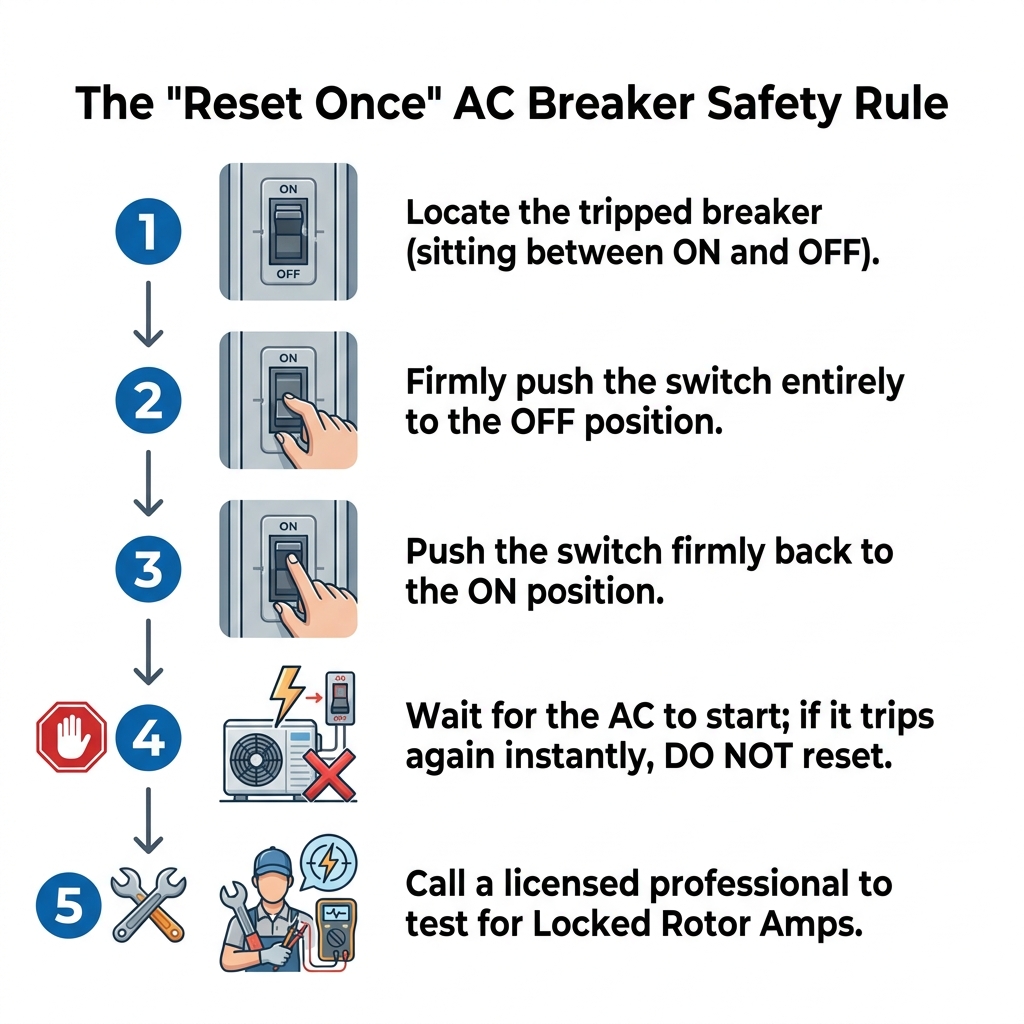
When you discover a tripped breaker, your immediate instinct is to flip it back on. While resetting the breaker is the logical next step, it must be done with extreme caution. HVAC professionals and the National Electrical Code (NEC) basic safety guidelines strictly advocate for the "Reset Once" rule.
When a system fails completely—like one local homeowner who lost their AC entirely during the hottest week in July and ultimately required a replacement—trying to force a broken unit to run with repeated resets only increases the danger of an electrical fire.
Homeowners can follow these standard safety guidelines to check and reset a breaker exactly one time:
1. Locate the correct breaker: Find the double-pole breaker labeled "AC" or "Condenser" in your main electrical panel. Verify that it is resting in the middle, tripped position.
2. Turn it completely off: You cannot simply push a tripped breaker back to the "ON" position. You must firmly push the switch entirely to the "OFF" position until you feel a definitive click. This resets the internal spring mechanism.
3. Turn it back on: Firmly push the switch back to the "ON" position.
4. Monitor the system: Go to your thermostat and call for cooling. Listen closely to the outdoor unit.
If the breaker trips again immediately upon startup, or trips a few minutes later, stop immediately. Do not reset it a second time. A second trip confirms a severe electrical fault or a dangerously high compressor amperage draw. Attempting DIY electrical diagnostics with multimeters on high-voltage equipment is incredibly dangerous. Repeated resets risk melting the internal wiring, ruining the compressor terminals, and causing catastrophic electrical fires. At this stage, it is time to request a free diagnostic estimate from a licensed professional.

How Midwest Humidity Triggers Nuisance Trips
Sometimes, a breaker trips not because a component has failed, but because the system is simply overwhelmed by the environment. During peak Midwest summer heatwaves, continuous AC operation causes significant grid strain. However, the temperature is only half of the equation; the humidity is what truly pushes your air conditioner to its absolute limits.
The Burden of Latent Cooling
Air conditioners perform two distinct jobs: lowering the temperature (sensible cooling) and removing moisture from the air (latent cooling). In our experience servicing homes throughout Greenville and the Ohio River Valley, our team knows that extreme high humidity—which frequently exceeds 70% in mid-summer—drastically increases the latent cooling load on your AC system.
Water vapor holds a tremendous amount of heat energy. Before your air conditioner can effectively lower the temperature in your living room, it must first condense and drain gallons of water out of the indoor air. This heavy lifting forces the compressor to run longer cycles and pull higher amperage to remove that moisture.
Environmental factors that lead to nuisance trips:
• Extended run times: Removing thick humidity requires the compressor to run for hours without a break, generating excessive internal heat.
• Thermal overload: As the compressor gets hotter, electrical resistance increases, which naturally causes the unit to pull more amps.
• Grid voltage drops: During neighborhood-wide heatwaves, the power grid can experience slight voltage drops. When voltage drops, amperage must increase to deliver the same amount of power, occasionally pushing the system over the breaker's limit.
If your breaker trips once during a massive heatwave, resets successfully, and continues to run normally for weeks, it was likely a temporary, heat-related nuisance trip. However, if it happens repeatedly, the humidity has likely exposed a deeper mechanical weakness.
Mechanical Failure vs. Electrical Faults: Understanding Locked Rotor Amps
When the "Reset Once" rule fails and the breaker trips instantly, you are dealing with a hard fault. This is where the distinction between a simple electrical issue and a catastrophic mechanical failure becomes critical. The technical metric that defines this difference is known as Locked Rotor Amps (LRA).
What Are Locked Rotor Amps?
Every electric motor, including your AC compressor, requires a surge of extra power to start spinning. This initial surge is normal. However, if the mechanical parts inside the compressor seize up or lock together due to wear, lack of lubrication, or overheating, the motor cannot turn.
When the thermostat sends the signal to start, the seized compressor acts like a brick wall to the electricity. It will continuously pull 3 to 5 times its normal running amperage in a desperate attempt to force the rotor to spin. This massive, sustained high compressor amperage draw is called Locked Rotor Amps. Because this draw far exceeds the wire's capacity, the breaker trips instantly to prevent a fire.
Isolating the True Cause
A hard trip does not automatically mean the compressor is dead. Several cheaper electrical faults can mimic a locked rotor.
• Capacitor Failure — Electrical Fault (Usually Repairable): The capacitor fails to deliver the startup jolt. The compressor hums, pulls high amps, and trips the breaker. (Inexpensive fix). — Mechanical Failure (Often Requires Replacement): N/A - The mechanical parts are fine, they just lack the electrical push to start.
• Short Circuits — Electrical Fault (Usually Repairable): Mice chew through the outdoor wiring, causing electricity to jump directly to the metal casing and trip the breaker instantly. — Mechanical Failure (Often Requires Replacement): Internal motor windings melt together, causing an internal short circuit inside the sealed steel shell.
• Contactor Issues — Electrical Fault (Usually Repairable): The electrical switch that sends power to the compressor becomes pitted or welded shut by electrical arcing. — Mechanical Failure (Often Requires Replacement): The mechanical valves inside the compressor shatter, physically jamming the motor.
Differentiating between a minor electrical repair and a major mechanical failure requires precise testing. For a deeper understanding of how these components work together, reviewing a comprehensive air conditioning guide can help you familiarize yourself with your system's anatomy before a technician arrives.
Honest Diagnostics: Avoiding Premature AC Replacement
The fear that a tripped breaker automatically means a dead compressor is a common homeowner anxiety, and unfortunately, it is an anxiety that some bad actors in the industry exploit. A technician who walks up to a unit, sees a tripped breaker, and immediately condemns the entire system without pulling out a multimeter is not doing their job.
At Allegiance Heating & Air, our commitment to honest diagnostics focuses on empowering you, the homeowner. We believe in ruling out simple electrical panel issues, bad capacitors, and frayed wiring before ever discussing a massive replacement. For instance, during a recent peak-heat July service call here in Greenville, our technician isolated the issue, showed the homeowner the defective electrical part, and replaced just that specific component to restore cooling performance quickly without a full system overhaul.
The Importance of Proof
You have the right to ask questions and request proof of component failure. An honest technician will gladly show you the multimeter reading. They will show you if the capacitor is reading zero microfarads, or they will show you the exact high compressor amperage draw if the unit is truly pulling Locked Rotor Amps.
Questions to ask your technician:
• Did you test the dual run capacitor? (This is the most common cause of hard-starting compressors).
• Are the internal compressor windings shorted to ground? (A true sign of a dead compressor).
• Is the breaker itself weak? (Sometimes the HVAC unit is fine, but the physical breaker in the panel has worn out and is tripping prematurely).
Catching these high-draw electrical issues before they permanently damage the compressor is the primary benefit of routine AC maintenance. Regular upkeep ensures that electrical connections are tight, capacitors are fully charged, and the compressor is not fighting against a wall of dirt and debris.
Frequently Asked Questions About AC Breaker Issues
Why does my AC keep tripping the breaker?
Your AC keeps tripping the breaker because it is pulling more electrical current than the circuit can safely handle. This high compressor amperage draw is most commonly caused by overheating due to severely dirty air filters, failing capacitors that force the motor to work harder, or a grounded compressor. When the system is suffocated for airflow or struggling mechanically, electrical resistance spikes, forcing the breaker to trip to prevent a fire.
Is it safe to reset a tripped AC breaker?
It is safe to reset a tripped AC breaker exactly one time to see if the trip was a temporary anomaly caused by a power surge or extreme heat. However, if the breaker trips immediately again upon startup, or trips a few minutes later, it is unsafe to continue. Forcing the system to run by repeatedly resetting the breaker can melt wires and cause severe electrical fires; at this point, you must call a professional.
How do I know if my AC compressor is bad?
You can suspect a bad AC compressor if the breaker trips instantly every time the outdoor unit attempts to start, or if you hear loud grinding and screeching noises before the shutdown. However, you cannot know for sure without a professional multimeter test. A licensed technician must measure the electrical draw to confirm if the unit is pulling locked rotor amps or if the internal windings have shorted out.
What happens if an AC breaker keeps tripping?
If an AC breaker keeps tripping and you continually force it back on, you risk catastrophic electrical failure and severe fire hazards. The breaker is tripping because the wires are overheating; bypassing this safety mechanism will eventually melt the wire insulation and destroy the compressor terminals. Continuous tripping indicates a severe fault that requires immediate professional intervention to prevent permanent mechanical damage.
Can a bad thermostat cause the breaker to trip?
A bad thermostat rarely causes the main high-voltage AC breaker in your electrical panel to trip. Instead, a short circuit in the thermostat wiring will usually blow the small, low-voltage automotive-style fuse located on the indoor air handler's control board. If your main outdoor breaker is tripping, the issue is almost always located in the high-voltage electrical components or the compressor itself.
Secure Your Comfort with Expert AC Diagnostics
Navigating an abrupt cooling failure during Midwest summer heatwaves is stressful, but understanding the difference between a simple electrical trip and a mechanical failure puts you in control. Remember the golden rule of electrical safety: check the panel, reset the breaker exactly once, and if it trips again, step away from the panel.
You deserve the satisfaction of knowing exactly what the problem is through honest, transparent testing. Don't let a simple bad capacitor be misdiagnosed as a dead compressor. If your system is struggling to stay online, reach out to a local expert today to secure your comfort with accurate diagnostics and reliable repairs.
Contact Us Or Schedule Expert Service
Other Blogs
ready to transform your home?
Discover our exceptional home services tailored to meet your needs and enhance your living space.
WHAT OUR CLIENTS HAVE TO SAY ABOUT US

We had a complete HVAC system and a hot water heater installed. The guys were professional, well mannered, and completed the work in a timely manner. Would definitely use them again.
I was nervous at first because my AC broke in the middle of 80 degree weather which is strange for April, but Allegiance Heating and Air was incredibly prompt and professional. The technician arrived within an hour, explained the problem clearly, and completed the repair. The technician , Mr. Garrett Moon was a very nice and courteous young man. He found the problem and fixed it within a timely manner. I highly recommend them for any heating or cooling needs. I’ll definitely give them a call again should I ever have another issue, but hopefully not. Knock on wood 😁. Give them a call… you won’t be disappointed!
From the moment I called to schedule a service, the team was quick to respond and arrived right on time. The technician was professional, friendly, and clearly knowledgeable about my heating system. He explained the repair options in plain language and completed the job efficiently. I appreciated the reliable service and the fact that the work was done the same day. I would definitely recommend Allegiance Heating and Air for any residential HVAC needs.
5/5 stars – I was very impressed with the efficient, affordable and timely service from Allegiance Heating and Air. The technician arrived on time, and performed the service quickly, no repairs needed at this time. Communication was clear and the whole experience felt hassle‑free. I would definitely recommend them for any residential HVAC needs.
Knowledgeable, experienced individual.
Explains Allegiance Heating and Air was incredibly reliable, professional and affordable. They arrived right on time, kept the work area clean and finished the furnace repair quickly. The technician explained everything clearly and the price was a great value. If happiness had a location on Google Maps, it would be here.
Gilbert had to go above and beyond because York is no longer making the part for my furnace. But he was able to find a way to construct a housing bracket for my furnace. Ingenuity, determination and integrity is what finally got my furnace fixed. Gilbert is truly a one of a kind technician.
Thank you for always going the extra mile. Gilbert is always respectful and helpful with any concerns.
"Great service, most knowledgeable and capable HVAC business in Kentuckiana!! Pete Flemming and Bryan the owner, are HVAC encyclopedias. They have the highest integrity of any HVAC business I have ever used. Allegiance has put numerous units in for me over the last 17 years. I will continue to use and trust them."
"Fast response from Allegiance when our heat was out on New Year’s day! Service technician was friendly and efficient. He took the time to explain the problem, tell us about the temporary fix and the plan for permanent repair. We were impressed!"
"Love Allegiance! Their technicians, in particular Benjamin, explain everything. Fast and thorough. A/C was out on a Sunday. Called Allegiance and within a few hours Benjamin arrived. Such a comfort as he was the one who last serviced our units. He quickly replaced part and cooling is restored!"
"My heat pump went out and I had to call after hours. The technician (Garrett) was outstanding and thorough. He got my system up and working until Monday and gave me several options of units. Also took the time to explain the issue to my Home warranty company. I highly recommend this company."
"Right on time :) respectful, fast, and polite. Even gave my fur babies some attention."
"Had Garrett out today to fix our AC. Fantastic tech. He showed up exactly when he said he would and kept us informed of what he was checking and what he found. Highly recommend!"
"Lucas with Allegiance showed up on time as promised, was professional and extremely patient and responsive with all my questions. He took care of the issue, and I feel he was trustworthy! He had us back to cool and comfortable on one of the hottest days of the year."
"Lucas did a great job! Very professional and expedient. Explained the process very well and represented Allegiance as a truly professional and reputable company."
"Arrived on time and work diligently to fix issue. These guy are great. Worked quickly to resolve my issues."
"Lucas was great - he spent a lot of time trying to figure out what was going on and explained everything he was doing. I trust Allegiance and wouldn’t want anyone else working on/in my house!!"

RELATED ARTICLES
Why Your AC Isn't Cooling Evenly in Sellersburg
An Essential Guide to What SEER2 Rating You Should Look For