
Why Allergy and Asthma Sufferers Need to Think Seriously About Indoor Air
If you're researching air purification options for allergy and asthma sufferers, here's a quick answer to get you started:
Best air purification options for allergy and asthma sufferers:
1. Portable True HEPA air purifiers - Best for bedrooms and living rooms; capture 99.95-99.97% of particles as small as 0.3 microns
2. Whole-home air filtration systems - Integrated with your HVAC to clean air throughout the entire house
3. Activated carbon filters - Target odors, VOCs, and chemical fumes that trigger asthma
4. UV-C purifiers - Help neutralize biological contaminants like mold spores and bacteria
5. Smart air purifiers with PM2.5 sensors - Auto-adjust based on real-time air quality readings
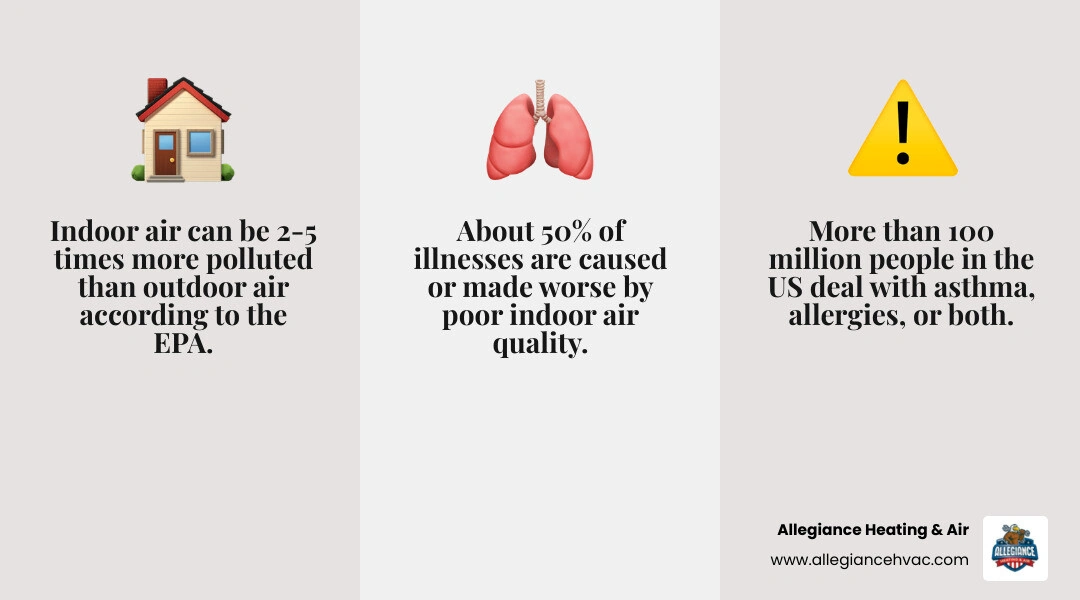
More than 100 million people in the United States deal with asthma, allergies, or both. That's roughly one in every three people. If you're one of them, you already know how much a bad air day can wreck your sleep, your breathing, and your daily routine.
What most people don't realize is that the air inside your home is often the bigger threat. Indoor air can be 2 to 5 times more polluted than outdoor air, according to the EPA. Dust mites hiding in your mattress, pet dander floating through your living room, mold spores near a damp basement wall — these aren't occasional problems. They're constant ones.
And about 50% of illnesses are caused or made worse by poor indoor air quality. For someone with asthma or allergies, that number hits close to home.
The good news? The right air purification setup can make a real difference. This guide walks you through the best options, what the science actually shows, and how to choose what fits your home in Greenville, IN.
Why Indoor Air Is Such a Big Problem for Allergy and Asthma Sufferers
When we think of air pollution, we usually picture exhaust fumes, factory smoke, or seasonal pollen swirling around the Ohio River Valley. But for those of us living in Southern Indiana, the air inside our homes is often where the real battle lies. For allergy and asthma sufferers, indoor air pollution is a persistent, concentrated trigger that is incredibly hard to escape without the right tools.
Why indoor air often feels worse than outdoor air
Modern homes are built to be highly energy-efficient. We seal them up tight with double-pane windows, heavy insulation, and weatherstripping to keep our heating and cooling costs down. While this is great for your utility bills, it has a major downside: it traps airborne contaminants inside.
Without regular fresh air exchange, indoor allergens accumulate over time. Every time you sweep, sit on the couch, or walk across the carpet, you kick up a cloud of microscopic particles that stay suspended in the air.
This lack of ventilation creates a "dust reservoir" effect. At night, when you are sleeping and breathing deeply for hours at a time, you are continuously exposed to these trapped irritants. This is why so many people experience their worst coughing, wheezing, and congestion overnight or first thing in the morning. Understanding the impact of Poor Indoor Air Quality on Health is the first step toward reclaiming your comfort and breathing easier.

The biggest indoor triggers to target first
To build an effective defense, you need to know what you are fighting. The most common indoor culprits include:
• Pollen: Even though pollen starts outdoors, it hitches a ride inside on your clothes, hair, shoes, and pets. Once inside, it settles into carpets and upholstery, triggering year-round symptoms.
• Dust Mite Waste: These microscopic pests thrive in warm, humid environments, living primarily in mattresses, pillows, and soft furniture. Their waste products are one of the most common triggers for year-round allergic rhinitis and asthma.
• Pet Dander: It isn't actually pet hair that triggers your allergies; it's the tiny flakes of dead skin (dander), saliva, and urine proteins that stick to furniture, bedding, and walls.
• Mold Spores: Damp areas like bathrooms, kitchens, and basements can harbor mold. Mold releases microscopic spores into the air, which can cause severe respiratory irritation when inhaled.
• Volatile Organic Compounds (VOCs) and Fumes: These are chemical gases released by household cleaning products, paints, new carpets, cosmetics, and cooking. They can easily irritate sensitive airways and trigger sudden asthma attacks.
Knowing how to address these triggers is essential, especially when Combating Seasonal Allergies in areas like Floyds Knobs or New Albany, where seasonal changes bring heavy outdoor pollen that inevitably migrates indoors.
Best air purification options for allergy and asthma sufferers
When looking for air purification options for allergy and asthma sufferers, you will quickly find that there is no one-size-fits-all solution. The best approach depends on the size of your home, your budget, and whether you want to target specific rooms or clean the air throughout your entire house.
• Coverage Area — Portable Room Purifiers: Single room or localized zone (e.g., bedroom) — Whole-House Air Filtration Systems: Entire home via central HVAC ductwork
• Installation — Portable Room Purifiers: Plug-and-play; no professional setup required — Whole-House Air Filtration Systems: Professionally integrated into your HVAC system
• Maintenance — Portable Room Purifiers: Manual filter changes; unit takes up floor space — Whole-House Air Filtration Systems: Out-of-sight maintenance; filter changes at the furnace
• Noise Level — Portable Room Purifiers: Varies by fan speed; can be audible in quiet rooms — Whole-House Air Filtration Systems: Virtually silent (uses your existing HVAC blower)
• Primary Benefit — Portable Room Purifiers: Targeted, rapid cleaning in high-use areas — Whole-House Air Filtration Systems: Continuous, comprehensive air cleaning in every room
Portable HEPA units: the top choice for air purification options for allergy and asthma sufferers
Portable air purifiers are self-contained units that plug into a standard wall outlet. They use an internal fan to pull air through a series of filters and release clean air back into the room.
For many homeowners, starting with a portable unit in the bedroom is a logical first step. Because we spend about a third of our lives sleeping, keeping the bedroom air pristine can drastically improve sleep quality and reduce morning congestion. Running a portable unit 24/7 on a low or "sleep" mode ensures that your immediate breathing zone remains free of airborne triggers. To learn more about how these compact systems target localized irritants, check out our guide on How Air Purification Can Help with Allergies.
Whole-home systems for air purification options for allergy and asthma sufferers
While portable units are great for individual rooms, they can't clean your entire house. If you want to eliminate triggers in the kitchen, living room, hallways, and bedrooms all at once, a whole-home system is the ultimate solution.
These systems are installed directly into your central HVAC system's return air duct. Every time your heating or cooling system runs, air is pulled through a medical-grade filtration media, cleaning the air before it is distributed back to your living spaces.
This setup provides several major benefits:
• It protects your HVAC equipment from dust buildup, improving efficiency and system lifespan.
• It provides uniform air cleaning across every square foot of your home without taking up floor space or adding noise to your bedrooms.
• It ensures constant air circulation, preventing stagnant pockets of dust and humidity from forming.
If you are considering this upgrade, you can read more about Whole House Air Filtration Jeffersonville IN to see how local homes benefit, and compare your choices in our breakdown of a Whole House Air Purifier vs Upgraded HVAC Filter.
Which technologies help most, and which to approach carefully
Not all air cleaning technologies are safe or effective for asthma and allergy sufferers. Here is what you need to know about the different methods available:
• True HEPA Filtration: This is the gold standard. Mechanical HEPA filters trap physical particles like dust, pollen, and dander. They do not produce any harmful byproducts and are 100% safe for sensitive lungs.
• Activated Carbon: HEPA filters cannot trap gases, odors, or VOCs. For that, you need an activated carbon filter, which uses chemical adsorption to trap gas molecules. Combining HEPA and carbon provides the most comprehensive protection.
• UV-C Light: Ultraviolet purifiers use germicidal light to neutralize biological contaminants like mold spores, bacteria, and viruses. This is a great add-on for damp climates or homes prone to mold.
• Ionizers and Electrostatic Precipitators: These devices charge airborne particles so they stick to metal plates or nearby walls and furniture. However, many of these systems produce small amounts of ozone as a byproduct. Even low levels of ozone can severely irritate sensitive airways and trigger asthma attacks, so they should be approached with extreme caution.
For a deeper dive into these technologies, read our article on the Different Types of Air Cleaners and Their Benefits and check out our Air Purifier vs Air Filtration System Comparison to find the safest technology for your family.
How Well Air Purifiers Work and What the Science Says
It is easy to get caught up in marketing buzzwords, but what does the actual scientific evidence say about the effectiveness of air purifiers for managing respiratory health?
What True HEPA means and why it matters
When shopping for air purification options for allergy and asthma sufferers, you will see many products labeled as "HEPA-type," "HEPA-like," or "99% dust reduction." These are marketing terms, not certifications.
A True HEPA filter (typically H13 medical-grade) is strictly rated to capture at least 99.95% to 99.97% of particles as small as 0.3 microns. To put that in perspective, a single human hair is about 70 microns wide. Dust mite waste, pollen, and mold spores are much larger than 0.3 microns, meaning a True HEPA filter will easily trap them. High-end medical-grade filters can even capture up to 99.9% of particles down to 0.1 microns, including ultra-fine smoke particles and many viruses.
What studies show about symptom reduction
Clinical research consistently supports the use of high-efficiency air filtration for managing asthma and allergy symptoms.
For example, clinical trials have shown that using a high-quality HEPA air purifier in the home significantly reduces PM2.5 (fine particulate matter) levels, leading to a direct reduction in the need for daily allergy medications among rhinitis sufferers.
Furthermore, real-world studies on pediatric asthma have shown that installing clinically proven HEPA air purifiers in children's bedrooms resulted in approximately 42 fewer unplanned doctor or emergency room visits over the course of a single year. By removing the physical triggers floating in the air, the body's immune system doesn't have to work overtime, allowing airways to remain clear and inflammation to subside. If you are curious about the mechanics behind these results, you can explore Air Purification vs Filtration Which is Better for Allergies.
Certifications that make shopping easier
To cut through the confusion when buying an air purifier, look for independent, third-party certifications:
• Asthma & Allergy Friendly® Certification: Jointly managed by the Asthma and Allergy Foundation of America (AAFA) and Allergy Standards Limited (ASL). To earn this certification, a purifier must be proven to reduce airborne allergens by at least 90% in real-world simulated environments and retain at least 50% of those captured allergens in the filter so they aren't blown back into the room.
• Zero Ozone Verification: Certified by organizations like Intertek, this ensures that the device emits virtually no ozone (less than 5 parts per billion), making it entirely safe for asthma sufferers.
• ENERGY STAR: Indicates that the unit is highly energy-efficient, allowing you to run it 24/7 without worrying about a massive spike in your electric bill.
How to Choose the Right Unit Size, Features, and Placement
Buying the right air purifier is only half the battle; you also need to make sure it is sized correctly for your space, has the right features for your lifestyle, and is placed in the optimal spot.
Match purifier size to your room
Air purifiers are rated by their Clean Air Delivery Rate (CADR), which measures how quickly the unit can filter smoke, dust, and pollen out of a specific room size.
When choosing a portable unit, look for the recommended room square footage. Ideally, you want a unit that can provide at least 4 to 5 Air Changes per Hour (ACH). This means all the air in the room passes through the filter every 12 to 15 minutes.
• Pro Tip: It is always better to buy an oversized unit for a smaller room than an undersized unit for a large room. An oversized unit can run on a lower, quieter fan speed while still cleaning the air effectively. An undersized unit will have to run on high constantly, creating annoying noise and failing to keep up with incoming allergens.
To help plan your strategy for high-pollen seasons, take a look at our Air Quality Solutions for Allergy Season.
Features worth getting for easier relief
While basic models simply have an on/off switch and fan speeds, modern smart air purifiers offer several convenient features:
• Auto Mode with PM2.5 Sensors: These sensors constantly monitor the air quality in real-time. If you cook, kick up dust, or open a window, the purifier detects the spike in particles and automatically increases the fan speed until the air is clean again.
• Sleep Mode: This dims the display lights and drops the fan to its quietest setting, ensuring your sleep is completely undisturbed.
• Filter Replacement Alerts: Instead of guessing when your filter is dirty, built-in sensors track actual runtime and air volume to let you know exactly when it's time for a fresh filter.
• App Control: Allows you to monitor your indoor air quality, set schedules, and control the unit remotely from your smartphone.
Best placement for maximum allergen removal
Where you put your air purifier matters just as much as which model you buy. To get the most out of your unit, follow these placement rules:
• Keep it in the "Breathing Zone": Place the unit in the room where you spend the most time, such as near your bed or close to your favorite spot on the couch.
• Give it Space: Do not tuck the purifier into a corner, behind a couch, or under a table. Most units rely on 360-degree airflow to pull in dirty air. Keep it at least 18 inches away from walls, furniture, and curtains.
• Avoid Vents and Drafts: Placing a purifier directly next to an HVAC register or an open window can disrupt its airflow pattern, causing it to clean the same air repeatedly instead of circulating the air throughout the entire room.
Maintenance Habits That Make Air Purification Work Better
An air purifier is not a "set-it-and-forget-it" appliance. Without proper maintenance and healthy household habits, even the most expensive system will eventually lose its effectiveness.
How often filters should be replaced
Over time, the fibers in a HEPA filter become clogged with trapped dust, hair, and allergens. This restricts airflow, forcing the motor to work harder and reducing the unit's clean air output.
• Standard HEPA Filters: Typically need to be replaced every 6 to 12 months, depending on your home's air quality. If you have multiple pets, live near a busy road, or use your fireplace often, you may need to replace them sooner.
• Pre-Filters: Many purifiers have a washable or vacuumable pre-filter that traps large particles like pet hair and dust bunnies. Cleaning this pre-filter every 2 to 4 weeks will dramatically extend the life of your expensive HEPA filter.
Habits that boost purifier performance
An air purifier is designed to clean the air, not your furniture or carpets. To truly control your allergy and asthma symptoms, combine your filtration system with these simple habits:
1. Vacuum with a HEPA Vacuum: Standard vacuums often blow fine dust particles right back out of their exhaust. Using a certified HEPA vacuum ensures that dust stays trapped.
2. Wash Bedding Weekly: Wash your sheets, pillowcases, and blankets weekly in hot water (at least 130°F) to kill dust mites.
3. Control Humidity: Keep your home's relative humidity below 50% to prevent mold growth and dust mite reproduction.
4. Remove Shoes at the Door: This simple step prevents outdoor pesticides, pollen, and dirt from being tracked onto your carpets.
For more helpful strategies on maintaining a healthy home, read our guides on Enhancing Indoor Air Quality and simple ways to Improve Indoor Air Quality.
Common buying and usage mistakes
Avoid these common pitfalls to make sure you get the full benefits of your clean air investment:
• Buying "HEPA-type" filters: Always double-check that the packaging says "True HEPA" or "H13 HEPA."
• Turning the unit off: Air pollution is continuous. To keep allergen levels low, run your purifier 24/7 on a low or auto setting rather than turning it on for just an hour or two a day.
• Ignoring Source Control: No purifier can keep up with an active mold leak or a heavily smoking indoor environment. Always fix leaks and eliminate pollution sources first, then let your purifier handle the rest. Learn how to maximize your results by Combining Air Purification and Filtration for Best Results.
Frequently Asked Questions about air purification options for allergy and asthma sufferers
Can an air purifier be covered by HSA or FSA?
Yes! Because air purifiers are considered a medical necessity for individuals with diagnosed respiratory conditions like asthma or severe allergies, they are often eligible for reimbursement through Health Savings Accounts (HSA) or Flexible Spending Accounts (FSA).
To qualify, you will typically need a Letter of Medical Necessity (LMN) from your doctor stating that the air purifier is required to help treat or alleviate your medical condition. Once you have this letter, you can use your HSA/FSA debit card to make the purchase or submit the receipt for reimbursement.
Should I put an air purifier in the bedroom or living room first?
If you can only start with one portable unit, put it in your bedroom.
We spend roughly 8 hours a night sleeping in our bedrooms. During sleep, our breathing slows down and deepens, making us highly susceptible to airborne irritants. Keeping your bedroom air clean ensures you get restorative, symptom-free sleep, which drastically reduces morning congestion and fatigue. Once your bedroom is taken care of, you can look into adding a second unit to your living room or upgrading to a whole-home system.
Do I still need cleaning and ventilation if I have an air purifier?
Yes. An air purifier is a powerful tool, but it is not a replacement for basic hygiene and ventilation. Heavy particles like dust mites and pet dander quickly settle onto carpets, bedding, and countertops. Because they are heavy, they don't stay airborne long enough for a portable purifier to catch them. Regular dusting, vacuuming, and washing are still required to keep these settled allergens under control.
Conclusion
Taking control of your indoor air quality is one of the most effective steps you can take to manage your asthma or allergy symptoms. Whether you choose to start with targeted, portable True HEPA units in your bedrooms or invest in a comprehensive, whole-home system that cleans every room simultaneously, the benefits of breathing cleaner air are undeniable.
At Allegiance Heating & Air, LLC, we have been "Taking Home Comfort Under Our Wing" since 2005. As a family-owned business, we understand how important a healthy, comfortable home is for your family's well-being. If you are ready to explore professional, whole-home Air Purification Systems Floyds Knobs IN or want to learn about the 8 Impressive Benefits of Having an In-Home Air Filtration System, we are here to help.
Our licensed and experienced technicians serve homeowners across Greenville, IN, and surrounding communities like Clarksville, Jeffersonville, New Albany, and Floyds Knobs. Let us help you design the perfect indoor air quality strategy for your home. For more details on our personalized air cleaning solutions, check out our air purification systems services and schedule your consultation today!
Contact Us Or Schedule Expert Service
Other Blogs
ready to transform your home?
Discover our exceptional home services tailored to meet your needs and enhance your living space.
WHAT OUR CLIENTS HAVE TO SAY ABOUT US

We had a complete HVAC system and a hot water heater installed. The guys were professional, well mannered, and completed the work in a timely manner. Would definitely use them again.
I was nervous at first because my AC broke in the middle of 80 degree weather which is strange for April, but Allegiance Heating and Air was incredibly prompt and professional. The technician arrived within an hour, explained the problem clearly, and completed the repair. The technician , Mr. Garrett Moon was a very nice and courteous young man. He found the problem and fixed it within a timely manner. I highly recommend them for any heating or cooling needs. I’ll definitely give them a call again should I ever have another issue, but hopefully not. Knock on wood 😁. Give them a call… you won’t be disappointed!
From the moment I called to schedule a service, the team was quick to respond and arrived right on time. The technician was professional, friendly, and clearly knowledgeable about my heating system. He explained the repair options in plain language and completed the job efficiently. I appreciated the reliable service and the fact that the work was done the same day. I would definitely recommend Allegiance Heating and Air for any residential HVAC needs.
5/5 stars – I was very impressed with the efficient, affordable and timely service from Allegiance Heating and Air. The technician arrived on time, and performed the service quickly, no repairs needed at this time. Communication was clear and the whole experience felt hassle‑free. I would definitely recommend them for any residential HVAC needs.
Knowledgeable, experienced individual.
Explains Allegiance Heating and Air was incredibly reliable, professional and affordable. They arrived right on time, kept the work area clean and finished the furnace repair quickly. The technician explained everything clearly and the price was a great value. If happiness had a location on Google Maps, it would be here.
Gilbert had to go above and beyond because York is no longer making the part for my furnace. But he was able to find a way to construct a housing bracket for my furnace. Ingenuity, determination and integrity is what finally got my furnace fixed. Gilbert is truly a one of a kind technician.
Thank you for always going the extra mile. Gilbert is always respectful and helpful with any concerns.
"Great service, most knowledgeable and capable HVAC business in Kentuckiana!! Pete Flemming and Bryan the owner, are HVAC encyclopedias. They have the highest integrity of any HVAC business I have ever used. Allegiance has put numerous units in for me over the last 17 years. I will continue to use and trust them."
"Fast response from Allegiance when our heat was out on New Year’s day! Service technician was friendly and efficient. He took the time to explain the problem, tell us about the temporary fix and the plan for permanent repair. We were impressed!"
"Love Allegiance! Their technicians, in particular Benjamin, explain everything. Fast and thorough. A/C was out on a Sunday. Called Allegiance and within a few hours Benjamin arrived. Such a comfort as he was the one who last serviced our units. He quickly replaced part and cooling is restored!"
"My heat pump went out and I had to call after hours. The technician (Garrett) was outstanding and thorough. He got my system up and working until Monday and gave me several options of units. Also took the time to explain the issue to my Home warranty company. I highly recommend this company."
"Right on time :) respectful, fast, and polite. Even gave my fur babies some attention."
"Had Garrett out today to fix our AC. Fantastic tech. He showed up exactly when he said he would and kept us informed of what he was checking and what he found. Highly recommend!"
"Lucas with Allegiance showed up on time as promised, was professional and extremely patient and responsive with all my questions. He took care of the issue, and I feel he was trustworthy! He had us back to cool and comfortable on one of the hottest days of the year."
"Lucas did a great job! Very professional and expedient. Explained the process very well and represented Allegiance as a truly professional and reputable company."
"Arrived on time and work diligently to fix issue. These guy are great. Worked quickly to resolve my issues."
"Lucas was great - he spent a lot of time trying to figure out what was going on and explained everything he was doing. I trust Allegiance and wouldn’t want anyone else working on/in my house!!"

RELATED ARTICLES

How to Choose the Best Heat Pump for Your Jeffersonville Home
Why Jeffersonville Residents Need an Emergency AC Service