Why the Air Purifier vs Air Filtration System Comparison Matters for Your Home
The air purifier vs air filtration system comparison is one of the most common questions homeowners ask when trying to breathe easier indoors. And it makes sense — both devices promise cleaner air, but they work in very different ways and solve different problems.
Here is a quick breakdown so you can find the right answer fast:
• How it works — Air Filtration System: Traps particles in a filter medium — Air Purifier: Neutralizes or removes pollutants using advanced tech
• Primary goal — Air Filtration System: Capture dust, pollen, pet dander — Air Purifier: Eliminate viruses, bacteria, odors, VOCs
• Placement — Air Filtration System: Built into your HVAC system — Air Purifier: Standalone unit or whole-home HVAC add-on
• Coverage — Air Filtration System: Whole home — Air Purifier: Single room or whole home
• Key technology — Air Filtration System: Fiberglass, pleated media, MERV ratings — Air Purifier: HEPA, UV-C light, activated carbon, ionization
• Best for — Air Filtration System: General particle control, HVAC protection — Air Purifier: Allergens, smoke, germs, chemical vapors
Most homes benefit from both working together — filters provide the baseline, while purifiers handle what filters miss.
Here in Greenville, IN, the air inside your home can carry more pollutants than you might expect. Dust, pollen, pet dander, mold spores, cooking fumes, and even microscopic viruses all float through your living spaces every day. According to the EPA, the most effective approach to indoor air quality combines source control, ventilation, and filtration — but choosing the right filtration technology is where many homeowners get stuck.
The confusion is understandable. Terms like "air purifier," "air cleaner," and "air filtration system" get used interchangeably — even by manufacturers. But under the hood, these systems work differently and target different pollutants. Picking the wrong one means spending money without actually solving your air quality problem.
This guide cuts through the noise so you can make a confident, informed decision.
Understanding the Air Purifier vs Air Filtration System Comparison
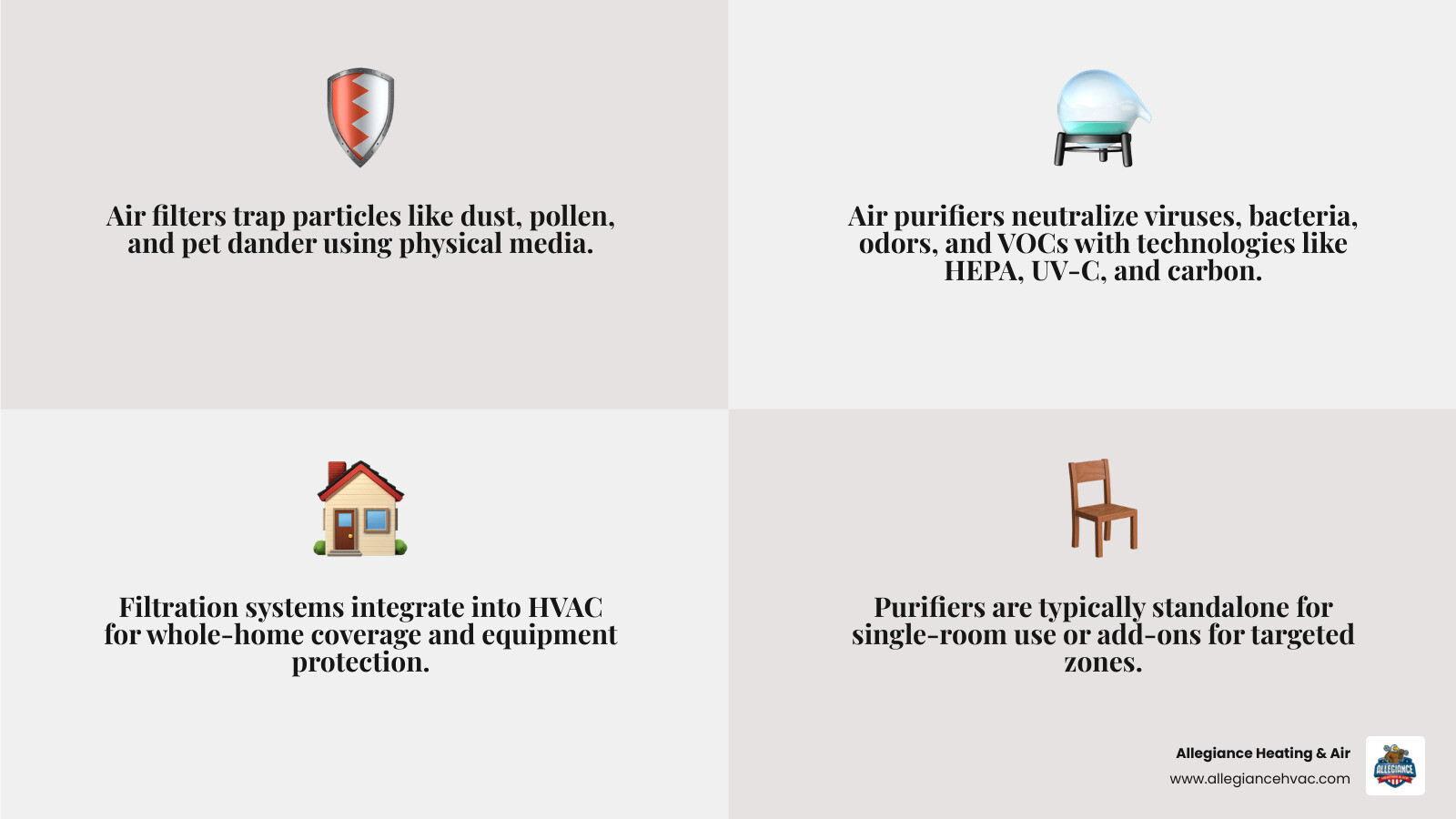
When we look at the air purifier vs air filtration system comparison, the fundamental difference lies in how they handle "bad" air. Think of an air filter as a high-tech net and an air purifier as a treatment plant.
An air filtration system is typically a passive component of your HVAC setup. As your furnace or air conditioner pulls air in to heat or cool it, that air passes through a physical barrier—the filter. This barrier traps physical particles like dust and lint. Its primary job is twofold: keeping the air you breathe cleaner and, perhaps more importantly, protecting your expensive HVAC equipment from getting gunked up with debris.
On the other hand, an air purifier is an active device. Whether it is a standalone unit sitting in your bedroom or a whole-home system integrated into your ductwork, it goes beyond just "trapping" things. Purifiers use advanced technologies to neutralize or eliminate threats. While a filter might stop a dust bunny, a purifier can tackle microscopic viruses, bacteria, and volatile organic compounds (VOCs) that are far too small for a standard filter to catch.
For families in areas like Louisville, KY, or New Albany, IN, understanding this "Passive vs. Active" distinction is key. A filter waits for the air to come to it; a purifier often works to actively seek out and deactivate contaminants in the air.
• Action — Air Filtration: Passive (Traps) — Air Purification: Active (Neutralizes/Treats)
• Integration — Air Filtration: Built-in HVAC component — Air Purification: Standalone or In-duct add-on
• Target Size — Air Filtration: Larger particulates — Air Purification: Microscopic germs & gases
• Maintenance — Air Filtration: Frequent replacement — Air Purification: Periodic bulb/filter changes
If you are unsure where your home stands, a Home Air Quality Test Clarksville IN can provide the data needed to see if you need simple filtration or advanced purification. For a deeper look at local needs, check out our resources on Indoor Air Quality Greenville IN.
How Whole-Home Air Filtration Systems Protect Your Property
Most homeowners are familiar with the standard 1-inch filter they swap out every few months. However, when we talk about a Whole House Air Filtration Jeffersonville IN system, we are usually referring to upgraded media filters that offer much higher protection than basic fiberglass versions.
MERV Ratings Explained
The gold standard for measuring filter effectiveness is the MERV (Minimum Efficiency Reporting Value) rating. Ratings typically range from 1 to 16 for residential use:
• MERV 1–4: Basic fiberglass filters. They stop large "boulders" like carpet fibers and heavy dust but do little for your health.
• MERV 8: The EPA-recommended minimum for modern homes. These capture 1.0 to 3.0-micron particles, including mold spores and hairspray.
• MERV 11–13: High-efficiency pleated filters. These are excellent for capturing pet dander, fine dust, and even some bacteria. A MERV 13 filter is often the "sweet spot" for families with mild allergies.
Protecting Your Investment
Beyond your lungs, air filtration is the "bodyguard" for your HVAC system. Dust buildup on an evaporator coil or blower motor can lead to restricted airflow, higher energy bills, and eventual system failure. By using a quality air filtration system, you ensure that your heating and cooling equipment stays clean, extending its lifespan and maintaining its efficiency.
Advanced Technologies Used in Modern Air Purifiers
If filters are the shield, purifiers are the sword. When we perform an Air Purifier Installation, we are often installing systems that use multiple layers of science to scrub the air. For residents seeking the best Air Purification Systems New Albany IN, these technologies are the heavy hitters.
HEPA Filtration
HEPA (High-Efficiency Particulate Air) filters are the titans of the filtration world. To be certified as HEPA, a filter must capture 99.97% of particles as small as 0.3 microns. To put that in perspective, a human hair is about 80–100 microns wide. HEPA is so effective it is used in hospitals and clean rooms.
UV-C Light
Microorganisms like mold, bacteria, and viruses are often too small to be trapped by standard filters. UV-C light purifiers use germicidal ultraviolet lamps to disrupt the DNA of these pathogens, rendering them harmless. This is particularly effective when installed near the HVAC coils where moisture can lead to mold growth. You can learn more about how Ultraviolet Air Cleaners Improved IAQ in our detailed blog post.
Activated Carbon
If you struggle with odors from cooking, pets, or tobacco smoke, you need activated carbon. Unlike mechanical filters, carbon filters use a process called adsorption to "stick" gas molecules, odors, and VOCs to the surface of the carbon. It’s like a chemical sponge for your air.
Ionization
Ionic purifiers send out negatively charged ions that attach to positively charged airborne particles (like dust or pollen). This makes the particles clump together and become heavy, causing them to fall out of the air or making them much easier for your HVAC filter to catch. Systems like the REME HALO® use this technology to reduce up to 99% of bacteria, viruses, and mold.
Key Metrics in an Air Purifier vs Air Filtration System Comparison
When comparing these two, you will run into some technical jargon. Here is what you actually need to know:
• CADR (Clean Air Delivery Rate): Used primarily for portable purifiers, this tells you how much clean air the unit produces for specific pollutants like smoke, dust, and pollen.
• ACH (Air Changes per Hour): This measures how many times the system can cycle the total volume of air in a room through its filters in 60 minutes. For allergy sufferers, we recommend 4–5 ACH.
• CFM (Cubic Feet per Minute): This measures airflow. It is crucial to match your filtration to your HVAC system’s CFM capacity. If a filter is too restrictive (like a HEPA filter in a system not designed for it), it can "choke" your HVAC unit, leading to high energy bills and damage.
For a deeper dive into these specifications, read about Different Types of Air Cleaners and Their Benefits.
Combining Technologies for a Comprehensive Air Purifier vs Air Filtration System Comparison
In our experience serving towns from Salem, IN, to Corydon, IN, the "best" solution is rarely just one or the other. We often recommend a layered approach.
1. The Baseline: High-quality MERV 11 or 13 pleated filters in your HVAC system for whole-home particle control.
2. The Protection: An in-duct Air Purification Systems Louisville KY that uses UV light or ionization to kill germs throughout the entire house.
3. The Focused Zone: A portable HEPA purifier in the bedroom of a child with severe asthma or in a home office where VOCs from new furniture might be an issue.
This combination ensures you are protected from large dust particles and microscopic biological threats simultaneously. Explore our Solutions for Improving IAQ Year-Round to see how these layers fit together.
Choosing the Right Solution for Allergies, Smoke, and Odors
Your specific "symptoms" should dictate your choice in the air purifier vs air filtration system comparison.
• For Seasonal Allergies: If pollen and ragweed are your enemies, a high-MERV air filtration system is your first line of defense. It captures the larger particles that cause itchy eyes and sneezing. Read more on How Air Purification Can Help with Allergies.
• For Wildfire Smoke & VOCs: Wildfire smoke consists of incredibly fine particulates and gases. A standard filter won't cut it. You need a purifier with a HEPA filter for the ash and an activated carbon filter for the chemical vapors.
• For Pet Owners: Pets bring two challenges: dander (particulates) and odors (gases). A pleated filter handles the dander, but you'll want an ionic or carbon-based Air Purification Systems Fredericksburg IN to neutralize the "wet dog" smell.
• For Germ Concerns: If your family seems to catch every cold that goes around, a UV air purifier is the smart choice to deactivate viruses and bacteria before they can circulate.
Frequently Asked Questions about Indoor Air Quality
What is the primary difference between an air filter and an air purifier?
The primary difference is that an air filter is a passive device designed to trap physical particles (dust, pollen, dander) as they pass through a medium. An air purifier is an active device that uses technology (UV light, ions, carbon) to neutralize or eliminate pollutants like viruses, odors, and chemicals.
Can I use a HEPA filter in my standard HVAC system?
Usually, the answer is no—at least not without modifications. Standard residential HVAC systems are not powerful enough to push air through the dense fibers of a true HEPA filter. Doing so can restrict airflow, increase energy costs, and potentially burn out your blower motor. If you want HEPA-level cleaning for your whole home, we usually recommend a bypass HEPA system or a high-output air purifier instead.
How often should I replace my air filters and purifier components?
• Standard 1-inch filters: Every 1–3 months.
• Deep pleated media filters: Every 6–12 months.
• UV-C Bulbs: Approximately once a year (9,000 hours).
• Activated Carbon: Every 3–6 months, depending on odor levels.Regular maintenance is the only way to ensure 8 Impressive Benefits of Having an In-Home Air Filtration System continue to protect your family.
Conclusion
At Allegiance Heating & Air, we know that "one size fits all" doesn't work for indoor air quality. Whether you are in Floyds Knobs, IN, or Jeffersonville, IN, your home’s needs are unique based on your family's health, your pets, and the age of your home.
As a family-owned business since 2005, we take "Home Comfort Under Our Wing." We don't just sell equipment; we provide peace of mind. From professional IAQ Services & Solutions New Albany IN to whole-home system installations, our trusted technicians are here to help you breathe easier.
Ready to clear the air? Start by exploring our full range of Indoor Air Quality services or schedule an assessment today to see which solution is truly right for your home.
Contact Us Or Schedule Expert Service
Other Blogs
ready to transform your home?
Discover our exceptional home services tailored to meet your needs and enhance your living space.
WHAT OUR CLIENTS HAVE TO SAY ABOUT US

We had a complete HVAC system and a hot water heater installed. The guys were professional, well mannered, and completed the work in a timely manner. Would definitely use them again.
I was nervous at first because my AC broke in the middle of 80 degree weather which is strange for April, but Allegiance Heating and Air was incredibly prompt and professional. The technician arrived within an hour, explained the problem clearly, and completed the repair. The technician , Mr. Garrett Moon was a very nice and courteous young man. He found the problem and fixed it within a timely manner. I highly recommend them for any heating or cooling needs. I’ll definitely give them a call again should I ever have another issue, but hopefully not. Knock on wood 😁. Give them a call… you won’t be disappointed!
From the moment I called to schedule a service, the team was quick to respond and arrived right on time. The technician was professional, friendly, and clearly knowledgeable about my heating system. He explained the repair options in plain language and completed the job efficiently. I appreciated the reliable service and the fact that the work was done the same day. I would definitely recommend Allegiance Heating and Air for any residential HVAC needs.
5/5 stars – I was very impressed with the efficient, affordable and timely service from Allegiance Heating and Air. The technician arrived on time, and performed the service quickly, no repairs needed at this time. Communication was clear and the whole experience felt hassle‑free. I would definitely recommend them for any residential HVAC needs.
Knowledgeable, experienced individual.
Explains Allegiance Heating and Air was incredibly reliable, professional and affordable. They arrived right on time, kept the work area clean and finished the furnace repair quickly. The technician explained everything clearly and the price was a great value. If happiness had a location on Google Maps, it would be here.
Gilbert had to go above and beyond because York is no longer making the part for my furnace. But he was able to find a way to construct a housing bracket for my furnace. Ingenuity, determination and integrity is what finally got my furnace fixed. Gilbert is truly a one of a kind technician.
Thank you for always going the extra mile. Gilbert is always respectful and helpful with any concerns.
"Great service, most knowledgeable and capable HVAC business in Kentuckiana!! Pete Flemming and Bryan the owner, are HVAC encyclopedias. They have the highest integrity of any HVAC business I have ever used. Allegiance has put numerous units in for me over the last 17 years. I will continue to use and trust them."
"Fast response from Allegiance when our heat was out on New Year’s day! Service technician was friendly and efficient. He took the time to explain the problem, tell us about the temporary fix and the plan for permanent repair. We were impressed!"
"Love Allegiance! Their technicians, in particular Benjamin, explain everything. Fast and thorough. A/C was out on a Sunday. Called Allegiance and within a few hours Benjamin arrived. Such a comfort as he was the one who last serviced our units. He quickly replaced part and cooling is restored!"
"My heat pump went out and I had to call after hours. The technician (Garrett) was outstanding and thorough. He got my system up and working until Monday and gave me several options of units. Also took the time to explain the issue to my Home warranty company. I highly recommend this company."
"Right on time :) respectful, fast, and polite. Even gave my fur babies some attention."
"Had Garrett out today to fix our AC. Fantastic tech. He showed up exactly when he said he would and kept us informed of what he was checking and what he found. Highly recommend!"
"Lucas with Allegiance showed up on time as promised, was professional and extremely patient and responsive with all my questions. He took care of the issue, and I feel he was trustworthy! He had us back to cool and comfortable on one of the hottest days of the year."
"Lucas did a great job! Very professional and expedient. Explained the process very well and represented Allegiance as a truly professional and reputable company."
"Arrived on time and work diligently to fix issue. These guy are great. Worked quickly to resolve my issues."
"Lucas was great - he spent a lot of time trying to figure out what was going on and explained everything he was doing. I trust Allegiance and wouldn’t want anyone else working on/in my house!!"

RELATED ARTICLES
New Albany's Smart Choice: Unbeatable Furnace Maintenance Offers
Finding the Best AC Repair in Pewee Valley: A Local's Guide