Why Combining Air Purification and Filtration for Best Results Matters in Your Home
Combining air purification and filtration for best results means using more than one method to clean your indoor air — layering technologies like HEPA filters, activated carbon, and UV-C light so each one handles what the others can't.
Here's a quick overview of how to do it:
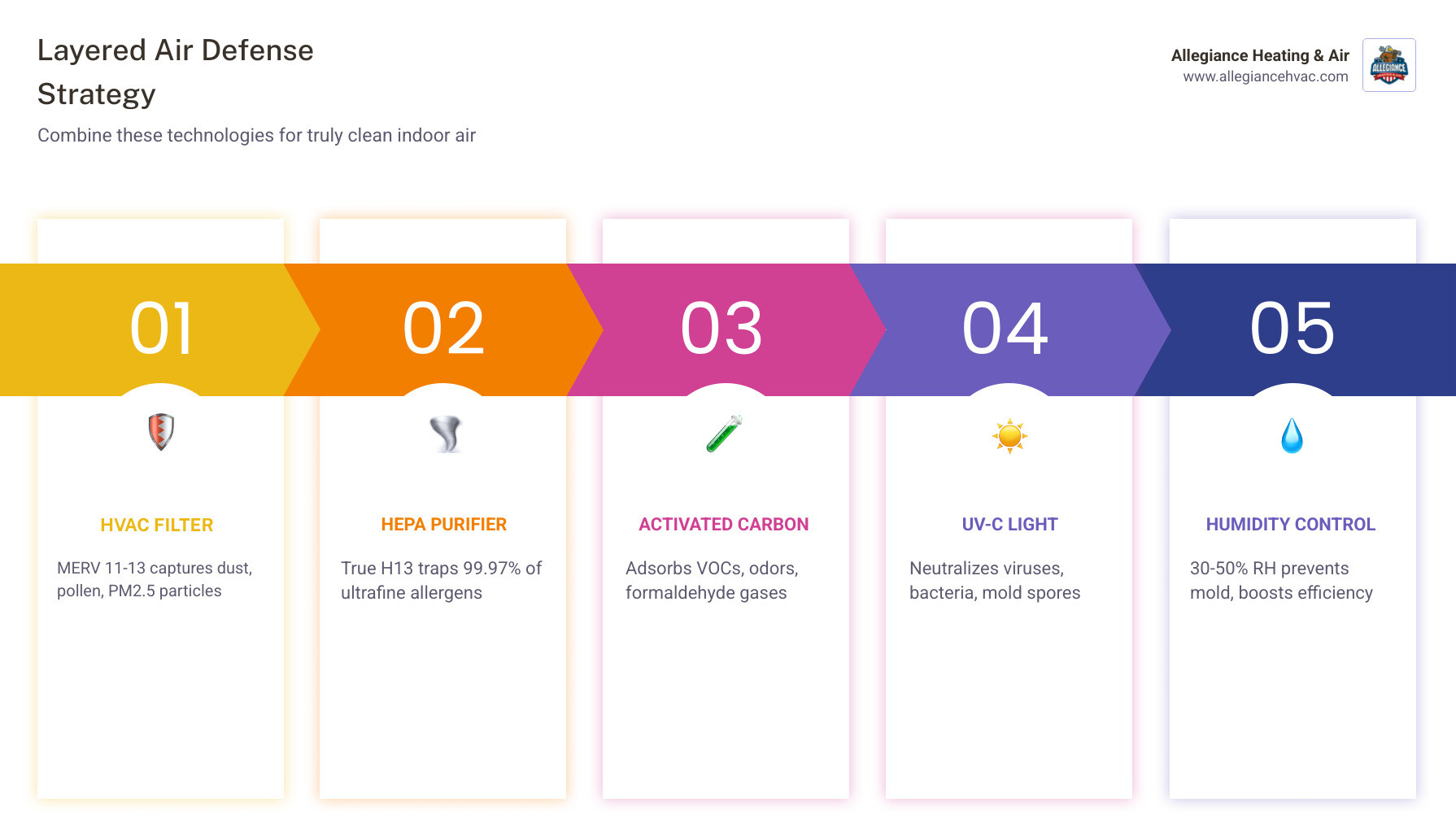
1. Upgrade your HVAC filter to MERV 11–13 to capture fine particles like dust, pollen, and pet dander
2. Add a portable or whole-home air purifier with True HEPA (H13) filtration for high-traffic rooms
3. Include activated carbon to handle odors and volatile organic compounds (VOCs)
4. Consider UV-C light to neutralize bacteria, viruses, and mold spores
5. Control humidity between 30–50% to prevent mold and help filters work more efficiently
6. Run systems consistently — continuous operation keeps pollutant levels low
Most people don't realize how bad the air inside their home can get. According to the U.S. EPA, indoor air can be 5 to 10 times more polluted than outdoor air — and we spend roughly 90% of our lives indoors. In homes near busy roads, that problem gets worse. Traffic pollution pushes fine particles (PM2.5) and chemical compounds through windows, doors, and even small gaps in your home's envelope.
A single air purifier helps. But it doesn't cover everything. Mechanical filters catch particles but miss gases. Purifiers neutralize pathogens but may not move enough air through large spaces. The only way to get truly clean indoor air is to combine the right tools in the right order.
That's exactly what this guide walks you through.
Understanding the Difference Between Purification and Filtration
When we talk about "cleaning the air," we often use the terms filtration and purification interchangeably. However, in indoor air quality (IAQ), they perform two very different jobs. Understanding these roles is the first step in combining air purification and filtration for best results.
What is Air Filtration?
Think of air filtration as a high-tech net. It uses physical media, like fiberglass or pleated paper, to "catch" particles as they fly through your vents. This is what your standard HVAC filter does. The most common measurement for these filters is the MERV (Minimum Efficiency Reporting Value) rating.
For the gold standard in particle capture, we look to True HEPA (High-Efficiency Particulate Air) filters, specifically H13 grade. These are capable of removing 99.97% of particles as small as 0.3 microns. To put that in perspective, a human hair is about 70 microns wide. We are talking about capturing the "invisible roommates" like dust mites, pet dander, and PM2.5 from local traffic in Greenville or Louisville.
What is Air Purification?
While filtration catches physical objects, air purification focuses on "neutralizing" or "deactivating" threats that might slip through a net. This includes technologies like UV-C light, which disrupts the DNA of viruses and bacteria, and activated carbon, which uses a process called adsorption to soak up gases and odors like a sponge.
Different Types of Air Cleaners and Their Benefits often include electronic air cleaners that use electrostatic attraction to pull fine smoke and pet dander out of the air. When you understand these 8 Impressive Benefits of an In-Home Air Filtration System, you start to see why one technology isn't enough to handle the complex soup of pollutants in a modern home.
• Primary Goal — Mechanical Filtration (Filters): Traps physical particles — Electronic/Chemical Purification: Neutralizes pathogens/gases
• Target Pollutants — Mechanical Filtration (Filters): Dust, pollen, dander, PM2.5 — Electronic/Chemical Purification: Viruses, bacteria, VOCs, odors
• Technology — Mechanical Filtration (Filters): Pleated media, HEPA H13 — Electronic/Chemical Purification: UV-C, Carbon, Ionization
• Maintenance — Mechanical Filtration (Filters): Regular filter replacement — Electronic/Chemical Purification: Bulb changes, plate cleaning
Why Combining Air Purification and Filtration for Best Results is Essential
You might wonder, "If I have a great filter, why do I need a purifier too?" The answer lies in synergy. Research shows that improving indoor air quality is significantly more effective when you use a multi-pronged approach.
In fact, scientific studies have shown that while a high-quality air purifier can reduce PM2.5 by about 80%, adding an air conditioning system and a fresh air system into the mix can reduce purification time by over 32.6%. This is because your HVAC system helps circulate the air, ensuring that pollutants don't just sit in stagnant corners but are actively pushed through your filtration "net."
For our neighbors in high-traffic areas like New Albany or Elizabeth, traffic pollution is a constant battle. PM2.5 particles are small enough to enter the bloodstream, and VOCs (Volatile Organic Compounds) from car exhaust and household cleaners can cause long-term health issues. By installing air purification systems in New Albany, IN, you aren't just filtering dust; you are addressing formaldehyde reduction and ultrafine particles as small as 0.003 microns.
When we look at air purification systems in Elizabeth, IN, we focus on this synergistic effect. A filter stops the "big" stuff, while advanced purification technologies like Plasmacluster ions or HyperHEPA take care of the microscopic threats.
How to Layer Your Home’s Air Defense System
To get the cleanest air possible, we recommend a "layered" strategy. This ensures that every breath you take has been scrubbed by multiple levels of protection. Proper airflow and air quality management is the foundation of this strategy. We often recommend incorporating fresh air systems to dilute CO2 levels, which can otherwise spike and cause grogginess or headaches.
If you are considering air purification systems in Fredericksburg, IN, here is the step-by-step approach we suggest for homeowners.
Step 1: Optimizing HVAC Filtration
Your HVAC system is the "lungs" of your home. If the filter is dirty or low-quality, the whole system suffers. We recommend upgrading to a MERV 13 filter if your system can handle the airflow resistance. MERV 13 is excellent for capturing bacteria and smoke particles.
However, be careful! A filter that is too restrictive can cause your blower motor to work too hard, leading to higher energy bills. Replacing your air filter every 1 to 3 months is the single most important maintenance task you can perform. High-efficiency pleated media filters provide more surface area to catch pollutants without suffocating your AC.
Step 2: Combining Air Purification and Filtration for Best Results in High-Traffic Rooms
In rooms where you spend the most time — like bedrooms or living rooms — the HVAC system might need a "helper." This is where portable HEPA units or whole-house air filtration in Sellersburg, IN comes in.
When choosing a portable unit, look at the Clean Air Delivery Rate (CADR). This tells you how quickly the unit can clean the air in a specific room size. For a bedroom, you want to aim for 4 to 6 Air Changes per Hour (ACH). This ensures that even if you're sleeping near a busy road in Jeffersonville or Clarksville, the air stays fresh all night long.
Step 3: Adding Specialized Purification for VOCs and Pathogens
The final layer involves deactivating the things filters can't catch. Ultraviolet air cleaners for improved IAQ use UV-C light to zap mold spores and viruses. This is particularly effective when installed near your AC's evaporator coil, where moisture can otherwise lead to mold growth.
For homes with heavy odors or chemical sensitivities, look for purifiers with significant carbon weight. We recommend at least 5 pounds of activated carbon for meaningful VOC removal. If you're looking into air purification systems in Henryville, IN, adding this chemical-adsorption layer is the "pro move" for a truly healthy home.
Maintaining Your Combined System for Peak Performance
Building a great system is only half the battle; you also have to keep it running. Poor maintenance can lead to a "rebound" effect where your filters become a source of pollution themselves. Enhancing indoor air quality requires a commitment to a schedule.
For those with whole-house air filtration in Jeffersonville, IN, we suggest the following maintenance checklist:
• Monthly: Check your HVAC filter. If it looks gray or dusty, swap it out.
• Quarterly: Clean the intake grilles and ensure no furniture is blocking the vents.
• Bi-Annually: Have a professional clean your AC coils. Dirty coils act as an insulator, making your system work harder and potentially harboring mold.
• Annually: Calibrate air quality sensors and replace UV-C bulbs, as their effectiveness fades over time.
Strategies for Combining Air Purification and Filtration for Best Results Year-Round
Air quality needs change with the seasons. In the winter, the air gets dry, which can irritate your sinuses and make it easier for viruses to travel. In the summer, humidity can skyrocket, leading to mold issues.
We recommend solutions for improving IAQ year-round that include humidity control. Keeping your home between 30% and 50% humidity is the "sweet spot." If the air is too dry, pollutants stay suspended longer; if it's too humid, dust mites thrive. Following these tips to increase your home's indoor air quality will keep your family comfortable regardless of the weather in Southern Indiana or Kentucky.
Frequently Asked Questions about Indoor Air Quality
Can I use a humidifier and air purifier together safely?
Absolutely! In fact, they are a great team. A humidifier adds moisture to the air to soothe your skin and throat, while an air purifier removes the particles that can be more concentrated in dry air. The key is maintenance. You must clean your humidifier regularly to prevent it from pumping bacteria into the air. If you use a combo unit, ensure it has a True HEPA filter to catch any minerals or microbes that might escape the water tank.
How often should I replace high-efficiency filters in a combined system?
While standard filters are often changed every 30 days, high-efficiency 4-inch media filters or HEPA filters in combined systems can sometimes last 6 to 12 months. However, if you live near a busy road with high traffic pollution, or if you have multiple pets, you may need to replace them more frequently. Always follow the filter replacement indicator on your device or check the physical condition of the filter every few months.
Do portable air conditioners help with traffic pollution?
Standard portable air conditioners provide a small amount of filtration, but they aren't a substitute for a dedicated purifier. Interestingly, many portable ACs create a slightly negative pressure environment by exhausting air outside, which can actually draw in more outdoor pollutants through gaps in windows. If you use a portable AC, we recommend pairing it with a standalone HEPA air purifier to clean the air that is being pulled into the room.
Conclusion
Achieving the best indoor air quality isn't about finding one "magic" machine; it's about the smart strategy of combining air purification and filtration for best results. By layering a high-quality HVAC filter with targeted room purification and specialized tools like UV-C light, you create a fortress of clean air for your family.
At Allegiance Heating & Air, we’ve been "Taking Home Comfort Under Our Wing" since 2005. Whether you are in Greenville, New Albany, or any of our surrounding communities, we are here to help you design the perfect IAQ strategy for your specific needs.
Ready to breathe easier? Explore our Indoor Air Quality Services today and let us help you double down on clean indoor air.
Contact Us Or Schedule Expert Service
Other Blogs
ready to transform your home?
Discover our exceptional home services tailored to meet your needs and enhance your living space.
WHAT OUR CLIENTS HAVE TO SAY ABOUT US

We had a complete HVAC system and a hot water heater installed. The guys were professional, well mannered, and completed the work in a timely manner. Would definitely use them again.
I was nervous at first because my AC broke in the middle of 80 degree weather which is strange for April, but Allegiance Heating and Air was incredibly prompt and professional. The technician arrived within an hour, explained the problem clearly, and completed the repair. The technician , Mr. Garrett Moon was a very nice and courteous young man. He found the problem and fixed it within a timely manner. I highly recommend them for any heating or cooling needs. I’ll definitely give them a call again should I ever have another issue, but hopefully not. Knock on wood 😁. Give them a call… you won’t be disappointed!
From the moment I called to schedule a service, the team was quick to respond and arrived right on time. The technician was professional, friendly, and clearly knowledgeable about my heating system. He explained the repair options in plain language and completed the job efficiently. I appreciated the reliable service and the fact that the work was done the same day. I would definitely recommend Allegiance Heating and Air for any residential HVAC needs.
5/5 stars – I was very impressed with the efficient, affordable and timely service from Allegiance Heating and Air. The technician arrived on time, and performed the service quickly, no repairs needed at this time. Communication was clear and the whole experience felt hassle‑free. I would definitely recommend them for any residential HVAC needs.
Knowledgeable, experienced individual.
Explains Allegiance Heating and Air was incredibly reliable, professional and affordable. They arrived right on time, kept the work area clean and finished the furnace repair quickly. The technician explained everything clearly and the price was a great value. If happiness had a location on Google Maps, it would be here.
Gilbert had to go above and beyond because York is no longer making the part for my furnace. But he was able to find a way to construct a housing bracket for my furnace. Ingenuity, determination and integrity is what finally got my furnace fixed. Gilbert is truly a one of a kind technician.
Thank you for always going the extra mile. Gilbert is always respectful and helpful with any concerns.
"Great service, most knowledgeable and capable HVAC business in Kentuckiana!! Pete Flemming and Bryan the owner, are HVAC encyclopedias. They have the highest integrity of any HVAC business I have ever used. Allegiance has put numerous units in for me over the last 17 years. I will continue to use and trust them."
"Fast response from Allegiance when our heat was out on New Year’s day! Service technician was friendly and efficient. He took the time to explain the problem, tell us about the temporary fix and the plan for permanent repair. We were impressed!"
"Love Allegiance! Their technicians, in particular Benjamin, explain everything. Fast and thorough. A/C was out on a Sunday. Called Allegiance and within a few hours Benjamin arrived. Such a comfort as he was the one who last serviced our units. He quickly replaced part and cooling is restored!"
"My heat pump went out and I had to call after hours. The technician (Garrett) was outstanding and thorough. He got my system up and working until Monday and gave me several options of units. Also took the time to explain the issue to my Home warranty company. I highly recommend this company."
"Right on time :) respectful, fast, and polite. Even gave my fur babies some attention."
"Had Garrett out today to fix our AC. Fantastic tech. He showed up exactly when he said he would and kept us informed of what he was checking and what he found. Highly recommend!"
"Lucas with Allegiance showed up on time as promised, was professional and extremely patient and responsive with all my questions. He took care of the issue, and I feel he was trustworthy! He had us back to cool and comfortable on one of the hottest days of the year."
"Lucas did a great job! Very professional and expedient. Explained the process very well and represented Allegiance as a truly professional and reputable company."
"Arrived on time and work diligently to fix issue. These guy are great. Worked quickly to resolve my issues."
"Lucas was great - he spent a lot of time trying to figure out what was going on and explained everything he was doing. I trust Allegiance and wouldn’t want anyone else working on/in my house!!"

RELATED ARTICLES

Smart Savings: Finding Affordable Heat Pump Repair in Louisville, KY

Decoding Local HVAC Estimates: How to Spot Hidden Costs in 'Cheap' Air Conditioner Replacements