


Why Air Purification vs Filtration Which Is Better for Allergies Is the Question Every Allergy Sufferer Should Be Asking
air purification vs filtration which is better for allergies depends on what's triggering your symptoms — and for most homes, the answer is a smart combination of both.
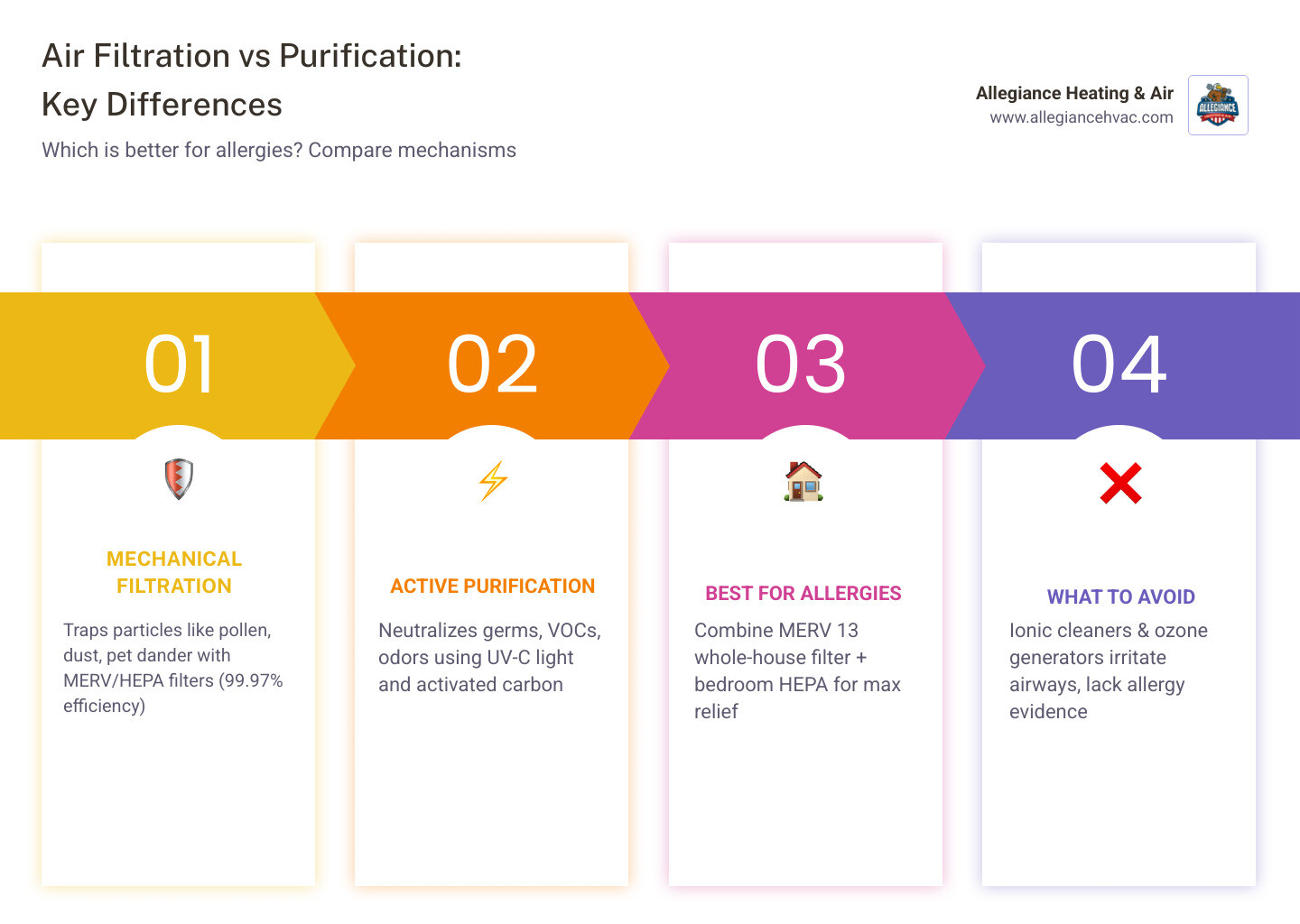
Here's a quick breakdown:
• Mechanical filtration (MERV 13 or HEPA) is best for capturing physical particles like pollen, dust mites, and pet dander
• Air purification (UV-C, activated carbon) is best for neutralizing biological contaminants, odors, and volatile organic compounds (VOCs)
• For most allergy sufferers, a whole-house MERV 13 filter paired with a HEPA purifier in the bedroom delivers the strongest relief
• Avoid ionic cleaners and ozone generators — they can irritate airways and lack solid evidence for allergy relief
If you've ever woken up congested despite keeping a clean home, you're not imagining things. The EPA ranks indoor air pollution among the top five environmental health risks, and studies show the air inside your home can be two to five times more polluted than the air outside. For allergy and asthma sufferers in Greenville, IN, that's not a small detail — it's a daily quality-of-life issue.
The problem is that "air purifier" and "air filter" get used interchangeably in stores and online, but they work in fundamentally different ways and target different pollutants. Choosing the wrong one — or skipping one you actually need — can mean continued sneezing, itchy eyes, and disrupted sleep even after you've invested in a solution.
This guide cuts through the confusion so you can make a clear, informed decision about what your home actually needs.
Air purification vs filtration which is better for allergies in Greenville?
When we talk to our neighbors in Greenville, Sellersburg, or New Albany about their itchy eyes and runny noses, the conversation usually turns to gear. "Should I get a better furnace filter, or do I need one of those fancy machines that sits in the corner?"
To understand air purification vs filtration which is better for allergies, we first have to look at how they handle "the bad guys" in your air.
Think of an air filter as a net. It's a passive technology. As your HVAC system's blower motor pulls air through your ducts, the filter stands in the way. If a particle of dust or a grain of ragweed pollen is too big to fit through the holes in the mesh, it gets trapped. This is mechanical filtration. It is excellent for the "big" stuff (relatively speaking) like dust mites, which are about 100 to 300 microns, or pollen, which ranges from 10 to 100 microns.
Air purification, on the other hand, is an active technology. Instead of just waiting for particles to get stuck in a screen, purifiers use technology like UV-C light or activated carbon to neutralize or eliminate contaminants. While a filter might trap a mold spore, a purifier with UV light can actually deactivate it so it can't reproduce.
For those of us living in the Ohio River Valley, where ragweed affects up to 75% of people with pollen allergies, getting the Airflow & Air Quality balance right is essential. If your filter is too restrictive, your airflow drops, and your air doesn't get cleaned as often. If it’s too loose, the allergens just sail right through.
One metric we always check is the CADR, or Clean Air Delivery Rate. This tells us how much clean air a portable unit can produce for a specific room size. For allergy relief, we usually recommend a unit that can provide 4 to 5 Air Changes per Hour (ACH).
• Primary Goal — Air Filtration (Mechanical): Trapping physical particles — Air Purification (Active): Neutralizing germs, odors, and gases
• Best For — Air Filtration (Mechanical): Dust, pollen, pet dander — Air Purification (Active): Viruses, bacteria, smoke, VOCs
• Technology — Air Filtration (Mechanical): Pleated mesh, HEPA media — Air Purification (Active): UV-C light, Activated Carbon
• Coverage — Air Filtration (Mechanical): Whole-house (via HVAC) — Air Purification (Active): Often room-specific (portable)
Mechanical Filtration: MERV Ratings and HEPA Standards
If you've ever stood in the filter aisle at the hardware store, you've seen the MERV ratings. MERV stands for Minimum Efficiency Reporting Value, and it’s a scale from 1 to 20.
For most of our residential clients, we find that MERV 11 to 13 is the "sweet spot." A MERV 13 filter is a powerhouse; it can capture up to 90% of particles in the 3 to 10-micron range, which is exactly where most pollen falls. If you are looking for Whole House Air Filtration Sellersburg IN, upgrading to a high-quality pleated filter is often the first and most cost-effective step.
Then there is the "Gold Standard": HEPA. A true HEPA filter is certified to remove 99.97% of dust, pollen, and any airborne particles as small as 0.3 microns. To put that in perspective, 0.3 microns is about 300 times smaller than the width of a human hair!
There are 8 Impressive Benefits of Having an In-Home Air Filtration System, but one of the biggest is protecting your HVAC equipment. Inexpensive fiberglass filters — those blue ones you can almost see through — provide less than a 20% reduction in indoor allergens. They are "rock catchers" designed to keep large debris out of your furnace, not to help you breathe better.
Is air purification vs filtration which is better for allergies when dealing with pet dander?
Pet dander is a tricky foe. It’s microscopic, often jagged, and incredibly lightweight, meaning it can stay suspended in the air for hours. If you have two cats or a golden retriever, you know the struggle.
When patients in a clinical study used Sleep Breathing Zone (SBZ) HEPA filtration, they saw a 26% reduction in morning allergic rhinitis symptoms. Why? Because the HEPA filter was able to snag those tiny dander particles that standard filters miss.
However, dander also carries odors. This is where the air purification vs filtration which is better for allergies debate gets interesting. While a filter traps the dander, it won't do much for the "dog smell." To truly win the war on pet allergies, we often suggest a "layered approach." Use a MERV 13 filter in your HVAC system to catch the bulk of the hair and dander, and use a purifier with an activated carbon stage to neutralize the odors. You can learn more about How Air Purification Can Help with Allergies to see how these technologies work together to create a dander-free zone.
Active Air Purification: UV and Carbon Technologies
Sometimes, trapping a particle isn't enough — you want it gone. This is where active purification shines.
One of the most effective tools we install is UV-C light. These systems are usually mounted inside your air handler or near the cooling coils. As air passes by, the Ultraviolet Air Cleaners Improved IAQ by using germicidal light to scramble the DNA of bacteria, viruses, and mold spores. It doesn't just "catch" them; it renders them harmless.
Then there is Activated Carbon. Unlike a mesh filter that works like a sieve, carbon works through "adsorption." The pollutants chemically bond to the surface of the carbon. This is the only way to effectively remove Volatile Organic Compounds (VOCs) — those chemical smells from new furniture, paint, or cleaning products — and stubborn odors like smoke or cooking smells.
When you look at the Different Types of Air Cleaners and Their Benefits, you'll see that these technologies are often combined into one unit. A high-end purifier might have a pre-filter for dust, a HEPA filter for allergens, a carbon block for odors, and a UV light for germs.
Deciding if air purification vs filtration which is better for allergies like mold and bacteria?
If your allergies are triggered by mold spores or you find yourself getting sick every time a cold goes around the office, purification is your best friend. Mold thrives in moist, poorly ventilated areas, and once it gets into your ductwork, it can spread throughout the house.
A professional Air Purifier Installation can target these biological contaminants. While a MERV 13 filter can catch mold spores (which are typically 3 to 40 microns), a UV purifier provides that extra layer of germicidal protection.
A word of caution, though: be wary of "ionic" or "electrostatic" cleaners. Some of these older technologies can produce ozone, which is a known respiratory irritant. For someone with asthma or sensitive lungs, ozone can actually make symptoms worse. We always recommend sticking with "True HEPA" and CARB-certified purifiers that produce zero ozone.
Beyond Filters: A Comprehensive Approach to IAQ
We’ve been in the HVAC business since 2005, and if there’s one thing we’ve learned, it’s that no single device is a silver bullet. You can't just plug in a purifier and expect to live in a bubble if the rest of your home environment is working against you.
One of the biggest factors in our local climate is humidity. Indoor humidity levels above 60% create the perfect breeding ground for dust mites and mold. On the flip side, air that is too dry (below 30%) can irritate your nasal passages, making you more susceptible to allergens. We aim for that "Goldilocks" zone of 30% to 55%.
Improving Indoor Air Quality also requires source control. This means:
• No smoking indoors: Tobacco smoke is a massive trigger for asthma and allergies.
• HEPA Vacuuming: Standard vacuums often blow tiny dust particles right back out the exhaust. A HEPA-certified vacuum keeps them trapped.
• Pet Grooming: Brush your pets outside to keep the dander from settling into your carpets and upholstery.
• Tracking Mats: Use high-quality mats at every door and remove your shoes. A single ragweed plant can produce a billion pollen grains, and you don't want them hitched to your sneakers.
When you are Combating Seasonal Allergies, every little bit helps. Think of filtration and purification as the foundation, and these habits as the walls that keep the "allergy house" standing.
Frequently Asked Questions and Conclusion
At Allegiance Heating & Air, we take "Taking Home Comfort Under Our Wing" seriously. Whether you're in Greenville, Louisville, or anywhere in between, we know that breathing clean air isn't just a luxury — it’s essential for your health.
If you’re still weighing air purification vs filtration which is better for allergies, filtration is your first line of defense for the whole house, while purification is your specialized strike team for smaller, more dangerous contaminants.
If you're ready to stop the sneezing and start sleeping better, we’re here to help. Our trusted technicians can perform a professional Indoor Air Quality assessment to see exactly what’s floating in your air and recommend the system that fits your home and your health needs.
Can a high-MERV filter damage my HVAC system?
This is a great question we hear a lot in Greenville. The answer is "potentially, yes," if it's not handled correctly. High-MERV filters are denser, which means they create more "static pressure" or resistance to airflow. If your blower motor isn't designed to handle that resistance, it can overheat, use more energy, or even fail prematurely.
This is why professional sizing is so important. We can measure the airflow in your system to see if it can handle a MERV 13, or if we need to install a deeper, 4-inch or 5-inch filter cabinet that allows for high filtration without choking the system.
Do air purifiers remove odors and smoke?
Yes, but only if they have the right technology. A standard HEPA filter is amazing at catching smoke particles (the visible soot), but it cannot catch the gases or the smell. For that, you need an activated carbon filter. The carbon uses gas-phase adsorption to pull those chemical vapors and odors out of the air. If you're dealing with wildfire smoke or a "musty" basement smell, look for a purifier with a heavy carbon stage.
How often should I replace my allergy filters?
For most homes in our area, we recommend checking your filters every month and replacing them at least every 3 to 6 months. However, if it’s peak pollen season in Indiana or if you have multiple pets, you might need to swap them out every 60 days.
A gray or "fuzzy" looking filter is a sign that it’s full. A clogged filter doesn't just stop cleaning your air; it also forces your HVAC system to work harder, which can lead to higher utility bills and a shorter system lifespan. Keeping up with your Indoor Air Quality maintenance is the easiest way to ensure you're getting the relief you paid for.
Ready to breathe easier? Give us a call at Allegiance Heating & Air today. We'll help you find the perfect balance of filtration and purification so you can finally relax in your own home.
Contact Us Or Schedule Expert Service
Other Blogs
ready to transform your home?
Discover our exceptional home services tailored to meet your needs and enhance your living space.
WHAT OUR CLIENTS HAVE TO SAY ABOUT US

We had a complete HVAC system and a hot water heater installed. The guys were professional, well mannered, and completed the work in a timely manner. Would definitely use them again.
I was nervous at first because my AC broke in the middle of 80 degree weather which is strange for April, but Allegiance Heating and Air was incredibly prompt and professional. The technician arrived within an hour, explained the problem clearly, and completed the repair. The technician , Mr. Garrett Moon was a very nice and courteous young man. He found the problem and fixed it within a timely manner. I highly recommend them for any heating or cooling needs. I’ll definitely give them a call again should I ever have another issue, but hopefully not. Knock on wood 😁. Give them a call… you won’t be disappointed!
From the moment I called to schedule a service, the team was quick to respond and arrived right on time. The technician was professional, friendly, and clearly knowledgeable about my heating system. He explained the repair options in plain language and completed the job efficiently. I appreciated the reliable service and the fact that the work was done the same day. I would definitely recommend Allegiance Heating and Air for any residential HVAC needs.
5/5 stars – I was very impressed with the efficient, affordable and timely service from Allegiance Heating and Air. The technician arrived on time, and performed the service quickly, no repairs needed at this time. Communication was clear and the whole experience felt hassle‑free. I would definitely recommend them for any residential HVAC needs.
Knowledgeable, experienced individual.
Explains Allegiance Heating and Air was incredibly reliable, professional and affordable. They arrived right on time, kept the work area clean and finished the furnace repair quickly. The technician explained everything clearly and the price was a great value. If happiness had a location on Google Maps, it would be here.
Gilbert had to go above and beyond because York is no longer making the part for my furnace. But he was able to find a way to construct a housing bracket for my furnace. Ingenuity, determination and integrity is what finally got my furnace fixed. Gilbert is truly a one of a kind technician.
Thank you for always going the extra mile. Gilbert is always respectful and helpful with any concerns.
"Great service, most knowledgeable and capable HVAC business in Kentuckiana!! Pete Flemming and Bryan the owner, are HVAC encyclopedias. They have the highest integrity of any HVAC business I have ever used. Allegiance has put numerous units in for me over the last 17 years. I will continue to use and trust them."
"Fast response from Allegiance when our heat was out on New Year’s day! Service technician was friendly and efficient. He took the time to explain the problem, tell us about the temporary fix and the plan for permanent repair. We were impressed!"
"Love Allegiance! Their technicians, in particular Benjamin, explain everything. Fast and thorough. A/C was out on a Sunday. Called Allegiance and within a few hours Benjamin arrived. Such a comfort as he was the one who last serviced our units. He quickly replaced part and cooling is restored!"
"My heat pump went out and I had to call after hours. The technician (Garrett) was outstanding and thorough. He got my system up and working until Monday and gave me several options of units. Also took the time to explain the issue to my Home warranty company. I highly recommend this company."
"Right on time :) respectful, fast, and polite. Even gave my fur babies some attention."
"Had Garrett out today to fix our AC. Fantastic tech. He showed up exactly when he said he would and kept us informed of what he was checking and what he found. Highly recommend!"
"Lucas with Allegiance showed up on time as promised, was professional and extremely patient and responsive with all my questions. He took care of the issue, and I feel he was trustworthy! He had us back to cool and comfortable on one of the hottest days of the year."
"Lucas did a great job! Very professional and expedient. Explained the process very well and represented Allegiance as a truly professional and reputable company."
"Arrived on time and work diligently to fix issue. These guy are great. Worked quickly to resolve my issues."
"Lucas was great - he spent a lot of time trying to figure out what was going on and explained everything he was doing. I trust Allegiance and wouldn’t want anyone else working on/in my house!!"

RELATED ARTICLES
How Does a Heat Pump Work: The Difference Between Cooling and Heating Mode
10 HVAC Maintenance Tips Every Homeowner Should Know
