


Why Your AC Compressor is the Heart of Your Home's Comfort
Learning how to tell if your ac compressor is failing is the best way to protect your home from the brutal summer heat. When your cooling system stops working, you need fast, reliable air conditioning repair in Greenville, IN to restore your comfort. The compressor acts as the heart of your air conditioner, pumping refrigerant to cool your indoor air. If it fails, your entire system shuts down, leaving your family in a hot, sticky house. Spotting the early warning signs can save you from a complete system breakdown.
If you suspect your system is struggling, check out our professional air conditioning services or schedule an inspection with Allegiance Heating & Air right away.
Quick Answer: How to Tell if Your AC Compressor is Failing
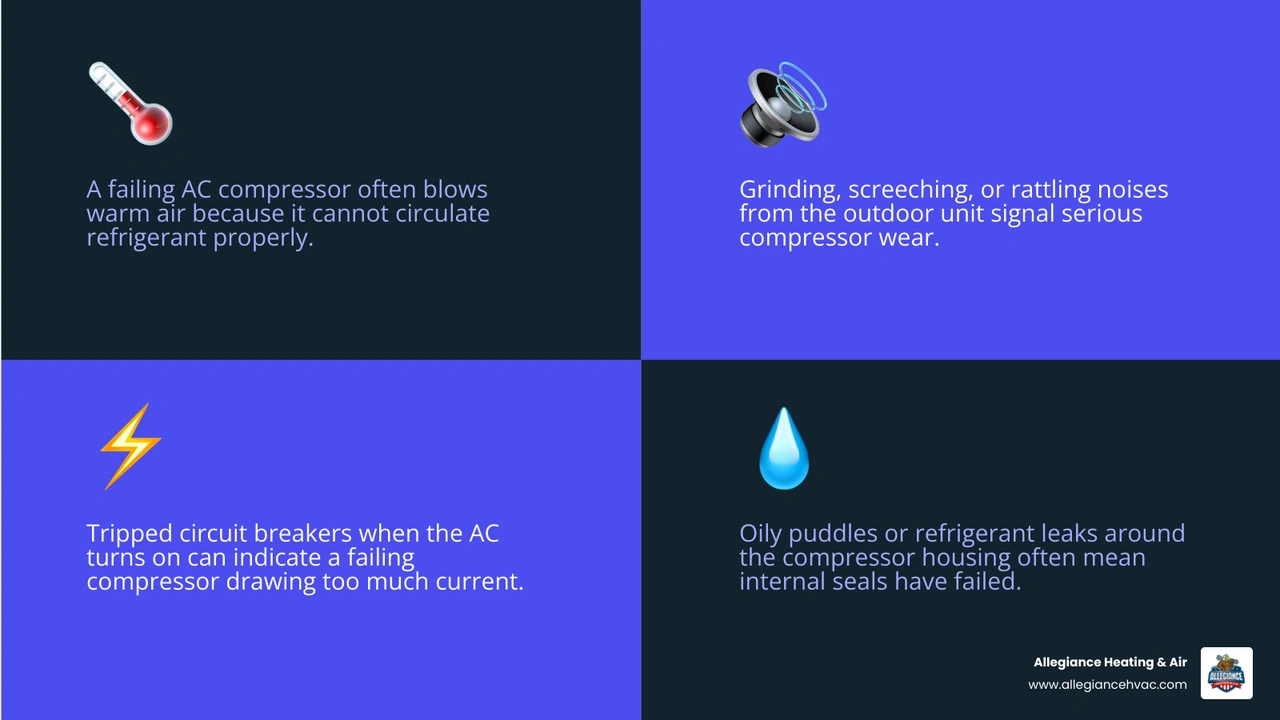
You can tell your AC compressor is failing if you notice these five common warning signs:
- Warm air blowing from your vents instead of cool air.
- Loud, unusual noises like grinding, screeching, or rattling when the outdoor unit starts.
- Frequently tripped circuit breakers when your air conditioner turns on.
- Visible shaking or shuddering of the outdoor condenser unit during startup.
- Refrigerant leaks or puddles of oily fluid around the base of the outdoor unit.
The AC compressor is the powerhouse of your cooling system. It takes low-pressure, cool refrigerant gas and squeezes it into a high-pressure, hot gas. This process allows the system to release heat outside and send cool air back into your home.
When the compressor begins to wear out, this entire cooling cycle breaks down. Knowing what to look for helps you catch problems early before they cause permanent damage to your air conditioner.
How to Tell if Your AC Compressor Is Failing: 5 Key Symptoms
An air conditioner is a lot like a car; it relies on several moving parts working in perfect harmony. However, the compressor is unique because it is the primary component doing the heavy lifting. When it starts to fail, it doesn't just quietly quit. It sends out distress signals.
In Southern Indiana, where July 2026 brings heavy humidity and high temperatures to communities like Floyds Knobs, Georgetown, and Clarksville, a failing compressor can quickly turn your home into a sauna. Recognizing these Air Conditioner Repair Signs early is the key to preventing a complete system meltdown.
Let's dive deep into the five primary symptoms that indicate your compressor is on its last legs.
1. Warm Air and Reduced Airflow: How to Tell if Your AC Compressor Is Failing
The most obvious sign of a struggling compressor is a sudden drop in cooling performance. If you feel lukewarm or flat-out warm air blowing from your supply vents, your compressor may no longer be pumping refrigerant effectively.
The Role of Refrigerant Circulation
For your air conditioner to cool your home, refrigerant must continuously circulate between the indoor evaporator coil and the outdoor condenser coil. The compressor is the pump that drives this process. If the internal valves of the compressor wear out, it loses its ability to pressurize the refrigerant. Without this pressure, the thermodynamic cycle stops, and the system cannot absorb heat from your indoor air.
Testing the Temperature Split
A simple way to check your system's performance is by measuring the "temperature split."
- A healthy, properly functioning air conditioning system should achieve a 15°F to 20°F difference between the air entering the return vent and the air blowing out of the supply vent.
- If you measure this difference and find a split of less than 10°F, your compressor is likely failing to compress the refrigerant gas, or you may be dealing with a severe refrigerant leak.
When the compressor loses its pumping efficiency, it may run continuously as it tries to meet the thermostat's demands. This leads to high energy bills and reduced airflow, which is a classic reason Why Your AC is Blowing Warm Air.
2. Loud and Unusual Noises: How to Tell if Your AC Compressor Is Failing
A healthy air conditioner should operate with a consistent, low hum. If your outdoor unit begins sounding like a bucket of loose bolts, it is trying to tell you something is seriously wrong.
When you hear your AC Making Strange Noises: What They Mean can help you identify if the issue is mechanical or electrical. Here are the most common sounds associated with a failing compressor:
- Grinding or Screeching: This metal-on-metal sound usually points to worn-out internal bearings. If the bearings seize, the compressor motor will lock up entirely.
- Rattling or Clattering: This can indicate that the internal mounts holding the compressor motor have failed, causing the motor to shake loose inside its sealed housing. It can also mean a piece of hardware has broken off and is bouncing around inside.
- Clicking or Chattering: A rapid clicking sound when the system tries to start up often indicates an electrical issue, such as a failing contactor or a struggling compressor clutch.
- Loud Electrical Humming: If the compressor hums loudly but refuses to start, the motor is trying to draw power but is mechanically seized or lacks the electrical boost required to turn over.
If you hear any of these noises, we highly recommend shutting off your system immediately to prevent further internal damage.
3. Electrical Issues and Tripped Circuit Breakers
Because the compressor is the single largest consumer of electricity in your home, any mechanical struggle inside the unit will immediately reflect in your home's electrical system.
Why the Breaker Keeps Tripping
When a compressor is failing, it experiences high friction due to worn bearings or a lack of lubrication. To overcome this resistance and start spinning, the motor must draw much more electrical current (amperage) than it normally would.
If this current draw exceeds the safety limit of your circuit breaker, the breaker will trip to prevent your home's wiring from overheating.
The Danger of Resetting the Breaker
If your AC trips the circuit breaker, reset it only once. If it trips a second time, do not keep flipping it back on. Continuously forcing a struggling compressor to start can lead to a catastrophic electrical short, melted wiring, or even an electrical fire.
Failing Capacitors vs. Compressor Failure
Often, what looks like a dead compressor is actually a failed run capacitor. The capacitor acts like a temporary battery, providing the electrical boost needed to start and run the compressor motor. If the capacitor fails, the compressor will hum and trip the breaker. Our professional technicians can quickly test the electrical windings and capacitors with a multimeter to pinpoint the exact issue.
4. Visible Shaking and Hard Starts on Startup
Have you noticed your outdoor condenser unit visibly shuddering, shaking, or jumping every time the cooling cycle kicks on? This phenomenon is known as "hard starting."
Hard starting occurs when the compressor struggles to overcome the physical resistance inside its cylinders. As the motor fights to turn over against high head pressure or worn mechanical parts, the entire outdoor cabinet will vibrate violently.
This constant shaking puts immense strain on the copper refrigerant lines and electrical connections, often leading to secondary leaks and electrical failures. While a temporary "hard-start kit" can sometimes be installed to reduce startup amperage and buy you some time, it is ultimately a temporary band-aid for an aging, failing motor.
5. Refrigerant Leaks and Moisture Puddles
Your air conditioning system is a closed loop. Refrigerant should never escape, and moisture should only ever appear as normal condensation draining through your designated condensate line.
If you notice puddles of fluid or an oily residue around the base of your outdoor unit, you may have a refrigerant leak coming directly from the compressor housing itself.
Over time, the seals around the compressor shafts, valves, and electrical terminals can dry out, crack, or corrode. When refrigerant leaks out, it carries the compressor's vital lubricating oil with it. This leads to a dangerous double-whammy:
- Low refrigerant levels force the compressor to work harder and run longer to cool your home.
- Loss of lubricating oil causes extreme friction and overheating, which is one of the most Common Causes of AC Compressor Failure.
If you notice an oily sheen on the copper lines or around the compressor body, it is a clear sign that professional intervention is needed.
Is It the Compressor or Something Else? Diagnostic Differences
Before you assume your compressor is completely dead, it is important to rule out other common HVAC issues. Up to 80% of perceived compressor failures are actually caused by external, easily repairable electrical components like contactors, capacitors, or control boards.
The table below outlines how to distinguish a failing compressor from other common system issues:
| Symptom | Bad AC Compressor | Low Refrigerant / Leak | Faulty Blower Motor |
|---|---|---|---|
| Airflow Temp | Warm or lukewarm | Warm, often with freezing coils | No airflow at all, or very weak |
| Outdoor Unit Sound | Loud grinding, screeching, or silent hum | Normal operation or slight clicking | Normal outdoor sound, but indoor unit is silent |
| Electrical Issues | Frequently trips circuit breaker | Rarely trips breaker | May trip indoor blower fuse |
| Physical Clues | Shaking on startup, oily leaks on unit | Ice buildup on copper lines and coils | Dust buildup on vents, musty smell |
| System Behavior | Hard starting, short cycling | Runs constantly without cooling | System runs but air doesn't circulate |
If you are experiencing symptoms that overlap, it is always best to rely on AC Problems That Require Expert Repair rather than attempting a risky DIY diagnosis.
The Risks of Running an AC with a Failing Compressor
It can be tempting to ignore a noisy or struggling compressor, especially if it is still managing to push out a little bit of cool air. However, running a failing compressor is a recipe for a catastrophic system "burnout."
When a compressor motor fails electrically, it can create an intense electrical arc. This extreme heat burns the motor windings, mixing with the refrigerant and oil to create highly corrosive acid and carbon soot.
Once this acid enters your refrigerant lines, it contaminates the entire system. It will quickly destroy:
- The expansion valve (TXV)
- The indoor evaporator coil
- Any replacement compressor you install, unless the lines are extensively and expensively flushed.
Additionally, a seized compressor can cause your outdoor fan motor to overheat or damage your home's electrical panel. If you suspect your compressor is failing, turn the system off at the thermostat immediately to protect your investment.
Repair vs. Replace: Making the Right Choice for Your Home
When faced with a failing compressor, one of the biggest decisions you will make is whether to replace the compressor itself or upgrade to a completely new air conditioning system.
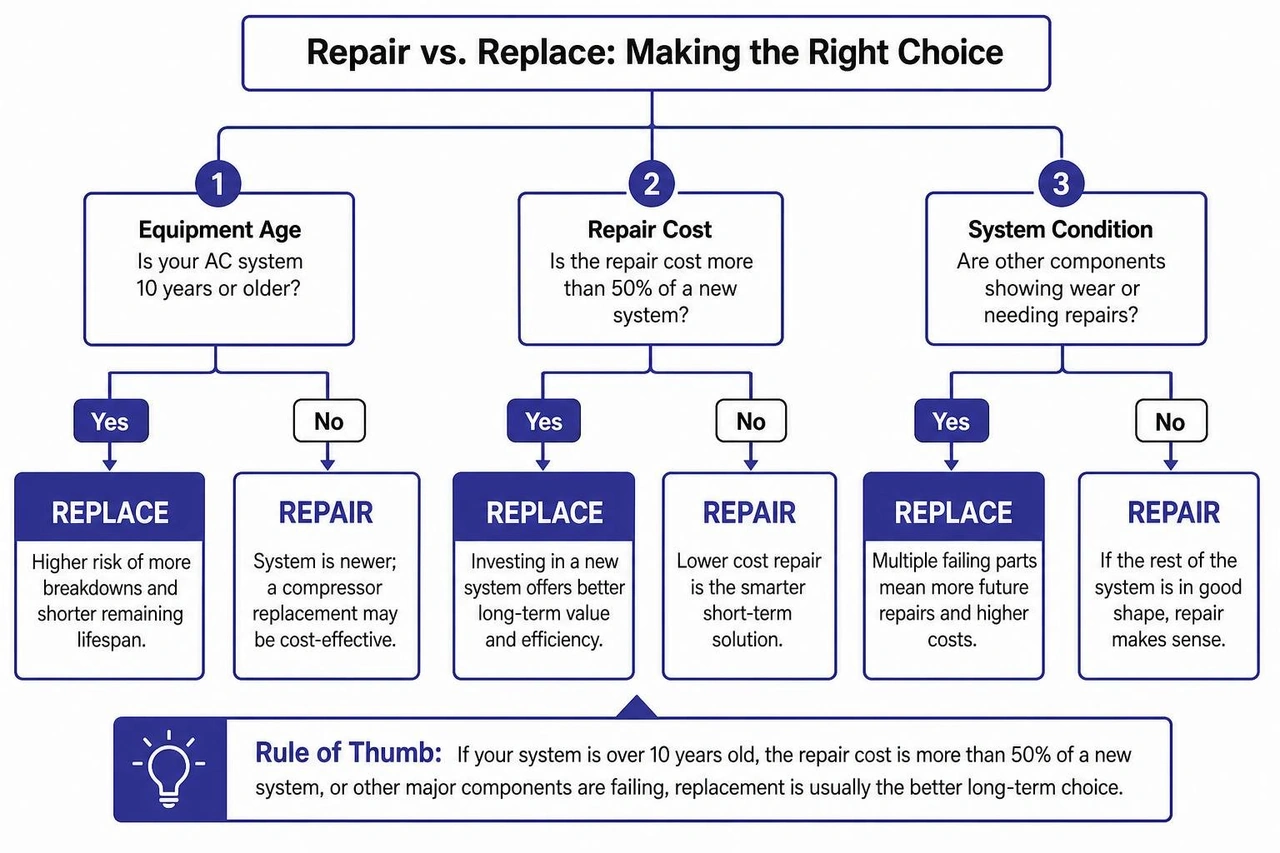
We recommend keeping these three factors in mind when making your decision:
1. The 10-Year Rule and Equipment Age
Most residential AC compressors have an expected lifespan of 10 to 15 years with proper maintenance. If your system is over 10 years old, replacing just the compressor is rarely a smart financial decision. The rest of the system's components—like the condenser fan, outdoor coil, and indoor blower motor—are likely nearing the end of their lifespans as well.
2. Refrigerant Compatibility (The R-22 Factor)
If your air conditioner was installed before 2010, it likely uses R-22 refrigerant, which has been completely phased out due to environmental regulations. Finding R-22 to recharge your system after a compressor swap is extremely difficult and incredibly expensive. If your system uses R-22, a full system replacement is almost always the only logical choice.
3. Energy Efficiency and SEER2 Standards
Modern air conditioners are significantly more efficient than systems built a decade ago. Upgrading to a new, high-efficiency SEER2 compliant system can cut your monthly cooling costs by 20% to 40%.
Preventive Maintenance to Extend Your Compressor's Lifespan
The good news is that up to 80% of premature AC compressor failures are preventable if you keep up with routine maintenance. Because the compressor is often the "victim" of other system failures, keeping the rest of your air conditioner healthy is the best way to protect it.
- Change Your Air Filters Monthly: A clogged air filter restricts airflow across the indoor evaporator coil. This can cause liquid refrigerant to flood back into the compressor—a phenomenon known as liquid slugging. Because liquids cannot be compressed, this instantly destroys the compressor's internal valves.
- Keep the Outdoor Unit Clean: Gently rinse your outdoor condenser coils with a garden hose (never a pressure washer) to remove dirt, pollen, and grass clippings.
- Maintain Clear Space: Ensure there is at least two feet of clear space around your outdoor unit. Blocking the airflow with shrubs, fences, or decorations causes the compressor to overheat and short cycle.
- Schedule Annual Professional Tune-Ups: Having our professional team inspect your electrical connections, measure compressor amp draw, and verify proper refrigerant levels every spring will catch minor issues before they turn into major compressor failures.
Frequently Asked Questions about AC Compressor Failure
What should I check if the compressor contactor or clutch is not engaging?
If the outdoor unit's fan is running but the compressor itself won't start, the issue could be a faulty electrical contactor, a tripped low-pressure safety switch (often caused by low refrigerant), or incorrect thermostat settings. Our technicians can safely test these low-voltage and high-voltage controls to find the root cause.
Can I safely run my AC if I suspect the compressor is failing?
No. Running a struggling compressor can cause an electrical burnout, releasing highly corrosive acids into your system's copper lines. This turns a simple component repair into a complete system replacement. Turn your system off immediately if you suspect a failure.
How do technicians perform electrical tests to diagnose a bad compressor?
Our licensed technicians use a multimeter to measure the electrical resistance (ohms) between the compressor's three terminal pins (Common, Start, and Run). We check for:
- Open Windings: Infinite resistance, indicating a broken internal wire.
- Shorted Windings: Zero or near-zero resistance, indicating an electrical short.
- Short to Ground: Any continuity between the terminal pins and the metal casing of the compressor, which indicates a dangerous electrical failure.
Trust Allegiance Heating & Air for Honest, Professional Diagnostics
At Allegiance Heating & Air, LLC, we have been "Taking Home Comfort Under Our Wing" since 2005. As a family-owned business serving Greenville, IN, and surrounding Southern Indiana communities, we pride ourselves on providing honest, transparent diagnostics and professional service.
We will never try to sell you a replacement system if a simple, reliable repair will get your home cool again. Our licensed and insured technicians have the specialized tools and expertise to accurately diagnose your compressor issues and help you make the best decision for your home and family.
Don't spend another day sweating in a hot home. Schedule professional air conditioning services today with the trusted experts at Allegiance Heating & Air!
Contact Us Or Schedule Expert Service
Other Blogs
ready to transform your home?
Discover our exceptional home services tailored to meet your needs and enhance your living space.
WHAT OUR CLIENTS HAVE TO SAY ABOUT US

We had a complete HVAC system and a hot water heater installed. The guys were professional, well mannered, and completed the work in a timely manner. Would definitely use them again.
I was nervous at first because my AC broke in the middle of 80 degree weather which is strange for April, but Allegiance Heating and Air was incredibly prompt and professional. The technician arrived within an hour, explained the problem clearly, and completed the repair. The technician , Mr. Garrett Moon was a very nice and courteous young man. He found the problem and fixed it within a timely manner. I highly recommend them for any heating or cooling needs. I’ll definitely give them a call again should I ever have another issue, but hopefully not. Knock on wood 😁. Give them a call… you won’t be disappointed!
From the moment I called to schedule a service, the team was quick to respond and arrived right on time. The technician was professional, friendly, and clearly knowledgeable about my heating system. He explained the repair options in plain language and completed the job efficiently. I appreciated the reliable service and the fact that the work was done the same day. I would definitely recommend Allegiance Heating and Air for any residential HVAC needs.
5/5 stars – I was very impressed with the efficient, affordable and timely service from Allegiance Heating and Air. The technician arrived on time, and performed the service quickly, no repairs needed at this time. Communication was clear and the whole experience felt hassle‑free. I would definitely recommend them for any residential HVAC needs.
Knowledgeable, experienced individual.
Explains Allegiance Heating and Air was incredibly reliable, professional and affordable. They arrived right on time, kept the work area clean and finished the furnace repair quickly. The technician explained everything clearly and the price was a great value. If happiness had a location on Google Maps, it would be here.
Gilbert had to go above and beyond because York is no longer making the part for my furnace. But he was able to find a way to construct a housing bracket for my furnace. Ingenuity, determination and integrity is what finally got my furnace fixed. Gilbert is truly a one of a kind technician.
Thank you for always going the extra mile. Gilbert is always respectful and helpful with any concerns.
"Great service, most knowledgeable and capable HVAC business in Kentuckiana!! Pete Flemming and Bryan the owner, are HVAC encyclopedias. They have the highest integrity of any HVAC business I have ever used. Allegiance has put numerous units in for me over the last 17 years. I will continue to use and trust them."
"Fast response from Allegiance when our heat was out on New Year’s day! Service technician was friendly and efficient. He took the time to explain the problem, tell us about the temporary fix and the plan for permanent repair. We were impressed!"
"Love Allegiance! Their technicians, in particular Benjamin, explain everything. Fast and thorough. A/C was out on a Sunday. Called Allegiance and within a few hours Benjamin arrived. Such a comfort as he was the one who last serviced our units. He quickly replaced part and cooling is restored!"
"My heat pump went out and I had to call after hours. The technician (Garrett) was outstanding and thorough. He got my system up and working until Monday and gave me several options of units. Also took the time to explain the issue to my Home warranty company. I highly recommend this company."
"Right on time :) respectful, fast, and polite. Even gave my fur babies some attention."
"Had Garrett out today to fix our AC. Fantastic tech. He showed up exactly when he said he would and kept us informed of what he was checking and what he found. Highly recommend!"
"Lucas with Allegiance showed up on time as promised, was professional and extremely patient and responsive with all my questions. He took care of the issue, and I feel he was trustworthy! He had us back to cool and comfortable on one of the hottest days of the year."
"Lucas did a great job! Very professional and expedient. Explained the process very well and represented Allegiance as a truly professional and reputable company."
"Arrived on time and work diligently to fix issue. These guy are great. Worked quickly to resolve my issues."
"Lucas was great - he spent a lot of time trying to figure out what was going on and explained everything he was doing. I trust Allegiance and wouldn’t want anyone else working on/in my house!!"

RELATED ARTICLES

Why Regular Maintenance Is Important for Heat Pump Installation in Jeffersonville
My air conditioner won't turn on. Who are some reliable HVAC repair services in the Greenville, IN area?
