My HVAC system is getting older. How long should it last before I need a replacement in Greenville, IN?
How long does an HVAC system last is one of the most common questions homeowners ask — and the answer depends on the type of equipment you have. Most residential HVAC systems last anywhere from 10 to 25 years, but that range varies significantly by system type, how well it's maintained, and where you live.
Here's a quick reference for average HVAC lifespans:
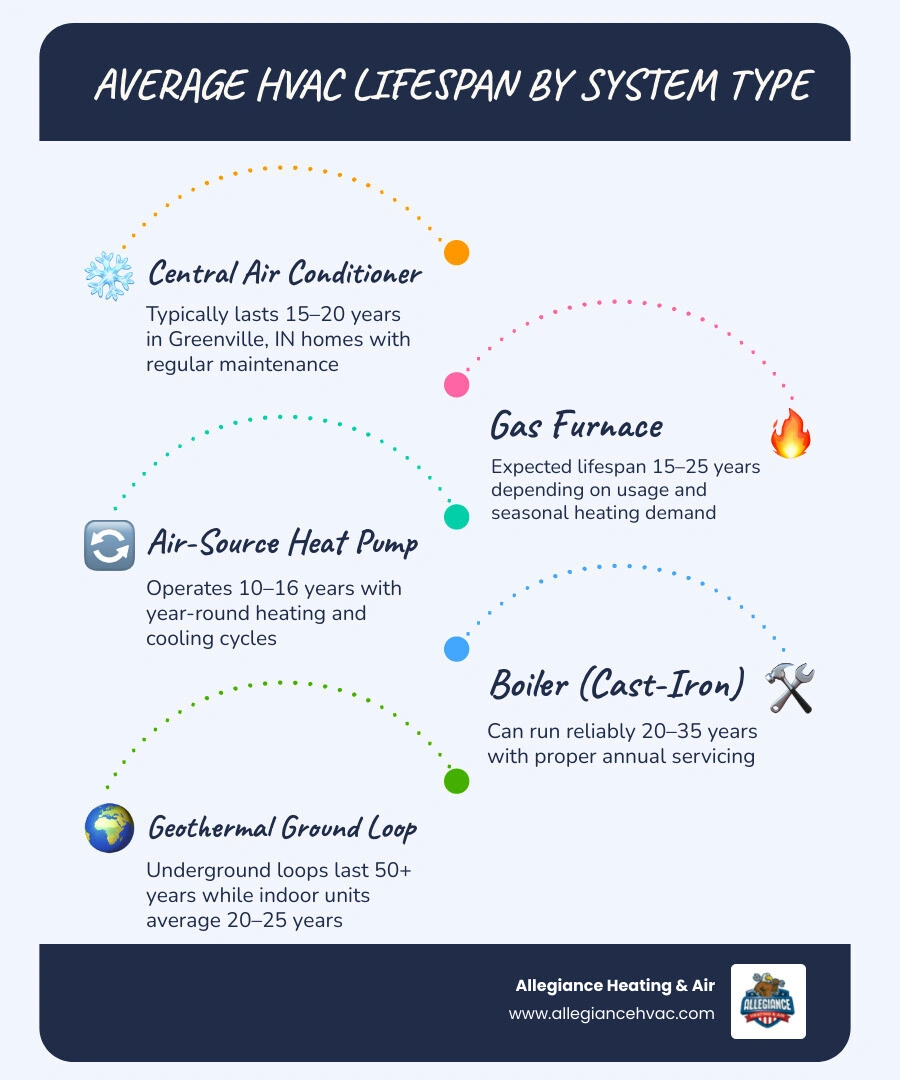
• Central Air Conditioner — Typical Lifespan: 15–20 years
• Gas Furnace — Typical Lifespan: 15–25 years
• Heat Pump (Air-Source) — Typical Lifespan: 10–16 years
• Boiler (Cast-Iron) — Typical Lifespan: 20–35 years
• Ductless Mini-Split — Typical Lifespan: 15–20 years
• Geothermal Heat Pump (Indoor Unit) — Typical Lifespan: 20–25 years
• Geothermal Ground Loop — Typical Lifespan: 50+ years
• Window AC Unit — Typical Lifespan: 5–8 years
For most Greenville, IN homeowners, that means your central AC or heat pump may be approaching end-of-life somewhere in the 12–18 year range, especially if annual maintenance has been inconsistent.
The tricky part? A system that's "still running" isn't always a system that's running well. Age, efficiency loss, frequent service needs, and outdated refrigerants all factor into whether your equipment still makes sense to keep — or whether it's time to plan for a replacement.
In this guide, we'll walk you through everything you need to know: lifespan by equipment type, what shortens or extends that lifespan here in Indiana, warning signs to watch for, and how to decide between a repair and a full replacement.
How Long Does an HVAC System Last by Equipment Type?
When we talk about the longevity of your home comfort system, we have to look at the individual components. A "system" is often a combination of different units that work together, and they don't all age at the same rate.
• Central Air Conditioners: On average, these units last between 15 and 20 years. However, in regions with high usage or humidity, you might see that lifespan dip closer to 12 to 15 years.
• Gas Furnaces: These are the workhorses of the Indiana winter. Because they only run for part of the year and have relatively simple mechanical designs compared to AC units, they often last 15 to 25 years. Some well-maintained cast-iron models can even push toward 30.
• Electric Heat Pumps: These systems work year-round, providing both heating and cooling. Because they accumulate roughly twice the "miles" of a furnace or a standalone AC, their lifespan is typically shorter, ranging from 10 to 16 years.
• Boilers: Boilers are known for their durability. A standard steel boiler might last 20 years, while a high-quality cast-iron boiler can easily provide warmth for 35 years or more.
• Geothermal Systems: These are the gold standard for longevity. While the indoor heat pump unit lasts about 20 to 25 years, the underground loops are often warrantied for 50 years and can realistically last much longer.
Understanding these timelines helps you plan for the future. If you are curious about your specific unit, you can check out our guide on How Old Is Too Old for an HVAC System.
Understanding the Average Lifespan of an HVAC System in Indiana
In Greenville and the surrounding Southern Indiana and Louisville areas, our climate plays a major role in how long does an hvac system last. We experience the full spectrum of seasons: humid, sweltering summers and freezing, snowy winters.
This "seesaw" climate puts unique stress on equipment. In the summer, high humidity levels force your air conditioner to work harder to dehumidify the air, increasing the load on the compressor. In the winter, your furnace or heat pump faces long heating cycles during cold snaps. These seasonal transitions—where we might use the heat in the morning and the AC by afternoon—require the system to cycle frequently, which can lead to faster mechanical wear than in more temperate climates.
Longevity of Specialized Systems
Beyond standard split systems, many homeowners in our community use specialized equipment:
• Ductless Mini-Splits: These typically last 15 to 20 years. Their longevity is highly dependent on keeping the filters clean, as they move air directly in the living space.
• Packaged Units: Often found in commercial settings or homes with limited space, these units house all components in one outdoor cabinet. Because everything is exposed to the elements, they usually have a slightly shorter lifespan of 12 to 15 years.
• Dual-Fuel Systems: By pairing an electric heat pump with a gas furnace, these systems optimize efficiency. Because the workload is shared, individual components may face less stress, often reaching the upper end of their respective 15–20 year lifespans.
Key Factors Influencing Your System’s Longevity
While manufacturer ratings give us a baseline, the real-world answer to how long does an hvac system last depends on several external factors.
First and foremost is installation quality. You could buy the most expensive, high-efficiency unit on the market, but if it is installed poorly, it won't last ten years. Issues like improper refrigerant charging, loose electrical connections, or poor airflow can "choke" a system from day one.
Proper sizing is equally critical. An oversized system will "short-cycle," turning on and off rapidly, which wears out the compressor. An undersized system will run constantly, never reaching the thermostat setting and burning out the motor prematurely.
Finally, your home's "envelope" matters. Good home insulation and ductwork integrity ensure that the air your system works so hard to heat or cool actually stays in your living space. If your ducts are leaking 30% of your treated air into the attic, your HVAC system has to run 30% longer to compensate, effectively shaving years off its life. To learn more about protecting your investment, read our tips on How to Extend Your HVAC Lifespan.
Why Maintenance is the Secret to How Long an HVAC System Lasts
If there is one "magic pill" for HVAC longevity, it is regular maintenance. We often compare it to changing the oil in your car; you wouldn't expect a truck to last 200,000 miles without a single oil change, yet many homeowners expect their HVAC to run for decades without a tune-up.
• Air Filters: A clogged filter forces the blower motor to work twice as hard to pull air through. Replacing filters every 1–3 months is the simplest way to extend system life.
• Coil Cleaning: Dirty condenser coils (the outdoor unit) can’t release heat efficiently. This causes the system to run hotter and longer.
• Lubrication: Moving parts like fans and motors need proper lubrication to prevent friction and overheating.
• Professional Tune-ups: A certified technician can spot a failing capacitor or a small refrigerant leak before it turns into a catastrophic compressor failure.
Annual maintenance can realistically add 3 to 5 years of useful life to your equipment.
Environmental and Usage Impacts
In Greenville, environmental factors like pollen, dust, and even cottonwood seeds can clog outdoor units during the spring. Furthermore, how you use your thermostat dictates the mechanical "mileage" you put on the system.
Using smart home integration can help. A smart thermostat can reduce total operating hours by adjusting temperatures when you are away or asleep, ensuring the system only runs when necessary. However, avoid extreme temperature swings (like turning the AC off entirely in 95-degree weather and then asking it to drop the house 20 degrees in an hour), as this creates immense thermal stress.

Warning Signs It’s Time for a Replacement
Sometimes, a system is trying to tell you it's ready for retirement. Recognizing these signs early can save you from a "no-heat" emergency in the middle of a January blizzard.
1. Inconsistent Temperatures: If some rooms are freezing while others are sweltering, your system is likely struggling to move air or maintain the correct cycle length.
2. Unusual Noises: Grinding, squealing, or banging sounds often indicate a failing motor or a loose internal component.
3. Frequent Service Calls: If you've had a technician out multiple times in the last two years, those recurring issues are starting to signal a larger problem.
4. Humidity Issues: An aging AC or heat pump loses its ability to pull moisture out of the air, leaving your home feeling "clammy" even when it's cool.
If you are seeing these red flags, it is worth reviewing our list of Signs Your HVAC Needs Replacing Not Just Fixing.
The Impact of Outdated Refrigerants and Efficiency Standards
Regulatory changes often dictate how long does an hvac system last from a practical standpoint. The most significant change in recent years is the R-22 phaseout. As of 2020, R-22 (Freon) is no longer produced or imported. If your older system has a major leak, the scarcity of reclaimed refrigerant can make a repair impractical, often making a replacement the more logical choice.
Modern SEER2 regulations have also raised the bar for efficiency. An older system might have a SEER rating of 10 or 12, while modern units start at 14 or 15 and go much higher. This efficiency decline means you are using significantly more energy each month just to keep an old unit limping along. To see how much you could improve performance by switching to a modern unit, check out How Much Does a High Efficiency HVAC Save Over Time.
Repair vs. Replace: Making the Right Decision for Your Home
When a major component fails, you face a crossroads. Do you invest in the old unit or upgrade to a new one? We often suggest evaluating the age of the system alongside the frequency and severity of recent repairs. If the system is well into its second decade and requires a major component replacement, an upgrade is usually the better long-term move for your home's reliability.
Another common benchmark is the nature of the failure. If a single repair involves a critical component like the compressor or heat exchanger on an aging unit, it’s often time to upgrade.
• System Age — Consider Repair: Under 10 years — Consider Replacement: Over 15 years
• Repair Type — Consider Repair: Minor component fix — Consider Replacement: Major failure (Compressor/Heat Exchanger)
• Energy Bills — Consider Repair: Stable — Consider Replacement: Rising steadily
• Comfort — Consider Repair: Consistent — Consider Replacement: Hot/Cold spots
• Refrigerant — Consider Repair: R-410A — Consider Replacement: R-22 (Freon)
For a deeper dive into this calculation, see our guide on When to Repair vs Replace Your HVAC System.
Evaluating Long-Term Performance
Safety should always be the priority. For gas furnaces, heat exchanger integrity is non-negotiable. A cracked heat exchanger can leak carbon monoxide into your home. If a furnace over 15 years old has a compromised heat exchanger, we almost always recommend replacement over repair due to safety concerns and the overall age of the unit.
Additionally, consider the technology upgrades available today. Variable-speed motors and two-stage compressors provide a level of comfort and quiet operation that older "single-stage" units simply cannot match.
Frequently Asked Questions about HVAC Longevity
Can an HVAC system last 30 years?
While it is rare for central air conditioners or heat pumps to reach 30 years, it is possible for boilers and some furnaces. Achieving this milestone requires a combination of high-quality installation, a moderate climate, and meticulous annual maintenance. However, by year 30, the system will be so inefficient compared to modern standards that you'd likely benefit from the performance and reliability of a newer model.
Does a heat pump last as long as a furnace?
Generally, no. A furnace only runs during the heating season, while a heat pump runs all year long to provide both heating and cooling. This constant operation leads to more mechanical wear on the compressor and fan motors, typically resulting in a lifespan of 10–15 years compared to a furnace's 15–25 years.
How long does an hvac system last if it is oversized?
An oversized system will have a significantly shorter lifespan. Because it cools or heats the home too quickly, it "short-cycles," turning on and off dozens of times a day. This frequent starting and stopping is the hardest thing you can do to an electric motor and compressor, often leading to premature failure within 8 to 10 years.
Conclusion
At Allegiance Heating & Air, LLC, we’ve been "Taking Home Comfort Under Our Wing" since 2005. We know that your HVAC system is one of the biggest investments in your Greenville home, and our goal is to help you get every possible year of service out of it.
Whether you need a precision tune-up to extend your system's life or an honest evaluation of an older unit, our licensed and insured, family-owned team is here to provide professional, transparent solutions. Our experienced technicians ensure your family stays comfortable all year round. Don't wait for a breakdown to find out how much life is left in your equipment. Schedule your HVAC inspection today and ensure reliable comfort for your home.
Contact Us Or Schedule Expert Service
Other Blogs
ready to transform your home?
Discover our exceptional home services tailored to meet your needs and enhance your living space.
WHAT OUR CLIENTS HAVE TO SAY ABOUT US

We had a complete HVAC system and a hot water heater installed. The guys were professional, well mannered, and completed the work in a timely manner. Would definitely use them again.
I was nervous at first because my AC broke in the middle of 80 degree weather which is strange for April, but Allegiance Heating and Air was incredibly prompt and professional. The technician arrived within an hour, explained the problem clearly, and completed the repair. The technician , Mr. Garrett Moon was a very nice and courteous young man. He found the problem and fixed it within a timely manner. I highly recommend them for any heating or cooling needs. I’ll definitely give them a call again should I ever have another issue, but hopefully not. Knock on wood 😁. Give them a call… you won’t be disappointed!
From the moment I called to schedule a service, the team was quick to respond and arrived right on time. The technician was professional, friendly, and clearly knowledgeable about my heating system. He explained the repair options in plain language and completed the job efficiently. I appreciated the reliable service and the fact that the work was done the same day. I would definitely recommend Allegiance Heating and Air for any residential HVAC needs.
5/5 stars – I was very impressed with the efficient, affordable and timely service from Allegiance Heating and Air. The technician arrived on time, and performed the service quickly, no repairs needed at this time. Communication was clear and the whole experience felt hassle‑free. I would definitely recommend them for any residential HVAC needs.
Knowledgeable, experienced individual.
Explains Allegiance Heating and Air was incredibly reliable, professional and affordable. They arrived right on time, kept the work area clean and finished the furnace repair quickly. The technician explained everything clearly and the price was a great value. If happiness had a location on Google Maps, it would be here.
Gilbert had to go above and beyond because York is no longer making the part for my furnace. But he was able to find a way to construct a housing bracket for my furnace. Ingenuity, determination and integrity is what finally got my furnace fixed. Gilbert is truly a one of a kind technician.
Thank you for always going the extra mile. Gilbert is always respectful and helpful with any concerns.
"Great service, most knowledgeable and capable HVAC business in Kentuckiana!! Pete Flemming and Bryan the owner, are HVAC encyclopedias. They have the highest integrity of any HVAC business I have ever used. Allegiance has put numerous units in for me over the last 17 years. I will continue to use and trust them."
"Fast response from Allegiance when our heat was out on New Year’s day! Service technician was friendly and efficient. He took the time to explain the problem, tell us about the temporary fix and the plan for permanent repair. We were impressed!"
"Love Allegiance! Their technicians, in particular Benjamin, explain everything. Fast and thorough. A/C was out on a Sunday. Called Allegiance and within a few hours Benjamin arrived. Such a comfort as he was the one who last serviced our units. He quickly replaced part and cooling is restored!"
"My heat pump went out and I had to call after hours. The technician (Garrett) was outstanding and thorough. He got my system up and working until Monday and gave me several options of units. Also took the time to explain the issue to my Home warranty company. I highly recommend this company."
"Right on time :) respectful, fast, and polite. Even gave my fur babies some attention."
"Had Garrett out today to fix our AC. Fantastic tech. He showed up exactly when he said he would and kept us informed of what he was checking and what he found. Highly recommend!"
"Lucas with Allegiance showed up on time as promised, was professional and extremely patient and responsive with all my questions. He took care of the issue, and I feel he was trustworthy! He had us back to cool and comfortable on one of the hottest days of the year."
"Lucas did a great job! Very professional and expedient. Explained the process very well and represented Allegiance as a truly professional and reputable company."
"Arrived on time and work diligently to fix issue. These guy are great. Worked quickly to resolve my issues."
"Lucas was great - he spent a lot of time trying to figure out what was going on and explained everything he was doing. I trust Allegiance and wouldn’t want anyone else working on/in my house!!"

RELATED ARTICLES

The 65-Degree Fallacy: Why Cranking Your Thermostat Down Doesn't Cool Your House Faster
The Ins and Outs of Single Stage vs Variable Speed AC