Is Your HVAC System Living on Borrowed Time?

How old is too old for an HVAC system is one of the most common questions homeowners face — and the answer depends on what type of equipment you have. Here's a quick breakdown:
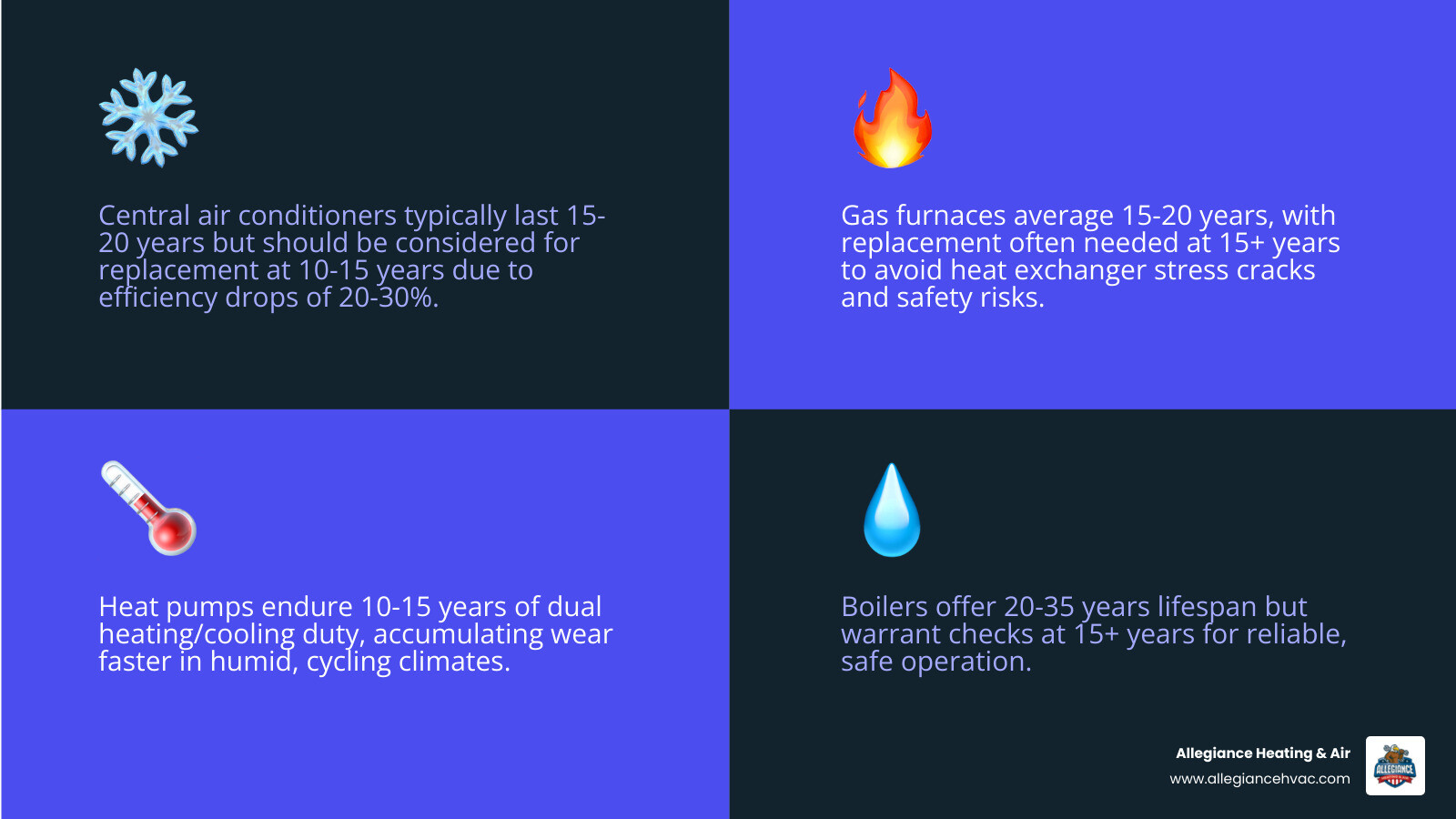
• Central Air Conditioner — Average Lifespan: 15-20 years — Consider Replacement At: 10-15 years
• Gas Furnace — Average Lifespan: 15-20 years — Consider Replacement At: 15+ years
• Heat Pump — Average Lifespan: 10-15 years — Consider Replacement At: 10+ years
• Boiler — Average Lifespan: 20-35 years — Consider Replacement At: 15+ years
• Ductless Mini-Split — Average Lifespan: 15-20 years — Consider Replacement At: 15+ years
Most systems start showing serious signs of wear well before they completely quit. By the time a central AC hits 12 years, it may already be running at 20-30% lower efficiency than when it was new. A furnace pushing 18 years could be developing stress cracks in its heat exchanger — a genuine safety concern, not just a comfort issue.
The tricky part? HVAC systems tend to age gradually and quietly. Higher utility bills creep up month by month. Rooms that used to stay comfortable start feeling stuffy or uneven. You call for a repair here and there, and it starts to feel normal. But those small warning signs add up — and ignoring them long enough can turn a planned replacement into an emergency one.
Whether your system is 10, 15, or 20 years old, knowing where it stands on the lifespan curve helps you make smarter decisions about your home comfort — and your budget.
Determining How Old is Too Old for an HVAC System
When we talk about the "life expectancy" of a heating and cooling system, we aren't just talking about the day it stops turning on. We are talking about its functional life—the period during which it operates safely, efficiently, and reliably. For many homeowners in Greenville, IN, the 12-to-15-year mark is a major inflection point. This is when the internal wear from thousands of cooling cycles begins to manifest as mechanical failure.
Understanding the specific lifespan of your equipment is the first step in Furnace Replacement Services. While a well-maintained gas furnace might hum along for 20 years, an air-source heat pump often reaches its limit around year 12 or 15. This is because heat pumps work double duty, providing both heating in our chilly Indiana winters and cooling during our humid summers. This year-round operation means they accumulate run-hours much faster than a dedicated AC unit.
Identifying performance drops and how old is too old for an hvac system
One of the quietest ways a system ages is through efficiency degradation. Research shows that by year 10, many central air systems operate at only 80–85% of their original efficiency. If you have a 13 SEER unit from 2012, it might currently be performing like a 9 or 10 SEER unit. This "hidden" cost shows up on your utility bill every month.
Component wear is another factor. As motors, fans, and compressors age, they require more electricity to move the same amount of air. When parts become obsolete or the cost to fix them climbs, you have reached the threshold of Air Conditioner Maintenance And Replacement. If your system was installed when smartphones were a brand-new novelty, the technology inside is likely struggling to keep up with modern comfort standards.
Regional climate impacts on equipment longevity
In our neck of the woods, Greenville weather plays a massive role in how fast a system wears out. We experience high humidity levels and significant temperature swings. This "thermal cycling"—the constant expansion and contraction of metal components like heat exchangers—eventually leads to stress fractures.
Furthermore, high humidity puts a heavy load on your air conditioner's evaporator coil and drainage system. If a system isn't properly sized for our local climate, it may "short cycle," turning on and off too frequently, which accelerates compressor wear. Knowing How To Extend Your Hvac Lifespan through local expertise is vital for getting the most out of your investment.
Critical Warning Signs of System Failure
Sometimes the signs that a system is "too old" aren't subtle at all. If you find yourself constantly adjusting the thermostat because one room is a freezer while the other is a sauna, your system is struggling to distribute air effectively. This lack of balance is often a sign that the blower motor or the ductwork is no longer up to the task.
You should also keep an ear out for strange noises. Rattling, buzzing, or banging sounds often indicate loose parts or a failing motor. Similarly, if you notice excessive dust around your home despite frequent cleaning, it could mean your system's filtration and air-handling capabilities are compromised. These are classic indicators that it might be Time To Replace Old Ac units before they fail during a July heatwave.
Warning signs that reveal how old is too old for an hvac system
Rising utility bills are perhaps the most objective "warning light" on your home's dashboard. If your energy consumption is climbing even though your habits haven't changed, your HVAC system is likely the culprit. An aging unit has to work harder and run longer to achieve the same temperature, which is why Air Conditioner Replacement Importance cannot be overstated for long-term savings.
Humidity imbalances are another red flag. A healthy AC unit acts as a dehumidifier. If your home feels "sticky" or clammy in the summer, your older unit is likely losing its ability to remove moisture from the air, which can lead to indoor air quality issues and even mold growth.
Mechanical red flags and frequent repairs
Are you on a first-name basis with your repair technician? If you've had more than two significant repairs in the last two years, you are experiencing the "slow bleed" of an aging system. Mechanical red flags include:
• Blower Motor Failure: The heart of your air distribution.
• Compressor Issues: The most expensive part of an AC unit.
• Electrical Glitches: Frequent tripped breakers or blown fuses.
When these high-ticket items start failing, our Guide Furnace Maintenance Replacement suggests looking at the big picture rather than sinking more money into a sinking ship.
The Decision Matrix: Repair vs. Replace
Deciding whether to keep fixing an old unit or buy a new one doesn't have to be guesswork. We often look at a few key factors: the frequency of repairs, whether the warranty has expired (most end at 10 years), and the overall reliability. If you are worried about your furnace failing while you're away for the holidays, that "peace of mind" factor carries a lot of weight. Our Heating System Replacement Guide 2025 highlights that modern systems offer reliability that 20-year-old units simply can't match.
Using the 5,000 Rule to decide how old is too old for an hvac system
In the HVAC industry, we use a simple mathematical formula to help homeowners decide. It's called the $5,000 Rule.
The Formula: Age of the Unit × Cost of Repair = [Result]
If the result is greater than $5,000, it is generally smarter to replace the unit. For example:
• A 12-year-old AC needs a $600 repair. (12 × 600 = 7,200). Replace.
• An 8-year-old furnace needs a $300 repair. (8 × 300 = 2,400). Repair.
This rule helps you see the investment value of your money. Sinking thousands into a system that is already past its median lifespan is often a "false economy." For more details, check out our Heating System Replacement Guide.
Refrigerant transitions and environmental regulations
Environmental laws also play a role in the "too old" conversation. If your AC was built before 2010, it likely uses R-22 (Freon). This refrigerant has been phased out by the EPA because it depletes the ozone layer. Since it is no longer produced or imported, the cost to "recharge" a system with a leak can be astronomical—sometimes over $1,000 just for the gas.
Even the newer refrigerant, R-410A, is currently undergoing a phasedown to make way for even more eco-friendly options. If your system relies on an obsolete refrigerant, Furnace Replacement Is Necessary to ensure you aren't left stranded when a simple leak becomes an unfixable disaster.
Safety Risks and Efficiency Benefits of Modern Upgrades
Beyond comfort and cost, there is the issue of safety. As gas furnaces age, the heat exchanger—the component that keeps combustion gases separate from your breathing air—can develop stress cracks. This poses a risk of carbon monoxide leaking into your home. While our Maintenance Plan includes safety checks for these cracks, a 20-year-old furnace is simply at a higher risk of failure than a newer model.
Upgrading to a modern system brings immediate benefits:
• SEER2 Ratings: Modern AC units use significantly less power.
• AFUE Standards: New furnaces convert nearly all their fuel into heat, with some reaching 96-98% efficiency.
• Electrical Safety: New units feature modern wiring and safety controls that reduce fire risks.
Proactive replacement vs. emergency breakdown
The best time to replace an HVAC system is when you want to, not when you have to. If you wait for a catastrophic failure in the middle of a 100-degree New Albany summer, you might be stuck waiting days for a technician or settling for whatever unit is in stock.
By planning a proactive replacement during the "shoulder seasons" (spring and fall), you can take your time to choose the right system, ensure compatibility with your ductwork, and even integrate smart thermostats. Newer systems also offer much better indoor air quality features, like advanced filtration and humidity control, which can make a huge difference for families with allergies.
Frequently Asked Questions About HVAC Age
How can I find the manufacture date of my unit?
You can usually find the age of your system by looking at the data plate on the side of the outdoor condenser or the indoor furnace cabinet. Look for a "Manufacture Date" or "MFR Date." If it isn't listed clearly, write down the serial number and enter it into the manufacturer's website or a search engine. The first few digits often represent the week and year the unit was built.
Is it better to replace the furnace and AC at the same time?
Generally, yes. HVAC systems are designed to work as a "matched set." If you pair a brand-new, high-efficiency AC with an old, inefficient furnace blower, you won't get the full SEER2 rating you paid for. Replacing both at once also saves on labor costs and ensures that all components are covered by a fresh warranty.
Does regular maintenance really extend system life?
Absolutely. Think of it like a car—regular oil changes won't make a car last forever, but they prevent the engine from seizing up at 50,000 miles. Annual inspections allow us to catch small issues, like a failing capacitor or a dirty coil, before they put undue stress on the expensive compressor or heat exchanger.
Conclusion
Is your system a summer disaster waiting to happen, or does it still have some good years left? Understanding how old is too old for an HVAC system is about balancing risk, safety, and monthly costs. While we all want our appliances to last forever, being proactive can save you from the stress of an emergency breakdown and the sting of rising utility bills.
At Allegiance Heating & Air, LLC, we’ve been "Taking Home Comfort Under Our Wing" since 2005. Whether you are in Floyds Knobs, Jeffersonville, or right here in Greenville, our family-owned team is here to help you navigate the repair-vs-replace maze with honesty and professional expertise.
Don't wait for the next heatwave or cold snap to find out your system is too old. Contact our team for expert HVAC solutions in Greenville and let us ensure your home stays comfortable for years to come.
Contact Us Or Schedule Expert Service
Other Blogs
ready to transform your home?
Discover our exceptional home services tailored to meet your needs and enhance your living space.
WHAT OUR CLIENTS HAVE TO SAY ABOUT US

We had a complete HVAC system and a hot water heater installed. The guys were professional, well mannered, and completed the work in a timely manner. Would definitely use them again.
I was nervous at first because my AC broke in the middle of 80 degree weather which is strange for April, but Allegiance Heating and Air was incredibly prompt and professional. The technician arrived within an hour, explained the problem clearly, and completed the repair. The technician , Mr. Garrett Moon was a very nice and courteous young man. He found the problem and fixed it within a timely manner. I highly recommend them for any heating or cooling needs. I’ll definitely give them a call again should I ever have another issue, but hopefully not. Knock on wood 😁. Give them a call… you won’t be disappointed!
From the moment I called to schedule a service, the team was quick to respond and arrived right on time. The technician was professional, friendly, and clearly knowledgeable about my heating system. He explained the repair options in plain language and completed the job efficiently. I appreciated the reliable service and the fact that the work was done the same day. I would definitely recommend Allegiance Heating and Air for any residential HVAC needs.
5/5 stars – I was very impressed with the efficient, affordable and timely service from Allegiance Heating and Air. The technician arrived on time, and performed the service quickly, no repairs needed at this time. Communication was clear and the whole experience felt hassle‑free. I would definitely recommend them for any residential HVAC needs.
Knowledgeable, experienced individual.
Explains Allegiance Heating and Air was incredibly reliable, professional and affordable. They arrived right on time, kept the work area clean and finished the furnace repair quickly. The technician explained everything clearly and the price was a great value. If happiness had a location on Google Maps, it would be here.
Gilbert had to go above and beyond because York is no longer making the part for my furnace. But he was able to find a way to construct a housing bracket for my furnace. Ingenuity, determination and integrity is what finally got my furnace fixed. Gilbert is truly a one of a kind technician.
Thank you for always going the extra mile. Gilbert is always respectful and helpful with any concerns.
"Great service, most knowledgeable and capable HVAC business in Kentuckiana!! Pete Flemming and Bryan the owner, are HVAC encyclopedias. They have the highest integrity of any HVAC business I have ever used. Allegiance has put numerous units in for me over the last 17 years. I will continue to use and trust them."
"Fast response from Allegiance when our heat was out on New Year’s day! Service technician was friendly and efficient. He took the time to explain the problem, tell us about the temporary fix and the plan for permanent repair. We were impressed!"
"Love Allegiance! Their technicians, in particular Benjamin, explain everything. Fast and thorough. A/C was out on a Sunday. Called Allegiance and within a few hours Benjamin arrived. Such a comfort as he was the one who last serviced our units. He quickly replaced part and cooling is restored!"
"My heat pump went out and I had to call after hours. The technician (Garrett) was outstanding and thorough. He got my system up and working until Monday and gave me several options of units. Also took the time to explain the issue to my Home warranty company. I highly recommend this company."
"Right on time :) respectful, fast, and polite. Even gave my fur babies some attention."
"Had Garrett out today to fix our AC. Fantastic tech. He showed up exactly when he said he would and kept us informed of what he was checking and what he found. Highly recommend!"
"Lucas with Allegiance showed up on time as promised, was professional and extremely patient and responsive with all my questions. He took care of the issue, and I feel he was trustworthy! He had us back to cool and comfortable on one of the hottest days of the year."
"Lucas did a great job! Very professional and expedient. Explained the process very well and represented Allegiance as a truly professional and reputable company."
"Arrived on time and work diligently to fix issue. These guy are great. Worked quickly to resolve my issues."
"Lucas was great - he spent a lot of time trying to figure out what was going on and explained everything he was doing. I trust Allegiance and wouldn’t want anyone else working on/in my house!!"

RELATED ARTICLES

Signs Your Commercial AC Needs Professional Service in Sellersburg
Signs You Need Emergency AC Repair in Sellersburg