Why Ohio Valley Homeowners Need to Think Carefully About Their HVAC Setup
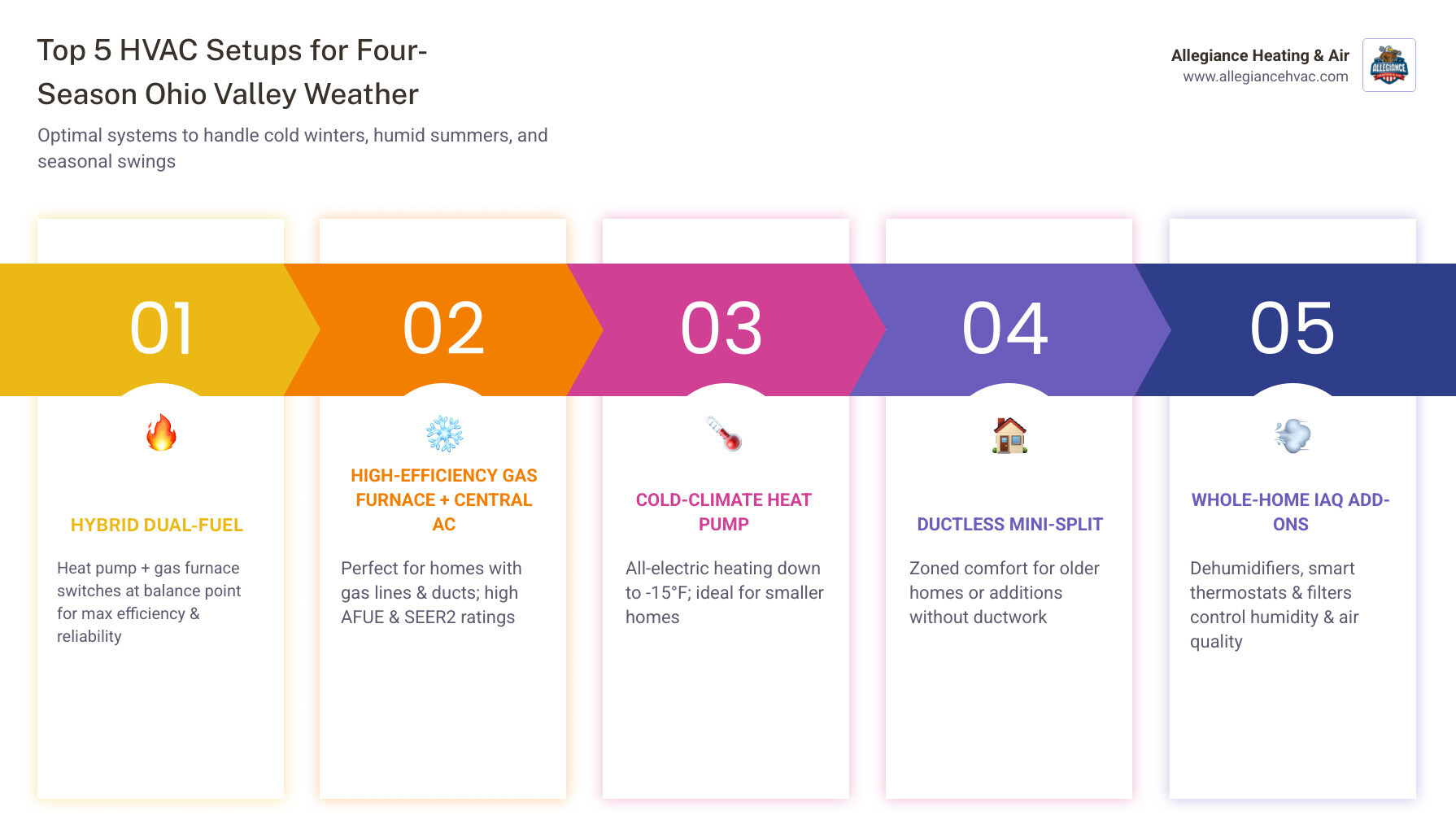
The best hvac setup for four season ohio valley weather balances powerful heating for cold winters, efficient cooling for humid summers, and the flexibility to handle everything in between. For most homes in Greenville, IN and the surrounding southern Indiana region, that means one of these configurations:
• Hybrid Dual-Fuel System (heat pump + gas furnace) — Best For: Most Ohio Valley homes — best balance of efficiency and reliability
• High-Efficiency Gas Furnace + Central AC — Best For: Homes with existing gas infrastructure and ductwork
• Cold-Climate Heat Pump — Best For: Smaller homes or those prioritizing all-electric operation
• Ductless Mini-Split System — Best For: Older homes, additions, or zoned comfort without ductwork
• Whole-Home IAQ Add-Ons (dehumidifier, smart thermostat, filtration) — Best For: Essential complement to any primary system in the Ohio Valley
Living in the Ohio Valley means dealing with a climate that genuinely tests your HVAC system every single season. Winters can drop hard and fast, summers pile on heat and humidity, and spring and fall bring the kind of week-to-week swings that leave systems running in overdrive. Heating and cooling already account for about 52% of the average household's energy costs — and in a four-season climate like southern Indiana's, that number can feel even heavier when your system isn't matched to what the weather actually demands.
The challenge isn't just picking a furnace or an air conditioner. It's choosing a complete setup that handles all four seasons without wasting energy or breaking down when you need it most.
Understanding the Unique Climate Challenges of the Ohio Valley
In the Ohio Valley, we don't just have weather; we have "all of it." Our region sits at a geographical crossroads where humid air from the Gulf of Mexico often meets cold air masses from Canada. This intersection creates a "Mixed-Humid" climate (officially classified as IECC Zone 4A for areas like Louisville and Southern Indiana).
The primary challenge for any Climate Control Systems in our area is the sheer unpredictability. It is not uncommon to need the furnace on a Monday morning and the air conditioner by Thursday afternoon. These rapid temperature swings cause frequent system cycling, which places significant wear and tear on compressors and blowers.
Furthermore, our humidity levels are legendary. During the peak of summer, humidity often tops 70%. When humidity is high, your air conditioner has to work "double duty." It isn't just cooling the air (sensible cooling); it is also working to pull moisture out of the air (latent cooling). If your system isn't properly sized or equipped to handle this latent load, you’ll end up with a home that feels "clammy" — cool, but heavy and damp.
Selecting the best hvac setup for four season ohio valley weather for older homes
Many of our neighbors in historic areas of New Albany, Jeffersonville, and Louisville live in beautiful older homes that present unique HVAC hurdles. These homes often have outdated insulation, original windows, and ductwork that wasn't designed for modern high-velocity airflow.
When we look for the best hvac setup for four season ohio valley weather in an older home, the first step is never a guess; it is a Manual J load calculation. This is a professional evaluation that measures exactly how much heat your home loses in the winter and gains in the summer.
Relying on square footage alone is a mistake. Two homes in Greenville might both be 2,000 square feet, but if one was built in 1920 with lath-and-plaster walls and the other in 2024 with modern spray foam, their HVAC needs will be worlds apart. Factors we consider include:
• Insulation Levels: Attic and wall insulation significantly impact how hard a furnace has to work.
• Air Leakage: Older homes tend to "breathe" more than we want them to, leading to energy loss.
• Window Orientation: Large south-facing windows can act like heaters in the summer.
For a deeper dive into how we determine the right capacity for your specific property, check out our guide on How to Choose the Right Size HVAC for Your Home. Getting the size right prevents "short-cycling," where an oversized unit turns on and off too quickly, failing to remove humidity and wearing out the motor prematurely.
Why a Hybrid Dual-Fuel System is the Best HVAC Setup for Four Season Ohio Valley Weather
If you asked our team at Allegiance Heating & Air to name the "gold standard" for our region, we would point to the hybrid dual-fuel system. This setup combines an electric heat pump with a high-efficiency gas furnace.
Think of it like a hybrid car. The heat pump handles the "cruising" during the mild parts of the year. In the spring, fall, and even many winter days, the heat pump is incredibly efficient at moving heat from the outside air into your home. However, when the temperature drops below the "balance point" (typically between 30°F and 35°F), the system automatically switches over to the gas furnace.
This is crucial because while modern Heat Pump Systems for Your Property are much better in the cold than they used to be, a gas furnace provides that "toasty" heat that many Indiana homeowners prefer during a deep January freeze. By using the heat pump for about 80% of the heating season and the gas furnace only for the extreme cold, you maximize energy efficiency without sacrificing comfort.
The benefits of this setup include:
1. Lower Energy Bills: You use the most cost-effective fuel source based on the outdoor temperature.
2. Extended Lifespan: Neither unit has to work at its absolute limit all year long.
3. Redundancy: If one part of the system has an issue, you often have a backup heat source.
How smart thermostats enhance the best hvac setup for four season ohio valley weather
A high-tech HVAC system is only as good as the brain controlling it. In the Ohio Valley, a smart thermostat is a game-changer. Research shows that shifting your thermostat settings by just 7-10 degrees for eight hours a day can shave 10% off your annual heating and cooling bills. That is roughly a 1% savings for every degree adjusted.
Smart thermostats allow you to manage the "deadband" — the range between your heating and cooling settings. This is vital during our transitional spring and fall months. You can set the system to keep the house no cooler than 68°F and no warmer than 78°F, and the thermostat will decide whether to engage the heat pump or the AC based on the afternoon sun or the midnight chill.
Beyond just scheduling, these devices offer:
• Remote Access: Adjust the air from your phone while you're at work in Louisville or shopping in Clarksville.
• Humidity Sensing: Some models can tell the AC to run a bit longer at a lower speed specifically to dehumidify the air.
• Maintenance Alerts: They can remind you when it's time to call us for your seasonal check-up.
To see how these devices pay for themselves, read about the Benefits of a Programmable Thermostat.
Comparing Heating and Cooling Technologies for Southern Indiana Homes
While hybrid systems are fantastic, they aren't the only option. Depending on your home's infrastructure, you might consider other HVAC Services.
High-Efficiency Gas FurnacesGas remains a popular and dependable choice in the Ohio Valley due to the availability of natural gas. Modern high-efficiency furnaces can reach AFUE (Annual Fuel Utilization Efficiency) ratings of 95% or higher. This means 95 cents of every dollar you spend on gas is converted directly into heat for your home, with only 5 cents lost through the chimney.
Central Air ConditioningFor cooling, we look at SEER2 (Seasonal Energy Efficiency Ratio) ratings. As of 2023, new federal standards require higher efficiency for all units installed in our region. Upgrading from an old SEER 10 unit to a modern SEER 16 or 18 unit can reduce your cooling energy consumption by up to 60%. This is a massive difference during a sweltering July in Floyds Knobs.
Boilers and Electric FurnacesIn some older neighborhoods, boilers and radiant heat are still common. While they don't provide cooling, they offer a very consistent, comfortable heat that doesn't dry out the air. Electric furnaces are also an option, though they can be more expensive to operate during peak winter months compared to gas or heat pumps.
Understanding these HVAC Energy Efficiency Standards is the best way to ensure you are making a smart long-term investment.
Ductless Mini-Split Solutions for Zoned Comfort
Sometimes, the best hvac setup for four season ohio valley weather isn't a central system at all. If you have a room that is always too hot, a finished basement, or a new sunroom addition, a ductless mini-split might be the answer.
Ductless systems consist of an outdoor compressor and one or more indoor air-handling units. They are incredibly efficient because they don't lose energy through ductwork — which can account for more than 30% of energy loss in traditional systems. They allow for "zoning," meaning you can keep your bedroom at 68°F for sleeping while the rest of the house stays at 72°F.
We often recommend these for:
• Older Homes: Where installing new ducts is impossible or too expensive.
• Guest Suites: That don't need to be heated or cooled when empty.
• Workshops or Garages: Providing year-round comfort for your hobbies.
Learn more by asking, What is a Ductless Mini-Split System? and see if it fits your home's layout.
Essential IAQ and Humidity Control for a Four-Season Climate
In the Ohio Valley, comfort is about more than just the temperature on the wall. Indoor Air Quality (IAQ) is a major concern, particularly during our intense allergy seasons. Between the pollen in the spring and the mold spores that thrive in our humid summers, your HVAC system needs to act as a high-performance filtration center.
The Role of FiltrationHigh-efficiency air filters (rated MERV 11 to 13) are essential. They trap dust, dander, and microscopic allergens before they circulate through your home. This is especially important for our customers in the Louisville area, which is often ranked as a challenging city for allergy sufferers.
Humidity ManagementAs we've mentioned, moisture is a major player here. In the summer, a whole-home dehumidifier can work alongside your AC to keep levels between 30% and 50%. This prevents mold growth and protects your wood floors and furniture from warping. Conversely, in the winter, the air can become incredibly dry, leading to itchy skin and respiratory issues. A whole-home humidifier adds just enough moisture to keep you comfortable.
For a comprehensive look at how to breathe easier, explore our Louisville IAQ Services & Solutions.
Maintaining Your System for Longevity and Performance
No matter which system you choose, the "best" setup is the one that actually works when you turn it on. Ohio Valley weather is hard on machinery. The wet-dry cycles we experience can lead to corrosion on outdoor coils, and seasonal storms can clog units with leaves and debris.
A regular HVAC Maintenance Plan is the only way to protect your investment. We recommend a "Spring Tune-Up" for your AC and a "Fall Tune-Up" for your furnace. During these visits, we:
• Clean the Coils: Dirty coils make the system work harder and use more power.
• Check Refrigerant Levels: Even a small leak can tank your efficiency.
• Inspect Electrical Connections: Preventing emergency breakdowns during a heatwave.
• Clear Condensate Drains: To prevent water damage and mold.
A well-maintained gas furnace can last 15-20 years, while a heat pump typically lasts 10-15 years. Regular care is the difference between reaching those milestones or facing an early (and expensive) replacement.
Frequently Asked Questions about Ohio Valley HVAC
What is the most efficient heating system for Indiana winters?
For most homes, a hybrid dual-fuel system (heat pump + gas furnace) is the most efficient. It utilizes the high efficiency of electricity for moderate cold and the raw power of gas for extreme freezes. However, if you don't have gas access, a cold-climate heat pump is an excellent, highly efficient alternative.
How does high humidity affect my air conditioner's performance?
High humidity makes your AC work much harder. The system must first remove the moisture from the air before it can effectively lower the temperature. This leads to longer run times and higher energy bills. If your home feels humid even with the AC running, you may need a system check or a supplemental dehumidifier.
When is the best time to schedule seasonal HVAC maintenance?
The ideal times are early spring (March or April) before the humidity hits, and early fall (September or October) before the first frost. Scheduling during these "shoulder seasons" ensures your system is ready for the extreme weather ahead and allows us to catch small issues before they become emergency repairs.
Conclusion
Finding the best hvac setup for four season ohio valley weather doesn't have to be overwhelming. Whether you are in Greenville, Floyds Knobs, Louisville, or Jeffersonville, the goal is the same: a system that is reliable, efficient, and tailored to your home's unique footprint.
At Allegiance Heating & Air, we’ve been "Taking Home Comfort Under Our Wing" since 2005. As a family-owned business, we understand the specific challenges of living in southern Indiana because we live here too. We pride ourselves on honest, transparent service and professional installations that stand up to whatever the Ohio Valley throws our way.
Ready to upgrade your comfort? From high-efficiency Heat Pump Services to complete HVAC Services, we are here to help you find the perfect fit for your family.
Contact Allegiance HVAC today to schedule an evaluation or to learn more about our seasonal maintenance plans. Let’s make sure your home stays comfortable, no matter what the four seasons bring!
Contact Us Or Schedule Expert Service
Other Blogs
ready to transform your home?
Discover our exceptional home services tailored to meet your needs and enhance your living space.
WHAT OUR CLIENTS HAVE TO SAY ABOUT US

We had a complete HVAC system and a hot water heater installed. The guys were professional, well mannered, and completed the work in a timely manner. Would definitely use them again.
I was nervous at first because my AC broke in the middle of 80 degree weather which is strange for April, but Allegiance Heating and Air was incredibly prompt and professional. The technician arrived within an hour, explained the problem clearly, and completed the repair. The technician , Mr. Garrett Moon was a very nice and courteous young man. He found the problem and fixed it within a timely manner. I highly recommend them for any heating or cooling needs. I’ll definitely give them a call again should I ever have another issue, but hopefully not. Knock on wood 😁. Give them a call… you won’t be disappointed!
From the moment I called to schedule a service, the team was quick to respond and arrived right on time. The technician was professional, friendly, and clearly knowledgeable about my heating system. He explained the repair options in plain language and completed the job efficiently. I appreciated the reliable service and the fact that the work was done the same day. I would definitely recommend Allegiance Heating and Air for any residential HVAC needs.
5/5 stars – I was very impressed with the efficient, affordable and timely service from Allegiance Heating and Air. The technician arrived on time, and performed the service quickly, no repairs needed at this time. Communication was clear and the whole experience felt hassle‑free. I would definitely recommend them for any residential HVAC needs.
Knowledgeable, experienced individual.
Explains Allegiance Heating and Air was incredibly reliable, professional and affordable. They arrived right on time, kept the work area clean and finished the furnace repair quickly. The technician explained everything clearly and the price was a great value. If happiness had a location on Google Maps, it would be here.
Gilbert had to go above and beyond because York is no longer making the part for my furnace. But he was able to find a way to construct a housing bracket for my furnace. Ingenuity, determination and integrity is what finally got my furnace fixed. Gilbert is truly a one of a kind technician.
Thank you for always going the extra mile. Gilbert is always respectful and helpful with any concerns.
"Great service, most knowledgeable and capable HVAC business in Kentuckiana!! Pete Flemming and Bryan the owner, are HVAC encyclopedias. They have the highest integrity of any HVAC business I have ever used. Allegiance has put numerous units in for me over the last 17 years. I will continue to use and trust them."
"Fast response from Allegiance when our heat was out on New Year’s day! Service technician was friendly and efficient. He took the time to explain the problem, tell us about the temporary fix and the plan for permanent repair. We were impressed!"
"Love Allegiance! Their technicians, in particular Benjamin, explain everything. Fast and thorough. A/C was out on a Sunday. Called Allegiance and within a few hours Benjamin arrived. Such a comfort as he was the one who last serviced our units. He quickly replaced part and cooling is restored!"
"My heat pump went out and I had to call after hours. The technician (Garrett) was outstanding and thorough. He got my system up and working until Monday and gave me several options of units. Also took the time to explain the issue to my Home warranty company. I highly recommend this company."
"Right on time :) respectful, fast, and polite. Even gave my fur babies some attention."
"Had Garrett out today to fix our AC. Fantastic tech. He showed up exactly when he said he would and kept us informed of what he was checking and what he found. Highly recommend!"
"Lucas with Allegiance showed up on time as promised, was professional and extremely patient and responsive with all my questions. He took care of the issue, and I feel he was trustworthy! He had us back to cool and comfortable on one of the hottest days of the year."
"Lucas did a great job! Very professional and expedient. Explained the process very well and represented Allegiance as a truly professional and reputable company."
"Arrived on time and work diligently to fix issue. These guy are great. Worked quickly to resolve my issues."
"Lucas was great - he spent a lot of time trying to figure out what was going on and explained everything he was doing. I trust Allegiance and wouldn’t want anyone else working on/in my house!!"

RELATED ARTICLES

Smart Savings: Finding Affordable Heat Pump Repair in Louisville, KY
Affordable Heating Replacement in Louisville: Keeping Your Wallet Toasty