
Why Humidity Control Tips for Homeowners Matter More Than You Think
The best humidity control tips for homeowners come down to a handful of consistent habits and the right equipment working together. Here's a quick overview of what actually works:
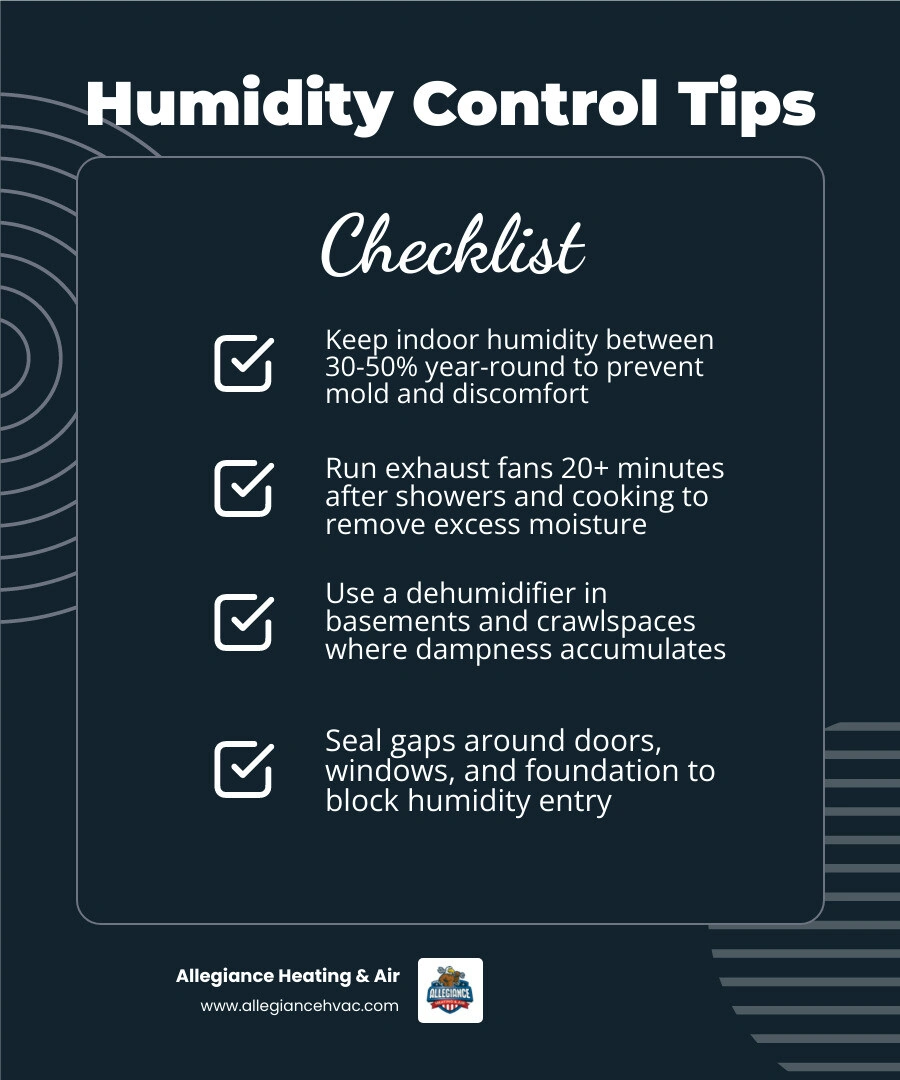
1. Keep indoor humidity between 30% and 50% year-round (30–40% in winter, 40–50% in summer)
2. Run exhaust fans during and for at least 20 minutes after showers and cooking
3. Use a dehumidifier in damp areas like basements and crawlspaces
4. Seal gaps and cracks around doors, windows, and your foundation
5. Set your HVAC fan to "Auto" so moisture drains properly from the coils
6. Fix leaks promptly — from pipes, roofs, and gutters
7. Monitor humidity levels with an inexpensive digital hygrometer
Your home might feel comfortable in terms of temperature, but if the air is too damp or too dry, it can quietly cause real damage. Mold grows when indoor humidity climbs above 60%. Wood warps. Paint peels. Dust mites thrive. And your HVAC system works harder than it should, driving up energy bills.
For homeowners in Greenville, IN and the surrounding southern Indiana area, this is especially relevant. Indiana summers bring high outdoor humidity that pushes its way indoors, while winters can leave indoor air painfully dry as heating systems run continuously. Both extremes create problems — for your home's structure and for the people living in it.
The good news is that managing indoor moisture is very doable once you understand what's causing the problem and which fixes actually move the needle.
Relevant articles related to humidity control tips for homeowners:
• high humidity inside house even with ac running
• how humidity affects your hvac and comfort
Understanding Ideal Indoor Humidity Levels
Relative humidity (RH) is a measure of how much moisture is in the air compared to the maximum amount of moisture the air can hold at that specific temperature. Because warm air can hold significantly more water vapor than cold air, the temperature inside your home directly dictates how comfortable a given amount of moisture will feel. Another critical concept to understand is the "dew point"—the exact temperature at which air becomes completely saturated and water vapor begins to condense into liquid droplets. When warm, humid air contacts a cold surface (like a window pane in winter or a cold water pipe in summer), it drops below its dew point, leaving behind pools of condensation that invite mold and rot.
To maintain a healthy, comfortable living environment, regulatory bodies and indoor air quality experts have established clear benchmarks. According to the Environmental Protection Agency (EPA), the ideal indoor relative humidity should be kept between 30% and 50%. Staying within this range ensures that mold spores remain dormant, dust mites struggle to survive, and respiratory viruses have a harder time spreading through the air.
However, the American Society of Heating, Refrigerating and Air-Conditioning Engineers (ASHRAE) provides a slightly broader standard, allowing up to 60% RH for general thermal comfort. In the peak of a muggy southern Indiana summer, keeping humidity between 50% and 60% is generally acceptable, but anything above that 60% threshold is a recipe for biological growth, musty odors, and a sticky, clammy living space.
To learn more about finding the perfect balance for your household, read our guide on the Best Humidity Levels for Your Home.
When outdoor temperatures swing dramatically, your indoor target needs to shift as well. During freezing winter days in places like New Albany or Floyds Knobs, keeping indoor humidity at 50% can actually cause severe moisture damage. As cold outdoor air chills your window glass, high indoor moisture will condense rapidly on the panes, eventually running down to rot the wooden frames or fuel mold growth on the drywall. To prevent this, ASHRAE recommends a sliding scale for winter indoor humidity based on outdoor temperatures:
• At +20°F outdoor temperature, indoor humidity should not exceed 35%.
• At +10°F outdoor temperature, indoor humidity should be kept around 30%.
• At 0°F outdoor temperature, the target drops to 25%.
• At -10°F outdoor temperature, maintain 20% humidity.
• At -20°F outdoor temperature, reduce indoor humidity to 15%.
For a deeper dive into why managing these numbers is so critical to your health, structural integrity, and comfort, check out our article on the Proper Humidity Control Importance.
Essential Humidity Control Tips for Homeowners to Manage Moisture
When it comes to keeping outdoor moisture from invading your living space, structural sealing is your first line of defense. Many homeowners believe that moisture primarily diffuses directly through solid walls, but building science tells a different story. Air movement accounts for more than 98% of all water vapor movement in building cavities. When humid outdoor air leaks into your home through unsealed gaps, it carries vast amounts of water vapor with it. This makes targeted air sealing one of the most effective, high-yield humidity control tips for homeowners.
To block these moisture pathways, focus on the following structural improvements:
• Apply Weatherstripping and Caulk: Seal the gaps around exterior doors and windows. Inspect these areas annually, as weatherstripping degrades over time under the stress of changing seasons.
• Seal Foundation and Envelope Penetrations: Use outdoor-rated caulk or expanding foam to seal cracks in your foundation and gaps where utility lines (pipes, cables, and vents) enter your home.
• Install Storm Windows and Doors: Adding storm windows creates an insulating air pocket that separates cold outdoor air from warm indoor air, raising the surface temperature of the interior glass and dramatically reducing condensation.
• Incorporate Vapor Barriers and Drainage: In crawlspaces, lay down a continuous 6-mil or 10-mil polyethylene vapor barrier directly over the dirt floor. Overlap all seams by at least 12 inches, tape them securely, and run the plastic at least 6 inches up the foundation walls.
• Insulate Cold Surfaces: Wrap cold-water pipes in foam insulation sleeves to prevent warm, humid indoor air from condensing on them during the summer months.
• Maintain Gutters and Downspouts: Ensure your gutter system is clear of leaves and debris. Downspouts should discharge water at least 5 to 6 feet away from your home's foundation, and the surrounding soil should slope away from the house at a minimum 5% grade to prevent water from seeping into your basement or crawlspace.
By taking these proactive structural steps in the spring, you set your home up for success before the heavy southern Indiana summer air rolls in. For more guidance on getting your home ready, see our advice on Preparing Your AC for a Humid Indiana Summer.
Practical Humidity Control Tips for Homeowners in Summer
Summer in the Louisville-area metro brings thick, heavy air that can make your home feel like a sauna. To keep indoor spaces crisp and dry, your air conditioning system is your primary tool, but it shouldn't have to do all the heavy lifting alone. You can make a substantial impact on indoor moisture levels simply by adjusting a few daily habits.
First, always use your kitchen and bathroom exhaust fans. Showers and cooking are massive internal moisture producers; a single hot shower can release pints of water vapor into the air. Run bathroom exhaust fans during your shower and keep them running for at least 20 minutes afterward to ensure all residual dampness is pulled out of the room. In the kitchen, make it a habit to cover pots with lids while boiling water, and always turn on your range hood (ensuring it actually vents to the outdoors, not just back into the kitchen).
Second, be mindful of air circulation and daily appliances. Keep interior doors open throughout your home to allow air to circulate freely, preventing pockets of stagnant, humid air from building up in unused rooms or closets. Run ceiling fans to create a wind-chill effect, which makes the room feel cooler and allows you to keep the thermostat set slightly higher without sacrificing comfort. Avoid hanging wet laundry to dry indoors, as this releases all that moisture directly into your living space. Finally, consider taking slightly cooler showers—not only is it refreshing on a hot July afternoon, but it also releases significantly less steam into your bathroom.
For more strategic advice on keeping your summer indoor air clean, dry, and healthy, read our post on Optimizing Indoor Air Quality During Summer.
Essential Humidity Control Tips for Homeowners in Winter
When winter arrives in southern Indiana, the problem flips completely. Cold outdoor air holds very little water vapor. When that cold air leaks into your home and is warmed up by your furnace to 70°F, its relative humidity plummets—often dropping below 20%. This dry indoor air acts like a sponge, rapidly drawing moisture out of everything it touches, including your skin, throat, wooden furniture, and hardwood floors.
The signs of overly dry winter air are hard to miss:
• Frequent static electricity shocks when touching doorknobs or fabrics.
• Dry, itchy skin, chapped lips, and scratchy throats.
• Increased susceptibility to colds and sinus infections due to dried-out nasal passages.
• Gaps appearing between hardwood floorboards and creaking floor joints.
• Crown molding or baseboards pulling away from walls as the wood shrinks.
To combat dry winter air, homeowners can employ several simple strategies. While portable humidifiers can help ease symptoms in individual bedrooms, a whole-home humidification system integrated directly into your HVAC ductwork is the most effective way to maintain a consistent, healthy 30% to 40% humidity level across every room.
On a daily basis, you can also let your home retain a little natural moisture by occasionally air-drying clean laundry on a drying rack inside, or by leaving the bathroom door cracked open after a shower to let the steam naturally humidify the surrounding rooms.
If you are currently struggling with the uncomfortable effects of winter drafts and parched indoor air, take a look at our guide on Dealing with Dry Air.
Leveraging Your HVAC System for Moisture Management
Your heating and cooling system does far more than just change the temperature on your thermostat—it is the heart of your home's humidity control. An air conditioner naturally removes moisture from the air as a byproduct of the cooling process. As warm, humid indoor air is pulled across the freezing cold evaporator coils of your AC, the moisture in the air condenses onto the coils, drips into a condensate pan, and drains safely outside.
However, if your system isn't running optimally, this process breaks down. One of the most common issues is "short cycling," which occurs when an AC unit is oversized for the home it serves. An oversized system cools the house down so rapidly that it shuts off before it has completed a full, sustained cooling cycle. Because moisture removal takes time, a short-cycling system will leave your home feeling cold but incredibly clammy.
To maximize your HVAC system's dehumidification capabilities, keep the following settings and maintenance tasks in mind:
• Set the Fan to "Auto," Not "On": When your thermostat fan is set to "On," the blower fan runs continuously, even when the outdoor compressor shuts off. This blows air over the wet evaporator coils, re-evaporating the newly collected moisture and sending it right back into your home. Setting the fan to "Auto" ensures the blower only runs during a cooling cycle, giving the moisture on the coils time to drip down the drain.
• Keep Air Filters Clean: A clogged, dirty air filter restricts airflow across the evaporator coils. This can cause the coils to freeze over, completely halting both the cooling and dehumidification processes. Change your filters every 1 to 3 months.
• Have a Technician Adjust Blower Speed: In highly humid climates, a certified HVAC technician can adjust your system's blower fan speed (for example, reducing it slightly from 400 CFM per ton of cooling to 350 CFM per ton). This slower airflow allows the air to spend more time in contact with the cold coils, removing up to 30% more moisture without overcooling your home.
• Clean the Evaporator Coils regularly: Dust and grime buildup on the coils acts as an insulating blanket, preventing efficient heat and moisture transfer. Regular professional maintenance ensures these coils stay clean and effective.
To understand the science behind how your air conditioner interacts with indoor moisture, read our comprehensive article on How Humidity Affects Your HVAC and Comfort. If you're currently dealing with a home that refuses to dry out despite the AC running constantly, check out our troubleshooting guide on having High Humidity Inside House Even With AC Running.
Whole-House Solutions vs. Portable Units
While portable dehumidifiers and humidifiers are widely available, they are best suited for localized, temporary fixes—such as drying out a single damp closet or adding moisture to a small nursery. Portable units require constant attention, including emptying heavy water buckets twice a day or refilling water reservoirs daily. They can also be noisy, take up valuable floor space, and only manage the air in their immediate vicinity.
For comprehensive, hassle-free comfort, whole-house systems integrated directly into your central HVAC ductwork are the gold standard. These systems monitor the humidity of the air as it returns to your furnace or air conditioner, automatically adding or removing moisture before distributing perfectly balanced air to every single room in your home.
• Coverage Area — Portable Units: Single room or small open area (up to 500 sq. ft.) — Whole-House Systems: Entire home (all rooms connected to ductwork)
• Maintenance — Portable Units: High (daily tank emptying/refilling, frequent cleaning) — Whole-House Systems: Low (annual filter/pad replacement during routine service)
• Noise Level — Portable Units: Moderate to high (compressor/fan in the living space) — Whole-House Systems: Virtually silent (equipment is located in basement or utility closet)
• Aesthetics — Portable Units: Cluttered (takes up floor space, visible cords) — Whole-House Systems: Hidden (completely integrated into existing ductwork)
• Lifespan — Portable Units: Short (typically 3 to 5 years) — Whole-House Systems: Long (10 to 15+ years when properly maintained)
• Control — Portable Units: Manual dials or basic on-unit humidistat — Whole-House Systems: Automated via smart thermostat or central humidistat
If you live in Clarksville or Jeffersonville and are tired of dealing with sticky summer air, a whole-house dehumidifier can completely transform your indoor comfort. Learn more about your options by visiting our service pages for Whole House Dehumidification Clarksville IN and Whole House Dehumidification Jeffersonville IN.
Conversely, if dry winter air is causing static shocks and dry skin in Sellersburg, Clarksville, or Jeffersonville, a whole-home humidifier is the ultimate solution. Discover how these systems work to protect your health and your home's woodwork by checking out our dedicated pages:
• Whole Home Humidifiers Sellersburg IN
• Whole Home Humidifiers Clarksville IN
• Whole Home Humidifiers Jeffersonville IN
For more insights on the benefits of whole-home humidity control, you can also read How Whole Home Humidifiers Help Homes and explore why they are the Home Humidifiers Key to Comfort.
Frequently Asked Questions About Home Moisture Control
What is the ideal indoor humidity level for a home?
The ideal indoor humidity level is between 30% and 50% relative humidity. Keeping your home within this sweet spot ensures maximum physical comfort, prevents respiratory irritation, and keeps mold, mildew, and dust mites from taking over. During hot summer months, staying below 50% helps your body cool itself naturally through sweat evaporation, while keeping winter levels above 30% prevents dry skin, sinus issues, and static shocks.
What are the main signs of high indoor humidity?
The most common warning signs that your home has too much moisture include:
• Frequent condensation, fogging, or water droplets forming on the inside of windows.
• Musty, damp odors, especially in basements, crawlspaces, or closets.
• Dark patches, peeling paint, or bubbling wallpaper on walls and ceilings.
• A sticky, clammy feeling on your skin, even when the air conditioner is running.
• Warp or cupping in hardwood floorboards.
When should a homeowner call a professional for humidity issues?
You should reach out to a licensed HVAC professional if you notice persistent mold growth that returns after cleaning, visible water damage to your walls or ceilings, or if your home remains sticky and humid even when your air conditioner runs continuously. A professional can perform a comprehensive indoor air quality assessment, check for hidden ductwork leaks, ensure your HVAC system is properly sized, and recommend targeted whole-house solutions to resolve the root cause of the moisture issue.
Conclusion
Achieving the perfect balance of indoor humidity doesn't have to be a constant struggle. By implementing these straightforward humidity control tips for homeowners—from running exhaust fans and sealing air leaks to optimizing your HVAC settings—you can protect your home's structural integrity, slash your energy bills, and breathe easier every day of the year.
At Allegiance Heating & Air, LLC, we have been helping our neighbors in Greenville, IN and surrounding communities like Borden, Pekin, Salem, and New Albany stay comfortable since 2005. As a family-owned and operated business, we take pride in our highly trained, professional technicians who are dedicated to honest service and complete customer satisfaction. Whether you need a seasonal AC tune-up, a smart thermostat installation, or a comprehensive indoor air quality consultation, we are always here to help, truly "Taking Home Comfort Under Our Wing."
If you are ready to banish sticky summer air or dry winter drafts for good, contact us today to discuss how we can help you achieve perfect year-round comfort. For our neighbors in Clarksville and the surrounding areas, take the first step toward a healthier home by exploring our services for Whole House Dehumidification Clarksville IN.
Contact Us Or Schedule Expert Service
Other Blogs
ready to transform your home?
Discover our exceptional home services tailored to meet your needs and enhance your living space.
WHAT OUR CLIENTS HAVE TO SAY ABOUT US

We had a complete HVAC system and a hot water heater installed. The guys were professional, well mannered, and completed the work in a timely manner. Would definitely use them again.
I was nervous at first because my AC broke in the middle of 80 degree weather which is strange for April, but Allegiance Heating and Air was incredibly prompt and professional. The technician arrived within an hour, explained the problem clearly, and completed the repair. The technician , Mr. Garrett Moon was a very nice and courteous young man. He found the problem and fixed it within a timely manner. I highly recommend them for any heating or cooling needs. I’ll definitely give them a call again should I ever have another issue, but hopefully not. Knock on wood 😁. Give them a call… you won’t be disappointed!
From the moment I called to schedule a service, the team was quick to respond and arrived right on time. The technician was professional, friendly, and clearly knowledgeable about my heating system. He explained the repair options in plain language and completed the job efficiently. I appreciated the reliable service and the fact that the work was done the same day. I would definitely recommend Allegiance Heating and Air for any residential HVAC needs.
5/5 stars – I was very impressed with the efficient, affordable and timely service from Allegiance Heating and Air. The technician arrived on time, and performed the service quickly, no repairs needed at this time. Communication was clear and the whole experience felt hassle‑free. I would definitely recommend them for any residential HVAC needs.
Knowledgeable, experienced individual.
Explains Allegiance Heating and Air was incredibly reliable, professional and affordable. They arrived right on time, kept the work area clean and finished the furnace repair quickly. The technician explained everything clearly and the price was a great value. If happiness had a location on Google Maps, it would be here.
Gilbert had to go above and beyond because York is no longer making the part for my furnace. But he was able to find a way to construct a housing bracket for my furnace. Ingenuity, determination and integrity is what finally got my furnace fixed. Gilbert is truly a one of a kind technician.
Thank you for always going the extra mile. Gilbert is always respectful and helpful with any concerns.
"Great service, most knowledgeable and capable HVAC business in Kentuckiana!! Pete Flemming and Bryan the owner, are HVAC encyclopedias. They have the highest integrity of any HVAC business I have ever used. Allegiance has put numerous units in for me over the last 17 years. I will continue to use and trust them."
"Fast response from Allegiance when our heat was out on New Year’s day! Service technician was friendly and efficient. He took the time to explain the problem, tell us about the temporary fix and the plan for permanent repair. We were impressed!"
"Love Allegiance! Their technicians, in particular Benjamin, explain everything. Fast and thorough. A/C was out on a Sunday. Called Allegiance and within a few hours Benjamin arrived. Such a comfort as he was the one who last serviced our units. He quickly replaced part and cooling is restored!"
"My heat pump went out and I had to call after hours. The technician (Garrett) was outstanding and thorough. He got my system up and working until Monday and gave me several options of units. Also took the time to explain the issue to my Home warranty company. I highly recommend this company."
"Right on time :) respectful, fast, and polite. Even gave my fur babies some attention."
"Had Garrett out today to fix our AC. Fantastic tech. He showed up exactly when he said he would and kept us informed of what he was checking and what he found. Highly recommend!"
"Lucas with Allegiance showed up on time as promised, was professional and extremely patient and responsive with all my questions. He took care of the issue, and I feel he was trustworthy! He had us back to cool and comfortable on one of the hottest days of the year."
"Lucas did a great job! Very professional and expedient. Explained the process very well and represented Allegiance as a truly professional and reputable company."
"Arrived on time and work diligently to fix issue. These guy are great. Worked quickly to resolve my issues."
"Lucas was great - he spent a lot of time trying to figure out what was going on and explained everything he was doing. I trust Allegiance and wouldn’t want anyone else working on/in my house!!"

RELATED ARTICLES

Solutions for Improving Indoor Air Quality Year-Round

The Upstairs Bedroom Dilemma: Adding a Window Unit vs. Fixing Your Home's Air Balancing