Why Humid Summers Are So Hard on Your Home — and How to Fight Back
Knowing how to keep your home cool during humid summers makes a real difference in comfort, energy costs, and even your home's health. If you live in the Ohio Valley area around Greenville, IN, you already know that summer heat here comes with a side of heavy moisture — and that combination can make your home feel like a sauna even with the AC running.
Here's a quick overview of the most effective ways to stay cool and comfortable:
1. Control indoor humidity — Use a dehumidifier, run exhaust fans, and seal gaps to stop moist outdoor air from sneaking in.
2. Block heat before it enters — Close blinds during peak sun hours, use reflective window film, and add external shading.
3. Use ceiling fans correctly — Set them to run counter-clockwise in summer to push cool air down.
4. Optimize your AC — Replace filters regularly, seal leaky ducts, and use a smart thermostat.
5. Reduce indoor heat sources — Switch to LED bulbs, avoid the oven during peak heat, and run appliances at night.
6. Seal and insulate — Weatherstrip doors and windows to keep cool air in and humid air out.
7. Landscape for shade — Plant trees on the south and west sides of your home to cut cooling needs.
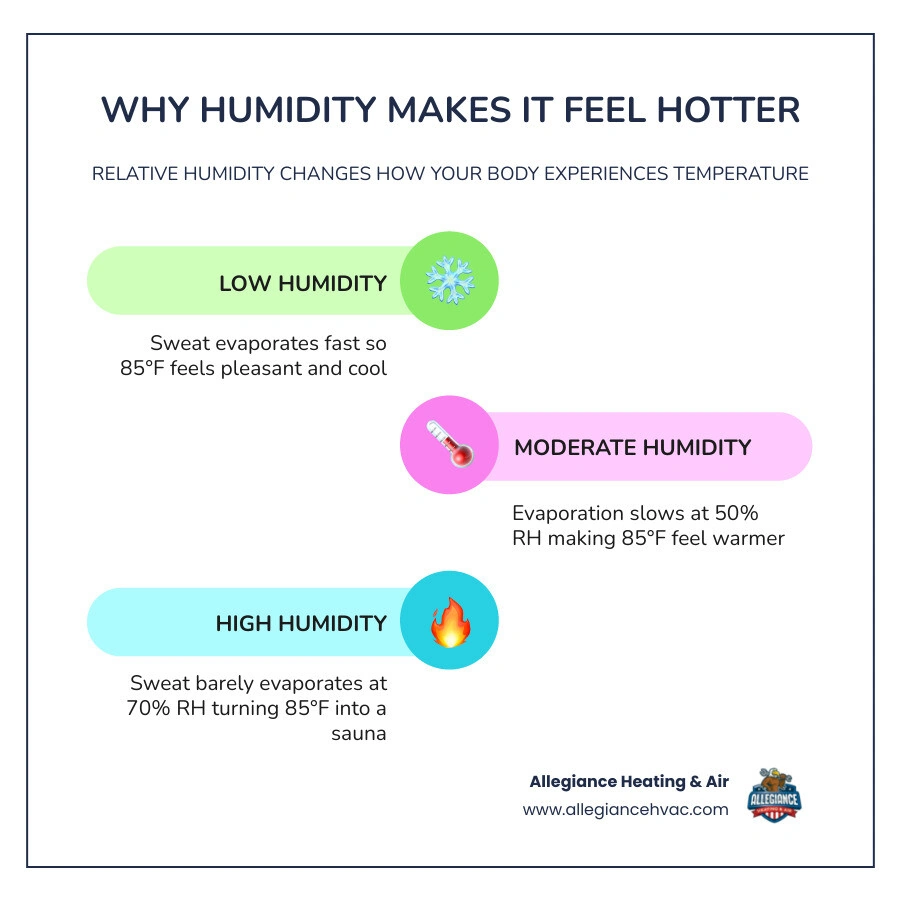
High humidity doesn't just feel uncomfortable — it makes your body's natural cooling system less effective. Sweat can't evaporate as easily when the air is already saturated with moisture, so even a moderately warm day can feel oppressive. Inside your home, that same humidity forces your air conditioner to work harder, drives up energy bills, and creates the right conditions for mold and wood damage.
In Indiana's Ohio Valley climate, summers bring both heat and heavy humidity together — a tough combination that requires more than just cranking up the AC.
Effective Strategies for Reducing Indoor Humidity

When it comes to proper humidity control importance, we cannot overstate how much moisture removal impacts your comfort. In places like Floyds Knobs or New Albany, the air can get "thick" in July. If your indoor humidity rises above 50%, you’ll start to see condensation on windows, feel a "sticky" sensation on your skin, and potentially smell musty odors.
One of the most effective tools in your arsenal is a dehumidifier. While we often talk about dealing with dry air in the winter, the summer requires the opposite approach. ENERGY STAR certified dehumidifiers are a great investment, as they use up to 15% less energy than standard models. For homes with chronically damp basements in the Louisville area, a whole-home dehumidifier integrated into your HVAC system is often the best long-term solution.
Beyond equipment, your daily habits play a huge role in indoor moisture:
• Run Exhaust Fans: Always use the exhaust fans in your bathroom and kitchen when showering or cooking. Keep them running for at least 20 minutes after you're done to ensure the moisture is completely vented outside, not just moved to the attic.
• Cover Your Pots: When boiling water on the stove, keep a lid on the pot to prevent steam from filling the kitchen.
• Check Your Dryer: Ensure your clothes dryer vents directly to the outdoors. A leaky vent can dump gallons of water vapor back into your laundry room.
• Cold Showers: Taking slightly cooler showers reduces the amount of steam generated, which helps keep the bathroom (and the rest of the house) drier.
How to Keep Your Home Cool During Humid Summers Without Overworking Your AC
If you're wondering how to keep your home cool during humid summers without seeing your energy bill skyrocket, you have to look at "passive" cooling. This involves stopping heat from entering your home in the first place. Understanding how Ohio Valley climate affects your HVAC system is key; because our air is so moist, once heat gets inside, it's much harder to remove.
Up to 30% of unwanted heat enters your home through your windows. By simply closing your blinds or curtains during the peak sun hours (usually 10 a.m. to 4 p.m.), you can block a significant amount of solar heat gain. Reflective window films are another excellent option, especially for south-facing windows in communities like Georgetown or Clarksville.
Another major heat source is right inside your walls: your appliances and lighting. Incandescent light bulbs are essentially small heaters; they produce 70-90% less heat when replaced with ENERGY STAR-rated LED bulbs.
• Incandescent — Heat Output: High (can raise room temp by 11°F/hr) — Efficiency: Low
• Halogen — Heat Output: High — Efficiency: Low
• LED — Heat Output: Very Low (70-90% less heat) — Efficiency: High
To keep things even cooler, try "night-flush" ventilation. If the temperature drops significantly at night, open windows on opposite sides of the house to create a cross-breeze. Just be sure to close them early in the morning before the humidity starts to climb again.
Using Ceiling Fans to Keep Your Home Cool During Humid Summers
Ceiling fans don't actually lower the temperature of a room; they cool people by creating a wind-chill effect. In the summer, ensure your fan is rotating counter-clockwise. This pushes air straight down, helping sweat evaporate from your skin. A ceiling fan can make a room feel up to 10 degrees cooler while using only about 10% of the energy a central air conditioner requires. Just remember to turn them off when you leave the room—fans cool people, not spaces!
Strategic Landscaping to Keep Your Home Cool During Humid Summers
Your yard is your first line of defense. Planting deciduous shade trees on the south and west sides of your home can reduce your air conditioning needs by up to 25%. Trees provide shade, but they also cool the air through a process called evapotranspiration—essentially "sweating" for plants. For those in more rural areas like Borden or Palmyra, well-placed trees and external awnings can keep the sun's rays from ever hitting your siding or windows.
Optimizing Your HVAC System for Maximum Efficiency
Your air conditioner has two jobs: lowering the temperature and removing moisture. If it isn't maintained, it will struggle with both. Following a comprehensive air conditioning guide starts with the basics: the air filter. A clogged filter restricts airflow, making your system work harder and reducing its ability to dehumidify. We recommend checking your filter once a month during the heavy cooling season in May and June.
Regular maintenance for AC matters because a technician can clean the evaporator coils. Dirty coils can't absorb heat or moisture effectively, leading to that "sticky" indoor feeling. Additionally, ways to make sure your HVAC system is ready for summer include checking your ductwork. Leaky ducts can account for 25% of cooling costs in an average home, often pulling humid air from attics or crawlspaces into your living areas.
Consider upgrading to a smart thermostat. These devices can save you about $180 a year by automatically adjusting the temperature when you're away. For the best balance of cost and comfort, Energy Star recommends setting your thermostat to 78°F when you are home. Increasing your thermostat by just 1°C (about 2°F) can reduce your cooling costs by a significant margin.
Sealing and Insulating Against the Indiana Heat
Your home's "envelope" needs to be tight to keep the Greenville humidity out. Use weatherstripping and caulk to seal gaps around windows and doors. If you can feel a draft, you're losing cool air and letting in moisture.
Don't forget the attic. Temperatures in an uninsulated attic can reach 150°F, which radiates heat directly through your ceiling. Ensuring you have the best HVAC setup for four-season Ohio Valley weather often involves topping up your attic insulation to keep that heat where it belongs—outside.
When comparing a central AC vs heat pump for your home, both systems rely on a sealed environment to function efficiently. In crawlspaces, installing a vapor barrier over dirt floors is a crucial step in Southern Indiana to prevent ground moisture from rising into your floor joists and eventually your living space.
Frequently Asked Questions about Summer Cooling
What is the ideal thermostat setting for a humid summer?
The Department of Energy suggests 78°F when you're home and higher when you're away. While this might sound warm, if your humidity is controlled (around 45-50%), 78°F feels much cooler than 72°F in a damp house. Every degree you raise the thermostat can save you roughly 2-3% on your cooling bill.
How do dehumidifiers help with cooling?
Dehumidifiers don't lower the actual temperature, but they remove the moisture that makes heat feel "heavy." By lowering the humidity, your body can cool itself more effectively through evaporation. This allows you to set your AC at a higher temperature while maintaining the same level of comfort, ultimately reducing the workload on your HVAC system.
Why is my AC running but the house is still humid?
There are several reasons for this. First, preparing your HVAC for the transition to cooling is essential; if your coils are dirty or your refrigerant is low, the system can't remove moisture properly. Another common issue is an oversized AC unit. If a unit is too big for the home, it "short cycles," meaning it cools the air so fast that it shuts off before it has a chance to pull the humidity out.
Conclusion
Mastering how to keep your home cool during humid summers is a combination of smart habits, home sealing, and professional HVAC care. At Allegiance Heating & Air, we’ve been "Taking Home Comfort Under Our Wing" since 2005. As a family-owned business serving the Greenville community and surrounding areas like Sellersburg and Jeffersonville, we know exactly what our local climate demands.
Whether you need a seasonal tune-up to ensure your system is optimizing indoor air quality during summer or you're interested in a whole-home dehumidifier, our trusted technicians are here to help. Don't let the Indiana humidity win this year.
Ready to stay cool? Explore our Air Conditioning Services today and let us help you find the perfect balance of comfort and efficiency for your home.
Contact Us Or Schedule Expert Service
Other Blogs
ready to transform your home?
Discover our exceptional home services tailored to meet your needs and enhance your living space.
WHAT OUR CLIENTS HAVE TO SAY ABOUT US

We had a complete HVAC system and a hot water heater installed. The guys were professional, well mannered, and completed the work in a timely manner. Would definitely use them again.
I was nervous at first because my AC broke in the middle of 80 degree weather which is strange for April, but Allegiance Heating and Air was incredibly prompt and professional. The technician arrived within an hour, explained the problem clearly, and completed the repair. The technician , Mr. Garrett Moon was a very nice and courteous young man. He found the problem and fixed it within a timely manner. I highly recommend them for any heating or cooling needs. I’ll definitely give them a call again should I ever have another issue, but hopefully not. Knock on wood 😁. Give them a call… you won’t be disappointed!
From the moment I called to schedule a service, the team was quick to respond and arrived right on time. The technician was professional, friendly, and clearly knowledgeable about my heating system. He explained the repair options in plain language and completed the job efficiently. I appreciated the reliable service and the fact that the work was done the same day. I would definitely recommend Allegiance Heating and Air for any residential HVAC needs.
5/5 stars – I was very impressed with the efficient, affordable and timely service from Allegiance Heating and Air. The technician arrived on time, and performed the service quickly, no repairs needed at this time. Communication was clear and the whole experience felt hassle‑free. I would definitely recommend them for any residential HVAC needs.
Knowledgeable, experienced individual.
Explains Allegiance Heating and Air was incredibly reliable, professional and affordable. They arrived right on time, kept the work area clean and finished the furnace repair quickly. The technician explained everything clearly and the price was a great value. If happiness had a location on Google Maps, it would be here.
Gilbert had to go above and beyond because York is no longer making the part for my furnace. But he was able to find a way to construct a housing bracket for my furnace. Ingenuity, determination and integrity is what finally got my furnace fixed. Gilbert is truly a one of a kind technician.
Thank you for always going the extra mile. Gilbert is always respectful and helpful with any concerns.
"Great service, most knowledgeable and capable HVAC business in Kentuckiana!! Pete Flemming and Bryan the owner, are HVAC encyclopedias. They have the highest integrity of any HVAC business I have ever used. Allegiance has put numerous units in for me over the last 17 years. I will continue to use and trust them."
"Fast response from Allegiance when our heat was out on New Year’s day! Service technician was friendly and efficient. He took the time to explain the problem, tell us about the temporary fix and the plan for permanent repair. We were impressed!"
"Love Allegiance! Their technicians, in particular Benjamin, explain everything. Fast and thorough. A/C was out on a Sunday. Called Allegiance and within a few hours Benjamin arrived. Such a comfort as he was the one who last serviced our units. He quickly replaced part and cooling is restored!"
"My heat pump went out and I had to call after hours. The technician (Garrett) was outstanding and thorough. He got my system up and working until Monday and gave me several options of units. Also took the time to explain the issue to my Home warranty company. I highly recommend this company."
"Right on time :) respectful, fast, and polite. Even gave my fur babies some attention."
"Had Garrett out today to fix our AC. Fantastic tech. He showed up exactly when he said he would and kept us informed of what he was checking and what he found. Highly recommend!"
"Lucas with Allegiance showed up on time as promised, was professional and extremely patient and responsive with all my questions. He took care of the issue, and I feel he was trustworthy! He had us back to cool and comfortable on one of the hottest days of the year."
"Lucas did a great job! Very professional and expedient. Explained the process very well and represented Allegiance as a truly professional and reputable company."
"Arrived on time and work diligently to fix issue. These guy are great. Worked quickly to resolve my issues."
"Lucas was great - he spent a lot of time trying to figure out what was going on and explained everything he was doing. I trust Allegiance and wouldn’t want anyone else working on/in my house!!"

RELATED ARTICLES
HVAC Repair vs Replacement: A Guide to Making the Right Call
Ultimate Checklist for HVAC Contractor Credentials