


Why the Ohio Valley Climate Is One of the Toughest Environments for Home HVAC Systems
How Ohio Valley climate affects your HVAC system is something every homeowner in Greenville, IN should understand — because this region puts heating and cooling equipment through some of the hardest working conditions in the country.
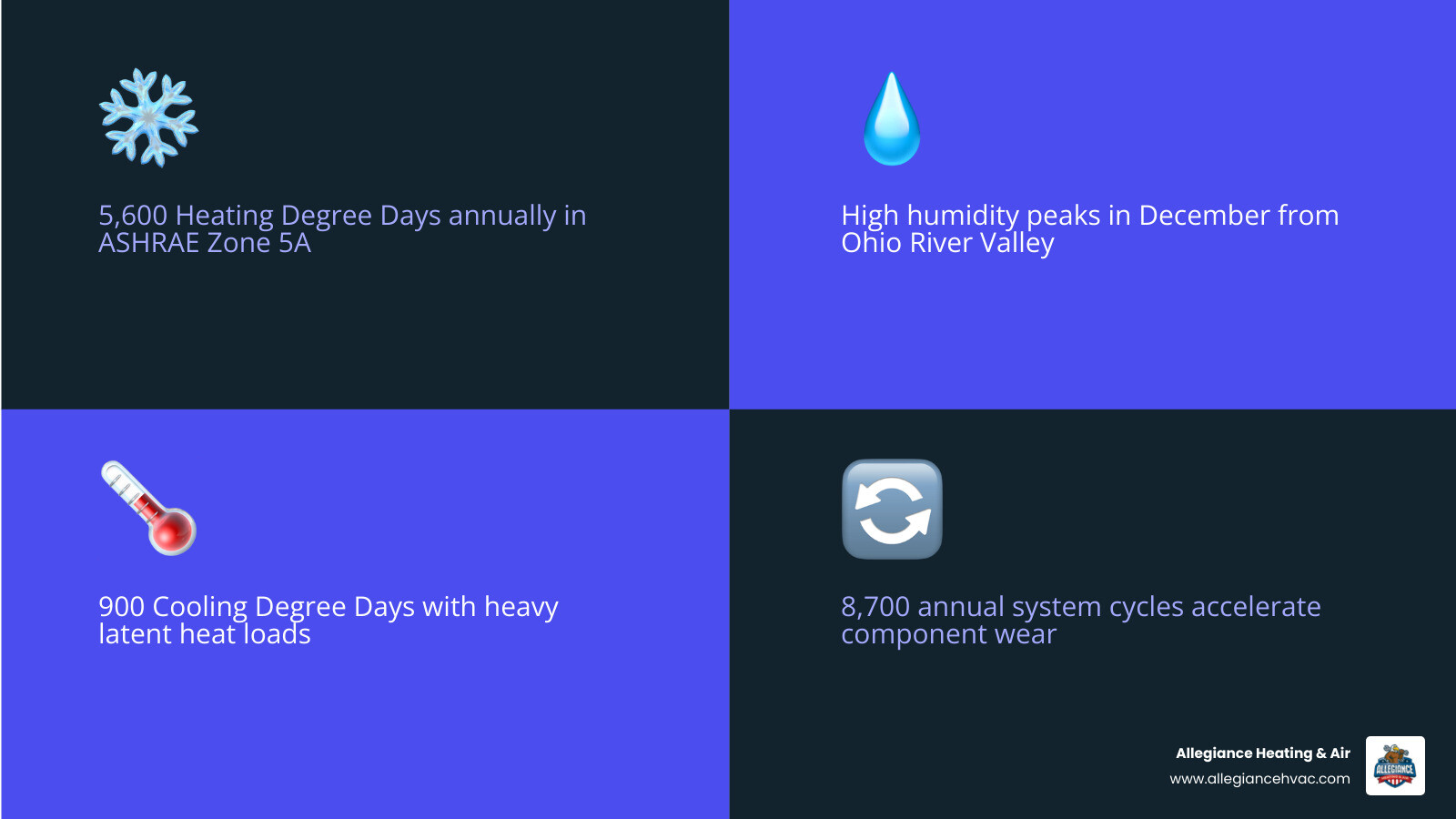
The Ohio Valley sits in ASHRAE Climate Zone 5A — a Cool-Humid classification that means your system faces both long, cold winters and hot, sticky summers. With roughly 5,600 Heating Degree Days and 900 Cooling Degree Days each year, heating is the dominant load, but the humidity adds a serious challenge to summer cooling too.
Here is a quick summary of how the Ohio Valley climate impacts your HVAC system:
• Cold winters — Winter lows near 22°F push heat pumps past their efficiency limits and trigger energy-intensive backup heat
• Hot, humid summers — High relative humidity in June, July, and August forces your AC to work harder to remove moisture, not just cool the air
• Year-round humidity — The Ohio River Valley is surprisingly one of the most humid regions in December, keeping your system busy even in winter
• Older housing stock — Many homes built before 1980 have insulation gaps that cause HVAC systems to run 20–40% longer than necessary
• Local geography — Hillside winds, cold air pooling in valleys, and river moisture all increase the heating and cooling load on your equipment
• High cycle counts — Standard systems in this region cycle roughly 8,700 times per year, wearing components faster than in milder climates
The result? Higher energy bills, more wear on equipment, and comfort problems that frustrate homeowners year after year — if the right system and maintenance plan are not in place.
In this guide, Allegiance Heating & Air walks you through exactly how the Ohio Valley climate shapes your HVAC performance, what equipment works best here, and what you can do to protect your system and your comfort all year long.
How Ohio Valley Climate Affects Your HVAC System
Living in the Ohio River Valley means dealing with a climate that is technically classified as "Cool-Humid." For your air conditioner and furnace, this is a double whammy. It isn't just the temperature that matters; it’s the moisture in the air. We are situated in a region where the continental climate meets subtropical influences, creating a heavy "latent heat load." This means your Climate Control Systems have to spend a massive amount of energy just wringing the water out of the air before they can even begin to lower the temperature.
Our proximity to the Ohio River plays a massive role in this. The river acts as a giant moisture source, especially during the sweltering months of June, July, and August. Interestingly, research shows that the Ohio River Valley is actually most humid in December. This high relative humidity in winter can lead to frost buildup on heat pump coils, forcing the system into frequent "defrost cycles" that temporarily stop the heating process to melt the ice.
How Ohio Valley Climate Affects Your HVAC System Performance in Extreme Weather
When the temperature swings, the stress on your equipment skyrockets. In the winter, our local lows frequently dip near 22°F. This is a critical "tipping point" for many standard heat pumps. Most traditional heat pumps begin to lose their efficiency significantly once temperatures drop below 30°F. When it gets that cold, the system often has to engage "auxiliary heat"—which are essentially electric heat strips that draw between 5 and 20 kW of power. This is much less efficient than the heat pump's normal operation and can lead to a spike in utility bills.
During our humid summers, the strategy changes. We often recommend that homeowners keep their thermostats set between 72–74°F. While it might be tempting to crank the AC down to 65°F during a July heatwave, doing so can prevent the unit from ever completing a full cooling cycle. If the unit runs constantly without stopping, it doesn't just waste energy; it can actually cause the evaporator coils to freeze up because the moisture from our humid air doesn't have time to drain away properly. Understanding How Weather Affects Your HVAC Unit is the first step toward avoiding these mid-summer breakdowns.
How Ohio Valley Climate Affects Your HVAC System Efficiency and Lifespan
The sheer number of times your system "cycles" (turns on and off) determines how long it will last. In a standard Ohio Valley home, an HVAC system might cycle up to 8,700 times per year. Every time that motor starts up, it experiences a burst of electrical and mechanical strain.
High-efficiency systems, particularly those with variable-speed motors, can reduce this count to roughly 4,500–5,000 cycles by running at lower speeds for longer periods. This is much easier on the equipment. Generally, we see heat pumps in our region last about 12–15 years, while gas furnaces—which don't have to run during the summer—often last between 15–20 years. To get the most out of these years, a consistent Maintenance Plan is essential to keep components clean and lubricated against the corrosive effects of high humidity.
Comparing Heating and Cooling Equipment for Southern Indiana
Choosing the right gear for Greenville or New Albany requires looking at the data. Because we have 5,600 Heating Degree Days (HDD) compared to only 900 Cooling Degree Days (CDD), your heating efficiency should be your top priority.
• Gas Furnace — Best Use Case: Homes with natural gas access; best for extreme cold. — Key Efficiency Metric: 95–98% AFUE
• Standard Heat Pump — Best Use Case: All-electric homes; great for mild winters. — Key Efficiency Metric: 14.3 SEER2 / 7.5 HSPF2
• Cold-Climate Heat Pump — Best Use Case: All-electric homes; efficient down to -15°F. — Key Efficiency Metric: High HSPF2 Ratings
• Hybrid (Dual-Fuel) — Best Use Case: The "Gold Standard" for the Ohio Valley. — Key Efficiency Metric: Combined AFUE & SEER2
For those looking for the best performance, Heating Services today often focus on high-efficiency condensing furnaces. These units capture heat that would normally escape out the chimney, boasting AFUE ratings of up to 98%. On the cooling side, new federal standards as of 2023 require a minimum of 14.3 SEER2 for Air Conditioning Services in our region.
The Role of Hybrid Systems in Zone 5A
We often tell our neighbors in Floyds Knobs and Sellersburg that a hybrid system is the "best of both worlds." A hybrid system uses an electric heat pump for the majority of the year. When the temperature is between 35°F and 65°F, the heat pump is incredibly efficient. However, when an Indiana cold snap hits and the temperature drops below 30°F, the system automatically switches over to a gas furnace.
This prevents the "cool air" feeling that some people dislike about heat pumps in deep winter and avoids the high cost of electric auxiliary heat. Our Heat Pump Services team can help you configure these "switch-over" points to maximize your comfort and savings based on current fuel prices.
Sizing and Configuration for Local Topography
The Ohio Valley isn't flat, and your HVAC design shouldn't be either. If your home sits on a hillside, it’s exposed to higher wind speeds that strip heat away from your siding in the winter. Conversely, homes in the lower valleys often deal with "cold air pooling" and higher moisture levels from the river.
We don't use "rules of thumb" to size units. We perform a Manual J load calculation. This takes into account your home’s orientation, window types, and even the local microclimate. Getting the size right is vital; an oversized unit will "short cycle," failing to remove humidity in the summer, while an undersized unit will run forever and never get you comfortable. Learn more about How to Choose the Right Size HVAC for Your Home to ensure your system is a perfect match for your property.
Essential Maintenance for Longevity in a Humid Continental Zone
In a climate as damp as ours, maintenance isn't optional—it’s a survival tactic for your machinery. One of the most common issues we see in the Louisville area is "slugging" or restricted airflow caused by dirty coils.
To combat our high humidity, we often adjust AC fan speeds to around 350 CFM (cubic feet per minute) per ton of cooling. While many people think faster air is better, slower airflow across the cooling coil actually allows more moisture to condense and drain away. We also recommend installing a TXV (Thermostatic Expansion Valve) coil, which precisely regulates refrigerant flow to ensure the system is dehumidifying as efficiently as possible. Taking these Ways to Make Sure Your HVAC System Is Ready for Summer seriously can prevent a mid-August breakdown.
Managing Indoor Air Quality and Humidity
Because the Ohio Valley is a "Cool-Humid" zone, Indoor Air Quality (IAQ) is a major concern. High humidity levels—especially that surprising December peak—can encourage mold growth in ductwork and allergens in the air.
Maintaining the Best Humidity Levels for Your Home (typically between 30% and 50%) is essential. In the summer, your AC acts as a dehumidifier, but in the "shoulder seasons" of spring and fall, the AC might not run enough to pull moisture out. In these cases, a whole-home dehumidifier can bridge the gap, protecting your wood floors and your family's health.
Home Improvements to Reduce System Strain
Your HVAC system is only as good as the "envelope" it lives in. In Southern Indiana, many homes built before the 1980s are significantly under-insulated. Upgrading your attic insulation from the old R-19 standard to the modern R-49 or higher can reduce your system's workload by 20%.
Other critical steps include:
• Air Sealing: Stopping leaks around windows, doors, and rim joists.
• Air Balancing: Adjusting dampers so that every room gets the right amount of air, preventing "hot spots" in the summer.
• Duct Sealing: The average home loses 25–40% of its conditioned air through leaky ducts in the attic or crawlspace.
Taking the time to Prepare Your Property for Winter: Essential Tips for Safety, Energy Savings, and Damage Prevention can significantly lower the strain on your furnace when the first frost arrives.
Frequently Asked Questions about Ohio Valley HVAC
Why does my heat pump run constantly when it is below 30 degrees?
In Greenville and the surrounding areas, this is actually often normal behavior. Because a heat pump extracts heat from the outdoor air, there is simply less heat available when it’s below 30°F. To compensate, the system must run longer cycles (sometimes 30–90 minutes or even continuously) to maintain your thermostat setting. As long as your home is staying warm and the "Auxiliary Heat" light isn't staying on 24/7, your system is likely just doing its job.
What is the best thermostat setting for Indiana summers?
For the best balance of comfort and dehumidification, we recommend 72–74°F. Setting the thermostat too low (like 68°F) during a humid Indiana summer can cause the system to run so long that the coils freeze over. Using ceiling fans can help you feel 4 degrees cooler without putting extra strain on your AC.
How does the Ohio River affect my home's cooling needs?
The river increases the "latent load" on your system. This means your AC has to work harder to remove the moisture (humidity) from the air before it can effectively lower the temperature. Homes closer to the river or in low-lying areas like Jeffersonville or New Albany often require more robust dehumidification strategies than homes further inland.
Conclusion
The Ohio Valley climate is undoubtedly challenging, but it isn't something your home can't handle with the right approach. From the heavy humidity of the river corridor to the bitter winter winds on our hillsides, your HVAC system is the heartbeat of your home’s comfort.
At Allegiance Heating & Air, LLC, we’ve been "Taking Home Comfort Under Our Wing" since 2005. As a family-owned business, we understand the specific needs of homeowners in Greenville, Floyds Knobs, and across Southern Indiana. Our licensed and insured technicians are experts in navigating the unique demands of ASHRAE Zone 5A, ensuring your system is sized correctly, maintained professionally, and ready for whatever the Ohio Valley throws at it.
Whether you need a seasonal tune-up, an emergency repair, or a complete system upgrade to a high-efficiency hybrid unit, we are here to provide honest, transparent service. Don't let the climate dictate your comfort—trust the local experts who live and work in the same weather you do.
Ready to optimize your home for the Ohio Valley seasons? Explore our full range of HVAC Services or contact us to learn more about our advanced Climate Control Systems today.
Contact Us Or Schedule Expert Service
Other Blogs
ready to transform your home?
Discover our exceptional home services tailored to meet your needs and enhance your living space.
WHAT OUR CLIENTS HAVE TO SAY ABOUT US

We had a complete HVAC system and a hot water heater installed. The guys were professional, well mannered, and completed the work in a timely manner. Would definitely use them again.
I was nervous at first because my AC broke in the middle of 80 degree weather which is strange for April, but Allegiance Heating and Air was incredibly prompt and professional. The technician arrived within an hour, explained the problem clearly, and completed the repair. The technician , Mr. Garrett Moon was a very nice and courteous young man. He found the problem and fixed it within a timely manner. I highly recommend them for any heating or cooling needs. I’ll definitely give them a call again should I ever have another issue, but hopefully not. Knock on wood 😁. Give them a call… you won’t be disappointed!
From the moment I called to schedule a service, the team was quick to respond and arrived right on time. The technician was professional, friendly, and clearly knowledgeable about my heating system. He explained the repair options in plain language and completed the job efficiently. I appreciated the reliable service and the fact that the work was done the same day. I would definitely recommend Allegiance Heating and Air for any residential HVAC needs.
5/5 stars – I was very impressed with the efficient, affordable and timely service from Allegiance Heating and Air. The technician arrived on time, and performed the service quickly, no repairs needed at this time. Communication was clear and the whole experience felt hassle‑free. I would definitely recommend them for any residential HVAC needs.
Knowledgeable, experienced individual.
Explains Allegiance Heating and Air was incredibly reliable, professional and affordable. They arrived right on time, kept the work area clean and finished the furnace repair quickly. The technician explained everything clearly and the price was a great value. If happiness had a location on Google Maps, it would be here.
Gilbert had to go above and beyond because York is no longer making the part for my furnace. But he was able to find a way to construct a housing bracket for my furnace. Ingenuity, determination and integrity is what finally got my furnace fixed. Gilbert is truly a one of a kind technician.
Thank you for always going the extra mile. Gilbert is always respectful and helpful with any concerns.
"Great service, most knowledgeable and capable HVAC business in Kentuckiana!! Pete Flemming and Bryan the owner, are HVAC encyclopedias. They have the highest integrity of any HVAC business I have ever used. Allegiance has put numerous units in for me over the last 17 years. I will continue to use and trust them."
"Fast response from Allegiance when our heat was out on New Year’s day! Service technician was friendly and efficient. He took the time to explain the problem, tell us about the temporary fix and the plan for permanent repair. We were impressed!"
"Love Allegiance! Their technicians, in particular Benjamin, explain everything. Fast and thorough. A/C was out on a Sunday. Called Allegiance and within a few hours Benjamin arrived. Such a comfort as he was the one who last serviced our units. He quickly replaced part and cooling is restored!"
"My heat pump went out and I had to call after hours. The technician (Garrett) was outstanding and thorough. He got my system up and working until Monday and gave me several options of units. Also took the time to explain the issue to my Home warranty company. I highly recommend this company."
"Right on time :) respectful, fast, and polite. Even gave my fur babies some attention."
"Had Garrett out today to fix our AC. Fantastic tech. He showed up exactly when he said he would and kept us informed of what he was checking and what he found. Highly recommend!"
"Lucas with Allegiance showed up on time as promised, was professional and extremely patient and responsive with all my questions. He took care of the issue, and I feel he was trustworthy! He had us back to cool and comfortable on one of the hottest days of the year."
"Lucas did a great job! Very professional and expedient. Explained the process very well and represented Allegiance as a truly professional and reputable company."
"Arrived on time and work diligently to fix issue. These guy are great. Worked quickly to resolve my issues."
"Lucas was great - he spent a lot of time trying to figure out what was going on and explained everything he was doing. I trust Allegiance and wouldn’t want anyone else working on/in my house!!"

RELATED ARTICLES
Why Your AC Isn't Cooling Evenly in Sellersburg
Don't Get Left in the Cold: Finding Top Furnace Installers in Greenville, IN
