Is It Time for a New System? Knowing When Should You Replace Your Furnace or AC
Knowing when should you replace your furnace or AC can save you from pouring money into a system that's already on its way out — or from replacing one that still has years of good service left. Most homeowners only face this question when something breaks down at the worst possible moment: the furnace quits on a cold January night in Greenville, IN, or the AC gives up in the middle of a humid Indiana summer. The good news is that the signs are usually there well before a full breakdown — you just need to know what to look for.
Quick Answer: When Should You Replace Your Furnace or AC?
• Gas Furnace — Replace If...: Over 15-20 years old, frequent repairs, rising bills, uneven heat, strange smells
• Central AC — Replace If...: Over 12-15 years old, repair costs are high, efficiency is declining, uses R-22 refrigerant
• Heat Pump — Replace If...: Over 10-15 years old, struggling with temperature control, needs repeated repairs
• Any System — Replace If...: Cracked heat exchanger, failed compressor, carbon monoxide risk, or repair cost × age exceeds $5,000
Use these quick rules to get your bearings:
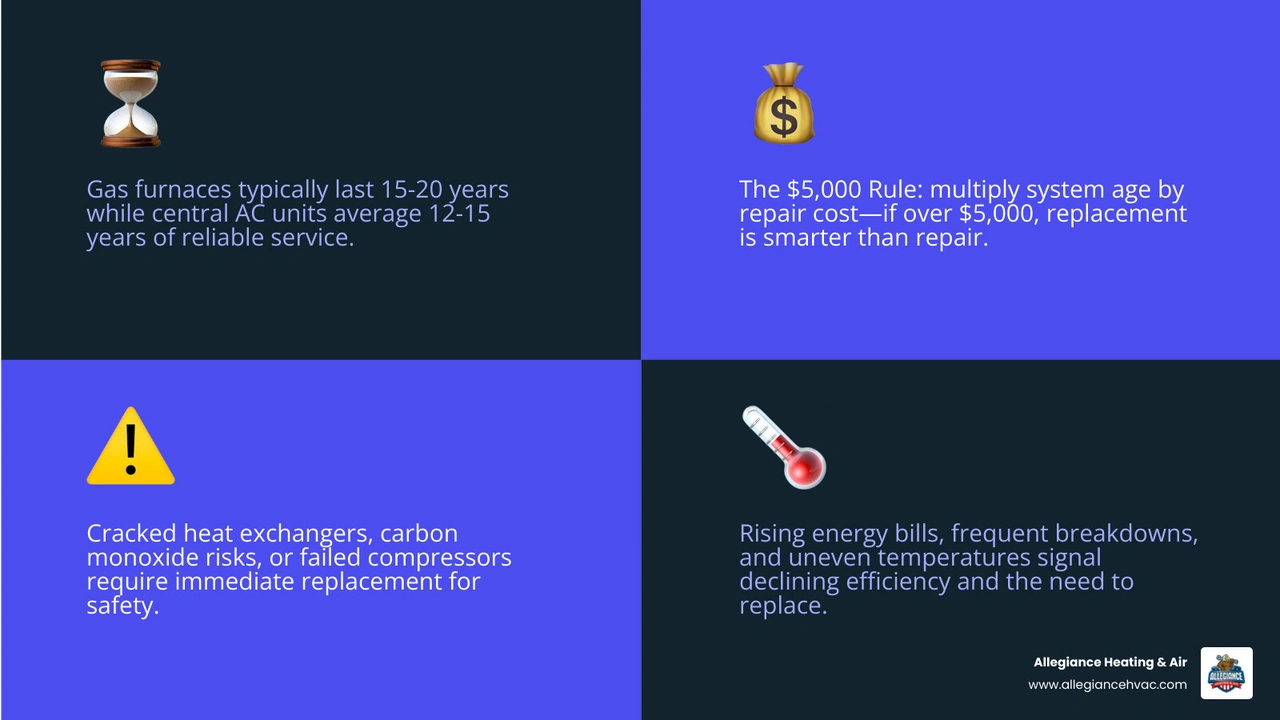
• The $5,000 Rule: Multiply the system's age (in years) by the repair cost. If the result is over $5,000, replacement is likely the smarter move.
• The 50% Rule: If the repair quote is more than half the cost of a new system, replace it.
• Age alone: ACs over 12-15 years and furnaces over 15-20 years are strong replacement candidates, especially if showing any performance issues.
In this guide, Allegiance Heating & Air walks you through every factor that should go into this decision — from lifespan and warning signs to safety risks and energy efficiency upgrades.
Understanding System Lifespans: How Old Is Too Old?

Every mechanical system has a natural expiration date. No matter how meticulously you clean, tune, and care for your heating and cooling systems, years of constant operation in southern Indiana's variable climate will eventually take a toll. Understanding How Old Is Too Old for an HVAC System is your first step in planning for a replacement rather than being caught off guard by an emergency.
Equipment age is the baseline from which all other repair decisions should be made. While a minor repair on a five-year-old system is a no-brainer, that same repair on a fifteen-year-old system is often the first domino to fall in a costly series of breakdowns. The average lifespan of your equipment varies significantly by system type:
• Gas Furnaces: 15 to 20 years
• Central Air Conditioners: 12 to 15 years
• Heat Pumps: 10 to 15 years
• Ductless Mini-Splits: Up to 20 years (with excellent maintenance)
The single biggest factor determining whether your system hits the high end of these ranges is routine maintenance. Skipping annual tune-ups can shorten your system's lifespan by five to ten years, forcing you to ask when should you replace your furnace or AC much sooner than expected.
Typical Lifespan of a Gas Furnace
With proper care, a gas furnace is one of the longest-lasting major appliances in your home. According to our comprehensive Heating System Replacement Guide, a well-maintained gas furnace typically lasts between 15 and 20 years.
As a furnace ages, its metal components undergo constant thermal expansion and contraction. Over time, this natural stress can lead to systemic degradation, most notably in the heat exchanger. The heat exchanger is the chamber where fuel is burned to create heat. If this component cracks due to age and wear, it can leak combustion gases—including dangerous carbon monoxide—directly into your home's air supply. Once a furnace passes the 15-year mark, we recommend annual safety inspections to monitor the integrity of this critical component.
Typical Lifespan of a Central Air Conditioner
Central air conditioning systems operate under high pressure and intense outdoor conditions. Because they are exposed to southern Indiana's summer heat, humidity, dirt, and debris, their average useful lifespan is slightly shorter than a furnace, typically ranging from 12 to 15 years. You can read more about this timeline in our guide on the Time to Replace Old AC systems.
The overall health of your air conditioner is heavily tied to its compressor—the "heart" of the AC system. As operating hours accumulate year after year, the compressor motor winding degrades, and the refrigerant lines become more susceptible to leaks. In addition, our local climate plays a massive role; systems in areas with high summer humidity work twice as hard to dehumidify the air, meaning a 12-year-old AC unit in our region has often accumulated the wear and tear of a 15-year-old unit in a milder climate.
Key Warning Signs: When Should You Replace Your Furnace or AC?
Your HVAC system rarely fails completely without giving you some warning signs first. Recognizing these red flags early allows you to plan an orderly upgrade rather than suffering through a freezing winter night or a blistering summer afternoon waiting for an emergency installation. For a detailed breakdown of these symptoms, explore our article on Signs Your HVAC Needs Replacing Not Just Fixing.
If you notice a combination of physical wear, performance decline, or escalating operational issues, your system is likely signaling that it is nearing the end of its useful life.
Rising Energy Bills and Decreasing Efficiency
Have you noticed that your monthly utility bills are steadily climbing, even though your heating and cooling habits haven't changed? This is a classic indicator of efficiency loss. As internal components wear down, your furnace or air conditioner must run longer and work harder to achieve the target temperature on your thermostat.
An older system's Seasonal Energy Efficiency Ratio (SEER) or Annual Fuel Utilization Efficiency (AFUE) rating degrades naturally over time. For example, an older furnace that started with an 80% AFUE rating might only operate at 60% or 65% efficiency after 15 years of service. If your home's energy consumption is significantly higher than your neighbors'—which you can track using tools like the EPA's Home Energy Yardstick—it is a strong sign that your aging equipment is wasting money.
Frequent Repairs and the "Repair Spiral"
It starts with a failed capacitor, followed a few months later by a broken blower motor, and then a faulty control board. Before you know it, you are on a first-name basis with your HVAC technician, and the repair bills are stacking up. We call this the "repair spiral."
A system that requires multiple service calls within a two-year window is experiencing systemic decline. If you find yourself investing in frequent repairs, that money is often better spent on a modern, reliable replacement. Regular Air Conditioner Maintenance and Replacement planning is crucial to avoiding this cycle, helping you transition smoothly to a new system before the next major component failure occurs.
Uneven Temperatures and Comfort Issues
An aging HVAC system gradually loses its ability to distribute air effectively throughout your home. If you are constantly adjusting the thermostat because the upstairs is stiflingly hot while the downstairs is freezing, your system is struggling to keep up.
Common comfort issues that point toward replacement include:
• Temperature Inconsistency: Hot and cold spots in different rooms due to an aging blower motor or failing ductwork.
• Humidity Problems: An air conditioner that can no longer pull humidity out of the air, leaving your home feeling sticky in July.
• Excessive Dust and Air Dryness: Older furnaces often lose their ability to filter and moisturize the air, leading to a dry, dusty indoor environment.
• Loud Noises: Banging, squealing, popping, or rattling sounds indicate that internal mechanical parts are loose, worn, or failing.
The Repair vs. Replace Decision Framework
When you are facing a major system breakdown, deciding whether to repair or replace your HVAC unit can feel overwhelming. To help you make a clear, unemotional decision, we have put together a comprehensive comparison table outlining the key factors you should weigh:
• System Age — Lean Toward Repair: Under 10 years (AC) or under 12 years (Furnace) — Lean Toward Replacement: Over 12 years (AC) or over 15 years (Furnace)
• Warranty Status — Lean Toward Repair: Under manufacturer warranty (parts are covered) — Lean Toward Replacement: Warranty has expired; labor and parts are fully out-of-pocket
• Repair Frequency — Lean Toward Repair: First major issue in several years — Lean Toward Replacement: Multiple breakdowns in the last 24-36 months
• Energy Bills — Lean Toward Repair: Stable, predictable utility costs — Lean Toward Replacement: Steadily rising bills despite normal usage
• Safety Concerns — Lean Toward Repair: None; standard wear-and-tear component — Lean Toward Replacement: Cracked heat exchanger, gas leaks, or electrical burning smells
• Refrigerant Type — Lean Toward Repair: Modern R-410A or R-454B system — Lean Toward Replacement: Outdated R-22 system
Navigating this choice requires looking at the big picture. Our guide on How to Decide Between HVAC Repair and Replacement emphasizes that you must balance the immediate cost of a quick fix against the long-term benefits of a modern, energy-efficient system.
Applying the $5,000 Rule and the 50% Rule
To remove the guesswork, HVAC professionals rely on two trusted mathematical formulas to evaluate the financial logic of your decision. In our detailed look at When to Repair vs Replace Your HVAC System, we highlight these key rules of thumb:
1. The $5,000 Rule: Multiply the age of your system (in years) by the cost of the repair quote. If the total exceeds $5,000, you should replace the system. If it is under $5,000, a repair is generally a sound investment.
— Example A (Repair): An 8-year-old AC needs a $300 fan motor repair. $300 × 8 = $2,400. Since this is well under $5,000, repairing the unit makes sense.
— Example B (Replace): A 14-year-old furnace needs a $600 control board repair. $600 × 14 = $8,400. Because this far exceeds the $5,000 threshold, investing in a new furnace is the wiser choice.
2. The 50% Rule: If a single repair quote costs more than 50% of the price of a brand-new system installation, the money is better spent upgrading.
Safety Risks and Red Flags Requiring Immediate Replacement
While financial formulas are helpful, some safety risks bypass the math entirely. If your system poses an active threat to your family's health, replacement is the only logical choice. Our technicians emphasize that Furnace Replacement Is Necessary immediately if you encounter any of the following critical red flags:
• Cracked Heat Exchanger: As mentioned, a crack in the heat exchanger allows carbon monoxide (CO) to mix with your indoor air. This is a silent, odorless hazard that can be fatal.
• Yellow Burner Flame: A healthy natural gas furnace should always burn a crisp, steady blue. A yellow or flickering flame indicates incomplete combustion, which is a primary source of carbon monoxide production.
• Persistent Gas Leaks: If you smell rotten eggs or suspect a natural gas leak, leave the home immediately and call for emergency assistance.
• Electrical Burning Smells: Strong, persistent burning odors coming from your HVAC cabinet indicate melting wires or failing motors that pose an active fire risk.
The R-22 Refrigerant Phase-Out and System Compatibility
If your central air conditioner was installed before 2010, there is a very high chance it uses R-22 refrigerant (often known by the brand name Freon). Because of its ozone-depleting properties, the EPA has completely phased out the production and import of R-22.
Today, servicing an R-22 system is incredibly expensive because technicians must rely on dwindling, recycled stockpiles. A single refrigerant recharge on an old R-22 system can cost a substantial amount, making it a poor financial decision. If your older system has a refrigerant leak, upgrading to a modern system that uses environmentally friendly refrigerants is the only sustainable path forward.
Furthermore, trying to replace only the outdoor compressor while keeping an outdated indoor evaporator coil creates mismatched components. These mismatched systems suffer from poor efficiency, voided warranties, and premature compressor failure. Understanding Air Conditioner Replacement Importance means recognizing when outdated technology is simply holding your home comfort hostage.
Replacing Both Systems Simultaneously: Pros and Cons
When one half of your HVAC system fails, you will inevitably face a major question: Should I replace both the furnace and the air conditioner at the same time?
While it is a larger upfront investment, upgrading both systems simultaneously offers several distinct advantages:
• Shared Labor Savings: Because the technician is already dismantling your system, reclaiming refrigerant, and modifying ductwork, installing both units together drastically reduces the overall labor hours compared to two separate installations.
• Warranty Synchronization: Replacing both units resets the clock on your manufacturer warranties, making it easy to track coverage and keep both systems protected under identical terms.
• Optimal System Performance: HVAC systems are engineered to work as matched sets. When you pair a brand-new, high-efficiency outdoor AC with a new indoor furnace, they utilize a shared, optimized blower motor to deliver peak airflow and efficiency.
When should you replace your furnace or ac at the same time?
You don't always have to replace both. If your furnace is only five years old and working perfectly, you can safely replace just your failing air conditioner. However, if both systems are over 12 years old, replacing them together is highly recommended.
When upgrading to advanced HVAC technology—such as a variable-capacity AC or a multi-stage heat pump—the system requires a compatible, variable-speed furnace blower motor to function. If you try to run a high-tech AC with a conventional, single-stage furnace blower, you will lose out on the comfort and efficiency benefits you paid for.
By working with Professional AC Replacement Services, you can ensure your system is AHRI (Air-Conditioning, Heating, and Refrigeration Institute) matched. This guarantees that your indoor and outdoor components are certified to work in perfect harmony, protecting your investment for the next two decades.
Benefits of Upgrading to High-Efficiency ENERGY STAR Systems
Replacing an old, inefficient system with a modern, high-efficiency ENERGY STAR-rated unit is one of the smartest upgrades you can make for your home. These systems utilize advanced technology—like modulating gas valves and variable-speed scroll compressors—to provide precise climate control with minimal energy waste.
The benefits of a high-efficiency upgrade include:
• Substantial Energy Savings: Upgrading an AC that is more than 10 years old with an ENERGY STAR unit can save up to 20% on your cooling costs. Similarly, replacing a furnace over 15 years old with an ENERGY STAR qualified model can improve heating efficiency by 15% compared to conventional options.
• Enhanced Comfort: High-efficiency units run in longer, lower-speed cycles. This prevents the dramatic temperature swings common with older "on-or-off" systems and provides superior humidity control.
• Financial Incentives: High-efficiency systems often qualify for federal tax credits under the Inflation Reduction Act, as well as local utility rebates, helping to offset your initial investment.
• Reduced Carbon Footprint: By burning less fuel and consuming less electricity, your home comfort system will have a significantly smaller environmental impact.
Frequently Asked Questions About HVAC Replacement
How do I know when should you replace your furnace or ac?
You should consider replacing your furnace or AC if it is nearing the end of its typical lifespan (12-15 years for ACs, 15-20 years for furnaces) and is exhibiting performance issues. Telltale signs include rising energy bills, a need for frequent and expensive repairs, inconsistent heating or cooling throughout your home, or safety issues like a cracked heat exchanger. For a professional assessment, you can explore our dedicated Furnace Replacement Services to have a technician inspect your system's overall health.
Can I replace just the outdoor AC unit?
Technically, yes, but it is highly discouraged. Your indoor evaporator coil and outdoor condenser are designed to work as a matched system. If you connect a new, high-efficiency outdoor unit to an old, dirty indoor coil, the system will operate at a much lower efficiency, the compressor will experience excessive wear and tear, and you may void the manufacturer's warranty on your new equipment.
How does a new HVAC system affect home resale value?
A new, high-efficiency HVAC system is a major selling point for prospective homebuyers. It provides peace of mind that they won't have to face an expensive replacement shortly after moving in. Additionally, many modern systems come with transferable manufacturer warranties, which can significantly increase buyer appeal and help your home sell faster during a professional home inspection.
Conclusion
Deciding when should you replace your furnace or AC doesn't have to be a stressful, late-night emergency decision. By understanding system lifespans, watching for the key warning signs of decline, and applying practical financial rules of thumb, you can make an informed choice that keeps your home comfortable and your energy bills low.
At Allegiance Heating & Air, we have been "Taking Home Comfort Under Our Wing" as a family-owned business in Greenville, IN since 2005. Our licensed, insured, and highly trained technicians are dedicated to providing honest, transparent advice to help you find the perfect heating and cooling solutions for your home. Whether you need a simple repair or a complete high-efficiency system upgrade, we are proud to serve our neighbors across southern Indiana and the Louisville area.
For more localized advice, check out our regional resources:
• Explore our Heating Replacement Guide Greenville IN for specialized local insights.
• Review our Heating Replacement Guide New Albany IN for New Albany homeowners.
• Read through the Affordable Heating Replacement Louisville KY Guide if you live across the river.
• Learn about options close to home with our guide on Affordable Furnace Replacement in Clarksville IN.
Don't wait for your old system to leave you in the cold or heat. Schedule professional HVAC services today with the trusted team at Allegiance Heating & Air, and let us restore reliable comfort to your home.
Contact Us Or Schedule Expert Service
Other Blogs
ready to transform your home?
Discover our exceptional home services tailored to meet your needs and enhance your living space.
WHAT OUR CLIENTS HAVE TO SAY ABOUT US

We had a complete HVAC system and a hot water heater installed. The guys were professional, well mannered, and completed the work in a timely manner. Would definitely use them again.
I was nervous at first because my AC broke in the middle of 80 degree weather which is strange for April, but Allegiance Heating and Air was incredibly prompt and professional. The technician arrived within an hour, explained the problem clearly, and completed the repair. The technician , Mr. Garrett Moon was a very nice and courteous young man. He found the problem and fixed it within a timely manner. I highly recommend them for any heating or cooling needs. I’ll definitely give them a call again should I ever have another issue, but hopefully not. Knock on wood 😁. Give them a call… you won’t be disappointed!
From the moment I called to schedule a service, the team was quick to respond and arrived right on time. The technician was professional, friendly, and clearly knowledgeable about my heating system. He explained the repair options in plain language and completed the job efficiently. I appreciated the reliable service and the fact that the work was done the same day. I would definitely recommend Allegiance Heating and Air for any residential HVAC needs.
5/5 stars – I was very impressed with the efficient, affordable and timely service from Allegiance Heating and Air. The technician arrived on time, and performed the service quickly, no repairs needed at this time. Communication was clear and the whole experience felt hassle‑free. I would definitely recommend them for any residential HVAC needs.
Knowledgeable, experienced individual.
Explains Allegiance Heating and Air was incredibly reliable, professional and affordable. They arrived right on time, kept the work area clean and finished the furnace repair quickly. The technician explained everything clearly and the price was a great value. If happiness had a location on Google Maps, it would be here.
Gilbert had to go above and beyond because York is no longer making the part for my furnace. But he was able to find a way to construct a housing bracket for my furnace. Ingenuity, determination and integrity is what finally got my furnace fixed. Gilbert is truly a one of a kind technician.
Thank you for always going the extra mile. Gilbert is always respectful and helpful with any concerns.
"Great service, most knowledgeable and capable HVAC business in Kentuckiana!! Pete Flemming and Bryan the owner, are HVAC encyclopedias. They have the highest integrity of any HVAC business I have ever used. Allegiance has put numerous units in for me over the last 17 years. I will continue to use and trust them."
"Fast response from Allegiance when our heat was out on New Year’s day! Service technician was friendly and efficient. He took the time to explain the problem, tell us about the temporary fix and the plan for permanent repair. We were impressed!"
"Love Allegiance! Their technicians, in particular Benjamin, explain everything. Fast and thorough. A/C was out on a Sunday. Called Allegiance and within a few hours Benjamin arrived. Such a comfort as he was the one who last serviced our units. He quickly replaced part and cooling is restored!"
"My heat pump went out and I had to call after hours. The technician (Garrett) was outstanding and thorough. He got my system up and working until Monday and gave me several options of units. Also took the time to explain the issue to my Home warranty company. I highly recommend this company."
"Right on time :) respectful, fast, and polite. Even gave my fur babies some attention."
"Had Garrett out today to fix our AC. Fantastic tech. He showed up exactly when he said he would and kept us informed of what he was checking and what he found. Highly recommend!"
"Lucas with Allegiance showed up on time as promised, was professional and extremely patient and responsive with all my questions. He took care of the issue, and I feel he was trustworthy! He had us back to cool and comfortable on one of the hottest days of the year."
"Lucas did a great job! Very professional and expedient. Explained the process very well and represented Allegiance as a truly professional and reputable company."
"Arrived on time and work diligently to fix issue. These guy are great. Worked quickly to resolve my issues."
"Lucas was great - he spent a lot of time trying to figure out what was going on and explained everything he was doing. I trust Allegiance and wouldn’t want anyone else working on/in my house!!"

RELATED ARTICLES
How Tariffs Are Impacting the HVAC Industry — And What That Means for Your Home Comfort

Indicators That Furnace Replacement Is Necessary