How to Decide Between HVAC Repair and Replacement the Right Way
Knowing how to decide between HVAC repair and replacement is one of the most important home comfort decisions you will ever face — and it almost always comes up at the worst possible time, like during a summer heat wave or a cold Indiana winter night.
Here is a quick-reference guide to help you decide:
• System under 8-10 years old, minor issue — Likely Best Choice: Repair
• System age × repair cost exceeds $5,000 — Likely Best Choice: Replace
• Repair cost is 50% or more of a new unit — Likely Best Choice: Replace
• 3+ repairs in the last 3 years — Likely Best Choice: Replace
• Cracked heat exchanger or CO risk — Likely Best Choice: Replace immediately
• R-22 refrigerant system needing major repair — Likely Best Choice: Replace
• System under warranty, isolated fault — Likely Best Choice: Repair
Most HVAC systems last between 15 and 20 years, but age alone does not tell the whole story. Repair history, energy bills, comfort performance, and safety all factor into the decision. Pouring money into a system that is quietly failing can cost you far more in the long run than a planned replacement would.
At Allegiance Heating & Air, we help homeowners in Greenville, IN make this call with honest, pressure-free guidance — because the right answer for your home may be different from your neighbor's.
Evaluating System Age and Lifespan

When we walk up to a unit in Floyds Knobs or New Albany, the first question we often ask is, "How old is this system?" While every unit is unique, the industry provides general benchmarks for a typical lifespan. Generally, air conditioners last about 12 to 15 years, while furnaces can stretch to 15 to 20 years. Heat pumps, which work hard year-round to both heat and cool, typically have a lifespan of 10 to 15 years.
However, these numbers aren't expiration dates; they are risk profiles. A system that has been meticulously maintained might hum along beautifully at year 18, while a neglected unit might be ready for retirement by year 11. If you aren't sure where your equipment stands, check out our guide on How Old is Too Old for an HVAC System.
Technological obsolescence is another factor. By April 2026, the gap between a 15-year-old unit and a modern one is massive. Older systems simply weren't built with the efficiency standards we see today. If your maintenance history shows a pattern of "one more fix" every season, the equipment is likely telling you that its useful life has come to an end.
How to Decide Between HVAC Repair and Replacement Using Financial Rules
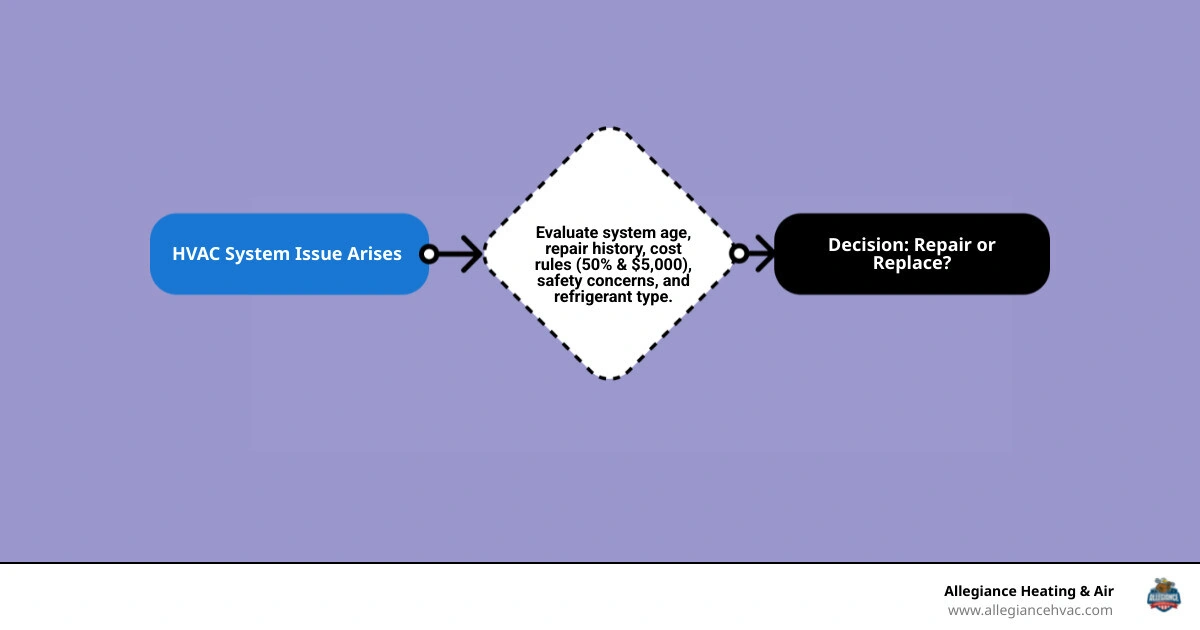
We know that choosing between a fix and a brand-new installation is a big financial move. To take the guesswork out of it, we often recommend using two industry-standard "litmus tests."
The $5,000 Rule
This is a simple math problem: Multiply the age of your system by the repair estimate. If the total is more than $5,000, we generally recommend replacement. For example:
• A 12-year-old AC needing a repair: 12 x repair amount. If that result is over $5,000, you are likely throwing good money after bad.
• A 5-year-old unit with the same repair: 5 x repair amount. This will likely fall well under the $5,000 threshold, making a repair the smarter investment.
The 50% Rule
If a single repair costs 50% or more of what a brand-new unit would cost, replacement is almost always the better choice. It’s like putting a new engine in a car with 300,000 miles; even if the engine is new, the transmission, alternator, and suspension are still old and prone to failure.
Deciding When to Repair vs Replace Your HVAC System requires looking at the return on investment. A new system lowers your monthly overhead, whereas a repair only restores the status quo of an inefficient unit.
• 0-1 repairs in 3 years — System Health Status: Stable — Recommended Action: Repair
• 2 repairs in 2 years — System Health Status: Declining — Recommended Action: Monitor closely
• 3+ repairs in 3 years — System Health Status: Failing — Recommended Action: Replace
Warning Signs That Replacement is Necessary
Sometimes the signs are subtle, and other times they are impossible to ignore. If you find yourself calling us for "emergency" service multiple times a year, your system is no longer reliable. Frequent breakdowns are the most obvious red flag.
Other indicators include:
• Rising Utility Bills: If your usage hasn't changed but your bills are climbing, your system is working harder and longer to achieve the same results.
• Uneven Temperatures: Are some rooms in your Jeffersonville home freezing while others stay warm? This suggests the system can no longer move air effectively.
• Unusual Noises and Dust: Grinding, squealing, or banging sounds often point to major mechanical failure. Similarly, excessive dust can mean your ductwork or filtration system is failing.
For a deeper dive into these red flags, read our article on Signs Your HVAC Needs Replacing Not Just Fixing.
Are there safety issues that require immediate replacement?
Safety is where we draw a hard line. If a furnace has a cracked heat exchanger, it can leak carbon monoxide (CO) into your home. CO is a "silent killer"—colorless and odorless. If we detect a cracked heat exchanger, we must shut the unit down for your protection. In these cases, Furnace Replacement is Necessary because the risk to your family is too high to ignore. Aging electrical components can also become fire hazards as insulation brittles and connections loosen over decades of heat cycles.
The impact of outdated refrigerants
If your air conditioner was installed before 2010, it likely uses R-22 refrigerant (often called Freon). The EPA has phased this out because it harms the ozone layer. By 2026, R-22 is extremely scarce and incredibly expensive to replace. If an R-22 system develops a major leak, the "recharge" alone can be a massive expense. This is often the point where we tell homeowners it is Time to Replace Old AC units rather than continuing to patch a sinking ship.
Benefits of Upgrading to a Modern System
While the initial transition to a new system is a significant step, the benefits start on day one. Modern systems are lightyears ahead in terms of energy efficiency.
• SEER2 Ratings: Current cooling standards (SEER2) ensure that new units use significantly less electricity. Upgrading from an old 10 SEER unit to a 16 or 20 SEER2 model can cut your cooling costs by 20% to 40%.
• AFUE Standards: Modern furnaces reach up to 98% efficiency, meaning almost none of the fuel you pay for is wasted.
• Smart Technology: Today's systems integrate with smart thermostats and home automation, allowing you to manage your comfort from your phone in Clarksville or Sellersburg.
Our Heating System Replacement Guide 2025 highlights how these advancements translate to real-world comfort. Furthermore, federal tax credits and local utility rebates can often offset a portion of the investment, making the upgrade more accessible.
How to Decide Between HVAC Repair and Replacement for Better Comfort
Comfort isn't just about the temperature on the thermostat; it's about how the air feels. Modern systems offer:
• Humidity Control: Newer units are much better at pulling moisture out of the air during muggy Indiana summers.
• Variable-Speed Motors: Instead of being "all on" or "all off," these motors ramp up and down slowly, providing a steady stream of air and eliminating hot or cold spots.
• Zoning Systems: You can finally heat or cool the upstairs and downstairs independently.
If you are tired of a "sticky" house or noisy fans, our Heating System Replacement Guide explains how new equipment solves these chronic comfort issues. Plus, a new system comes with a fresh manufacturer’s warranty—usually 10 years—giving you total peace of mind.
Frequently Asked Questions
How to decide between hvac repair and replacement if my system is 12 years old?
At 12 years, you are in the "decision zone." We look at three things: repair frequency, the efficiency gap, and the type of refrigerant. If the system has been reliable and the repair is minor (like a capacitor), we usually suggest repairing it. However, if this is the third repair in two years or if it’s an R-22 system with a leak, replacement is likely the smarter long-term financial move.
When should I consult a professional HVAC technician for an evaluation?
You should call us if you notice any "new" symptoms: unusual smells (burning or sulfur), new noises, or a sudden spike in your utility bill. We also recommend a professional evaluation if your system is over 10 years old and you are planning a major home renovation. It’s always better to evaluate the system during a mild spring or fall day than during a mid-summer breakdown.
What maintenance practices can extend the life of my current system?
The single best thing you can do is change your air filters every 1 to 3 months. A clogged filter forces the motor to work harder, leading to premature failure. We also recommend keeping your outdoor unit clear of weeds, grass clippings, and debris. Finally, scheduling professional annual tune-ups allows us to catch small issues—like a failing contactor or a dirty coil—before they turn into expensive "replace vs. repair" dilemmas.
Conclusion
Deciding how to decide between hvac repair and replacement doesn't have to be a stressful guessing game. By weighing the age of your system, the cost of repairs, and the potential for energy savings, you can make a choice that fits your budget and your family's needs.
At Allegiance Heating & Air, we’ve been "Taking Home Comfort Under Our Wing" since 2005. Whether you are in Greenville, Louisville, or Corydon, our family-owned team is here to provide honest evaluations and expert service. We don't just want to sell you a unit; we want to ensure you have reliable, year-round comfort for years to come.
Ready for a professional opinion on your system? Schedule your Greenville HVAC service with our trusted technicians today.
Contact Us Or Schedule Expert Service
Other Blogs
ready to transform your home?
Discover our exceptional home services tailored to meet your needs and enhance your living space.
WHAT OUR CLIENTS HAVE TO SAY ABOUT US

We had a complete HVAC system and a hot water heater installed. The guys were professional, well mannered, and completed the work in a timely manner. Would definitely use them again.
I was nervous at first because my AC broke in the middle of 80 degree weather which is strange for April, but Allegiance Heating and Air was incredibly prompt and professional. The technician arrived within an hour, explained the problem clearly, and completed the repair. The technician , Mr. Garrett Moon was a very nice and courteous young man. He found the problem and fixed it within a timely manner. I highly recommend them for any heating or cooling needs. I’ll definitely give them a call again should I ever have another issue, but hopefully not. Knock on wood 😁. Give them a call… you won’t be disappointed!
From the moment I called to schedule a service, the team was quick to respond and arrived right on time. The technician was professional, friendly, and clearly knowledgeable about my heating system. He explained the repair options in plain language and completed the job efficiently. I appreciated the reliable service and the fact that the work was done the same day. I would definitely recommend Allegiance Heating and Air for any residential HVAC needs.
5/5 stars – I was very impressed with the efficient, affordable and timely service from Allegiance Heating and Air. The technician arrived on time, and performed the service quickly, no repairs needed at this time. Communication was clear and the whole experience felt hassle‑free. I would definitely recommend them for any residential HVAC needs.
Knowledgeable, experienced individual.
Explains Allegiance Heating and Air was incredibly reliable, professional and affordable. They arrived right on time, kept the work area clean and finished the furnace repair quickly. The technician explained everything clearly and the price was a great value. If happiness had a location on Google Maps, it would be here.
Gilbert had to go above and beyond because York is no longer making the part for my furnace. But he was able to find a way to construct a housing bracket for my furnace. Ingenuity, determination and integrity is what finally got my furnace fixed. Gilbert is truly a one of a kind technician.
Thank you for always going the extra mile. Gilbert is always respectful and helpful with any concerns.
"Great service, most knowledgeable and capable HVAC business in Kentuckiana!! Pete Flemming and Bryan the owner, are HVAC encyclopedias. They have the highest integrity of any HVAC business I have ever used. Allegiance has put numerous units in for me over the last 17 years. I will continue to use and trust them."
"Fast response from Allegiance when our heat was out on New Year’s day! Service technician was friendly and efficient. He took the time to explain the problem, tell us about the temporary fix and the plan for permanent repair. We were impressed!"
"Love Allegiance! Their technicians, in particular Benjamin, explain everything. Fast and thorough. A/C was out on a Sunday. Called Allegiance and within a few hours Benjamin arrived. Such a comfort as he was the one who last serviced our units. He quickly replaced part and cooling is restored!"
"My heat pump went out and I had to call after hours. The technician (Garrett) was outstanding and thorough. He got my system up and working until Monday and gave me several options of units. Also took the time to explain the issue to my Home warranty company. I highly recommend this company."
"Right on time :) respectful, fast, and polite. Even gave my fur babies some attention."
"Had Garrett out today to fix our AC. Fantastic tech. He showed up exactly when he said he would and kept us informed of what he was checking and what he found. Highly recommend!"
"Lucas with Allegiance showed up on time as promised, was professional and extremely patient and responsive with all my questions. He took care of the issue, and I feel he was trustworthy! He had us back to cool and comfortable on one of the hottest days of the year."
"Lucas did a great job! Very professional and expedient. Explained the process very well and represented Allegiance as a truly professional and reputable company."
"Arrived on time and work diligently to fix issue. These guy are great. Worked quickly to resolve my issues."
"Lucas was great - he spent a lot of time trying to figure out what was going on and explained everything he was doing. I trust Allegiance and wouldn’t want anyone else working on/in my house!!"

RELATED ARTICLES
The Golden Years: When Your HVAC Is Officially Too Old
Everything You Get Inside a Typical HVAC Service Plan