



Is a High SEER Rating Worth It? A Homeowner's Quick Comparison
A high SEER vs standard SEER AC comparison comes down to one core question: how much efficiency do you actually need for your home? The short answer is that higher SEER ratings use less electricity to deliver the same cooling — and in a place like Greenville, IN, where summer humidity and heat push your AC to work hard for months at a time, that difference shows up on your utility bill.
Here's a quick breakdown of what separates standard and high-efficiency units:
• 13.4 SEER2 — Efficiency Level: Minimum (North) — Best For: Tight budgets, mild climates
• 14.3 SEER2 — Efficiency Level: Minimum (South/Midwest) — Best For: Basic replacement needs
• 16 SEER2 — Efficiency Level: Mid-range / "Sweet spot" — Best For: Most Indiana homeowners
• 18 SEER2 — Efficiency Level: High efficiency — Best For: Long cooling seasons, comfort focus
• 20+ SEER2 — Efficiency Level: Ultra-efficient — Best For: Maximum savings, hot/humid climates
Key facts at a glance:
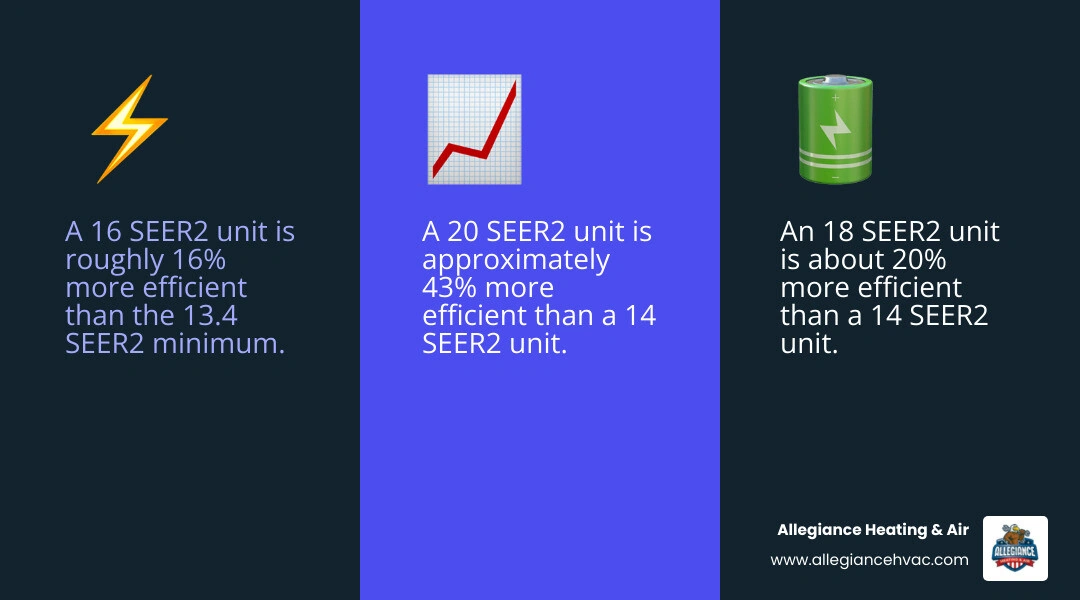
• A 16 SEER2 unit is roughly 16% more efficient than the 13.4 SEER2 minimum
• An 18 SEER2 unit is about 20% more efficient than a 14 SEER2 unit
• A 20 SEER2 unit is approximately 43% more efficient than a 14 SEER2 unit
• Higher SEER units typically include variable-speed compressors, better humidity control, and quieter operation — not just energy savings
• For the 2025 federal tax credit, split systems generally need to be at least 16 SEER2
Standard units (13–14 SEER2) are simpler, more affordable upfront, and get the job done. High-efficiency units (16 SEER2 and above) cost more initially but can meaningfully reduce monthly cooling costs, improve indoor comfort, and qualify for rebates and tax credits.
The right choice depends on how long you plan to stay in your home, how hot your summers get, and what you value — lower bills, quieter operation, or both. The sections below walk through each factor in detail.
Understanding SEER and SEER2 Standards in 2026
If you’ve looked at the side of an outdoor AC unit recently, you’ve likely seen a bright yellow "EnergyGuide" sticker. This sticker displays the SEER rating, which stands for Seasonal Energy Efficiency Ratio. Think of SEER like the "miles per gallon" (MPG) rating for your car. It measures how much cooling a system provides per watt-hour of electricity consumed over an entire cooling season.
However, as of April 2026, we are now operating under the SEER2 standard. This update, mandated by the Department of Energy (DOE), changed how manufacturers test equipment to better reflect "real-world" conditions. In the past, SEER testing didn't account for the resistance found in typical home ductwork (known as external static pressure). The new M1 testing procedure uses a much higher static pressure—0.5 inches of water column compared to the old 0.1 inches—to give you a more accurate expectation of performance.
Because the testing is harder, SEER2 numbers often look slightly lower than old SEER numbers, even if the unit is just as efficient. For example, a 16 SEER system under the old rules translates to roughly 15.2 SEER2 today. Understanding these energy efficiency standards for your HVAC is vital because it ensures the equipment we install in your home actually delivers the savings promised on the box.
High SEER vs Standard SEER AC Comparison: What Homeowners Need to Know
When we sit down with families in Greenville or Floyds Knobs to discuss a high SEER vs standard SEER AC comparison, we look at more than just the purchase price. We look at the "total cost of ownership."
A standard efficiency unit is essentially an "on or off" machine. It runs at 100% capacity until the thermostat is satisfied, then shuts down. A high-efficiency unit is much more sophisticated. These systems often use two-stage or variable-speed technology, allowing them to sip electricity rather than gulp it.
• Compressor Type — Standard SEER2 (13.4 - 14.3): Single-stage (On/Off) — High SEER2 (16 - 20+): Two-stage or Variable-speed
• Blower Motor — Standard SEER2 (13.4 - 14.3): Fixed speed — High SEER2 (16 - 20+): Variable-speed (ECM)
• Humidity Control — Standard SEER2 (13.4 - 14.3): Basic — High SEER2 (16 - 20+): Advanced (Longer run cycles)
• Noise Level — Standard SEER2 (13.4 - 14.3): Standard (72-76 dB) — High SEER2 (16 - 20+): Quiet (as low as 55-60 dB)
• Electricity Use — Standard SEER2 (13.4 - 14.3): Higher — High SEER2 (16 - 20+): 15% to 43% Lower
By choosing a high-efficiency model, you aren't just lowering your utility bills; you're also reducing your home's environmental impact. High-efficiency systems consume fewer natural resources and often utilize more eco-friendly refrigerants like R-32, helping to lower greenhouse gas emissions. You can find a deeper dive into these differences in our standard vs high efficiency HVAC comparison.
Efficiency Benchmarks in a High SEER vs Standard SEER AC Comparison
The Department of Energy has set regional minimums that we must follow. In Northern states (including Indiana), the absolute minimum is 13.4 SEER2. However, many homeowners in the Southern Indiana and Louisville area opt for the 14.3 SEER2 standard used in the South because our summers can be quite intense.
If you are looking for the "sweet spot," we often recommend 16 SEER2. This level typically qualifies for federal tax credits and offers a significant wattage reduction. For instance, a 16 SEER unit uses about 214 fewer watts per hour than a 14 SEER unit of the same size. If you want the absolute best air conditioning technology available, 20+ SEER2 ultra-efficient units are nearly 43% more efficient than the standard base models.
Comfort Factors in a High SEER vs Standard SEER AC Comparison
Efficiency is about the wallet, but comfort is about the "feel." This is where high SEER units really shine.
Standard units often create an "ice-box then sauna" effect. The AC blasts cold air until the room is chilly, turns off, and then the room gets humid and warm before the cycle repeats. High-efficiency units with variable-speed compressors avoid this. They can run at 30% or 50% capacity for longer periods.
These longer run cycles are a secret weapon against Indiana humidity. Because the air is moving across the cold cooling coils more consistently, the system removes twice as much moisture from the air as a standard unit. Additionally, because they don't constantly "kick on" at full blast, they are significantly quieter—some operate as a "whisper" compared to the loud hum of a standard condenser.
Maximizing Performance with Professional Installation
You could buy the most efficient 25 SEER2 unit on the market, but if it isn't installed correctly, it might perform like a 13 SEER2 unit. At Allegiance Heating & Air, we know that energy efficient AC installation is about the whole system, not just the box outside.
To get the rated efficiency, we ensure:
1. Manual J Sizing: We calculate the exact cooling load of your home based on square footage, insulation, and window placement. An oversized unit will "short-cycle," wasting energy and failing to remove humidity.
2. Matched Components: Your outdoor condenser must be matched with a compatible indoor evaporator coil and blower motor. If they aren't matched, you won't achieve the SEER2 rating on the label.
3. Ductwork Integrity: We check for leaky or undersized ducts. High-efficiency systems rely on proper airflow; if your ducts are restricted, the system has to work harder, negating your energy savings.
Incentives for High-Efficiency Upgrades
While high-efficiency systems represent a larger upfront investment, there are several ways to offset that cost. Thanks to the Inflation Reduction Act, homeowners can now claim federal tax credits for qualifying high-efficiency HVAC equipment.
• Federal Tax Credits: For 2025 and 2026, you may be eligible for a tax credit of up to $2,000 for qualified heat pumps or $600 for high-efficiency central AC units. Generally, these must be Energy Star certified (typically 16 SEER2 or higher for split systems).
• Utility Rebates: Many local utility providers in the Louisville and Southern Indiana area offer instant rebates or bill credits for upgrading to high-efficiency cooling.
• Manufacturer Incentives: During certain times of the year, manufacturers offer special financing or rebates that we can pass directly to you.
Our team stays up to date on all available HVAC services and incentives to ensure you get the maximum value from your upgrade.
Frequently Asked Questions About AC Efficiency
What is a good SEER2 rating for Indiana homes?
For most homes in Greenville, New Albany, and Clarksville, a 16 SEER2 rating is considered excellent. It strikes the best balance between a reasonable upfront cost and long-term energy savings, while also qualifying for most federal tax incentives.
Does a higher SEER2 rating mean a quieter unit?
Generally, yes. High SEER2 units use variable-speed fans and compressors that run at lower, quieter speeds most of the time. They also often include sound-dampening blankets around the compressor to further reduce noise.
Can I just replace the outdoor unit to get a higher rating?
Usually, no. To achieve a specific SEER2 rating, the indoor coil and the outdoor condenser must be a "matched set." If you hook a new high-efficiency condenser to an old, inefficient indoor coil, the system won't work correctly, and you could even damage the new compressor.
Conclusion
Choosing between a high-efficiency and standard unit is a big decision, but you don't have to make it alone. At Allegiance Heating & Air, we’ve been "Taking Home Comfort Under Our Wing" since 2005. As a family-owned business serving the Greenville, IN community and surrounding areas like Georgetown and Sellersburg, we pride ourselves on honest, transparent service.
Whether you are looking for the maximum energy savings of a 20 SEER2 system or a reliable standard replacement to keep your family cool, our licensed technicians are here to help. We focus on providing reliable, year-round comfort tailored to your specific home and budget.
Ready to see how much you could save? Get a customized efficiency solution for your home by contacting our team today. We look forward to serving you!
Contact Us Or Schedule Expert Service
Other Blogs
ready to transform your home?
Discover our exceptional home services tailored to meet your needs and enhance your living space.
WHAT OUR CLIENTS HAVE TO SAY ABOUT US

We had a complete HVAC system and a hot water heater installed. The guys were professional, well mannered, and completed the work in a timely manner. Would definitely use them again.
I was nervous at first because my AC broke in the middle of 80 degree weather which is strange for April, but Allegiance Heating and Air was incredibly prompt and professional. The technician arrived within an hour, explained the problem clearly, and completed the repair. The technician , Mr. Garrett Moon was a very nice and courteous young man. He found the problem and fixed it within a timely manner. I highly recommend them for any heating or cooling needs. I’ll definitely give them a call again should I ever have another issue, but hopefully not. Knock on wood 😁. Give them a call… you won’t be disappointed!
From the moment I called to schedule a service, the team was quick to respond and arrived right on time. The technician was professional, friendly, and clearly knowledgeable about my heating system. He explained the repair options in plain language and completed the job efficiently. I appreciated the reliable service and the fact that the work was done the same day. I would definitely recommend Allegiance Heating and Air for any residential HVAC needs.
5/5 stars – I was very impressed with the efficient, affordable and timely service from Allegiance Heating and Air. The technician arrived on time, and performed the service quickly, no repairs needed at this time. Communication was clear and the whole experience felt hassle‑free. I would definitely recommend them for any residential HVAC needs.
Knowledgeable, experienced individual.
Explains Allegiance Heating and Air was incredibly reliable, professional and affordable. They arrived right on time, kept the work area clean and finished the furnace repair quickly. The technician explained everything clearly and the price was a great value. If happiness had a location on Google Maps, it would be here.
Gilbert had to go above and beyond because York is no longer making the part for my furnace. But he was able to find a way to construct a housing bracket for my furnace. Ingenuity, determination and integrity is what finally got my furnace fixed. Gilbert is truly a one of a kind technician.
Thank you for always going the extra mile. Gilbert is always respectful and helpful with any concerns.
"Great service, most knowledgeable and capable HVAC business in Kentuckiana!! Pete Flemming and Bryan the owner, are HVAC encyclopedias. They have the highest integrity of any HVAC business I have ever used. Allegiance has put numerous units in for me over the last 17 years. I will continue to use and trust them."
"Fast response from Allegiance when our heat was out on New Year’s day! Service technician was friendly and efficient. He took the time to explain the problem, tell us about the temporary fix and the plan for permanent repair. We were impressed!"
"Love Allegiance! Their technicians, in particular Benjamin, explain everything. Fast and thorough. A/C was out on a Sunday. Called Allegiance and within a few hours Benjamin arrived. Such a comfort as he was the one who last serviced our units. He quickly replaced part and cooling is restored!"
"My heat pump went out and I had to call after hours. The technician (Garrett) was outstanding and thorough. He got my system up and working until Monday and gave me several options of units. Also took the time to explain the issue to my Home warranty company. I highly recommend this company."
"Right on time :) respectful, fast, and polite. Even gave my fur babies some attention."
"Had Garrett out today to fix our AC. Fantastic tech. He showed up exactly when he said he would and kept us informed of what he was checking and what he found. Highly recommend!"
"Lucas with Allegiance showed up on time as promised, was professional and extremely patient and responsive with all my questions. He took care of the issue, and I feel he was trustworthy! He had us back to cool and comfortable on one of the hottest days of the year."
"Lucas did a great job! Very professional and expedient. Explained the process very well and represented Allegiance as a truly professional and reputable company."
"Arrived on time and work diligently to fix issue. These guy are great. Worked quickly to resolve my issues."
"Lucas was great - he spent a lot of time trying to figure out what was going on and explained everything he was doing. I trust Allegiance and wouldn’t want anyone else working on/in my house!!"

RELATED ARTICLES
Breathe Easy: A Guide to Commercial Air Filtration and HVAC Solutions

Neglecting Your HVAC: A Fast Track to Expensive Repairs
