


The Late-Summer Threat Hiding in Plain Sight
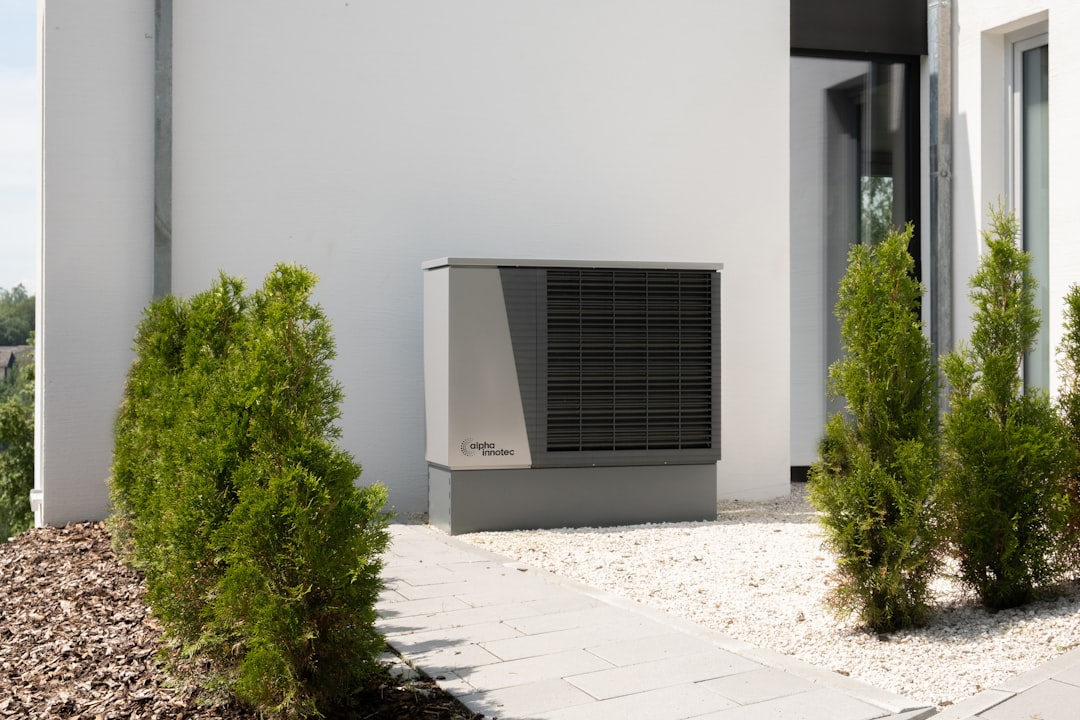
It is late summer, and the heat is relentless. Here at Allegiance Heating & Air, we notice a distinct pattern when homeowners call us about their air conditioners running non-stop, struggling to keep the house cool despite being set to the usual temperature. The overgrown bush problem: how August yard growth quietly chokes your AC's efficiency is a common issue that sneaks up on our customers. What started as a small, manageable shrub in May has likely exploded into a dense thicket by now, completely surrounding your outdoor condenser unit. When vegetation suffocates the compressor, your system is robbed of the airflow it desperately needs to function during the hottest weeks of the year.
If your system is already struggling, explore our air conditioning services or read our guide on preparing your AC for a humid Indiana summer to get back on track.
The Invisible Barrier Around Your Condenser
We often see homeowners overlook their outdoor landscaping late in the summer. By the time the back-to-school transition begins, yard work usually takes a backseat to other priorities. However, the August late-summer vegetation peak acts as a silent efficiency killer. Your outdoor air conditioning unit is not just a metal box; it is a vital breathing apparatus for your entire home cooling system. It requires a massive volume of unobstructed air to pull heat out of your house and disperse it into the atmosphere.
The progression of the problem:
• Spring planting: Shrubs and decorative grasses are planted near the unit to hide the equipment.
• Early summer growth: Mild weather and regular watering cause these plants to fill out, slowly encroaching on the equipment.
• Late-summer suffocation: By August, leaves, branches, and vines are pressing directly against the metal fins, completely blocking the intake of fresh air.
In our experience, connecting the overgrown landscaping directly to restricted airflow is critical. When the compressor is overworked, it draws more electricity to achieve the same amount of cooling. What was just a small obstruction in May becomes a complete blockade by late summer, drastically reducing the lifespan of your equipment.
How Midwest Spring Rain Leads to August AC Strain
Understanding why this specific problem peaks right now requires looking at our regional weather patterns. As local experts, we know that Greenville IN residential yards experience rapid vegetation growth fueled by heavy spring and early summer rainfall. The soil retains deep moisture, allowing decorative bushes, climbing vines, and tall grasses to grow at explosive rates. By the time late summer arrives, this lush landscaping becomes a significant liability for your home comfort system.
The Physics of Heat Dissipation
To grasp why a blocked unit is so problematic, you have to understand how air conditioning actually works. Your AC does not create cold air out of thin air. Instead, it acts as a heat transfer system. It absorbs the thermal energy from inside your living space, carries it outside via chemical refrigerant, and exhausts that heat into the outdoor air using the large fan inside the condenser cabinet.
The Anatomy of Heat Transfer Strain
• Restricted Intake — The Environmental Cause: Dense August foliage blocks the side panels of the condenser. — The System Impact: The system cannot pull in enough ambient air to cool the hot refrigerant coils.
• High Humidity — The Environmental Cause: The Ohio River Valley experiences thick, heavy moisture in the air. — The System Impact: Moisture-laden air holds more heat, requiring the system to work twice as hard to reject thermal energy.
• Trapped Exhaust — The Environmental Cause: Overhanging tree branches block the top exhaust fan. — The System Impact: Hot air is pushed out, hits the canopy, and gets sucked right back into the unit, causing severe overheating.
When you combine the high Midwest humidity in August with a physical barrier of overgrown plants, you create the perfect storm for AC strain. Choked airflow prevents efficient heat transfer. The system traps the heat it was supposed to reject, causing internal temperatures and pressures to spike. This forces your air conditioner to run longer, harder, and much less efficiently just to maintain a baseline level of comfort.
Spotting the Symptoms of a Suffocating Compressor
Because the outdoor unit is often out of sight, many homeowners do not realize their landscaping is causing a problem until the system starts acting up indoors. Diagnosing the issue early can save you from a complete system failure. In the field, our technicians look for several clear signs that your unit is struggling to breathe.
Key Warning Signs to Watch For
• Constant running or short-cycling: If your system runs continuously without ever reaching the desired indoor temperature on the thermostat, it is likely struggling to reject heat outdoors. Conversely, if it turns on and off rapidly (short-cycling), the internal safety switches might be tripping due to overheating.
• Unexplained energy bill spikes: Compare your late-summer utility bills to previous months or the same time last year. An overworked compressor draws significantly more amperage, which shows up directly on your monthly statement.
• Excessive heat and noise: Walk outside and stand near your condenser. If the metal cabinet feels excessively hot to the touch, or if the unit sounds much louder and more strained than normal, airflow restriction is highly probable.
• Weak airflow indoors: While blocked outdoor units primarily affect heat rejection, the resulting frozen evaporator coils can eventually lead to weak, warm air blowing from your indoor vents.
Many assume these issues are due to low refrigerant or a failing motor, but airflow restriction from Greenville IN residential yards is often the true culprit. Sometimes, a suffocating compressor pushes an already aging system over the edge. Just this summer, our team at Allegiance Heating & Air responded to a local homeowner whose older AC unit finally needed a complete replacement after years of overgrown brush suffocating the system. One of our technicians responded quickly, scheduled a same-day visit to provide options, and successfully installed a new unit that restored their comfort and efficiency. (Note: Generic federal tax credits may apply to qualifying heat pump or high-efficiency AC installations, helping offset costs). If you are noticing persistent issues, securing comprehensive HVAC care is the safest next step.
The Golden Rule of Landscaping: Establishing Your Clear Zone
Resolving this issue does not require specialized mechanical skills, but it does require a proactive approach to your yard work. Delivering actionable, safe landscaping around your condenser is the best way to protect your investment. The goal is to create a buffer that allows the system to breathe freely without compromising the aesthetic appeal of your home.
Steps to Secure Your System's Airflow
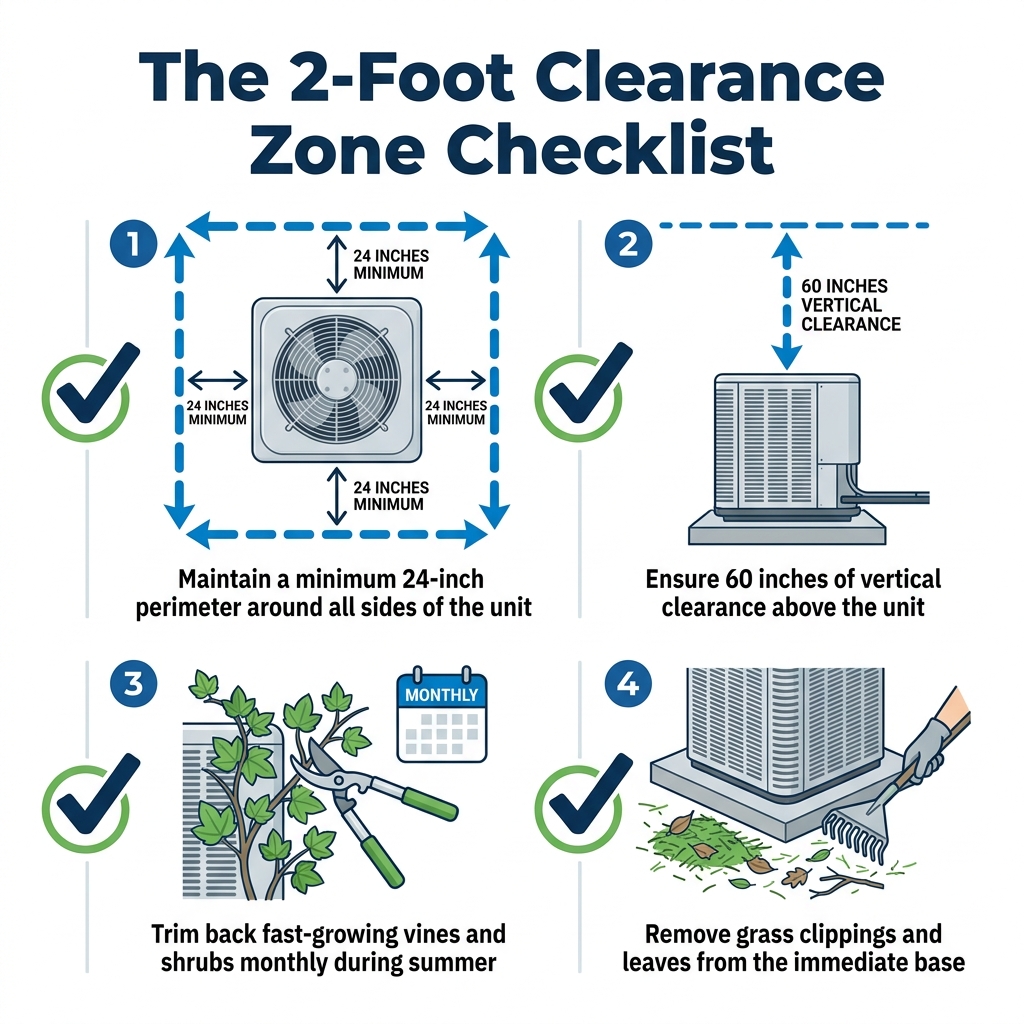
1. Measure your perimeter: The absolute mandatory spacing required for proper heat dissipation is a 2-foot clearance zone on all sides of the condenser unit. Use a tape measure to ensure no branches, leaves, or tall grasses cross this invisible boundary.
2. Trim safely and frequently: Use hand shears or hedge trimmers to cut back bushes and vines. Always turn off the power to the AC unit at the thermostat and the outdoor disconnect box before trimming to prevent debris from being sucked into the fan while you work.
3. Clear the overhead airspace: The fan on top of the unit blows hot air straight up. Ensure there is at least 60 inches (5 feet) of vertical clearance above the unit. Trim back low-hanging tree branches or large ferns that might trap exhausted heat.
4. Rake the foundation: Remove dead leaves, grass clippings, and mulch from the immediate base of the concrete pad. These lightweight materials are easily pulled against the intake fins by the powerful suction of the fan.
5. Plan for future planting: If you are redesigning your garden, choose drought-resistant, slow-growing shrubs. Plant them at least three to four feet away from the unit to account for their mature size, ensuring they never breach the 2-foot clearance zone.
Never attempt to open the metal cabinet or perform DIY mechanical work on the internal components. Stick to clearing the external perimeter and leave the mechanical diagnostics to trained professionals like our crew.

When Overgrown Bushes Trigger End-of-Season Breakdowns
The danger of overgrown landscaping goes far beyond a temporary dip in comfort. There is a severe compounding effect that occurs when mechanical fatigue meets restricted airflow. By the time August arrives, your air conditioner has already been running hard for months. The internal components—such as the contactors, capacitors, and the compressor itself—are experiencing natural end-of-season wear.
The Breaking Point of a Fatigued System
Adding restricted airflow to a fatigued system pushes the compressor to its absolute breaking point. The compressor is the heart of your cooling system, responsible for pumping pressurized refrigerant through the lines. When the August late-summer vegetation peak chokes off the cooling air, the compressor's internal temperature skyrockets. Continuous overheating degrades the lubricating oils inside the compressor, causing metal-to-metal friction.
This friction can quickly lead to premature compressor failure, which is one of the most extensive and disruptive repairs a homeowner can face. When an overworked system finally gives out, it rarely happens at a convenient time. For instance, our dispatchers recently took a call from a local customer who experienced a complete failure when their air-conditioning broke on a sweltering 89° day. Fortunately, our technician arrived at the house within a couple of hours and successfully repaired the AC, but proactive landscaping could have prevented the emergency entirely.
Addressing the overgrown brush around your unit is urgent. We strongly recommend clearing the perimeter before the hottest late-summer weeks hit to protect your equipment. If your system is already showing signs of severe fatigue, our service area throughout Kentuckiana ensures that professional help from Allegiance Heating & Air is never far away.
Beyond Trimming: Addressing Debris Inside the Unit
Clearing the outer perimeter of your landscaping is an essential first step, but we often find it is only half the battle. If your bushes have been pressing against the unit for weeks, leaves, twigs, pollen, and dirt have likely already been sucked through the metal grilles. This transitions the problem from an external landscaping issue that you can handle, to an internal maintenance issue that requires professional attention.
The Danger of Internal Blockages
The Problem: Micro-debris bypasses the outer metal louvers and gets lodged directly into the delicate aluminum condenser fins. The Cause: The powerful suction of the exhaust fan pulls lightweight organic material deep into the cabinet. Over time, this debris decays and forms a thick, insulating blanket of dirt over the coils. The Solution: The coils must be thoroughly washed and chemically cleaned to restore proper heat transfer.
It is incredibly important that homeowners do not attempt to clean these internal coils themselves using high-pressure washers. The aluminum fins that surround your unit are thinner than a credit card. We've seen too many instances where a blast from a pressure washer or a heavy garden hose nozzle has bent the fins flat, permanently blocking airflow and ruining the equipment.
This is where professional intervention becomes necessary. As part of Allegiance Heating & Air's maintenance plans, our technicians safely dismantle the outer cabinet, remove the debris safely, and use specialized, low-pressure chemical cleaners to dissolve the insulating dirt. This proactive approach is the perfect safety net for busy homeowners who might overlook these silent efficiency killers until it is too late. Scheduling a routine AC maintenance plan ensures that even if the 2-foot clearance zone was breached during the summer, your system is fully restored and protected.
Frequently Asked Questions
How much clearance does an outdoor AC unit need?
We recommend a minimum of 24 inches of clear space on all four sides to operate efficiently. Additionally, it needs at least 60 inches of unobstructed vertical clearance above the exhaust fan. Maintaining this clearance ensures the system can pull in enough fresh air to cool the internal coils and safely exhaust the absorbed heat away from your home.
Can plants around my air conditioner cause it to break down?
Yes, overgrown plants can absolutely cause an air conditioner to break down. When bushes and vines block the intake panels, the compressor is forced to work much harder to reject heat, leading to severe internal overheating. Over time, this continuous strain degrades the system's components and frequently results in premature compressor failure.
Why is my AC struggling to cool in late summer?
Late summer cooling struggles are often the result of compounded seasonal wear and restricted airflow from peak vegetation growth. By August, your system has been running for months, and overgrown landscaping can easily suffocate the outdoor unit. This combination of mechanical fatigue and trapped heat drastically reduces the system's cooling capacity.
How do you hide an AC unit without blocking airflow?
You can hide an AC unit by using decorative privacy screens, lattice fencing, or slow-growing, drought-resistant shrubs. The critical rule is to place any barrier or plant at least three feet away from the unit to account for future growth. Ensure that whatever method you choose allows wind to pass through freely and does not create a solid wall that traps hot exhaust.
What happens if leaves and twigs get inside the condenser unit?
When leaves and twigs get inside the condenser unit, they decay and form an insulating layer of dirt over the delicate aluminum coils. This trapped debris prevents the refrigerant from releasing heat into the outside air, causing your energy bills to rise and the system to overheat. Removing internal debris requires professional cleaning to avoid bending the fragile fins.
Establishing a clear perimeter around your outdoor unit is one of the easiest ways to protect your home comfort during the late-summer heat. By keeping vegetation at bay and relying on our professional maintenance team to clean out internal debris, you ensure your system runs smoothly when you need it most. Schedule your tune-up with Allegiance Heating & Air today to catch any lingering issues before the season ends.
Contact Us Or Schedule Expert Service
Other Blogs
ready to transform your home?
Discover our exceptional home services tailored to meet your needs and enhance your living space.
WHAT OUR CLIENTS HAVE TO SAY ABOUT US

We had a complete HVAC system and a hot water heater installed. The guys were professional, well mannered, and completed the work in a timely manner. Would definitely use them again.
I was nervous at first because my AC broke in the middle of 80 degree weather which is strange for April, but Allegiance Heating and Air was incredibly prompt and professional. The technician arrived within an hour, explained the problem clearly, and completed the repair. The technician , Mr. Garrett Moon was a very nice and courteous young man. He found the problem and fixed it within a timely manner. I highly recommend them for any heating or cooling needs. I’ll definitely give them a call again should I ever have another issue, but hopefully not. Knock on wood 😁. Give them a call… you won’t be disappointed!
From the moment I called to schedule a service, the team was quick to respond and arrived right on time. The technician was professional, friendly, and clearly knowledgeable about my heating system. He explained the repair options in plain language and completed the job efficiently. I appreciated the reliable service and the fact that the work was done the same day. I would definitely recommend Allegiance Heating and Air for any residential HVAC needs.
5/5 stars – I was very impressed with the efficient, affordable and timely service from Allegiance Heating and Air. The technician arrived on time, and performed the service quickly, no repairs needed at this time. Communication was clear and the whole experience felt hassle‑free. I would definitely recommend them for any residential HVAC needs.
Knowledgeable, experienced individual.
Explains Allegiance Heating and Air was incredibly reliable, professional and affordable. They arrived right on time, kept the work area clean and finished the furnace repair quickly. The technician explained everything clearly and the price was a great value. If happiness had a location on Google Maps, it would be here.
Gilbert had to go above and beyond because York is no longer making the part for my furnace. But he was able to find a way to construct a housing bracket for my furnace. Ingenuity, determination and integrity is what finally got my furnace fixed. Gilbert is truly a one of a kind technician.
Thank you for always going the extra mile. Gilbert is always respectful and helpful with any concerns.
"Great service, most knowledgeable and capable HVAC business in Kentuckiana!! Pete Flemming and Bryan the owner, are HVAC encyclopedias. They have the highest integrity of any HVAC business I have ever used. Allegiance has put numerous units in for me over the last 17 years. I will continue to use and trust them."
"Fast response from Allegiance when our heat was out on New Year’s day! Service technician was friendly and efficient. He took the time to explain the problem, tell us about the temporary fix and the plan for permanent repair. We were impressed!"
"Love Allegiance! Their technicians, in particular Benjamin, explain everything. Fast and thorough. A/C was out on a Sunday. Called Allegiance and within a few hours Benjamin arrived. Such a comfort as he was the one who last serviced our units. He quickly replaced part and cooling is restored!"
"My heat pump went out and I had to call after hours. The technician (Garrett) was outstanding and thorough. He got my system up and working until Monday and gave me several options of units. Also took the time to explain the issue to my Home warranty company. I highly recommend this company."
"Right on time :) respectful, fast, and polite. Even gave my fur babies some attention."
"Had Garrett out today to fix our AC. Fantastic tech. He showed up exactly when he said he would and kept us informed of what he was checking and what he found. Highly recommend!"
"Lucas with Allegiance showed up on time as promised, was professional and extremely patient and responsive with all my questions. He took care of the issue, and I feel he was trustworthy! He had us back to cool and comfortable on one of the hottest days of the year."
"Lucas did a great job! Very professional and expedient. Explained the process very well and represented Allegiance as a truly professional and reputable company."
"Arrived on time and work diligently to fix issue. These guy are great. Worked quickly to resolve my issues."
"Lucas was great - he spent a lot of time trying to figure out what was going on and explained everything he was doing. I trust Allegiance and wouldn’t want anyone else working on/in my house!!"

RELATED ARTICLES
High Efficiency HVAC Pros and Cons for Savvy Homeowners

Borden's Best Kept Secret: Top Furnace Repair Services Near You
