The 15-Year-Old AC Dilemma: Why Patching Freon Leaks in July is a Losing Financial Battle
Topping off a struggling AC with obsolete R-22 refrigerant might seem like a quick fix during a heatwave. Here is the financial reality of masking a leak versus upgrading to a modern cooling system.
The Mid-Summer Mirage: Why a Quick Freon Patch Isn't the Fix You Think It Is
Topping off a struggling air conditioner with refrigerant is widely considered a cheap, straightforward fix, but if you are currently navigating the 15-year-old AC dilemma: why patching Freon leaks in July is a losing financial battle is a harsh reality you need to understand. In our years of providing cooling solutions across the local area, we frequently see homeowners who don't realize that a closed-loop cooling system is never supposed to consume refrigerant. When your vents start blowing warm air and a technician suggests a quick recharge, you are not just buying a fluid; you are temporarily masking a physical hole in your equipment. Addressing a system failure during peak cooling demand is intensely frustrating, and the instinct is always to restore comfort as quickly and cheaply as possible. However, choosing to patch an obsolete unit during a mid-summer July heatwave often traps you in a cycle of recurring breakdowns and escalating expenses. Before you sink another dollar into a deteriorating system, evaluating your options with experts in professional HVAC services is the smartest way to protect your wallet. The decision you make today should be weighed objectively, contrasting the exorbitant, guaranteed future costs of obsolete refrigerant against the long-term return on investment of a modern, efficient cooling system. Here is the thing: a temporary patch is a mirage that leaves you vulnerable to another failure just when you need your air conditioner the most.
The Mathematical Certainty of R-22 Obsolescence
Understanding the actual value of your aging cooling equipment requires looking closely at the economics of the refrigerant it uses. If you are operating a 15-year-old R-22 AC unit, your system relies on a chemical compound that is effectively extinct in the modern manufacturing world. On January 1, 2020, the Environmental Protection Agency (EPA) officially banned the production and import of R-22 refrigerant in the United States due to its severe ozone-depleting properties. This regulatory shift transformed a once-common maintenance supply into a highly restricted, finite commodity.
The Supply and Demand Trap: Because no new R-22 is entering the market, our team has seen firsthand how the HVAC industry relies entirely on stockpiled reserves and reclaimed refrigerant. The mathematical certainty here is simple: as the available supply continues to dwindle every single year, the price per pound of R-22 mathematically guarantees continuously escalating costs for any future top-offs.
The Reality of Closed-Loop Systems: Air conditioners do not burn refrigerant like a car burns gas. If your 15-year-old R-22 AC unit is low on Freon, it has a leak. Pumping an expensive, obsolete chemical into a leaking system is financially identical to pouring premium gasoline into a car with a cracked fuel tank.
The Compound Effect of Aging Components: An aging system that has developed one leak is highly likely to develop further leaks. The metal components that hold the pressurized refrigerant have degraded over a decade and a half. Fixing one pinhole leak today does absolutely nothing to prevent a second, third, or fourth leak from opening up along the same weakened coil next month. Investing heavily in obsolete refrigerant yields zero return on investment for your home's infrastructure. It does not lower your utility bills, it does not improve your indoor air quality, and it certainly does not add value to your property.
How High Humidity Accelerates the Decline of an Aging Compressor
Residential cooling systems reach their absolute peak thermal load during the hottest months of the year, forcing continuous, grueling operation. A system that might limp along during a mild spring will quickly expose its fatal flaws when the weather turns severe.
The Problem: The Dual Role of Your Air Conditioner
Your air conditioner performs two distinct jobs simultaneously: it lowers the sensible heat (the temperature you read on the thermostat) and it removes latent heat (the moisture suspended in your indoor air). In regions dealing with Kentuckiana's hot, humid July weather, the air conditioner acts as a primary dehumidifier. This heavy moisture extraction adds massive latent heat load to the equipment. The compressor has to work exponentially harder to wring the water out of the air before it can even begin to effectively drop the room temperature.
The Cause: Environmental Stress on Compromised Equipment
When you apply a temporary patch to a mid-summer July refrigerant leak, you are sending a compromised, weakened compressor back into the most hostile working conditions of the year. Low refrigerant levels prior to the patch likely caused the compressor to overheat, stressing its internal electrical windings and mechanical valves. Now, operating with a patched coil and facing extreme humidity, that aging compressor is forced to run non-stop to keep up with the thermal load. The system is no longer operating within its original design specifications; it is merely surviving on borrowed time.
The Solution: Eliminating the Cycle of Failure
One pattern we see often during our peak summer service calls across the local area is that a patched system operating under this relentless environmental stress is highly likely to fail again before the cooling season even ends. The sheer volume of moisture and heat that must be moved out of the home overwhelms the aging components. Modern systems are engineered with advanced scroll compressors and larger coil surface areas specifically designed to handle massive latent heat loads efficiently, removing the humidity without straining the mechanical core of the unit.
The Sunk-Cost Fallacy: Patching an Evaporator Coil on Borrowed Time
When faced with a sudden breakdown, our technicians frequently see homeowners fall victim to a well-documented behavioral economics trap known as the sunk-cost fallacy. In the context of residential HVAC maintenance, the sunk-cost fallacy occurs when you continue to pour money into a failing system simply because you have already invested heavily in past repairs. You might think, "I just spent money fixing the blower motor last year, so I have to fix this leak now to make that previous investment worth it." This mindset leads to devastating financial outcomes when dealing with an aging 15-year-old R-22 AC unit.
Refrigerant leaks in older systems are rarely isolated incidents caused by a random puncture. Instead, they are the primary symptom of systemic degradation and formicary corrosion. Formicary corrosion looks like tiny, microscopic tunnels eating through the copper tubing of your evaporator coil, caused by years of exposure to volatile organic compounds (VOCs) naturally present in household air.
• Systemic Degradation: A leak means the walls of the copper tubing have thinned out entirely. Where there is one microscopic hole, there are thousands of weakened spots right next to it.
• The Ineffectiveness of Patches: Applying a sealant or brazing a specific hole does not reverse the existing corrosion across the rest of the coil. It is a hyper-localized fix for a systemic disease.
• Guaranteed Future Failures: Because the underlying chemical corrosion remains, future leaks are a near certainty. The pressure of the refrigerant will simply find the next weakest point in the degraded metal.
Evaluating the repair objectively means looking at the future, not the past. The money spent on previous repairs is gone and cannot be recovered. Throwing good money after bad by repeatedly patching an irreparably corroded coil only delays the inevitable replacement while draining your savings.
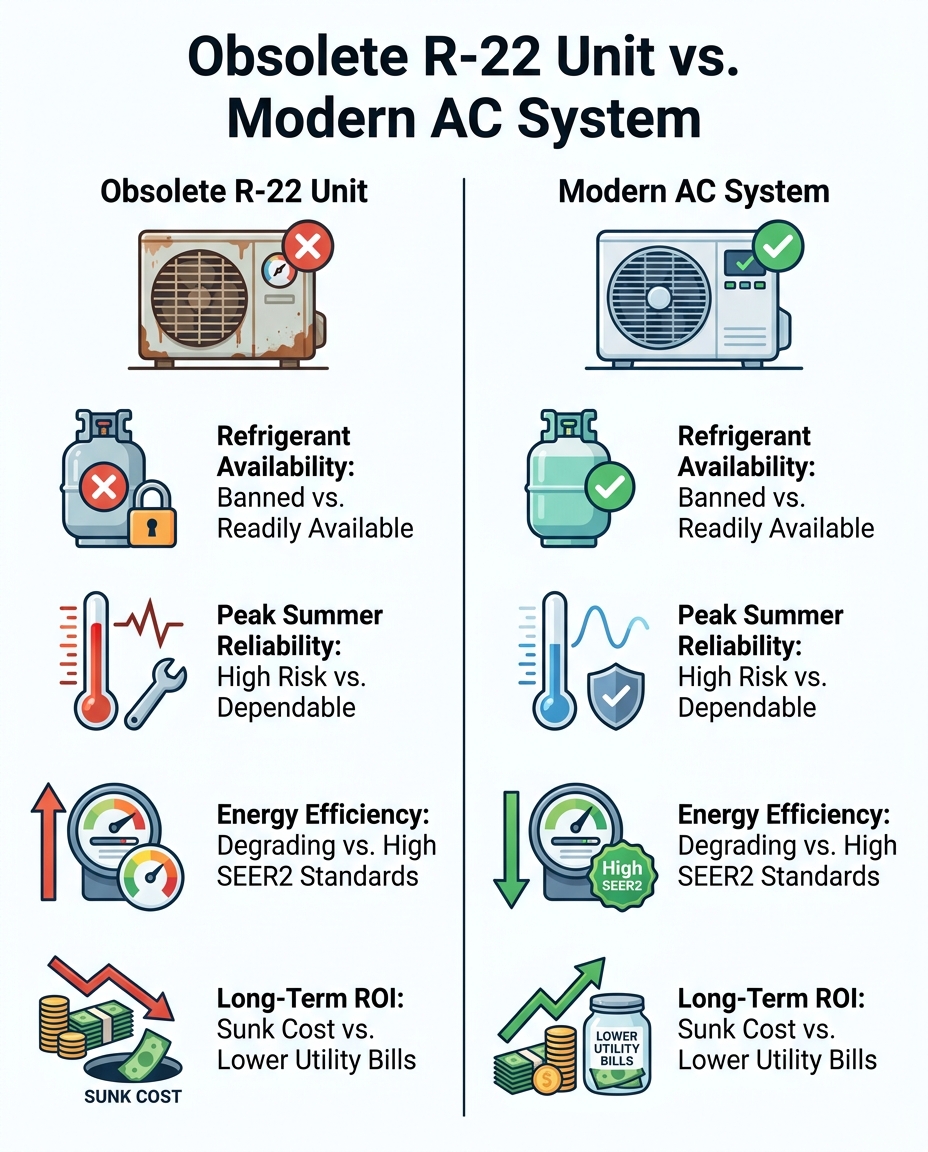
Obsolete R-22 Unit vs. Modern AC System: A Side-by-Side Reality Check
To make an informed financial decision, you must strip away the emotion of a hot house and look at the raw data. Comparing your patched 15-year-old R-22 AC unit directly against a modern replacement across key performance and financial metrics clarifies exactly what you are paying for when you choose to maintain obsolete equipment.
• Refrigerant Availability — 15-Year-Old Patched R-22 Unit: Banned from production (2020); relies on finite, highly expensive reclaimed supply. — Modern High-Efficiency AC System: Uses accessible, environmentally compliant modern refrigerants.
• Peak Summer Reliability — 15-Year-Old Patched R-22 Unit: High risk of recurring mid-summer failure due to compounding component stress. — Modern High-Efficiency AC System: Dependable, consistent operation backed by comprehensive manufacturer warranties.
• Energy Efficiency — 15-Year-Old Patched R-22 Unit: Severely degraded SEER performance; costs significantly more to operate monthly. — Modern High-Efficiency AC System: Meets or exceeds modern high-efficiency SEER2 standards, optimizing power usage.
• Long-Term ROI — 15-Year-Old Patched R-22 Unit: Sunk costs with zero addition to home value; guaranteed future repair expenses. — Modern High-Efficiency AC System: Lower monthly utility bills, reduced maintenance costs, and increased property appeal.
As the table illustrates, the perceived savings of a quick patch evaporate when you factor in the high cost of obsolete refrigerant, the inflated monthly energy bills of a degraded unit, and the looming threat of the next breakdown.
Shifting from Panic Repairs to Long-Term ROI
Making a major mechanical decision when your home is sweltering is inherently stressful. The psychological pressure of a mid-summer July breakdown often pushes homeowners into panic repairs. When the thermostat reads 85 degrees inside your living room, the immediate desire is simply to stop the discomfort. However, shifting your perspective from merely "surviving the summer" to actively "investing in your home's future efficiency" changes the entire financial equation.
Modernizing your HVAC system eliminates the deep anxiety of unpredictable breakdowns and the continuously escalating costs associated with obsolete refrigerants. Instead of waiting for the next component to fail, you take control of your home's comfort and energy footprint. A new system operates quietly, removes humidity effectively, and significantly reduces the monthly draw on your electrical panel.
As a dedicated local business, our approach focuses on providing transparent, honest financial guidance focused on long-term homeowner ROI rather than pushing for a quick, recurring patch job. We want you to understand the exact mechanics of what is failing and why, so you can make a choice that serves your household for the next decade, not just the next two weeks. Reiterating the importance of objective financial evaluation over high-pressure sales tactics is how we ensure you never feel trapped by a failing system. If you are struggling to weigh the immediate costs against the long-term benefits, reviewing a comprehensive HVAC repair vs replacement cost guide can provide the exact framework you need to calculate your true return on investment.
Frequently Asked Questions About Aging AC Units and Refrigerant Leaks
Is it worth fixing a 15-year-old AC?
The short answer is generally no, especially if the repair involves the sealed refrigerant system. At 15 years old, the equipment has outlived its expected mechanical lifespan and operates on outdated efficiency standards. The high cost of obsolete refrigerant combined with the strong likelihood of subsequent component failures makes major repairs a poor financial investment.
Why is R-22 refrigerant obsolete?
The EPA phased out R-22 due to its severe ozone-depleting properties, officially ceasing all production and import in the United States as of January 1, 2020. Because no new supply is being manufactured, the industry relies entirely on a dwindling stock of reclaimed refrigerant. This finite supply is what drives the cost of a simple recharge to exorbitant levels.
Does a Freon leak mean I need a new AC?
If you notice a leak on a newer system still under warranty, a repair might make perfect sense. However, on a 15-year-old R-22 AC unit, a leak usually indicates severe, widespread coil corrosion that cannot be permanently patched. In these older systems, replacing the entire unit is almost always the financially sound choice to avoid recurring repair bills.
How long does an AC last after a Freon leak?
If a technician patches a leak and recharges an older system, the fix may hold temporarily for a few weeks or months. Unfortunately, the underlying chemical corrosion that caused the first leak remains active inside the copper tubing. This systemic degradation often leads to new leaks opening up within the exact same cooling season, completely neutralizing the value of the initial repair.
Will a new AC system perform better in high humidity than my old unit?
Yes, modern air conditioning systems are vastly superior at managing indoor moisture. Today's equipment is built with higher SEER2 ratings, larger evaporator coils, and advanced compressor technology that is significantly more efficient at latent heat removal. This means a new system will dehumidify your home much faster and more consistently than an older, degrading unit ever could.
Make the Smart Financial Call for Your Home's Comfort
Patching an obsolete system during peak heat is ultimately a losing financial battle that drains your wallet without adding any permanent value to your property. The exorbitant cost of R-22, combined with the near certainty of future leaks on a degraded coil, makes a mid-summer July patch a classic sunk-cost trap. By choosing to step off the treadmill of recurring repairs, you secure long-term reliability, superior warranty protection, and vastly improved daily comfort. Do not let the panic of a breakdown force you into a poor investment. Take control of your home's infrastructure and contact our team today for a professional, transparent evaluation of your replacement options, backed by our years of local industry experience.
Contact Us Or Schedule Expert Service
Other Blogs
ready to transform your home?
Discover our exceptional home services tailored to meet your needs and enhance your living space.
WHAT OUR CLIENTS HAVE TO SAY ABOUT US

We had a complete HVAC system and a hot water heater installed. The guys were professional, well mannered, and completed the work in a timely manner. Would definitely use them again.
I was nervous at first because my AC broke in the middle of 80 degree weather which is strange for April, but Allegiance Heating and Air was incredibly prompt and professional. The technician arrived within an hour, explained the problem clearly, and completed the repair. The technician , Mr. Garrett Moon was a very nice and courteous young man. He found the problem and fixed it within a timely manner. I highly recommend them for any heating or cooling needs. I’ll definitely give them a call again should I ever have another issue, but hopefully not. Knock on wood 😁. Give them a call… you won’t be disappointed!
From the moment I called to schedule a service, the team was quick to respond and arrived right on time. The technician was professional, friendly, and clearly knowledgeable about my heating system. He explained the repair options in plain language and completed the job efficiently. I appreciated the reliable service and the fact that the work was done the same day. I would definitely recommend Allegiance Heating and Air for any residential HVAC needs.
5/5 stars – I was very impressed with the efficient, affordable and timely service from Allegiance Heating and Air. The technician arrived on time, and performed the service quickly, no repairs needed at this time. Communication was clear and the whole experience felt hassle‑free. I would definitely recommend them for any residential HVAC needs.
Knowledgeable, experienced individual.
Explains Allegiance Heating and Air was incredibly reliable, professional and affordable. They arrived right on time, kept the work area clean and finished the furnace repair quickly. The technician explained everything clearly and the price was a great value. If happiness had a location on Google Maps, it would be here.
Gilbert had to go above and beyond because York is no longer making the part for my furnace. But he was able to find a way to construct a housing bracket for my furnace. Ingenuity, determination and integrity is what finally got my furnace fixed. Gilbert is truly a one of a kind technician.
Thank you for always going the extra mile. Gilbert is always respectful and helpful with any concerns.
"Great service, most knowledgeable and capable HVAC business in Kentuckiana!! Pete Flemming and Bryan the owner, are HVAC encyclopedias. They have the highest integrity of any HVAC business I have ever used. Allegiance has put numerous units in for me over the last 17 years. I will continue to use and trust them."
"Fast response from Allegiance when our heat was out on New Year’s day! Service technician was friendly and efficient. He took the time to explain the problem, tell us about the temporary fix and the plan for permanent repair. We were impressed!"
"Love Allegiance! Their technicians, in particular Benjamin, explain everything. Fast and thorough. A/C was out on a Sunday. Called Allegiance and within a few hours Benjamin arrived. Such a comfort as he was the one who last serviced our units. He quickly replaced part and cooling is restored!"
"My heat pump went out and I had to call after hours. The technician (Garrett) was outstanding and thorough. He got my system up and working until Monday and gave me several options of units. Also took the time to explain the issue to my Home warranty company. I highly recommend this company."
"Right on time :) respectful, fast, and polite. Even gave my fur babies some attention."
"Had Garrett out today to fix our AC. Fantastic tech. He showed up exactly when he said he would and kept us informed of what he was checking and what he found. Highly recommend!"
"Lucas with Allegiance showed up on time as promised, was professional and extremely patient and responsive with all my questions. He took care of the issue, and I feel he was trustworthy! He had us back to cool and comfortable on one of the hottest days of the year."
"Lucas did a great job! Very professional and expedient. Explained the process very well and represented Allegiance as a truly professional and reputable company."
"Arrived on time and work diligently to fix issue. These guy are great. Worked quickly to resolve my issues."
"Lucas was great - he spent a lot of time trying to figure out what was going on and explained everything he was doing. I trust Allegiance and wouldn’t want anyone else working on/in my house!!"

RELATED ARTICLES

Tips To Increase Your Homes Indoor Air Quality
The Clarksville Homeowner's Handbook: Top Furnace Maintenance Companies & Services