Why Professional Air Handler Installation Makes All the Difference
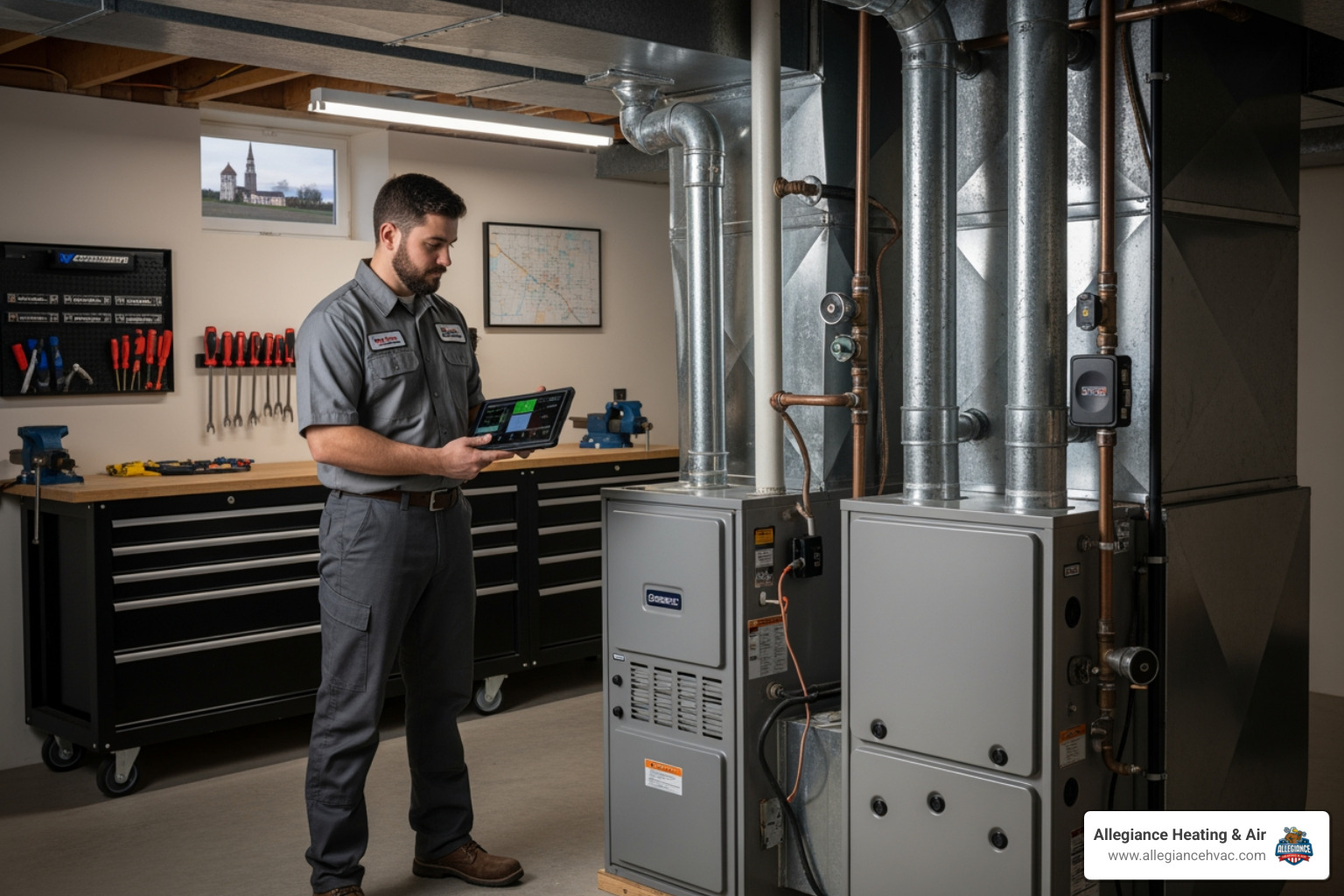
Air handling unit installation is the foundation of your home's comfort system, requiring precise technical expertise to ensure optimal performance, energy efficiency, and safety. Whether you're upgrading an existing system or installing a new HVAC setup, proper installation directly impacts your energy bills, indoor air quality, and equipment lifespan.
Key Steps for Air Handling Unit Installation:
1. Pre-installation planning - Calculate proper sizing using Manual J load calculations
2. Unit positioning - Ensure level mounting with proper clearances and vibration isolation
3. Critical connections - Connect ductwork, refrigerant lines, and electrical components
4. Condensate drainage - Install proper pitch (⅛ to ¼ inch per foot) with P-trap and secondary drain
5. Electrical wiring - Install dedicated circuit with appropriate amperage rating
6. Final sealing and testing - Seal all connections and commission the complete system
As one HVAC professional noted, "At the very least, installing an air handler yourself takes more time than necessary. It can also result in mistakes, which can cause a malfunction and major damage requiring repairs."
The complexity goes beyond basic connections. Modern air handlers require precise refrigerant line sizing, proper electrical load calculations, and strict adherence to local building codes. A 2-ton unit typically draws 15-20 amps, while a 5-ton system may require up to 40 amps - often necessitating electrical panel upgrades.
Professional installation ensures your system operates at peak efficiency from day one, avoiding the costly repairs and energy waste that result from improper setup.
Why Proper Air Handler Installation is Non-Negotiable
Your air handler is the heart of your home's comfort system. Correct air handling unit installation is the difference between a system that runs efficiently for years and one that causes constant headaches and expensive repairs.
A properly installed air handler delivers improved system efficiency, which you'll notice in your energy bills. It ensures consistent home comfort in every room, better indoor air quality by filtering allergens, and extended equipment lifespan.
Most importantly, correct installation guarantees operational safety and helps you avoid costly repairs and emergency calls. Cutting corners on installation is like building a house on a shaky foundation. For more insights, check out our detailed guide on professional HVAC installation beats DIY.
The Risks of Improper Installation
Shortcuts during air handling unit installation always lead to problems.
• Energy waste is the first sign. An incorrectly installed unit works harder, driving up electricity bills.
• Hot and cold spots often follow, making your home uncomfortable.
• Premature system failure can occur as components wear out faster, leading to major repairs or a full system replacement years earlier than expected.
• Refrigerant leaks and electrical hazards are genuine safety threats. Incorrect wiring can cause fires, and refrigerant leaks harm your health and the environment.
• Voided manufacturer warranty is a common consequence, leaving you responsible for repairs that should have been covered.
Maximizing Performance and Efficiency
When air handling unit installation is done right, everything works together to create the perfect indoor environment.
You'll experience optimal airflow reaching every corner of your home, leading to reduced energy consumption and lower monthly bills. Even temperature distribution becomes the new normal, along with effective humidity control that prevents mold and mildew.
A key benefit is quiet operation. A properly installed air handler runs so smoothly you'll barely notice it's there. Proper installation is an investment that pays dividends in comfort, savings, and peace of mind.
The Complete Guide to Air Handling Unit Installation
A successful air handling unit installation requires a methodical, step-by-step approach to ensure your system keeps you comfortable for decades.
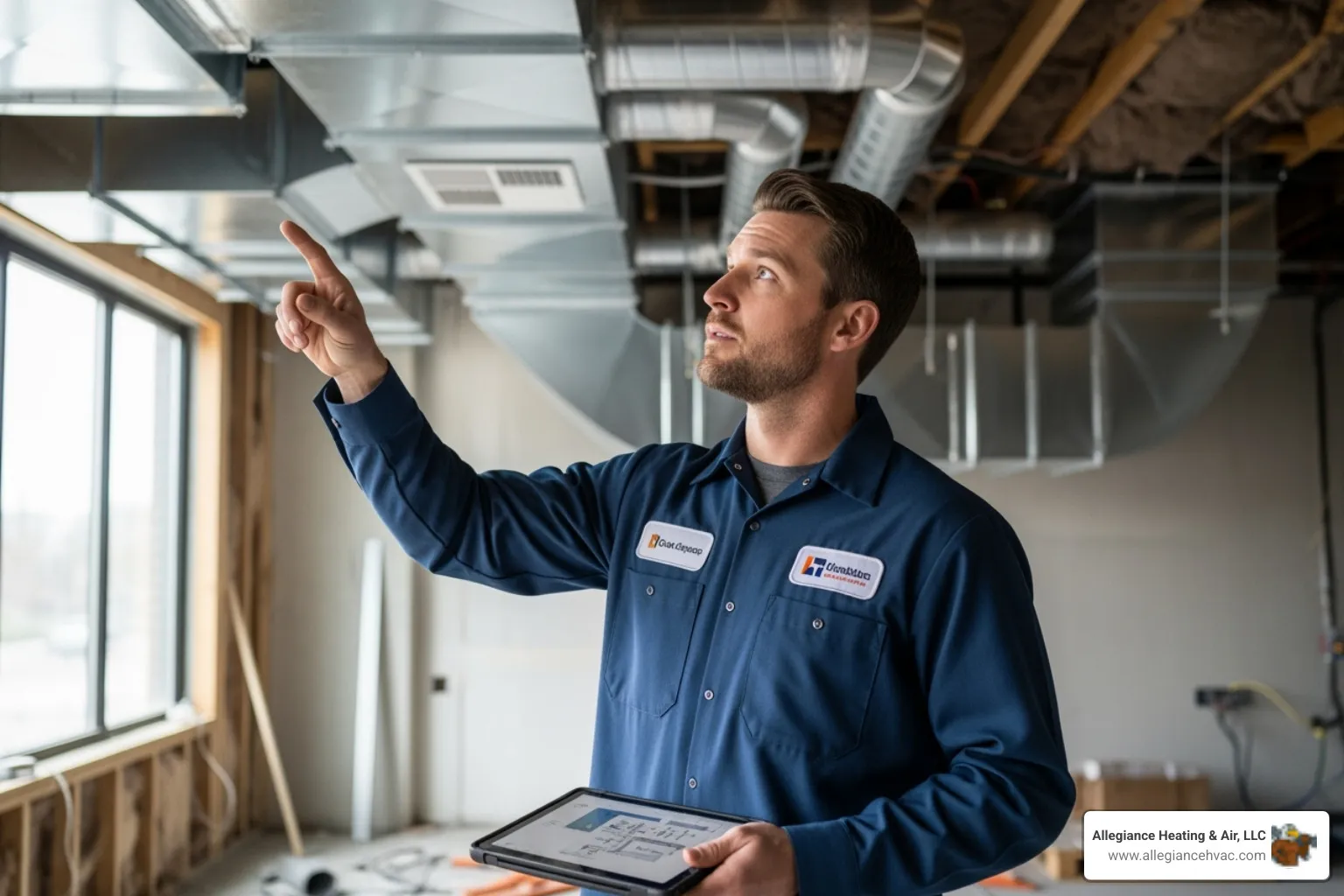
Before starting, we perform a thorough site assessment. Every house is different, so we examine its layout, airflow patterns, ductwork, and electrical capacity. Our technicians arrive with proper safety gear and adhere to all local building codes and manufacturer requirements. This initial planning is crucial for a successful installation. For technical details, Johnson Controls provides comprehensive AHU assembly guidance that our technicians reference.
Step 1: Pre-Installation Planning and Sizing
This step is the foundation of your air handling unit installation. Getting it right ensures years of reliable comfort.
Proper sizing relies on Manual J load calculations, an engineering standard that considers your home's square footage, ceiling heights, insulation, windows, and occupancy.
Our pre-installation assessment includes: calculating your home's precise heating and cooling load, selecting the right BTU capacity, ensuring system compatibility, matching the air handler to the outdoor condenser, and assessing existing ductwork.
An oversized unit cycles on and off constantly, while an undersized unit runs endlessly without reaching the desired temperature. Both scenarios waste energy and reduce comfort.
We help you choose the right size HVAC for your home to get it right the first time and save you years of frustration.
Step 2: Positioning and Mounting the Unit
The location of your air handling unit installation significantly impacts performance and maintenance.
• Attic installations save living space but expose the unit to extreme temperatures, requiring proper insulation and support.
• Utility rooms or closets provide a stable environment and easier maintenance access but require adequate return airflow.
• Crawl spaces are another option but present challenges with moisture control and accessibility.
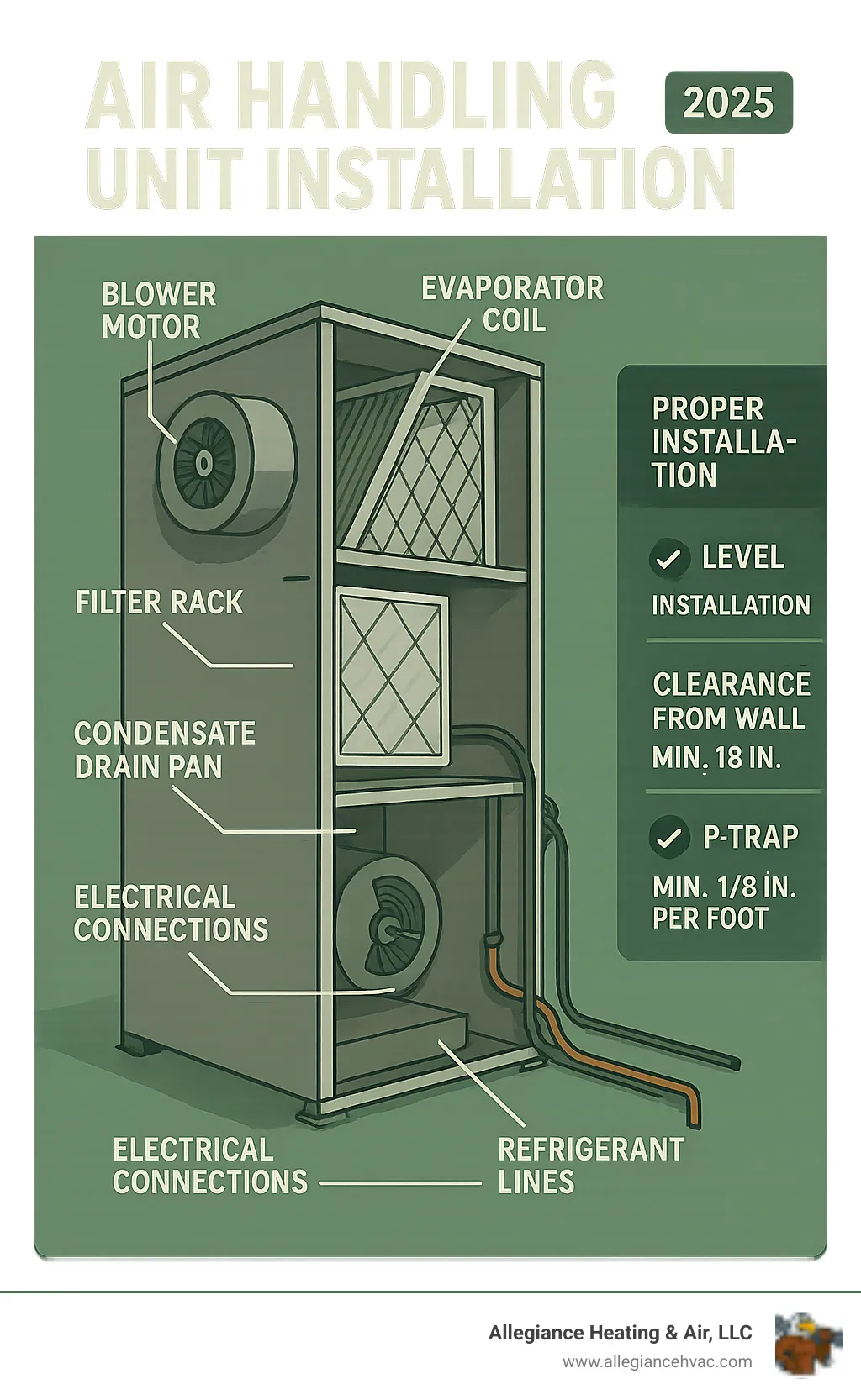
Regardless of location, we follow strict rules: the unit must be on a level surface to ensure proper drainage, and we install vibration pads to minimize noise.
Service access clearance is also crucial. We ensure adequate space around the unit (at least 3 inches on back/top/sides and 12 inches wider than the unit) for future maintenance.
Step 3: Making Critical Connections for Your Air Handling Unit Installation
This is where technical expertise shines during an air handling unit installation. Correctly making these connections separates a professional job from a potential disaster.
• Ductwork connections must be seamless and sealed. We use canvas connectors to prevent vibrations from traveling through your home.
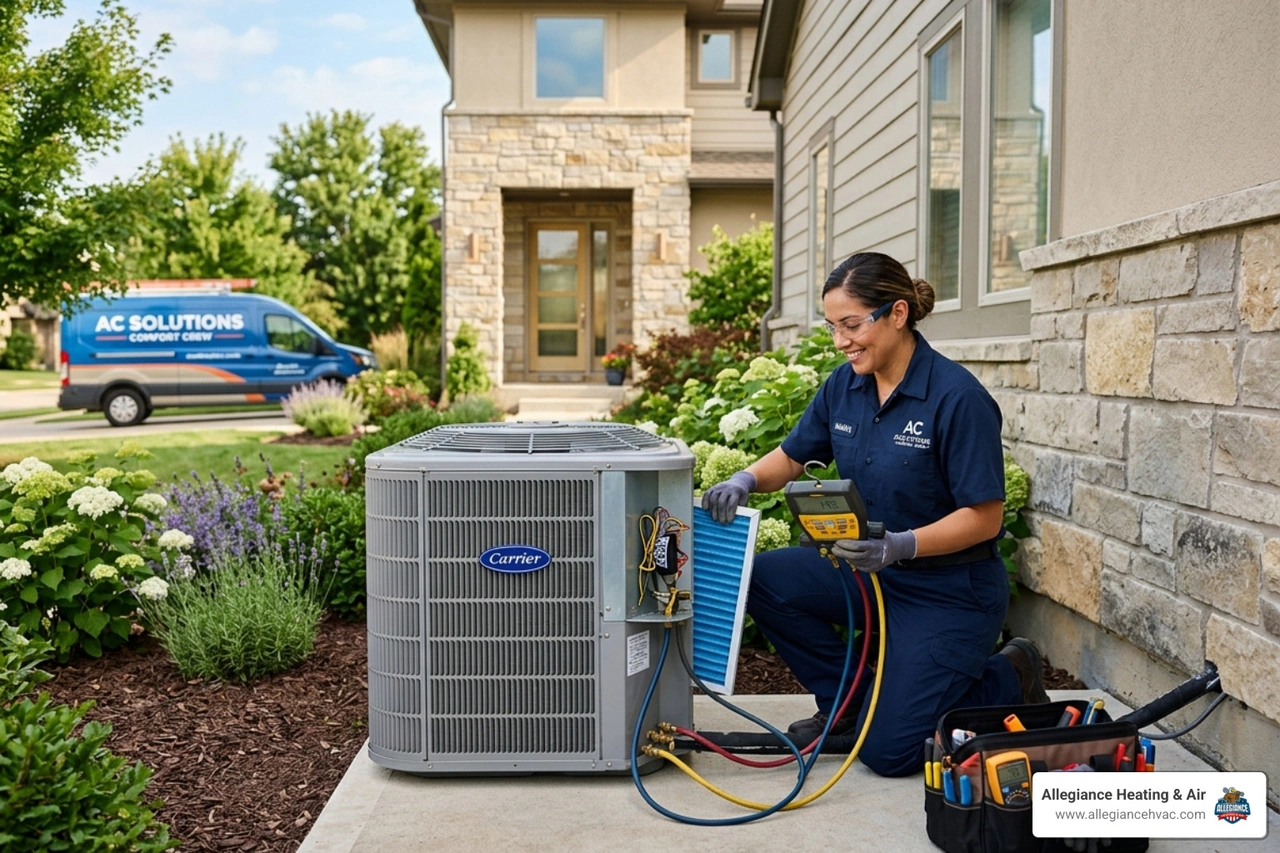
• Refrigerant lines are insulated with 3/8-inch closed-cell insulation. When brazing, we bleed nitrogen through the system to prevent oxidation—a small detail that ensures a great installation.
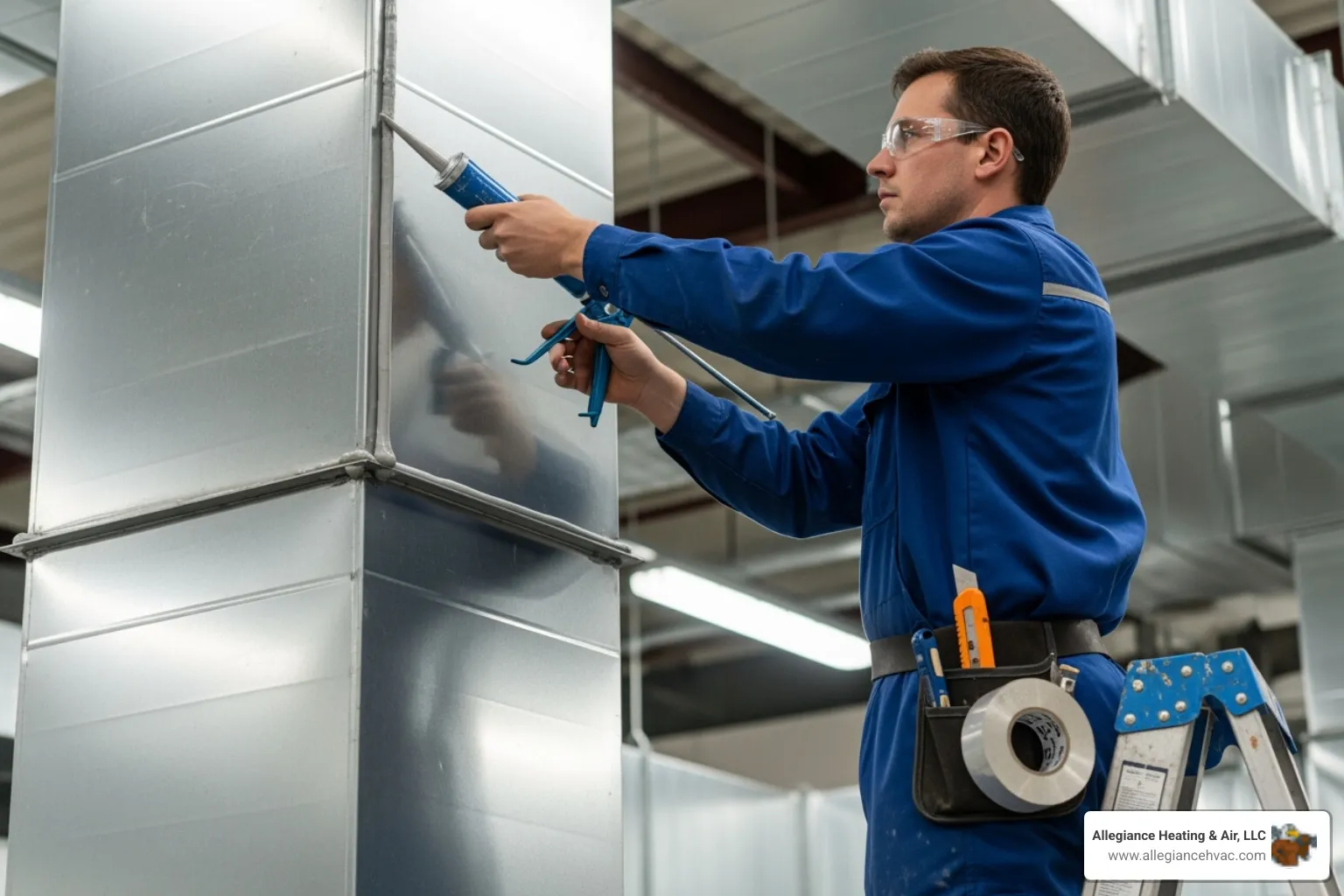
• Electrical wiring is strictly professional territory.
• Condensate drains must be properly installed to prevent water damage.
• Thermostat wiring connects the system's brain to its body.
We seal every line entry point into the cabinet with butyl tape. Without properly sealed connections, even the most expensive equipment won't perform as designed.
Step 4: The Importance of the Condensate Drain
The condensate drain is a critical component of your air handling unit installation. If installed incorrectly, it can lead to water damage, mold, and system failures.
As your air handler dehumidifies the air, it produces water that must drain properly. We ensure the drain line has the proper pitch (at least 1/8 inch per foot) and is at least 3/4 inch in diameter.
A P-trap installation is essential to prevent air from interfering with drainage. We also recommend primary and secondary drains, especially for units in attics. The secondary drain provides an early warning if the primary drain is clogged.
An overflow switch is a key safety feature that shuts down the system if water backs up, preventing damage. For maintenance, periodically flushing the drain with distilled vinegar can prevent clogs.
Following our HVAC spring maintenance checklist helps keep your system running smoothly.
Step 5: Electrical and Thermostat Wiring
Electrical work for an air handling unit installation is not a DIY project and requires a professional to prevent injury, damage, or malfunction.
Every air handler needs a dedicated circuit to prevent overload. The circuit sizing depends on the unit's capacity: a 2-ton unit needs 15-20 amps, while a 5-ton system may require up to 40 amps. This can sometimes necessitate an electrical panel upgrade for safe operation.
We install a disconnect switch near the unit for safety and connect the low-voltage wiring from the thermostat to control the system.
Thermostat placement is also critical. It should be on an interior wall, 4-5 feet above the floor, away from heat sources like sunlight or lamps to ensure accurate readings.
We can also integrate smart thermostats that learn your schedule to improve control and energy savings.
Step 6: Sealing, Insulating, and Final Checks
The final steps of your air handling unit installation maximize efficiency and ensure long-term performance.
• Duct sealing with mastic or foil tape prevents air leaks, which can waste 20-30% of your conditioned air.
• Cabinet sealing at all line entry points prevents unconditioned air from entering the system and reducing efficiency.
• Insulating refrigerant lines with 3/8-inch closed-cell insulation prevents energy loss and condensation.
After sealing, we perform post-installation testing, checking for air leaks and verifying that temperature control, cycling, and airflow meet manufacturer specifications.
Commissioning the system is the final quality check. We verify refrigerant levels, calibrate controls, and ensure all components communicate perfectly. This fine-tuning guarantees peak performance from day one.
Common Installation Challenges and How to Solve Them
Even the most experienced technicians encounter surprises during an air handling unit installation. Most issues have straightforward solutions when you know how to diagnose them systematically.
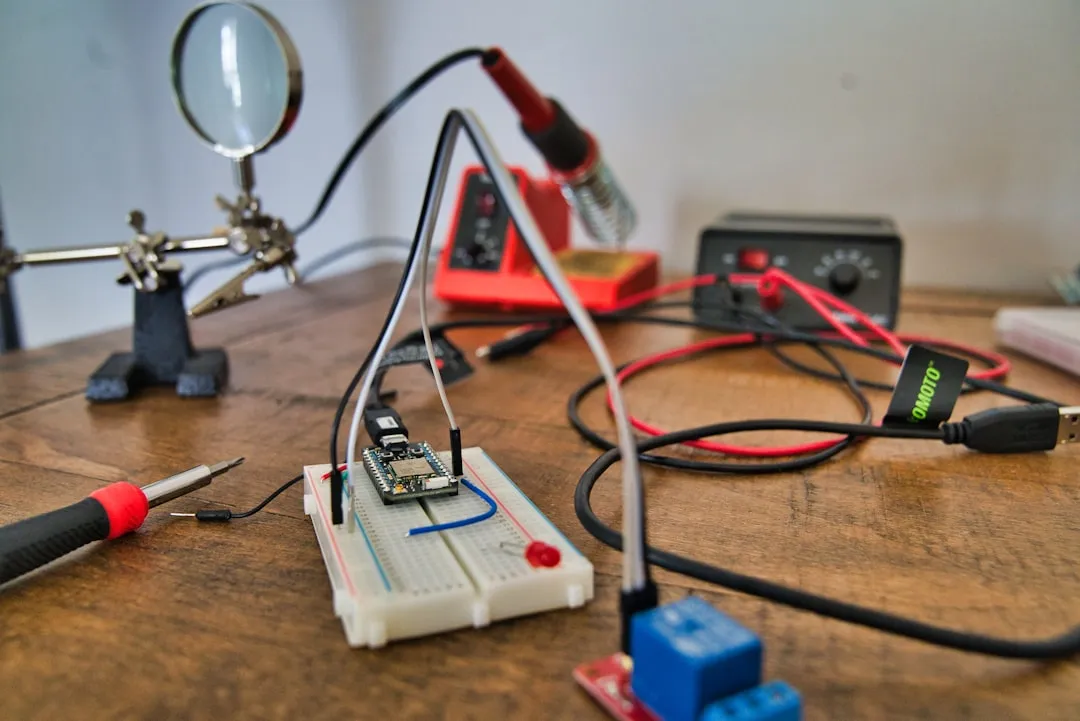
For example, insufficient airflow is often caused by a dirty filter, and a complex electrical issue could be a loose wire.
More serious challenges include:
• Refrigerant leaks: These require immediate professional attention and specialized equipment to locate and repair safely. Handling refrigerant requires EPA certification.
• Unusual noises: Rattling might indicate a loose panel, while humming could be a blower motor issue. Proper vibration isolation during installation prevents most noise problems.
Troubleshooting Your Air Handling Unit Installation
When problems arise after your air handling unit installation, we follow a methodical approach to identify and resolve them. This includes checking airflow restrictions like dirty filters, making blower speed adjustments, using professional leak detection methods, securing loose components, and verifying electrical connections.
We always recommend checking filters monthly for the first few months after installation, as construction dust can cause premature clogging.
When to Call a Professional
While we appreciate the DIY spirit, air handling unit installation and troubleshooting involve serious safety risks. Always call a professional for:
• Complex electrical issues: Working with high-voltage circuits is dangerous without proper training.
• Refrigerant handling: This requires EPA certification and specialized equipment to perform safely.
• Persistent performance problems: These often have underlying causes, like ductwork issues or incorrect sizing, that require an expert diagnosis.
• Safety concerns: If you smell gas, see sparks, or suspect any dangerous condition, call for immediate help.
As a family-owned business serving the Louisville, KY area and Southern Indiana since 2005, we've built our reputation on reliable, professional service. For expert HVAC installation in Louisville, KY, we're here to help with any challenge.
Frequently Asked Questions about Air Handler Installation
When homeowners consider an air handling unit installation, they often have questions. Here are the most common concerns we address.
Can I install an air handler myself?
While the DIY spirit is admirable, air handling unit installation is not a DIY project. It involves complex electrical work, refrigerant handling, and precise connections that require specialized tools and knowledge.
The safety risks are significant, including electrical hazards and improper refrigerant handling, which requires EPA certification. A small installation error can void your manufacturer's warranty, reduce efficiency, and lead to costly repairs.
Our licensed technicians have the expertise to ensure your installation meets all local codes and manufacturer specifications, providing safety, peace of mind, and optimal performance.
How does the location of my air handler affect my system?
The location is crucial for performance and serviceability.
• Attics save living space but can have extreme temperatures that strain the unit.
• Utility rooms or closets offer stable temperatures and easier maintenance access but take up indoor space.
• Crawl spaces offer a middle ground, protecting the unit from temperature extremes while keeping it out of living areas.
In any location, proper clearance and ventilation are essential. We ensure there is adequate space around the unit for airflow and future service, which is critical for efficient operation and proper maintenance.
What are the electrical requirements for an air handler?
Every air handler requires its own dedicated electrical circuit to prevent overloading your home's system. The circuit's amperage depends on the unit's size, typically ranging from 15-20 amps for a 2-ton unit up to 40 amps for larger systems, especially those with electric heat strips.
Your home's electrical panel may need an upgrade to handle this load, particularly in older homes. This is not a DIY task. A qualified professional must perform the work to meet local electrical codes and prevent fire hazards. Proper electrical installation ensures reliable power and safe operation.
Conclusion
When it comes down to it, proper air handling unit installation isn't just about getting your system up and running – it's about creating a foundation for years of reliable comfort, lower energy bills, and peace of mind. Every detail we've covered, from those crucial Manual J calculations to the final system commissioning, works together to ensure your HVAC investment pays dividends for decades to come.
Think about it: a well-installed air handler operates quietly in the background, maintaining perfect temperatures throughout your home while using less energy than a poorly installed system. It filters your air effectively, handles humidity like a champ, and rarely needs repairs. That's the difference professional installation makes.
The safety aspect alone makes professional installation worth every penny. Electrical work, refrigerant handling, and ensuring proper ventilation aren't areas where you want to cut corners or learn on the job. These systems are complex, and even small mistakes can lead to big problems – or worse, safety hazards for your family.
We've been part of the Greenville, IN and Louisville, KY communities since 2005, and we've seen how proper installation transforms homes. Our certified technicians don't just follow protocols; they understand that behind every air handling unit installation is a family who deserves reliable comfort and energy efficiency.
Whether you're in Floyd County, Clarksville, Sellersburg, Jeffersonville, Floyds Knobs, or anywhere throughout Southern Indiana and Kentuckiana, we're here to ensure your system is installed right the first time. That's been our promise since day one – trusted, customer-first service that puts your family's comfort and safety above everything else.
Ready to experience the difference that professional installation makes? Schedule your expert HVAC installation service today! Your future self (and your energy bills) will thank you.
Contact Us Or Schedule Expert Service
Other Blogs
ready to transform your home?
Discover our exceptional home services tailored to meet your needs and enhance your living space.
WHAT OUR CLIENTS HAVE TO SAY ABOUT US

We had a complete HVAC system and a hot water heater installed. The guys were professional, well mannered, and completed the work in a timely manner. Would definitely use them again.
I was nervous at first because my AC broke in the middle of 80 degree weather which is strange for April, but Allegiance Heating and Air was incredibly prompt and professional. The technician arrived within an hour, explained the problem clearly, and completed the repair. The technician , Mr. Garrett Moon was a very nice and courteous young man. He found the problem and fixed it within a timely manner. I highly recommend them for any heating or cooling needs. I’ll definitely give them a call again should I ever have another issue, but hopefully not. Knock on wood 😁. Give them a call… you won’t be disappointed!
From the moment I called to schedule a service, the team was quick to respond and arrived right on time. The technician was professional, friendly, and clearly knowledgeable about my heating system. He explained the repair options in plain language and completed the job efficiently. I appreciated the reliable service and the fact that the work was done the same day. I would definitely recommend Allegiance Heating and Air for any residential HVAC needs.
5/5 stars – I was very impressed with the efficient, affordable and timely service from Allegiance Heating and Air. The technician arrived on time, and performed the service quickly, no repairs needed at this time. Communication was clear and the whole experience felt hassle‑free. I would definitely recommend them for any residential HVAC needs.
Knowledgeable, experienced individual.
Explains Allegiance Heating and Air was incredibly reliable, professional and affordable. They arrived right on time, kept the work area clean and finished the furnace repair quickly. The technician explained everything clearly and the price was a great value. If happiness had a location on Google Maps, it would be here.
Gilbert had to go above and beyond because York is no longer making the part for my furnace. But he was able to find a way to construct a housing bracket for my furnace. Ingenuity, determination and integrity is what finally got my furnace fixed. Gilbert is truly a one of a kind technician.
Thank you for always going the extra mile. Gilbert is always respectful and helpful with any concerns.
"Great service, most knowledgeable and capable HVAC business in Kentuckiana!! Pete Flemming and Bryan the owner, are HVAC encyclopedias. They have the highest integrity of any HVAC business I have ever used. Allegiance has put numerous units in for me over the last 17 years. I will continue to use and trust them."
"Fast response from Allegiance when our heat was out on New Year’s day! Service technician was friendly and efficient. He took the time to explain the problem, tell us about the temporary fix and the plan for permanent repair. We were impressed!"
"Love Allegiance! Their technicians, in particular Benjamin, explain everything. Fast and thorough. A/C was out on a Sunday. Called Allegiance and within a few hours Benjamin arrived. Such a comfort as he was the one who last serviced our units. He quickly replaced part and cooling is restored!"
"My heat pump went out and I had to call after hours. The technician (Garrett) was outstanding and thorough. He got my system up and working until Monday and gave me several options of units. Also took the time to explain the issue to my Home warranty company. I highly recommend this company."
"Right on time :) respectful, fast, and polite. Even gave my fur babies some attention."
"Had Garrett out today to fix our AC. Fantastic tech. He showed up exactly when he said he would and kept us informed of what he was checking and what he found. Highly recommend!"
"Lucas with Allegiance showed up on time as promised, was professional and extremely patient and responsive with all my questions. He took care of the issue, and I feel he was trustworthy! He had us back to cool and comfortable on one of the hottest days of the year."
"Lucas did a great job! Very professional and expedient. Explained the process very well and represented Allegiance as a truly professional and reputable company."
"Arrived on time and work diligently to fix issue. These guy are great. Worked quickly to resolve my issues."
"Lucas was great - he spent a lot of time trying to figure out what was going on and explained everything he was doing. I trust Allegiance and wouldn’t want anyone else working on/in my house!!"

RELATED ARTICLES

Furnace Replacement Services in Sellersburg, IN
Expert Hands, Warm Home: Professional Furnace Repair in Clarksville