The August Breakdown: Why Ignoring Minor AC Grinding Noises Leads to Complete Compressor Failure
That faint metallic sound from your outdoor unit isn't just a harmless quirk of an aging system. Find out how a failing fan bearing can quickly destroy your compressor if left unchecked this August.
The Temptation to Ignore Late-Summer AC Noises
Your outdoor AC unit is suddenly making a faint, metallic grinding sound, but the house still feels relatively cool. Because it is already late August and the back-to-school transition is underway, you might be tempted to just let it run and hope the system survives until the weather cools down. However, understanding the August breakdown: why ignoring minor AC grinding noises leads to complete compressor failure is critical for protecting your home. That noise is not just a minor annoyance. It is a mechanical warning sign of active metal-on-metal friction happening inside your outdoor unit. If you delay addressing it, our technicians warn that you are putting the most critical component of your cooling system at risk.
Whether you need foundational professional HVAC services or emergency air conditioning repair, waiting out a strange mechanical noise is a dangerous gamble.
The psychological trap: In our years of serving Greenville IN, we've seen many homeowners fall into the trap of end-of-season cooling. When September is just around the corner, spending time and energy on a cooling system feels counterintuitive. You might think that because the air coming out of the vents is still cold, the grinding sound is just a harmless quirk of an aging system. We call this the "finish line" fallacy. Mechanical parts do not know what month it is, and friction does not take a break just because autumn is approaching.
The mechanical reality: A grinding noise indicates that a moving part has lost its lubrication or structural integrity. In an air conditioner, parts move at incredibly high speeds. When friction is introduced into that environment, it generates intense heat and physical resistance. Gambling on a minor noise usually results in facing a catastrophic system failure just when you need your equipment the most.
What That Grinding Sound Actually Means
The Problem: You step outside to your patio or backyard and hear a distinct grinding, screeching, or harsh humming noise coming through the vents of your outdoor condenser unit. The fan blade might still be spinning, but the sound is abrasive and metallic. In our daily service calls, this is almost always a symptom of a failing condenser fan motor bearing.
The Cause: The condenser fan motor is responsible for pulling air through the outdoor unit to exhaust heat. To do this effectively, these motors typically spin at high speeds, usually between 825 and 1075 revolutions per minute (RPM). Operating at these speeds requires perfectly smooth, well-lubricated bearings. Over time, the factory lubrication inside these bearings breaks down, or dirt and debris breach the bearing seal. When the lubrication fails, the smooth rolling action turns into harsh metal-on-metal scraping. This friction is what produces the audible grinding sound. The resistance also forces the motor to work harder, generating excess electrical heat and slowly decreasing the speed of the fan blade.
The Solution: Breaking this cycle requires professional intervention. At Allegiance Heating & Air, our licensed technicians evaluate the motor and the bearings. In most cases, a sealed bearing cannot simply be re-greased once it begins grinding; the physical metal has already been scarred. The motor or the bearing assembly must be replaced before it seizes entirely. For more foundational knowledge on how these components work together, you can review our comprehensive air conditioning guide.
The Cumulative Wear of Continuous Summer Cooling
Mechanical failures rarely happen overnight. By the time late August arrives, your cooling system has been subjected to months of cumulative mechanical wear. Components have been running almost continuously since May, constantly starting, stopping, and spinning to keep your indoor environment comfortable.
The regional climate factor: In our experience, the intense heat and high humidity of the Ohio River Valley create a uniquely demanding environment for HVAC equipment. High humidity requires extended run cycles. Your air conditioner does not just lower the temperature; it must also extract heavy moisture from the indoor air. This means the system runs longer and rests less. There is virtually no recovery time for friction-heavy parts. When a bearing starts to lose its lubrication in early July, the relentless humidity forces it to keep grinding for hundreds of hours without a break.
The vulnerability of peak loads: Systems are most vulnerable during the hottest weeks of the year when peak cooling loads are demanded. This is precisely when a struggling component will finally give out. We see this pattern often. Just last season, our team responded to a local homeowner who lost their AC completely during the hottest week in August when a neglected issue escalated. Our technicians had to promptly replace the old AC system because the internal damage had gone too far. The sheer stress of maximum capacity operation turns minor wear into major issues rapidly.
Breaking the cycle of wear: The best defense against cumulative summer wear is proactive care. Having a professional inspect and lubricate moving parts before the extreme heat arrives reduces the friction that causes late-summer breakdowns. Staying enrolled in a routine maintenance plan ensures that failing bearings are caught and resolved long before they start grinding audibly.
Domino Effect Step 1: The Loss of Heat Dissipation
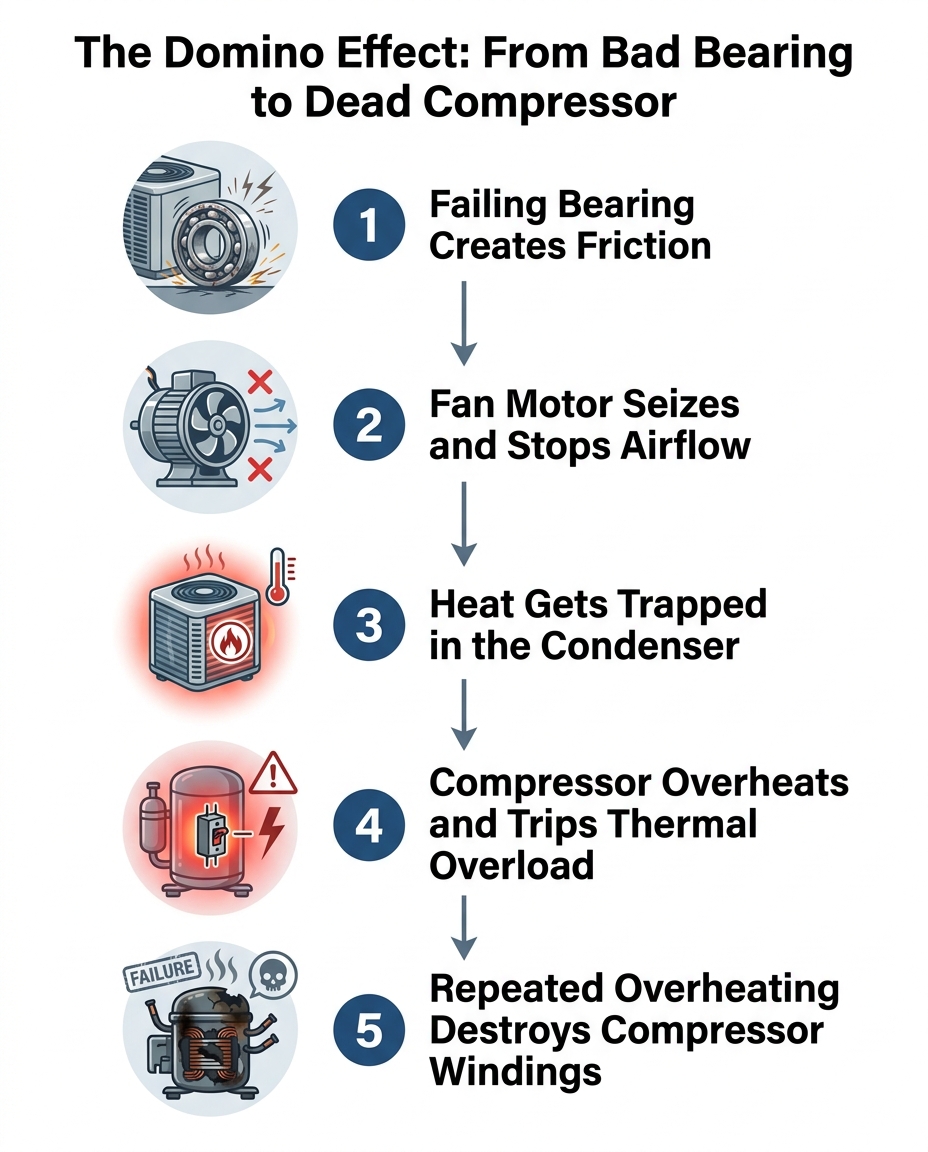
When our team encounters an ignored grinding fan motor bearing, we know it will eventually seize completely. The metal scars itself so deeply that the bearing locks into place, and the fan motor stops spinning entirely. This is the first step in a dangerous mechanical domino effect.
1. The fan blade stops: The immediate result of a seized bearing is a dead fan. The outdoor unit will sound strangely quiet, except for the heavy humming of the compressor still trying to run.
2. Airflow ceases: The primary function of the outdoor unit is to dissipate absorbed indoor heat into the outside air. The fan is responsible for pulling cooler outside air across the hot coils. Without the fan, airflow drops to zero.
3. Heat becomes trapped: Because the compressor is still pumping hot refrigerant into the outdoor unit, but there is no fan to blow that heat away, the temperature inside the condenser cabinet skyrockets.
4. Refrigerant cannot cool: The refrigerant remains hot. Instead of returning to your indoor unit as a cool liquid ready to absorb more heat, it travels back indoors still carrying the heat it was supposed to release. Your vents will start blowing warm air.
The Role of the Condenser Coil
To understand why this is so destructive, you have to look at the condenser coil. The refrigerant inside your system acts as a sponge, soaking up heat from inside your house and carrying it outside. The condenser coil is where that heat is squeezed out. Continuous airflow is absolutely mandatory for this heat exchange process. The coils are covered in hundreds of tiny aluminum fins designed to increase surface area, but without a fan actively forcing air across those fins, the heat simply radiates outward slowly, trapping the majority of the thermal energy inside the system.
Domino Effect Step 2: Thermal Overload and Compressor Stress
Once the heat is trapped in the outdoor unit, the situation escalates from a broken fan to severe compressor stress. The compressor is the heart of your cooling system. It is a powerful pump that pressurizes the refrigerant and keeps it moving. It is also completely dependent on the fan to keep it cool.
The pressure spike: As heat builds up in the condenser coil, the pressure of the refrigerant increases dramatically. The compressor is forced to push against this immense pressure, working harder than it was ever designed to work. This causes the internal temperature of the compressor to rise to dangerous levels.
Tripping the thermal overload: Modern compressors are equipped with internal thermal overload protectors. These are safety switches designed to cut electrical power to the compressor if it gets too hot. When the fan dies and the heat spikes, this switch trips, shutting the compressor down to prevent it from melting its own internal wiring.
The dangerous cycle: The problem is that the thermostat inside your house is still calling for cooling. Once the compressor sits idle for an hour and cools down, the thermal overload switch resets. The compressor turns back on, tries to pump against the trapped heat, overheats again, and trips the switch again. This cycle of cooling down, restarting, and overheating repeats endlessly because the fan is still dead.
Degrading the windings: Our repair teams frequently see the devastating effects of repeated thermal overload on the compressor. Every time it overheats, the protective insulation on the electrical windings inside the compressor degrades a little more. Eventually, this insulation burns away completely, leading to a catastrophic electrical short.

Catastrophic Lockup: When Minor Fixes Become Major Replacements
The final stage of this mechanical chain reaction is the ultimate failure of the system. When the compressor's electrical windings short out, or when the mechanical internals lock up permanently from the extreme heat and pressure, the compressor is dead. There is no repairing a dead compressor; it must be completely replaced.
The contrast between catching the issue early and waiting for the catastrophic lockup is stark. Replacing a failing fan motor is a standard, straightforward repair. Replacing a compressor is one of the most labor-intensive and mechanically complex procedures in the HVAC industry. In many older units we service around the Greenville area, a dead compressor means the entire outdoor unit—or the entire HVAC system—must be replaced because the equipment uses outdated refrigerant or the remaining parts are too worn to justify the repair.
• Scope of Work — Early Intervention (Bad Bearing): Replace fan motor or bearing assembly — Catastrophic Failure (Dead Compressor): Replace entire compressor or full outdoor unit
• System Downtime — Early Intervention (Bad Bearing): Minimal (usually fixed in one visit) — Catastrophic Failure (Dead Compressor): Significant (requires major component sourcing)
• Secondary Damage — Early Intervention (Bad Bearing): None — Catastrophic Failure (Dead Compressor): Acid buildup in refrigerant lines, electrical stress
If your system has already reached this catastrophic stage because a noise went ignored for too long, there is no need to panic. Professional teams can assess the damage and help you navigate financing options to make a necessary system replacement manageable.
The Value of Honest, Early Diagnostics
Breaking the mechanical chain reaction requires catching the problem before the fan stops spinning. This is where the value of honest, expert diagnostics becomes clear. Trained technicians do not just listen to the noise; they use specialized tools to measure the electrical draw of the fan motor and isolate a failing bearing long before it seizes.
Protecting your investment: At Allegiance Heating & Air, our commitment is to honest, expert diagnostics. Our technicians aim to catch failing components early, saving homeowners from massive full-system replacements when a simple repair is sufficient. We believe in showing you the exact problem. For example, our team recently helped a local Greenville customer experiencing unexpected back-to-school AC trouble. Our technician isolated the issue, physically showed the homeowner the defective part, and replaced it with a new one immediately. The AC was up and running in a timely manner, and the compressor was fully protected from secondary damage.
Proactive vs. reactive care: A reactive approach waits for the catastrophic breakdown. A proactive approach evaluates a strange noise, identifies the friction, and replaces the worn component while the rest of the system is still healthy. We constantly remind our customers that early intervention is the only reliable way to stop a minor bearing failure from destroying your compressor.
Protecting Your Cooling System Before the Season Ends
We always warn our customers that the "finish line" fallacy is a dangerous mindset. Just because the calendar says late August does not mean your air conditioner is safe from severe mechanical breakdowns. In fact, the cumulative wear of the summer months makes this the most critical time to pay attention to how your system sounds and operates.
Prioritize the health of your cooling system over the hope that it will just survive the season. If you hear a grinding, screeching, or harsh metallic noise coming from your outdoor unit, do not wait for the fan to stop spinning. Seek a professional evaluation immediately to address the friction, protect your compressor, and ensure your home stays comfortable without facing a catastrophic failure.
Frequently Asked Questions
Is it safe to run my AC if it's making a grinding noise?
No, our technicians generally advise that it is not safe for the equipment to run with a grinding noise. The sound indicates active metal-on-metal friction, usually from a failing fan motor bearing. Continuing to run the system generates excessive heat and forces the motor to draw too much electricity. Shutting the unit down immediately prevents the fan from seizing and protects the compressor from overheating.
How long can an AC run with a bad bearing?
An air conditioner might run for a few days or even a few weeks with a bad bearing, but in our experience, failure is imminent and unpredictable. Every hour it runs, the friction worsens and the metal degrades further. Operating the unit in this condition guarantees that the bearing will eventually lock up entirely. It is always better to replace the part while the system is still functioning rather than waiting for a total breakdown.
What does a bad AC compressor sound like?
A failing compressor often produces a loud, heavy clanking, rattling, or deep rumbling noise. Unlike the higher-pitched screech of a fan bearing, compressor noises sound like heavy internal parts are loose or struggling to pump. If the compressor is experiencing thermal overload, you might also hear it hum loudly for a few seconds before abruptly clicking off.
Why does my AC sound like metal grinding?
A metal grinding sound is almost always caused by a lack of lubrication in a moving part. In most outdoor units we inspect, the primary culprit is the condenser fan motor bearing. When the protective seal on the bearing fails or the factory grease dries up, the steel ball bearings scrape against their housing, creating a harsh, grinding acoustic signature.
Will a bad condenser fan motor ruin my compressor?
Yes, a dead condenser fan motor is one of the leading causes of premature compressor failure. Without the fan to blow heat away from the coils, the heat remains trapped inside the system. This forces the compressor to operate under extreme pressure and temperature, eventually burning out its internal electrical windings and causing a complete lockup.
Can a worn AC bearing be lubricated instead of replaced?
In modern HVAC systems, most condenser fan motors use sealed bearings that cannot be manually lubricated. Once a sealed bearing begins to grind, the internal metal is already scarred and damaged. Adding oil to the outside of the motor will not fix the internal friction; the motor or the bearing assembly must be professionally replaced.
Contact Us Or Schedule Expert Service
Other Blogs
ready to transform your home?
Discover our exceptional home services tailored to meet your needs and enhance your living space.
WHAT OUR CLIENTS HAVE TO SAY ABOUT US

We had a complete HVAC system and a hot water heater installed. The guys were professional, well mannered, and completed the work in a timely manner. Would definitely use them again.
I was nervous at first because my AC broke in the middle of 80 degree weather which is strange for April, but Allegiance Heating and Air was incredibly prompt and professional. The technician arrived within an hour, explained the problem clearly, and completed the repair. The technician , Mr. Garrett Moon was a very nice and courteous young man. He found the problem and fixed it within a timely manner. I highly recommend them for any heating or cooling needs. I’ll definitely give them a call again should I ever have another issue, but hopefully not. Knock on wood 😁. Give them a call… you won’t be disappointed!
From the moment I called to schedule a service, the team was quick to respond and arrived right on time. The technician was professional, friendly, and clearly knowledgeable about my heating system. He explained the repair options in plain language and completed the job efficiently. I appreciated the reliable service and the fact that the work was done the same day. I would definitely recommend Allegiance Heating and Air for any residential HVAC needs.
5/5 stars – I was very impressed with the efficient, affordable and timely service from Allegiance Heating and Air. The technician arrived on time, and performed the service quickly, no repairs needed at this time. Communication was clear and the whole experience felt hassle‑free. I would definitely recommend them for any residential HVAC needs.
Knowledgeable, experienced individual.
Explains Allegiance Heating and Air was incredibly reliable, professional and affordable. They arrived right on time, kept the work area clean and finished the furnace repair quickly. The technician explained everything clearly and the price was a great value. If happiness had a location on Google Maps, it would be here.
Gilbert had to go above and beyond because York is no longer making the part for my furnace. But he was able to find a way to construct a housing bracket for my furnace. Ingenuity, determination and integrity is what finally got my furnace fixed. Gilbert is truly a one of a kind technician.
Thank you for always going the extra mile. Gilbert is always respectful and helpful with any concerns.
"Great service, most knowledgeable and capable HVAC business in Kentuckiana!! Pete Flemming and Bryan the owner, are HVAC encyclopedias. They have the highest integrity of any HVAC business I have ever used. Allegiance has put numerous units in for me over the last 17 years. I will continue to use and trust them."
"Fast response from Allegiance when our heat was out on New Year’s day! Service technician was friendly and efficient. He took the time to explain the problem, tell us about the temporary fix and the plan for permanent repair. We were impressed!"
"Love Allegiance! Their technicians, in particular Benjamin, explain everything. Fast and thorough. A/C was out on a Sunday. Called Allegiance and within a few hours Benjamin arrived. Such a comfort as he was the one who last serviced our units. He quickly replaced part and cooling is restored!"
"My heat pump went out and I had to call after hours. The technician (Garrett) was outstanding and thorough. He got my system up and working until Monday and gave me several options of units. Also took the time to explain the issue to my Home warranty company. I highly recommend this company."
"Right on time :) respectful, fast, and polite. Even gave my fur babies some attention."
"Had Garrett out today to fix our AC. Fantastic tech. He showed up exactly when he said he would and kept us informed of what he was checking and what he found. Highly recommend!"
"Lucas with Allegiance showed up on time as promised, was professional and extremely patient and responsive with all my questions. He took care of the issue, and I feel he was trustworthy! He had us back to cool and comfortable on one of the hottest days of the year."
"Lucas did a great job! Very professional and expedient. Explained the process very well and represented Allegiance as a truly professional and reputable company."
"Arrived on time and work diligently to fix issue. These guy are great. Worked quickly to resolve my issues."
"Lucas was great - he spent a lot of time trying to figure out what was going on and explained everything he was doing. I trust Allegiance and wouldn’t want anyone else working on/in my house!!"

RELATED ARTICLES

I'm looking for quotes on a budget-friendly furnace replacement in the Greenville, Indiana area.

Home Humidifiers: Key to Comfort and Health in Your Living Space