
Why Does Your Home Suddenly Smell Like a Locker Room?
If you are searching for information on Dirty Sock Syndrome: decoding the strange smells coming from your vents in peak summer, you are likely dealing with a sudden, embarrassing odor resembling a high school locker room filling your home the moment the air conditioner kicks on. You keep a clean house, you take out the trash, and yet, an unmistakable, foul, mildew-like scent continues to blast from your supply registers. This is an incredibly frustrating problem that often leaves homeowners wondering what went wrong with their cooling system.
During the intense heat of a July peak summer, this is a highly common issue. As temperatures soar and cooling systems run around the clock, the internal components of your equipment are pushed to their limits. The sudden onset of this gym-sock odor introduces a critical decision point for homeowners: is this simply a matter of a dirty air filter that needs to be swapped out, or is there a deeper biological problem taking root inside the ductwork and equipment?
Understanding the root cause of this odor is the first step toward breathing clean air again. Temporary fixes and scented sprays will not resolve the underlying issue. If you need professional help right away, exploring dedicated indoor air quality solutions or scheduling comprehensive air conditioning services is the most effective path forward. Otherwise, read on to decode the science behind this strange smell and discover how to permanently neutralize it.
What Exactly is Dirty Sock Syndrome?
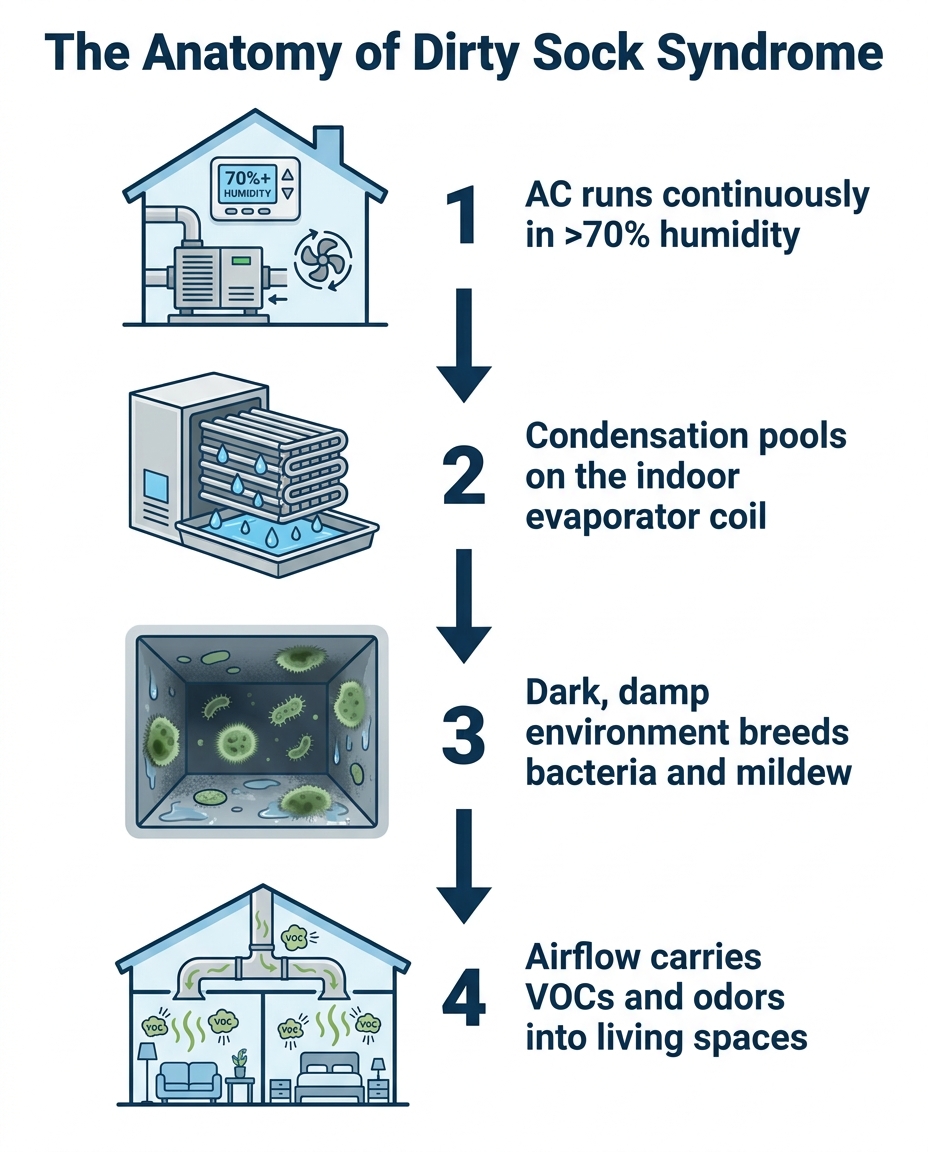
Dirty Sock Syndrome is the colloquial term for active biological growth—specifically mold, mildew, and bacteria—thriving inside the dark, damp environment of an HVAC system. When your system cycles on, the blower fan forces air directly over this microbial growth, picking up volatile organic compounds (VOCs) and carrying those foul odors straight into your living space.
To understand why this happens, you have to look at the exact location where the problem originates. The issue rarely starts in the ductwork itself; instead, it is almost always localized to a specific, critical component of your cooling system that handles heat transfer and moisture removal.
The Anatomy of the Indoor Evaporator Coil
The heart of the odor problem lies on the indoor evaporator coil. This component is typically an A-shaped structure made of tightly packed copper or aluminum tubes and extremely thin metal fins. Its primary job is to absorb heat from the warm air inside your home. As the warm air blows over the freezing cold metal of the indoor evaporator coil, condensation forms—much like water droplets forming on the outside of a cold glass of ice water on a hot day.
This condensation is completely normal and necessary for dehumidifying your home. However, it also creates a perpetually wet habitat. Because the indoor evaporator coil is housed inside a dark, enclosed cabinet, it receives no natural sunlight. When airborne dust, pet dander, and microscopic organic matter bypass your air filter, they stick to the wet metal fins. You now have moisture, darkness, and a food source—the perfect recipe for microbial life.
The bacteria that colonize the coil feed on the trapped organic debris. As they digest this material, they release chemical byproducts. Interestingly, the specific bacteria that thrive in these HVAC conditions often release isovaleric acid—the exact same volatile organic compound produced by the bacteria on human skin, which is why the resulting smell is identical to sweaty feet or dirty gym socks.
• Dirty Gym Socks / Mildew — Likely Cause: Bacterial or mold growth (Dirty Sock Syndrome) — Location in System: Indoor evaporator coil or drain pan
• Burning Dust / Hair — Likely Cause: Dust burning off heat exchangers — Location in System: Furnace burners (common in fall)
• Electrical / Ozone — Likely Cause: Overheating blower motor or failing capacitor — Location in System: Blower compartment or outdoor unit
• Rotten Eggs / Sulfur — Likely Cause: Natural gas leak (Evacuate immediately) — Location in System: Gas lines or furnace valve
The Role of Peak Summer Humidity in Microbial Growth
While the indoor evaporator coil is always somewhat damp during operation, the problem historically explodes during the hottest, most humid months of the year. In our region, particularly around Greenville, IN and the greater Ohio River Valley, summer humidity levels frequently exceed 70%. This intense environmental moisture fundamentally changes how your cooling system operates.
During a July peak summer heatwave, your air conditioner runs almost continuously to combat the heavy heat load. Because the system rarely cycles off for long periods, the indoor evaporator coil never gets a chance to fully dry out. It remains in a constant state of saturation. The condensate drain pan, located directly beneath the coil, is also constantly filled with water, draining gallons of moisture out of your home every single day.
When relative humidity remains consistently high and the equipment stays wet for weeks on end, the localized bacteria and mildew populations experience exponential growth. What might have been a minor, unnoticeable amount of biofilm in May can turn into a thick, odor-producing mat of biological contamination by late July. The Environmental Protection Agency (EPA) consistently lists poor indoor air quality, exacerbated by biological pollutants like mold and bacteria, as a top environmental health risk. When your HVAC system is actively breeding these microbes, it acts as a distribution network, pumping contaminated air into every room of the house.

The Air Filter Myth: Why Swapping Filters Won't Stop the Stink
When faced with a sudden, foul odor from the vents, the first instinct for most homeowners is to check the air filter. This is a logical step, and maintaining a clean filter is excellent for general system health. However, there is a widespread misconception that installing a brand-new, high-efficiency filter will cure Dirty Sock Syndrome.
The problem: You swap out your old, dusty filter for a premium pleated model, wait a few hours, and realize the locker room smell is still blasting through the house just as strongly as before.
The cause: Standard fiberglass or pleated air filters are mechanical filters. They are designed to trap physical particulate matter—things like dust mites, pollen, pet hair, and lint. They are essentially physical nets. However, the odors associated with Dirty Sock Syndrome are volatile organic compounds (VOCs). VOCs are gases. A physical net cannot catch a gas. Furthermore, the biological growth causing the odor is located on the indoor evaporator coil, which sits downstream from the air filter. The air passes through the clean filter, hits the contaminated coil, picks up the bacterial odors, and carries them into your home.
The solution: If the smell persists after a filter change, you are definitively dealing with active microbial growth inside the air handler. Resolving this requires a chemical or biological intervention, not just a physical barrier. You cannot filter your way out of Dirty Sock Syndrome; the source must be neutralized.
Professional Neutralization: Eradicating Microbes at the Source
Because the indoor evaporator coil is buried inside the sheet metal cabinetry of your HVAC system, and because its aluminum fins are delicate enough to be crushed by a heavy hand, addressing microbial growth is strictly a professional job. Attempting to scrub the coil yourself or spraying household cleaners like bleach onto the metal can cause catastrophic corrosion, leading to refrigerant leaks and premature system failure.
When a local homeowner recently experienced severe AC trouble during a July peak summer heatwave, our technician isolated the issue, physically showed the customer the defective component, and completed a targeted replacement to get the system running in a timely manner. This same level of diagnostic precision is required when treating indoor air quality issues. A professional technician will expose the coil, assess the level of biological growth, and implement a targeted neutralization strategy.
Deep Coil Cleaning vs. Active Purification
Eradicating the microbes typically involves a two-step approach: resetting the baseline and preventing the return.
• Professional Biocide Application: Technicians use specialized, foaming coil cleaners that are non-corrosive to aluminum. These expanding foams push deep into the microscopic crevices of the coil, lifting dirt and killing the active bacterial colonies on contact. The natural condensation of the cooling cycle then rinses the dead biological matter safely down the condensate drain.
• UV Germicidal Irradiation: To prevent the bacteria from returning the next time the humidity spikes, ASHRAE-backed UV-C lights can be mounted directly inside the coil cabinet. These ultraviolet lights shine continuously on the indoor evaporator coil. The specific wavelength of UV-C light penetrates the cellular walls of mold and bacteria, scrambling their DNA so they cannot reproduce. This actively sterilizes the wet environment 24/7.
• Whole-Home Air Purifiers: For comprehensive odor control, advanced purification systems can be tied into the ductwork. If you are interested in actively neutralizing VOCs and airborne odors before they reach your living space, installing a whole-home air purifier is a highly effective upgrade that works in tandem with coil sterilization.
The critical difference here is between merely masking an odor with air fresheners and permanently destroying the biological source at a cellular level.
Long-Term Prevention for Pristine Indoor Air
Once your system has been professionally neutralized, keeping the air in your home fresh and clean requires proactive management. The conditions that caused the bacterial bloom—moisture, heat, and organic debris—will always attempt to return during a July peak summer. By taking a few preventative steps, you can ensure your system remains odor-free for the lifespan of the equipment.
Your Prevention Checklist:
• Monitor the Condensate Drainage: The water dripping off your indoor evaporator coil must have a clear path out of the house. If the PVC drain line becomes clogged with algae or debris, water will pool in the drain pan beneath the unit. This stagnant water is a prime breeding ground for the bacteria that cause Dirty Sock Syndrome. Ensure the drain line is clear and water is flowing freely outside.
• Manage Indoor Humidity: Keep your home's relative humidity between 40% and 50%. If your AC is oversized and short-cycling (turning on and off too quickly), it won't run long enough to properly dehumidify the air. Using standalone dehumidifiers in damp areas like basements can take the moisture load off the primary HVAC system.
• Schedule Proactive Check-Ups: The best way to catch early signs of microbial growth is before the heavy summer heat arrives. Enrolling in a routine HVAC maintenance plan ensures that a professional is inspecting your coil, clearing your drain lines, and verifying your system's hygiene long before the bacteria has a chance to spread through your ductwork.
Frequently Asked Questions About Summer AC Odors
What is dirty sock syndrome in air conditioners?
Dirty Sock Syndrome is the buildup of mold, mildew, and bacteria on the indoor evaporator coil of an air conditioning system. When the AC turns on, the blower pushes air over this biological growth, distributing volatile organic compounds (VOCs) that smell exactly like dirty gym socks throughout the home. It is primarily caused by dust and moisture mixing in the dark environment of the air handler.
Why does my AC smell like dirty socks in the summer?
During the summer, your air conditioner runs frequently, generating constant condensation on the indoor evaporator coil. Because the system rarely has enough downtime to completely dry out during peak heatwaves, the continuous moisture creates an ideal breeding ground for bacteria. The high temperatures and high humidity accelerate this microbial growth, causing the sudden onset of strong odors.
Will changing my air filter fix AC odors?
Changing your air filter will not fix odors caused by biological growth inside the system. Standard air filters are designed to capture physical particles like dust and pet hair, not chemical gases or volatile organic compounds. Because the bacteria causing the smell live on the coil downstream from the filter, the air will still pick up the odor even after passing through a brand-new filter.
Can dirty sock syndrome make you sick?
While the odor itself is primarily a nuisance, the underlying cause—mold and bacteria blowing through your vents—can trigger health issues for sensitive individuals. Prolonged exposure to biological pollutants can exacerbate allergies, asthma, and other respiratory conditions. The EPA notes that poor indoor air quality can lead to headaches, fatigue, and irritation of the eyes, nose, and throat.
How do professionals get rid of the mildew smell in an AC?
Professionals eliminate the mildew smell by physically cleaning the indoor evaporator coil with specialized, non-corrosive biocides that kill the bacteria on contact. They also clear the condensate drain lines to remove any standing water. To prevent the smell from returning, professionals often install UV germicidal lights inside the cabinet to continuously sterilize the coil.
Are UV lights effective against dirty sock syndrome?
Yes, UV-C germicidal lights are highly effective at preventing and eliminating Dirty Sock Syndrome. When mounted directly over the indoor evaporator coil, the specific wavelength of the ultraviolet light penetrates the cellular walls of mold and bacteria, destroying their DNA. This renders the microbes unable to reproduce, keeping the coil sterile and the air smelling fresh.
Restore Your Home's Fresh Air with Local Kentuckiana Experts
You do not have to live with embarrassing, locker-room odors blowing through your vents during the hottest days of the year. While temporary fixes and scented sprays might offer a brief reprieve, true indoor comfort requires a scientific, permanent solution to biological growth. When you are dealing with the intense humidity of a July peak summer, you need an approach that addresses the root cause of the moisture and the microbes.
As a local, family-owned Kentuckiana expert, Allegiance Heating & Air understands exactly how regional humidity creates this specific problem. We offer permanent, trust-based indoor air quality solutions rather than the generic, high-pressure up-sells often pushed by national chains. If your home is suffering from Dirty Sock Syndrome, reach out to our team to inspect your indoor evaporator coil and discuss targeted, effective upgrades that will restore your home's fresh air for good.
Contact Us Or Schedule Expert Service
Other Blogs
ready to transform your home?
Discover our exceptional home services tailored to meet your needs and enhance your living space.
WHAT OUR CLIENTS HAVE TO SAY ABOUT US

We had a complete HVAC system and a hot water heater installed. The guys were professional, well mannered, and completed the work in a timely manner. Would definitely use them again.
I was nervous at first because my AC broke in the middle of 80 degree weather which is strange for April, but Allegiance Heating and Air was incredibly prompt and professional. The technician arrived within an hour, explained the problem clearly, and completed the repair. The technician , Mr. Garrett Moon was a very nice and courteous young man. He found the problem and fixed it within a timely manner. I highly recommend them for any heating or cooling needs. I’ll definitely give them a call again should I ever have another issue, but hopefully not. Knock on wood 😁. Give them a call… you won’t be disappointed!
From the moment I called to schedule a service, the team was quick to respond and arrived right on time. The technician was professional, friendly, and clearly knowledgeable about my heating system. He explained the repair options in plain language and completed the job efficiently. I appreciated the reliable service and the fact that the work was done the same day. I would definitely recommend Allegiance Heating and Air for any residential HVAC needs.
5/5 stars – I was very impressed with the efficient, affordable and timely service from Allegiance Heating and Air. The technician arrived on time, and performed the service quickly, no repairs needed at this time. Communication was clear and the whole experience felt hassle‑free. I would definitely recommend them for any residential HVAC needs.
Knowledgeable, experienced individual.
Explains Allegiance Heating and Air was incredibly reliable, professional and affordable. They arrived right on time, kept the work area clean and finished the furnace repair quickly. The technician explained everything clearly and the price was a great value. If happiness had a location on Google Maps, it would be here.
Gilbert had to go above and beyond because York is no longer making the part for my furnace. But he was able to find a way to construct a housing bracket for my furnace. Ingenuity, determination and integrity is what finally got my furnace fixed. Gilbert is truly a one of a kind technician.
Thank you for always going the extra mile. Gilbert is always respectful and helpful with any concerns.
"Great service, most knowledgeable and capable HVAC business in Kentuckiana!! Pete Flemming and Bryan the owner, are HVAC encyclopedias. They have the highest integrity of any HVAC business I have ever used. Allegiance has put numerous units in for me over the last 17 years. I will continue to use and trust them."
"Fast response from Allegiance when our heat was out on New Year’s day! Service technician was friendly and efficient. He took the time to explain the problem, tell us about the temporary fix and the plan for permanent repair. We were impressed!"
"Love Allegiance! Their technicians, in particular Benjamin, explain everything. Fast and thorough. A/C was out on a Sunday. Called Allegiance and within a few hours Benjamin arrived. Such a comfort as he was the one who last serviced our units. He quickly replaced part and cooling is restored!"
"My heat pump went out and I had to call after hours. The technician (Garrett) was outstanding and thorough. He got my system up and working until Monday and gave me several options of units. Also took the time to explain the issue to my Home warranty company. I highly recommend this company."
"Right on time :) respectful, fast, and polite. Even gave my fur babies some attention."
"Had Garrett out today to fix our AC. Fantastic tech. He showed up exactly when he said he would and kept us informed of what he was checking and what he found. Highly recommend!"
"Lucas with Allegiance showed up on time as promised, was professional and extremely patient and responsive with all my questions. He took care of the issue, and I feel he was trustworthy! He had us back to cool and comfortable on one of the hottest days of the year."
"Lucas did a great job! Very professional and expedient. Explained the process very well and represented Allegiance as a truly professional and reputable company."
"Arrived on time and work diligently to fix issue. These guy are great. Worked quickly to resolve my issues."
"Lucas was great - he spent a lot of time trying to figure out what was going on and explained everything he was doing. I trust Allegiance and wouldn’t want anyone else working on/in my house!!"

RELATED ARTICLES

7 Signs You Need Emergency Furnace Repair
Signs You Need Emergency AC Repair in Sellersburg