The Myth of the Master Bedroom: Why Closing Vents Backfires
Closing registers in unused guest rooms doesn't save energy—in fact, our team at Allegiance Heating & Air frequently sees how falling into the closed vent trap: how trying to save airflow actually damages your blower motor is one of the most common and costly mistakes a homeowner can make. The logical assumption seems sound on the surface: if you shut off the airflow to an empty bedroom or a rarely used office, all that extra cold air will naturally be forced into the master bedroom or the main living room. It feels like a smart, proactive way to direct cooling exactly where you want it while potentially lowering your monthly utility bills.
However, a pattern we see often is that this practice achieves the exact opposite result. Instead of redirecting air efficiently, closing vents suffocates the blower motor and creates a dangerous level of elevated static pressure inside your ductwork. Your cooling equipment is designed to move a specific volume of air, and when you block its intended path, the air does not magically reroute itself—it backs up, creating resistance that the internal components must fight against. Realizing that restricting airflow does not save energy is the critical first decision point for any homeowner; opening all your supply vents is the simplest, most immediate step you can take to prevent premature system failure.
For more foundational knowledge on how your home breathes, reviewing the principles of proper airflow and air quality is a great place to start.
The Plumbing Misconception vs. The HVAC Breathing Loop
To understand why closing a vent causes so much damage, it helps to dismantle the core myth that air ducts function exactly like water pipes. In our experience serving homes throughout Greenville IN, we notice many people apply a plumbing mindset to their indoor climate control, but the physical dynamics of moving air are entirely different from moving water.
Why Air Doesn't Behave Like Water
The plumbing valve misconception is easy to adopt. If you turn off a faucet or close a valve in a water pipe, the water pressure increases elsewhere in the system, and the fluid easily flows out of the remaining open taps. Water is an incompressible fluid driven by a high-pressure municipal pump or well system. Air inside residential ductwork, on the other hand, is a compressible gas moved by a relatively sensitive blower motor.
Your HVAC system is not a one-way delivery pipe; it is a carefully balanced breathing loop. It requires an equal amount of intake (return air) and exhaust (supply air) to function correctly. Forced air will always take the path of least resistance. When you close off supply vents, you do not smoothly redirect the air to the open vents. Instead, you increase the resistance across the entire system, forcing the blower motor to push against a wall of trapped air.
The 'Breathing Through a Straw' Analogy
Think of your blower motor as a pair of human lungs. When all the vents are open, the system breathes normally, inhaling through the return grilles and exhaling effortlessly through the supply registers. Now, imagine trying to exhale that exact same volume of air through a tiny cocktail straw. The sheer effort required makes your lungs strain, your face turn red, and your breathing become incredibly labored.
This is exactly what happens when you shut room registers. The blower motor struggles to push the required volume of air through a restricted airway. This struggle leads directly to elevated static pressure, turning a balanced breathing loop into a high-stress environment that degrades mechanical parts long before their time.
Understanding this loop is a core concept in any comprehensive air conditioning guide.
The Physics of Elevated Static Pressure Explained
Static pressure is the measurement of resistance to airflow within a heating and cooling system. In modern residential ductwork, maintaining the correct static pressure is the single most important factor in ensuring both energy efficiency and equipment longevity. When vents are closed, that physical barrier immediately spikes the resistance against the blower motor.
Measuring the Resistance
HVAC technicians measure static pressure much like a doctor measures human blood pressure. Using a specialized tool called a manometer, professionals test the pressure on both the supply side and the return side of the equipment. A healthy system operates within a very narrow, specific pressure range designed by the manufacturer.
When you close registers, the manometer readings skyrocket. This invisible toll places immense resistance on the internal components. Our technicians at Allegiance Heating & Air recently saw this firsthand when a Greenville homeowner's system shut down on an 89-degree afternoon. We arrived within a couple of hours and found that restricted airflow had caused the system to overwork and trip its safety limits, requiring a fast repair to restore cooling.
The 20% Efficiency Penalty
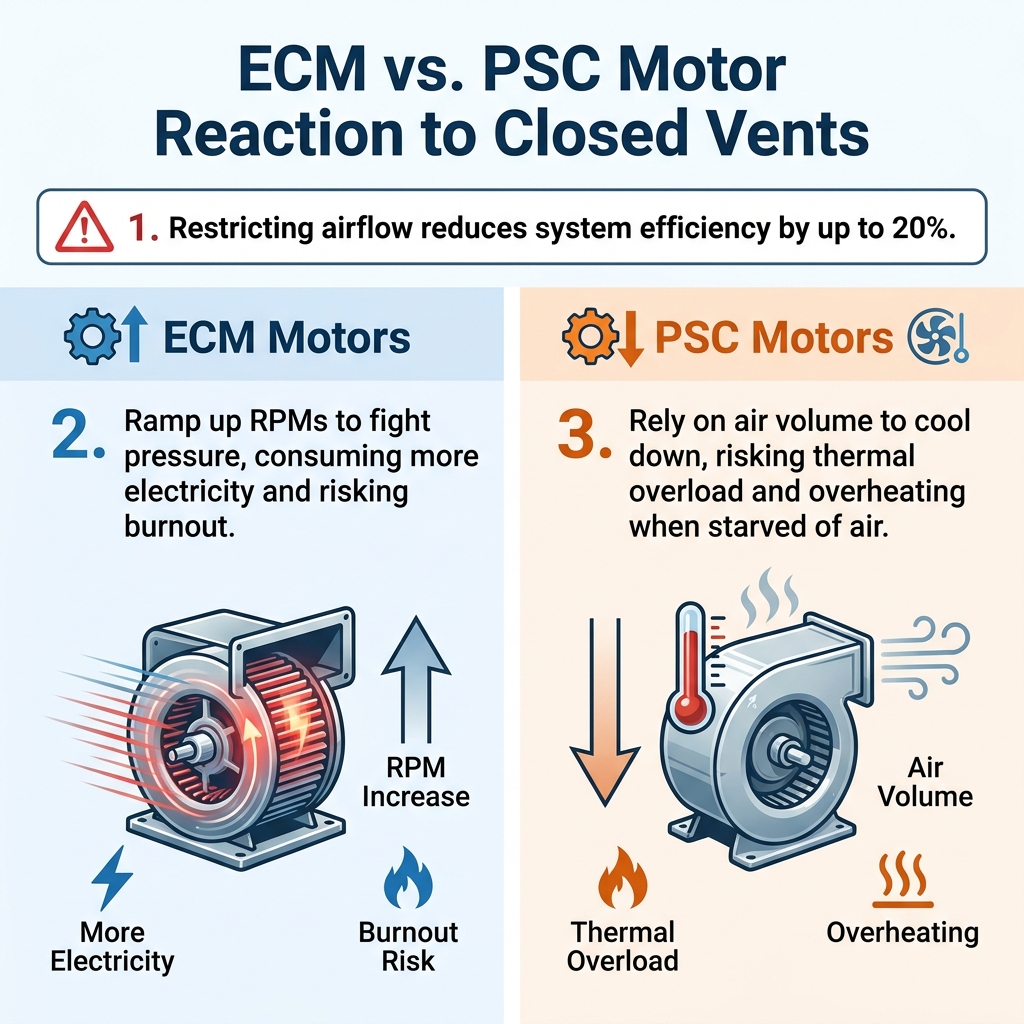
According to Department of Energy data, restricting indoor airflow can reduce overall system efficiency by up to 20%. When a system works 20% less efficiently, it consumes significantly more electricity while delivering a lower level of comfort. The perceived savings of closing vents in an unused room are entirely lost to this massive efficiency drop. The compressor runs longer cycles, the blower motor draws more amperage, and the elevated static pressure ensures that your monthly utility bills actually go up instead of down.
When the pressure gets too high, the entire air conditioning system suffers, leading to sudden, preventable breakdowns right when outside temperatures soar.
Motor Meltdown: ECM vs. PSC Blower Motors
The blower motor is the beating heart of the HVAC breathing loop. When evaluating HVAC systems across our service area, we typically find one of two types of motors installed depending on the equipment's age and efficiency rating: a modern Electronically Commutated Motor (ECM) or a standard Permanent Split Capacitor (PSC) motor. Both react disastrously to closed vents, but they fail in very different ways.
ECM Motors: Working Themselves to Death
Modern ECMs are variable-speed motors programmed with a specific set of instructions: maintain a precise volume of airflow at all costs. When an ECM senses the elevated static pressure caused by closed vents, its internal computer registers a drop in airflow. To compensate, the motor automatically ramps up its RPMs (revolutions per minute) to push harder against the blockage.
As the RPMs increase, the motor's electricity consumption spikes dramatically. The ECM will continue to fight the pressure, running hotter and faster than its design limits allow, until the internal electronics literally burn out from the strain.
PSC Motors: Overheating from Air Starvation
Older PSC motors operate at a single, fixed speed. They do not have the programming to ramp up when they encounter resistance. Instead, these standard motors rely entirely on the volume of moving air passing over their casing to keep their internal components cool.
When you close vents and restrict the total volume of air moving through the system, you starve the PSC motor of its only cooling mechanism. The motor continues to run at its fixed speed, but without enough air to dissipate the heat it generates, it quickly suffers from thermal overload. The wiring insulation degrades, the bearings dry out, and the motor eventually seizes up completely.
• ECM (Variable Speed) — Reaction to Closed Vents (Elevated Static Pressure): Ramps up RPMs to fight the resistance and maintain airflow. — Primary Cause of Failure: Electronic module burnout from excessive amperage draw.
• PSC (Single Speed) — Reaction to Closed Vents (Elevated Static Pressure): Airflow drops significantly; motor cannot shed generated heat. — Primary Cause of Failure: Thermal overload and mechanical bearing failure.

The Compounding Threat: Late-Summer Heat and High Humidity
The mechanical strain of closed vents is bad enough on a mild day, but the danger compounds exponentially when extreme weather arrives. During the August late-summer cooling season, HVAC systems are already operating near maximum capacity. Adding vent restrictions pushes aging, heat-fatigued motors past their thermal limits right when you need them most.
Battling Greenville's Summer Humidity
In our years of keeping homes comfortable, our team has learned that temperature is only half the battle. Greenville's high summer humidity requires maximum airflow over the indoor evaporator coil to properly dehumidify the home. As warm, moist air passes over the cold indoor coil, the moisture condenses and drains away. If you close vents, you drastically reduce the volume of air moving over that coil. This crippled dehumidification cycle traps humidity indoors, making your home feel sticky and uncomfortable even if the thermostat reads 72 degrees.
The Frozen Evaporator Coil Risk
Poor humidity control is just the first symptom; a frozen coil is the catastrophic result. When airflow is restricted by closed vents, there isn't enough warm return air blowing over the evaporator coil to keep it above freezing. The coil's temperature plummets, and all that condensed summer humidity instantly turns into ice.
Once a layer of ice forms, it acts as an insulator, further restricting airflow and causing a rapid chain reaction until the entire coil is encased in a solid block of ice. A frozen coil completely halts the cooling process and risks sending liquid refrigerant back to the outdoor compressor—a fatal event for the unit. The strain of peak temperatures is unforgiving. During the back-to-school transition last August, our team responded to a call where a local family completely lost cooling because their aging, overworked unit finally failed under this exact strain. Our professional installation team had to promptly replace the old system to restore comfort to the home. (If you ever find yourself needing a sudden system replacement, keep in mind that federal tax credits may apply to qualifying high-efficiency heat pump installations—we always advise readers to verify current programs with their utility or a tax professional.)
The Winter Warning: Why Summer Blower Motor Strain Impacts Your Furnace
It is easy to think of the air conditioner and the furnace as two completely separate appliances, but they share a critical component: the blower motor. The exact same motor that pushes cold air through your home in July is responsible for distributing heated air in December.
When a blower motor is forced to fight against elevated static pressure during the August late-summer cooling season, the internal wear and tear doesn't reset when autumn arrives. The weakened bearings, the degraded electrical insulation, and the heat-fatigued components carry over into the cold months. A pattern we see often is that a motor that barely survived the summer becomes a massive liability for the upcoming freezing winter.
Preventing a mid-winter breakdown of your heating system starts with how you manage airflow in the summer. Keeping vents open year-round ensures the motor remains healthy, cool, and capable of handling the demands of both seasons.
Proper Solutions for Uneven Cooling (Without Closing Vents)
If closing vents is off the table, how do you handle a home where the master bedroom is always too warm and the guest room is freezing? Our team at Allegiance Heating & Air prioritizes homeowner education to prevent unnecessary breakdowns. We focus on helping families maximize comfort and efficiency through proper system operation rather than just selling premature motor replacements. Here are the safe, professional alternatives we recommend for balancing your home's temperature.
Professional Air Balancing
Instead of choking off the air at the end of the duct run (the room register), airflow should be adjusted at the source. Professional air balancing involves a technician adjusting the dampers located near the indoor unit's plenum.
1. Testing the airflow: Technicians measure the air volume reaching each room to identify severe imbalances.
2. Adjusting the dampers: Small metal valves inside the main duct trunks are adjusted to gently direct air toward struggling rooms.
3. Preserving total volume: Because these adjustments happen at the source, they preserve the total air volume required by the blower motor, avoiding dangerous spikes in static pressure.
Addressing Hidden Duct Leakage
Often, the reason a distant master bedroom isn't getting enough cold air has nothing to do with the guest room vents being open. The real culprit we find is hidden duct leakage.
• Lost air in the attic: Leaking duct seams in an unconditioned attic or crawlspace can steal up to 30% of your conditioned air before it ever reaches the intended room.
• Sealing the leaks: Having a professional seal the ductwork ensures all the air your system produces actually makes it into your living spaces.
• Solving the root cause: Sealing ducts solves the fundamental problem of poor airflow without increasing static pressure or straining the blower motor.
The quick fix: Keep all interior doors open as much as possible, and ensure every single supply and return register in the home is unblocked by furniture, rugs, or closed louvers.
Frequently Asked Questions About HVAC Airflow
Does closing vents damage HVAC?
Yes, it spikes static pressure, which places immense strain on the entire system. This elevated resistance can burn out the electronic modules in modern ECMs and overheat the mechanical components of standard PSC blower motors. Over time, the continuous strain leads to premature breakdowns and costly repairs.
Will closing vents redirect air to other rooms?
No, it acts more like a blockage in a breathing loop rather than a valve in a plumbing system. Instead of smoothly forcing air into other rooms, the blockage reduces overall system efficiency and causes air to back up into the ductwork. The slight increase in airflow you might feel in an adjacent room is heavily outweighed by the damage being done to the equipment.
Why shouldn't I close air vents in unused rooms?
It suffocates the system, leading to a cascade of mechanical failures including frozen evaporator coils, higher energy bills, and premature motor failure. The HVAC system was explicitly sized and designed to heat or cool the total square footage of the home, and it requires all vents to be open to maintain the proper air balance.
Does closing vents save money?
No, restricting airflow can actually reduce system efficiency by up to 20%. Because the blower motor has to work significantly harder against the elevated static pressure, the system consumes more electricity and runs for longer cycles. You end up paying higher utility bills for a less comfortable home.
How does static pressure affect my blower motor?
Elevated static pressure forces the motor to work harder against a physical resistance, similar to breathing through a narrow straw. For variable-speed motors, this causes RPMs to spike and electronics to burn out; for single-speed motors, the lack of airflow leads to severe thermal overload or mechanical burnout.
Protect Your Blower Motor with Proactive Airflow Management
The danger of the closed vent trap is real, but avoiding it is incredibly simple: keep the HVAC breathing loop fully open. By leaving all your supply registers unblocked, you prevent elevated static pressure from silently destroying your equipment. Surviving the demanding August late-summer cooling season requires a healthy, unrestricted blower motor that can move the right volume of air without overheating.
Opening your vents today gives you the confidence that your system is protected from unnecessary internal strain. If your home still suffers from hot spots or uneven cooling after all the registers are open, it's time to have our professionals evaluate your ductwork's health. Consider enrolling in a routine HVAC maintenance plan to keep your system breathing easily year-round, ensuring optimal airflow and long-lasting comfort.
Contact Us Or Schedule Expert Service
Other Blogs
ready to transform your home?
Discover our exceptional home services tailored to meet your needs and enhance your living space.
WHAT OUR CLIENTS HAVE TO SAY ABOUT US

We had a complete HVAC system and a hot water heater installed. The guys were professional, well mannered, and completed the work in a timely manner. Would definitely use them again.
I was nervous at first because my AC broke in the middle of 80 degree weather which is strange for April, but Allegiance Heating and Air was incredibly prompt and professional. The technician arrived within an hour, explained the problem clearly, and completed the repair. The technician , Mr. Garrett Moon was a very nice and courteous young man. He found the problem and fixed it within a timely manner. I highly recommend them for any heating or cooling needs. I’ll definitely give them a call again should I ever have another issue, but hopefully not. Knock on wood 😁. Give them a call… you won’t be disappointed!
From the moment I called to schedule a service, the team was quick to respond and arrived right on time. The technician was professional, friendly, and clearly knowledgeable about my heating system. He explained the repair options in plain language and completed the job efficiently. I appreciated the reliable service and the fact that the work was done the same day. I would definitely recommend Allegiance Heating and Air for any residential HVAC needs.
5/5 stars – I was very impressed with the efficient, affordable and timely service from Allegiance Heating and Air. The technician arrived on time, and performed the service quickly, no repairs needed at this time. Communication was clear and the whole experience felt hassle‑free. I would definitely recommend them for any residential HVAC needs.
Knowledgeable, experienced individual.
Explains Allegiance Heating and Air was incredibly reliable, professional and affordable. They arrived right on time, kept the work area clean and finished the furnace repair quickly. The technician explained everything clearly and the price was a great value. If happiness had a location on Google Maps, it would be here.
Gilbert had to go above and beyond because York is no longer making the part for my furnace. But he was able to find a way to construct a housing bracket for my furnace. Ingenuity, determination and integrity is what finally got my furnace fixed. Gilbert is truly a one of a kind technician.
Thank you for always going the extra mile. Gilbert is always respectful and helpful with any concerns.
"Great service, most knowledgeable and capable HVAC business in Kentuckiana!! Pete Flemming and Bryan the owner, are HVAC encyclopedias. They have the highest integrity of any HVAC business I have ever used. Allegiance has put numerous units in for me over the last 17 years. I will continue to use and trust them."
"Fast response from Allegiance when our heat was out on New Year’s day! Service technician was friendly and efficient. He took the time to explain the problem, tell us about the temporary fix and the plan for permanent repair. We were impressed!"
"Love Allegiance! Their technicians, in particular Benjamin, explain everything. Fast and thorough. A/C was out on a Sunday. Called Allegiance and within a few hours Benjamin arrived. Such a comfort as he was the one who last serviced our units. He quickly replaced part and cooling is restored!"
"My heat pump went out and I had to call after hours. The technician (Garrett) was outstanding and thorough. He got my system up and working until Monday and gave me several options of units. Also took the time to explain the issue to my Home warranty company. I highly recommend this company."
"Right on time :) respectful, fast, and polite. Even gave my fur babies some attention."
"Had Garrett out today to fix our AC. Fantastic tech. He showed up exactly when he said he would and kept us informed of what he was checking and what he found. Highly recommend!"
"Lucas with Allegiance showed up on time as promised, was professional and extremely patient and responsive with all my questions. He took care of the issue, and I feel he was trustworthy! He had us back to cool and comfortable on one of the hottest days of the year."
"Lucas did a great job! Very professional and expedient. Explained the process very well and represented Allegiance as a truly professional and reputable company."
"Arrived on time and work diligently to fix issue. These guy are great. Worked quickly to resolve my issues."
"Lucas was great - he spent a lot of time trying to figure out what was going on and explained everything he was doing. I trust Allegiance and wouldn’t want anyone else working on/in my house!!"

RELATED ARTICLES

New Albany Enterprises: Expert Commercial Heat Pump Installation
How to Get Same Day Heating Replacement in New Albany