


The Simple Answer to How Often Should You Service Your HVAC System

How often should you service your HVAC system depends on what type of equipment you have, but for most Greenville, IN homeowners, the answer is straightforward:
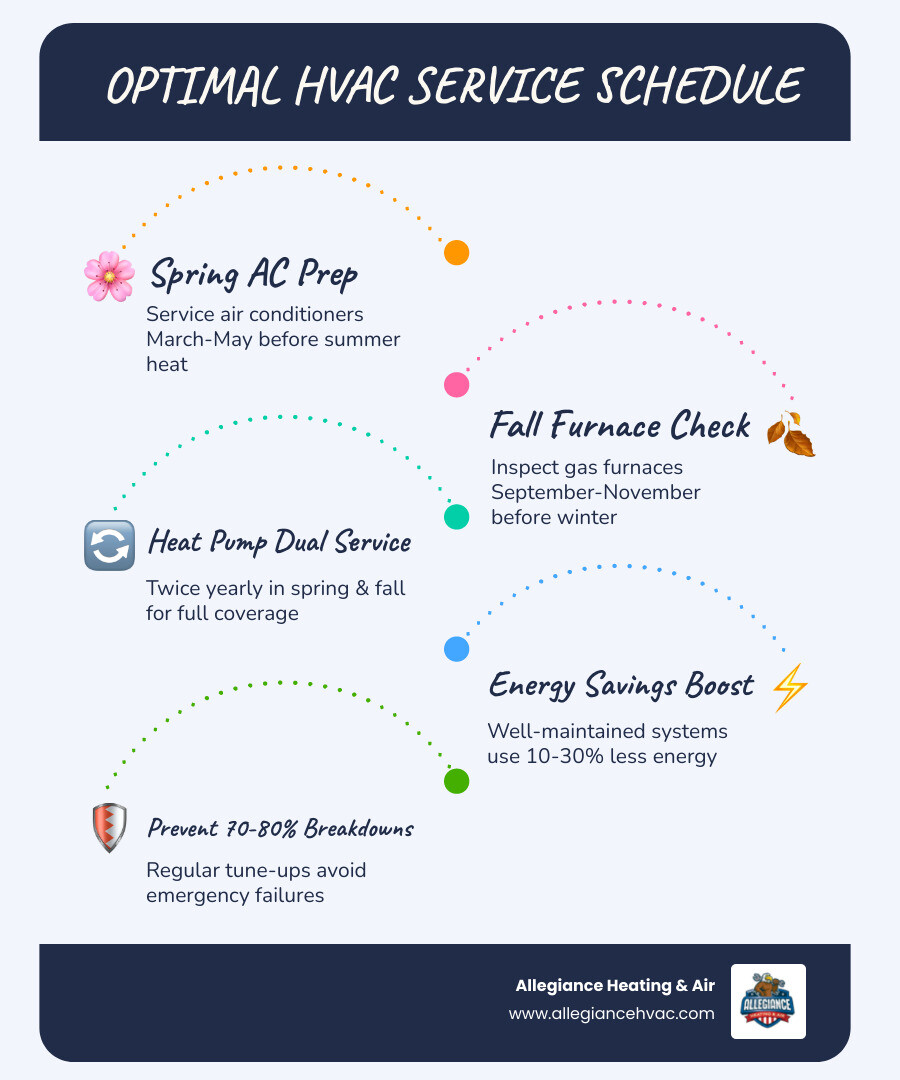
• Central Air Conditioner — Recommended Service Frequency: Once per year — Best Timing: Spring (March-May)
• Gas Furnace — Recommended Service Frequency: Once per year — Best Timing: Fall (September-November)
• Heat Pump — Recommended Service Frequency: Twice per year — Best Timing: Spring & Fall
For most homes, that means two professional visits per year - one before cooling season and one before heating season. If you only have a furnace and separate AC, one visit each season still covers both units on the ideal schedule.
Here's why this matters more than you might think: research consistently shows that a neglected HVAC system can use 10-30% more energy than a well-maintained one. Regular maintenance also prevents 70-80% of breakdowns - the kind that tend to happen on the hottest day of July or the coldest night in January.
Think of it like your car. You wouldn't skip oil changes and hope for the best. Your HVAC system runs thousands of hours a year moving conditioned air through your entire home. It deserves the same basic attention.
And skipping service doesn't just mean a higher energy bill. Many manufacturer warranties require documented professional maintenance to stay valid. Miss a visit, and you could be paying out of pocket for a repair that should have been covered.
The good news? Staying ahead of this is simple once you know the schedule.
How Often Should You Service Your HVAC System in Bradford?
In our local area, including communities like Bradford and Georgetown, we experience the full range of Indiana seasons. From humid, sweltering summers to bone-chilling winters, your comfort system never really gets a long vacation. Because of this high demand, the "twice-yearly" rule is the gold standard for reliability.
Ideally, you want to schedule your Essential Air Conditioner Maintenance in the spring. This ensures that when the first 90-degree day hits, your system is clean, charged with refrigerant, and ready to hum along efficiently. Conversely, fall is the time for a furnace check-up to ensure your heating components are safe and operational before the first frost.
Following a consistent HVAC Spring Checklist helps us catch small issues—like a fraying belt or a struggling capacitor—before they turn into a total system failure. By aligning your service with these seasonal transitions, you ensure peak efficiency and avoid the "peak season rush" when technicians are busiest responding to emergencies.
Why seasonal changes dictate how often should you service your hvac system
Your HVAC system isn't just one machine; it’s a collection of components that work differently depending on the mode. In the summer, your AC or heat pump is working to strip heat and humidity from your home. In the winter, your furnace is managing combustion and heat exchange.
Because these modes put stress on different parts of the system, a single annual visit often leaves half the system unchecked for too long. For example, if you only service the furnace in the fall, your AC unit sits all winter collecting debris and could develop a refrigerant leak that goes unnoticed until you try to turn it on in June. Using our Ways to Make Sure Your HVAC System is Ready for Summer guide can help you understand why this preparation is vital for peak performance and energy savings.
Household factors that influence how often should you service your hvac system
While twice a year is the standard, some homes in our service area—from New Albany to Sellersburg—might need a little extra attention. Several factors can increase the wear and tear on your equipment:
• System Age: If your unit is over 10–12 years old, parts are naturally closer to the end of their lifespan. More frequent checks can help you How to Extend Your HVAC Lifespan by catching fatigue early.
• Pets: Fur and dander are the enemies of airflow. If you have multiple indoor pets, your coils and filters will clog much faster than a pet-free home.
• Allergies: If family members suffer from severe respiratory issues, more frequent servicing and filter changes are necessary to keep indoor air quality high.
• Usage Patterns: A home that is occupied 24/7 or a "work from home" household puts more "miles" on the HVAC system than a house that sits empty during the workday.
Professional Maintenance vs. Homeowner DIY Tasks
We often get asked if homeowners can handle maintenance themselves. The answer is: yes and no. There are several vital tasks you should do to keep things running smoothly, but they don't replace the need for a professional eye.
Homeowner DIY Tasks:
• Filter Replacement: This is the single most important thing you can do. Check them monthly and replace them every 1–3 months.
• Clear Debris: Keep the outdoor unit clear of leaves, grass clippings, and weeds. Maintain at least two feet of clearance around the unit.
• Visual Inspections: Keep an eye out for Furnace Maintenance Tips like checking for unusual rust or soot around your furnace burners.
Professional Service Tasks:When we visit for a professional tune-up, we go much deeper than a surface cleaning. We use specialized tools to check electrical connections, measure refrigerant levels (which should never be low unless there is a leak), and calibrate the thermostat. In places like Bradford, we provide Affordable Furnace Maintenance Tips Bradford IN that include safety checks you simply can't do without professional equipment.
• Change Air Filters — Homeowner DIY: Yes — Professional Technician: Yes (during visit)
• Clean Outdoor Debris — Homeowner DIY: Yes — Professional Technician: Yes (deep coil cleaning)
• Check Refrigerant Levels — Homeowner DIY: No — Professional Technician: Yes (required)
• Inspect Heat Exchanger — Homeowner DIY: No — Professional Technician: Yes (critical safety)
• Tighten Electrical Links — Homeowner DIY: No — Professional Technician: Yes
• Lubricate Moving Parts — Homeowner DIY: No — Professional Technician: Yes
The Real Risks of Skipping Your Scheduled Tune-Up
It’s easy to think, "If it ain't broke, don't fix it." However, HVAC systems are "stealth" failers. They often continue to run while a problem is brewing, but they do so by consuming significantly more energy.
Skipping your service leads to:
1. Emergency Breakdowns: 70–80% of repairs are preventable. Without a tune-up, you risk needing our 24 Hour Furnace Maintenance Guide Bradford IN during a winter storm because a simple sensor was dirty.
2. Voided Warranties: Most major brands require proof of annual professional maintenance. If a major part like a compressor fails, the manufacturer may deny the claim if you haven't kept up with service.
3. Safety Hazards: This is especially true for gas furnaces. We check for cracked heat exchangers, which can leak deadly carbon monoxide into your home.
4. Efficiency Loss: Dirty coils can reduce cooling efficiency by up to 40%. You’re essentially paying the utility company for air you aren't feeling.
Keep an eye out for Key Signs of HVAC Issues, such as strange smells or a sudden spike in your monthly bill. These are the system's way of telling you that skipping maintenance is starting to catch up.
Frequently Asked Questions about HVAC Maintenance
Do new systems really need annual service or is it a sales tactic?
It is definitely not a sales tactic. Think of a new system like a new car—you still need to change the oil to keep the warranty valid and the engine running at factory-rated efficiency. New systems rely on high-precision components that are sensitive to dust and electrical fluctuations. Regular service protects your large investment and ensures you actually get the 15–20 years of life the system is designed to provide.
What are the signs my system needs service sooner than scheduled?
Sometimes a system needs help between its bi-annual visits. Check out the Top Signs HVAC System Needs Service, which include:
• Unusual Noises: Squealing, banging, or rattling.
• Weak Airflow: If the air coming out of the vents feels like a whisper.
• Frequent Cycling: The unit turning on and off every few minutes.
• Uneven Temperatures: One room is an ice box while the other is a sauna.
How often should I change my air filters and clean my vents?
We recommend checking your filters every 30 days. If you use basic 1-inch fiberglass filters, they usually need changing every month. Higher-end pleated filters can last 90 days. For vents, a simple vacuuming of the grilles monthly is great for preventing dust accumulation. If you see visible mold or a thick "carpet" of dust inside the vents, it may be time for a more professional duct inspection.
Conclusion
At Allegiance Heating & Air, we’ve been "Taking Home Comfort Under Our Wing" since 2005. As a family-owned business serving Greenville, IN, and the surrounding areas from Floyds Knobs to Corydon, we know that our neighbors value honesty and reliability. We don't want you to wait until you see smoke or feel the heat to give us a call.
Regular maintenance is the most cost-effective way to run your home. By understanding the Benefits Our Maintenance Plan Provides, you can take the guesswork out of your schedule. Our Maintenance Plan is designed to give you priority service and peace of mind, ensuring your system is always ready for whatever the Indiana weather throws our way.
Don't let your HVAC system become an afterthought. Schedule your tune-up today and breathe easier knowing your home is in professional hands.
Contact Us Or Schedule Expert Service
Other Blogs
ready to transform your home?
Discover our exceptional home services tailored to meet your needs and enhance your living space.
WHAT OUR CLIENTS HAVE TO SAY ABOUT US

We had a complete HVAC system and a hot water heater installed. The guys were professional, well mannered, and completed the work in a timely manner. Would definitely use them again.
I was nervous at first because my AC broke in the middle of 80 degree weather which is strange for April, but Allegiance Heating and Air was incredibly prompt and professional. The technician arrived within an hour, explained the problem clearly, and completed the repair. The technician , Mr. Garrett Moon was a very nice and courteous young man. He found the problem and fixed it within a timely manner. I highly recommend them for any heating or cooling needs. I’ll definitely give them a call again should I ever have another issue, but hopefully not. Knock on wood 😁. Give them a call… you won’t be disappointed!
From the moment I called to schedule a service, the team was quick to respond and arrived right on time. The technician was professional, friendly, and clearly knowledgeable about my heating system. He explained the repair options in plain language and completed the job efficiently. I appreciated the reliable service and the fact that the work was done the same day. I would definitely recommend Allegiance Heating and Air for any residential HVAC needs.
5/5 stars – I was very impressed with the efficient, affordable and timely service from Allegiance Heating and Air. The technician arrived on time, and performed the service quickly, no repairs needed at this time. Communication was clear and the whole experience felt hassle‑free. I would definitely recommend them for any residential HVAC needs.
Knowledgeable, experienced individual.
Explains Allegiance Heating and Air was incredibly reliable, professional and affordable. They arrived right on time, kept the work area clean and finished the furnace repair quickly. The technician explained everything clearly and the price was a great value. If happiness had a location on Google Maps, it would be here.
Gilbert had to go above and beyond because York is no longer making the part for my furnace. But he was able to find a way to construct a housing bracket for my furnace. Ingenuity, determination and integrity is what finally got my furnace fixed. Gilbert is truly a one of a kind technician.
Thank you for always going the extra mile. Gilbert is always respectful and helpful with any concerns.
"Great service, most knowledgeable and capable HVAC business in Kentuckiana!! Pete Flemming and Bryan the owner, are HVAC encyclopedias. They have the highest integrity of any HVAC business I have ever used. Allegiance has put numerous units in for me over the last 17 years. I will continue to use and trust them."
"Fast response from Allegiance when our heat was out on New Year’s day! Service technician was friendly and efficient. He took the time to explain the problem, tell us about the temporary fix and the plan for permanent repair. We were impressed!"
"Love Allegiance! Their technicians, in particular Benjamin, explain everything. Fast and thorough. A/C was out on a Sunday. Called Allegiance and within a few hours Benjamin arrived. Such a comfort as he was the one who last serviced our units. He quickly replaced part and cooling is restored!"
"My heat pump went out and I had to call after hours. The technician (Garrett) was outstanding and thorough. He got my system up and working until Monday and gave me several options of units. Also took the time to explain the issue to my Home warranty company. I highly recommend this company."
"Right on time :) respectful, fast, and polite. Even gave my fur babies some attention."
"Had Garrett out today to fix our AC. Fantastic tech. He showed up exactly when he said he would and kept us informed of what he was checking and what he found. Highly recommend!"
"Lucas with Allegiance showed up on time as promised, was professional and extremely patient and responsive with all my questions. He took care of the issue, and I feel he was trustworthy! He had us back to cool and comfortable on one of the hottest days of the year."
"Lucas did a great job! Very professional and expedient. Explained the process very well and represented Allegiance as a truly professional and reputable company."
"Arrived on time and work diligently to fix issue. These guy are great. Worked quickly to resolve my issues."
"Lucas was great - he spent a lot of time trying to figure out what was going on and explained everything he was doing. I trust Allegiance and wouldn’t want anyone else working on/in my house!!"

RELATED ARTICLES

The 65-Degree Fallacy: Why Cranking Your Thermostat Down Doesn't Cool Your House Faster
Identifying When Mini Split Heat Pumps Need Service
