Breaking Through the August Heat: Why Wait Times Spike
Your air conditioner has been running constantly since sunrise, but the house still feels uncomfortably warm, and you are suddenly facing The Late-Summer Booking Crunch: How to Get Faster HVAC Service in Clarksville. That strange rattling noise you ignored in June has finally turned into a total system failure right as the late-summer August crunch hits its peak. You pick up the phone, make a call, and are met with the frustrating news that you are on a waiting list. Sweating in your own living room while waiting for a callback is a miserable experience, but this sudden surge in air conditioning failures creates an unavoidable bottleneck for every contractor in the region.
When the dispatch boards here at Allegiance Heating & Air light up on a Monday morning after a scorching weekend, the sheer volume of calls can be overwhelming. In our years of keeping Clarksville and Greenville IN homes comfortable, we've seen how heat waves do not just break one or two older systems; they stress hundreds of aging units across the region simultaneously. However, there is a distinct decision point that many homeowners miss: the specific details you provide during your initial phone call directly influence how fast a technician arrives at your door. Knowing what to say and what information to have ready can be the difference between waiting days or getting same-day attention. When you need reliable HVAC services or fast air conditioning service, understanding how our dispatch process works is the key to getting a technician to your home faster.
Inside the Dispatch Board: It Is Not Just First-Come, First-Served
A common misconception among homeowners is that service tickets are handled in strict chronological order—that if you call at 8:00 AM, you will automatically be seen before the person who calls at 8:15 AM. In reality, dispatching is a highly dynamic triage process. Our team actively organizes calls based on severity, safety risks, and logistical efficiency to ensure we help the most vulnerable people as quickly as possible while maximizing our technicians' time in the field.
When you contact our dispatch team, you are speaking directly to local professionals who understand the layout of the community. Generic national call centers simply plug addresses into a computer and assign numbers. In contrast, our local dispatchers at Allegiance Heating & Air understand Clarksville neighborhoods, traffic patterns, and regional weather realities, allowing for smarter, faster routing. We know exactly how long it takes to get from one side of town to the other during afternoon rush hour, and we use that knowledge to build highly efficient routes.
• Every call is placed at the back of a single, long line. — The Actual Dispatch Triage Reality: Calls are grouped by geographic zones and prioritized by safety risks.
• A warm house always means a long wait during peak season. — The Actual Dispatch Triage Reality: Specific symptoms (like electrical smells or vulnerable residents) elevate priority instantly.
• Technicians bounce randomly from one side of town to the other. — The Actual Dispatch Triage Reality: Routes are tightly clustered to minimize driving and maximize repair time.
• Whoever answers the phone is just taking messages. — The Actual Dispatch Triage Reality: Local dispatchers actively analyze your symptoms to ensure the right parts are on the truck.
The Anatomy of a Service Route
To understand why wait times fluctuate, it helps to look at how technicians are deployed. Our Allegiance Heating & Air service area is divided into geographic zones to minimize "windshield time"—the unproductive hours spent sitting in traffic. If a technician is already working in a specific neighborhood and an urgent call comes in two streets over, that nearby call might get bumped ahead of a less severe issue across town. This is not about playing favorites; it is about pure logistics. By clustering calls geographically, a single technician can restore cooling to five homes in a day instead of just three. This geographic grouping is exactly why providing accurate details upfront is so critical to getting slotted into a technician's active route.
What Makes a Broken AC a True Emergency?
Not all air conditioning failures are created equal. From the perspective of our dispatch desk, there is a massive difference between mild discomfort and a true health hazard. If your system is running but struggling to keep up with the afternoon heat, you are experiencing a breakdown. But if your system has suffered a catastrophic failure and the indoor temperature is climbing rapidly, that call requires a different level of attention.
As local experts serving the Ohio River Valley, our team typically sees how the oppressive late-summer heat and high humidity severely accelerate indoor heat rise. High humidity drastically reduces the human body's ability to cool itself through evaporation. Because of this regional climate factor, high indoor temperatures become a critical health and safety risk much faster here than in dry climates. When we triage the board during the late-summer August crunch, we look for specific triggers that elevate a call to emergency status:
• Vulnerable individuals in the home: The presence of infants, elderly family members, or individuals with medical conditions that are exacerbated by heat instantly elevates a call's priority.
• Dangerous indoor temperatures: A thermostat reading 80+ degrees indoors, especially when combined with our regional humidity, transitions the situation from an inconvenience to a safety concern.
• Electrical hazards: If you notice the smell of burning plastic, ozone, or see sparking near your equipment, the system must be shut down immediately and the call is prioritized to prevent fire risks.
• Active water leaks: A frozen evaporator coil that thaws rapidly or a clogged condensate drain can dump gallons of water through your ceiling or onto your floors. Active property damage triggers immediate triage escalation.
By clearly communicating these specific factors, you give our dispatch team the exact information they need to move your ticket up the board.
The 4 Crucial Details to Tell Your HVAC Dispatcher
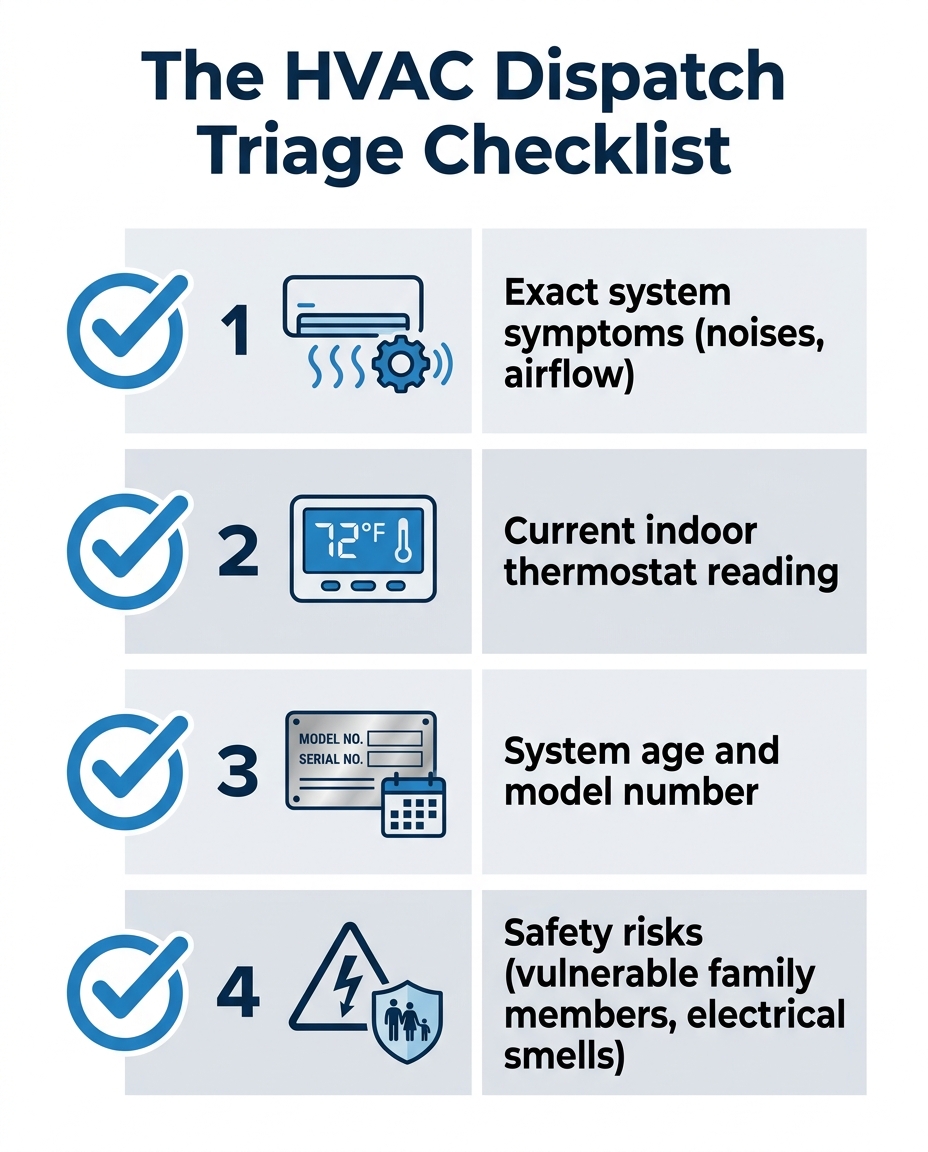
When you are frustrated and sweating, it is easy to just call and say, "My AC is broken, please send someone." However, vague descriptions force dispatchers to guess at the severity of the problem. To cut through the noise and get faster service, you need to provide a highly actionable checklist of details. Giving us a clear picture of the situation helps us understand exactly what is happening and ensures the technician arrives prepared.
1. Exact Symptoms: Do not just state that the unit is broken. Describe what you hear, see, and feel. Is the outdoor condenser fan spinning? Is warm air blowing from the vents, or is there no airflow at all? Are there grinding or squealing noises? These clues help us diagnose the issue before we even arrive.
2. Current Indoor Temperature: Walk over to your thermostat and provide the exact reading. A house sitting at 74 degrees because the system is just struggling to keep up is prioritized differently than a thermostat reading 80+ degrees indoors with the temperature still climbing.
3. System Age and History: Let the dispatcher know if this is a relatively new unit still under warranty or an aging system that has a history of breaking down every summer. This context helps us determine if we are likely looking at a simple capacitor swap or a major component failure.
4. Safety Risks: Clearly state if anyone in the home is highly sensitive to heat, or if you have noticed any unusual electrical smells, tripped breakers that will not reset, or water pooling around the indoor air handler.
Locating Your System Details Fast
Before you pick up the phone, take two minutes to locate your system's data plate. This is usually a sticker or metal plate located on the side of the outdoor condenser cabinet. Snap a clear photo of it with your smartphone. This plate contains the model and serial number of your equipment. Providing these numbers to the dispatcher is one of the best ways to speed up your service. It allows our team to look up the exact specifications of your unit, ensuring that the technician has the correct size capacitor, fan motor, or contactor on the truck before they even pull into your driveway. If you want to learn more about how your equipment functions, spending some time understanding your air conditioning system can make these conversations much easier.

Navigating Weekend and After-Hours Cooling Failures
Air conditioners rarely wait for regular business hours to fail. They tend to break down when they are working their hardest—which is often late on a Friday afternoon just as the kids get home from back-to-school activities, or in the middle of a sweltering Sunday. Navigating the weekend dispatch board requires a slightly different approach.
During the weekend, HVAC companies operate with skeleton crews and on-call technicians. The board is managed differently, and the triage process becomes even more strict. If you reach an after-hours answering service, the most important thing you can do is leave a highly detailed message using the four crucial details outlined above. Many homeowners hang up, assuming they will just call back on Monday, but leaving a clear message puts you directly into the queue for the on-call technician to review.
At Allegiance Heating & Air, we excel in these after-hours situations because we have the flexibility to escalate severe issues directly to ownership or senior technicians for rapid resolution. For example, our team recently helped a local homeowner who experienced a sudden heating and air issue late on a weekend. Because they communicated the severity of the problem clearly, we personally responded, performed the necessary quality work quickly, and resolved the issue efficiently without the massive corporate red tape found elsewhere. Setting realistic expectations is also vital during these times. A weekend call is primarily focused on restoring cooling and handling diagnostics; if a system requires a massive, complex overhaul, our tech will stabilize the situation and schedule the heavy lifting for regular hours across the Clarksville service area.
When Repair Isn't Enough During the Hottest Week of the Year
Sometimes, the diagnostic call reveals a harsh reality: the system is beyond simple repair. When an older unit suffers a catastrophic failure—like a seized compressor or a massive refrigerant leak in a degraded coil—a full replacement becomes the only viable option to restore comfort safely.
Handling a full system replacement during the peak late-summer August crunch involves a different set of logistics. Installation crews are dispatched separately from diagnostic technicians. When a diagnostic tech condemns a system, they immediately hand the file over to an install coordinator who begins sourcing the new equipment and rearranging the installation schedule. We prioritize emergency replacements for homes without any cooling, pushing routine upgrades back slightly to ensure families are not left in dangerous heat.
This rapid pivot from repair to replacement is a true test of a local company's operational strength. Just last August, our team worked with another local customer who lost their AC entirely right as the back-to-school season began. Because the diagnostic details were clear and the triage was accurate, we were able to promptly replace the old AC system, sending out professional, knowledgeable installers to get the home cooling again in record time. While an unexpected replacement is stressful, resolving an older, failing system with modern, high-efficiency equipment provides long-term energy savings and vastly improved indoor comfort.
Proactive Strategies: Bypassing the Wait Entirely
In our experience serving Clarksville and Greenville IN, the absolute best way to handle the late-summer booking crunch is to bypass it entirely. Proactive maintenance is the ultimate insurance policy against long wait times and uncomfortable afternoons. When you take care of your system before the severe weather hits, you drastically reduce the chances of an emergency breakdown.
One of the most effective strategies is enrolling in a routine maintenance plan. These agreements typically come with VIP priority service benefits. When the dispatch board is completely full in August, customers with active maintenance agreements are automatically bumped to the front of the line. It is our way of rewarding the homeowners who partner with us to keep their equipment in top shape year-round.
From our years of field experience, we recommend pre-season tune-ups because they catch the small, hidden issues that turn into major failures. A technician can identify a failing capacitor, clean a suffocating blanket of dirt off the condenser coil, and top off low refrigerant long before the August heat arrives. If you do find yourself facing a warm house, always run through a quick basic checklist before making the call:
• Check the air filter: A severely clogged filter restricts airflow so badly that the evaporator coil can freeze solid, shutting down the whole system.
• Inspect thermostat batteries: A blank screen often just means the AA batteries need replacing, not that the AC is dead.
• Verify the breaker panel: Sometimes a temporary power surge trips the dedicated AC breaker. Reset it once; if it trips again immediately, leave it off and call for service.
An established relationship with a local HVAC provider means we already have your equipment history, model numbers, and service records on file, making the entire dispatch process seamless.
Getting Your Cooling Restored with Local Experts
When the heat is rising and your system is failing, clear communication is your best tool for cutting through the noise. Do not wait for the situation to become unbearable. Gather your system details, check your exact indoor temperature, and prepare to explain your symptoms clearly.
By understanding how triage works, you take control of the situation and give the dispatchers exactly what they need to help you. If you are currently dealing with The Late-Summer Booking Crunch: How to Get Faster HVAC Service in Clarksville, reach out to the Allegiance Heating & Air team. We understand the regional climate and prioritize community safety. We are ready to get your home back to a comfortable, safe temperature—reach out for your air conditioning service today.
Frequently Asked Questions
Is a broken AC considered an emergency?
A broken AC becomes an emergency when indoor temperatures rise to dangerous levels, typically 80 degrees or higher, especially in high humidity. It is also an emergency if there are vulnerable individuals in the home, such as infants or the elderly. Electrical burning smells or active water leaks instantly elevate a breakdown to emergency status.
How do HVAC companies prioritize service calls?
HVAC companies prioritize calls using a triage system based on safety risks, severity of the issue, and geographic routing. Rather than a strict first-come, first-served line, dispatchers group calls by neighborhood to minimize driving time. Homes with extreme temperatures or vulnerable residents are always moved to the front of the queue.
How long does it take for an HVAC tech to come out?
Response times vary wildly depending on the season and the severity of your issue. During peak late-summer heat, routine calls might wait a day or two, while true emergencies are often handled the same day. Providing clear details about your symptoms and indoor temperature can help speed up your specific response time.
What is the most important information to give an HVAC dispatcher?
The most crucial details are your exact indoor temperature, the specific symptoms your system is showing, and whether there are any safety risks in the home. Additionally, providing the model and serial number from your outdoor unit helps the dispatcher ensure the technician brings the correct parts. Clear information prevents guesswork and speeds up triage.
What should I check before calling for AC repair in August?
Always check your thermostat batteries and ensure your indoor air filter is clean before making a call. You should also verify that the dedicated circuit breaker for your air conditioner has not tripped. Resolving these simple issues yourself can save you the cost and wait time of a professional service visit.
Does having a maintenance plan change my place in line?
Yes, most reputable HVAC companies offer VIP priority routing to customers enrolled in their maintenance programs. When the dispatch board is completely full during a heatwave, maintenance members are automatically moved ahead of non-members. It is one of the most valuable benefits of proactive system care.
Contact Us Or Schedule Expert Service
Other Blogs
ready to transform your home?
Discover our exceptional home services tailored to meet your needs and enhance your living space.
WHAT OUR CLIENTS HAVE TO SAY ABOUT US

We had a complete HVAC system and a hot water heater installed. The guys were professional, well mannered, and completed the work in a timely manner. Would definitely use them again.
I was nervous at first because my AC broke in the middle of 80 degree weather which is strange for April, but Allegiance Heating and Air was incredibly prompt and professional. The technician arrived within an hour, explained the problem clearly, and completed the repair. The technician , Mr. Garrett Moon was a very nice and courteous young man. He found the problem and fixed it within a timely manner. I highly recommend them for any heating or cooling needs. I’ll definitely give them a call again should I ever have another issue, but hopefully not. Knock on wood 😁. Give them a call… you won’t be disappointed!
From the moment I called to schedule a service, the team was quick to respond and arrived right on time. The technician was professional, friendly, and clearly knowledgeable about my heating system. He explained the repair options in plain language and completed the job efficiently. I appreciated the reliable service and the fact that the work was done the same day. I would definitely recommend Allegiance Heating and Air for any residential HVAC needs.
5/5 stars – I was very impressed with the efficient, affordable and timely service from Allegiance Heating and Air. The technician arrived on time, and performed the service quickly, no repairs needed at this time. Communication was clear and the whole experience felt hassle‑free. I would definitely recommend them for any residential HVAC needs.
Knowledgeable, experienced individual.
Explains Allegiance Heating and Air was incredibly reliable, professional and affordable. They arrived right on time, kept the work area clean and finished the furnace repair quickly. The technician explained everything clearly and the price was a great value. If happiness had a location on Google Maps, it would be here.
Gilbert had to go above and beyond because York is no longer making the part for my furnace. But he was able to find a way to construct a housing bracket for my furnace. Ingenuity, determination and integrity is what finally got my furnace fixed. Gilbert is truly a one of a kind technician.
Thank you for always going the extra mile. Gilbert is always respectful and helpful with any concerns.
"Great service, most knowledgeable and capable HVAC business in Kentuckiana!! Pete Flemming and Bryan the owner, are HVAC encyclopedias. They have the highest integrity of any HVAC business I have ever used. Allegiance has put numerous units in for me over the last 17 years. I will continue to use and trust them."
"Fast response from Allegiance when our heat was out on New Year’s day! Service technician was friendly and efficient. He took the time to explain the problem, tell us about the temporary fix and the plan for permanent repair. We were impressed!"
"Love Allegiance! Their technicians, in particular Benjamin, explain everything. Fast and thorough. A/C was out on a Sunday. Called Allegiance and within a few hours Benjamin arrived. Such a comfort as he was the one who last serviced our units. He quickly replaced part and cooling is restored!"
"My heat pump went out and I had to call after hours. The technician (Garrett) was outstanding and thorough. He got my system up and working until Monday and gave me several options of units. Also took the time to explain the issue to my Home warranty company. I highly recommend this company."
"Right on time :) respectful, fast, and polite. Even gave my fur babies some attention."
"Had Garrett out today to fix our AC. Fantastic tech. He showed up exactly when he said he would and kept us informed of what he was checking and what he found. Highly recommend!"
"Lucas with Allegiance showed up on time as promised, was professional and extremely patient and responsive with all my questions. He took care of the issue, and I feel he was trustworthy! He had us back to cool and comfortable on one of the hottest days of the year."
"Lucas did a great job! Very professional and expedient. Explained the process very well and represented Allegiance as a truly professional and reputable company."
"Arrived on time and work diligently to fix issue. These guy are great. Worked quickly to resolve my issues."
"Lucas was great - he spent a lot of time trying to figure out what was going on and explained everything he was doing. I trust Allegiance and wouldn’t want anyone else working on/in my house!!"

RELATED ARTICLES

Tips To Increase Your Homes Indoor Air Quality
Cheat Sheet to Inflation Reduction Act HVAC Benefits for Kentuckiana