The R-22 Phaseout Reality: Why Sourcing Old Refrigerant for Your Dying AC is No Longer Viable
When your aging air conditioner fails in the late summer heat, patching a leak with obsolete R-22 refrigerant is rarely worth the investment. It is time to consider a modern, reliable system.
Is Sourcing Obsolete Refrigerant for Your Failing AC Worth the Investment?
Is your aging air conditioner actually suffering from a catastrophic mechanical failure, or is it simply starved of a chemical you can no longer easily buy? When your system starts blowing warm air during the brutal August / late-summer end-of-season cooling demand, you are immediately forced to confront the R-22 phaseout reality: why sourcing old refrigerant for your dying AC is no longer viable. Most homeowners do not realize that patching a leak on an obsolete system is just throwing good money at a temporary band-aid. Instead of panicking as the indoor temperature climbs, it is time to weigh the compounding costs of tracking down scarce, phased-out chemicals against investing in a reliable, modern cooling unit.
If you are tired of sweating out the end of the season with a struggling system, our comprehensive air conditioning services can help you find a lasting, comfortable solution.
To understand why a simple recharge is no longer a simple fix, you have to look at the mechanics of your cooling system. Air conditioners do not consume refrigerant like a car consumes gas. The chemical operates in a closed loop, constantly absorbing heat from inside your home and releasing it outside. If your system is low on refrigerant, it means there is a physical leak in the copper lines or the evaporator coil. In the past, one of our technicians might have patched the leak and topped off the system. Today, if your equipment relies on R-22, that "simple top-off" has become a monumental financial hurdle due to strict federal environmental regulations. Deciding whether to repair or replace is no longer just about the age of your equipment; it is about the sheer unavailability of the materials needed to keep it running.
Understanding the EPA Ban on R-22 Production and Import
The scarcity of R-22 is not an artificial shortage created by manufacturers; it is the direct result of a decades-long environmental initiative. R-22 is a hydrochlorofluorocarbon (HCFC), a class of chemicals identified as significantly contributing to the depletion of the Earth's ozone layer. To combat this, the Environmental Protection Agency (EPA) mandated a phased reduction in the use and manufacturing of these substances.
As outlined in our comprehensive air conditioning guide, identifying your system's refrigerant type is the first crucial step in making an informed decision about your home's comfort infrastructure. Here is exactly how the regulatory landscape has shifted:
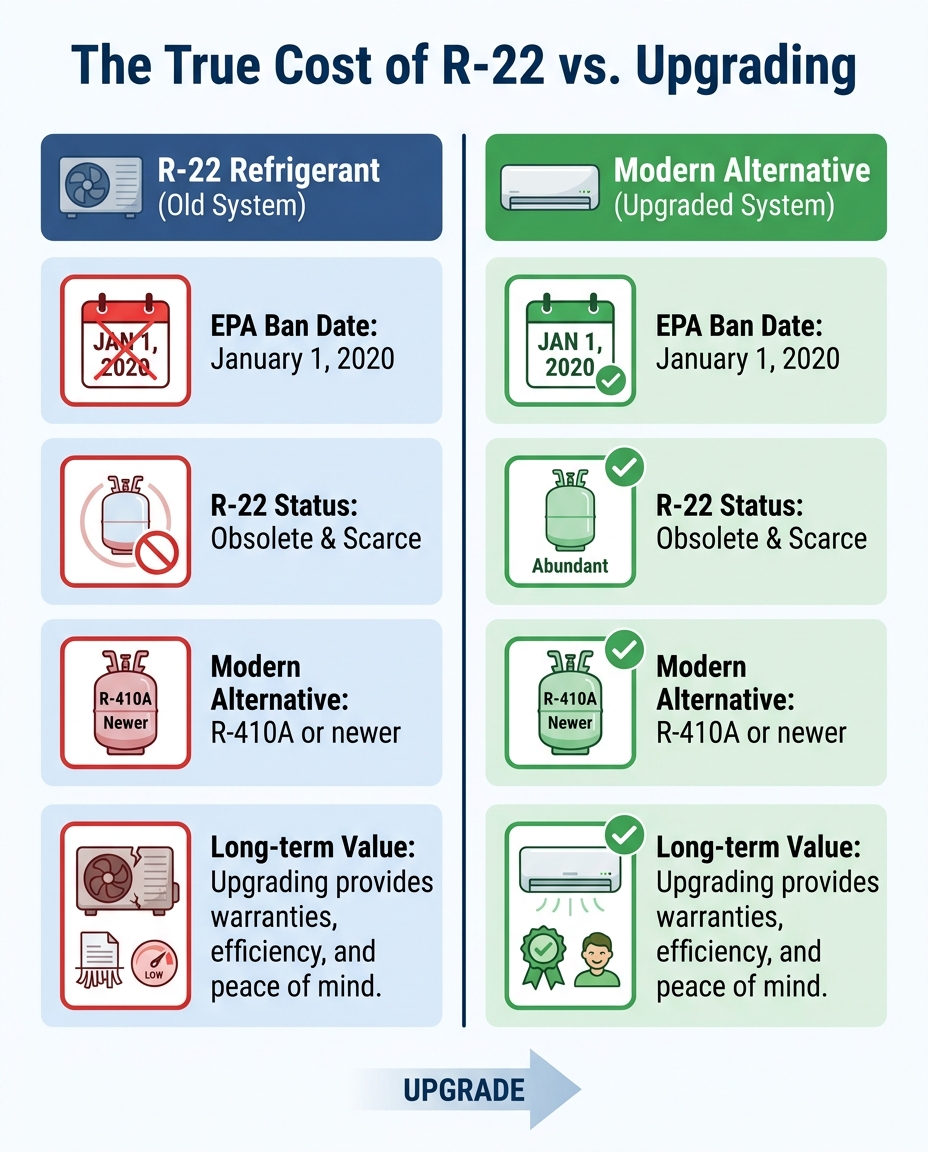
1. The 2010 Equipment Ban: The EPA prohibited the manufacturing of new air conditioning systems that rely on R-22. If your current unit is a pre-2010 model, it is almost certainly using this phased-out chemical.
2. The Gradual Supply Reduction: Between 2010 and 2020, the EPA drastically reduced the amount of new R-22 that could be produced or imported into the United States, forcing the industry to transition to safer alternatives.
3. The January 1, 2020 Total Ban: On this date, the production and import of R-22 became completely illegal in the United States. The supply valve was permanently shut off.
4. The Current Scarcity Reality: Today, the only R-22 legally available for repairs is recovered, recycled, or stockpiled from previous years. As this finite supply dwindles every single summer, the cost to acquire it continues to skyrocket.
It is important to clarify that it is not illegal for you to continue operating an existing R-22 air conditioner. The government is not forcing homeowners to replace perfectly functioning units. However, the regulatory reality means that the moment your pre-2010 system develops a leak, you are trapped. You cannot simply buy a cheap jug of R-22 to get you through the rest of the year. Sourcing the chemical is incredibly difficult, and sinking funds into a dying system is a losing battle because the underlying scarcity issue will only worsen with each passing season.
Band-Aid Repairs vs. Modern System Replacements: A Clear Comparison
When faced with a breakdown during the August / late-summer end-of-season cooling period, the desperation to restore comfort can lead to poor financial decisions. In our years of serving Greenville families, our team at Allegiance Heating & Air sees a common pattern: systems failing right during the back-to-school transition. Recently, one local homeowner lost their AC during the hottest week of August. Instead of wasting money trying to track down scarce R-22 for a temporary fix on an aging unit, they reached out to us for help. Our technicians promptly responded and replaced the old AC system with a brand-new, compliant unit, restoring reliable comfort before the week was over. This is the exact decision point many families face: nursing a dying unit or embracing a modern upgrade.
To make the best choice for your home, you need to look at a side-by-side comparison of what you are actually paying for when you choose a band-aid repair versus a full system replacement.
• Refrigerant Availability — Band-Aid Repair (Old R-22 System): Obsolete, heavily restricted, and sourced only from dwindling recycled stockpiles. — Modern System Replacement (R-410A or Newer): Readily available, legally compliant, and standard across the HVAC industry.
• Long-Term Costs — Band-Aid Repair (Old R-22 System): Astronomical recharge fees that compound every time the aging coils develop a new leak. — Modern System Replacement (R-410A or Newer): Predictable, manageable monthly investments with significantly lower utility bills.
• Energy Efficiency — Band-Aid Repair (Old R-22 System): Degraded efficiency due to age, wear, and outdated single-stage compressor technology. — Modern System Replacement (R-410A or Newer): High-efficiency ratings (SEER2) that optimize energy consumption and reduce waste.
• Warranty Protection — Band-Aid Repair (Old R-22 System): None. You assume 100% of the financial risk for the next inevitable breakdown. — Modern System Replacement (R-410A or Newer): Comprehensive manufacturer warranties covering major parts, compressors, and coils.
• Environmental Impact — Band-Aid Repair (Old R-22 System): High risk of venting ozone-depleting HCFCs into the atmosphere during a leak. — Modern System Replacement (R-410A or Newer): Utilizes modern refrigerants designed with significantly lower environmental risks.
The Hidden Costs of Prolonging the Inevitable
The upfront price of a recharge might seem lower than a full replacement today, but that perspective ignores the hidden costs of prolonging the inevitable. When an aging system springs a leak, patching that specific hole does not reverse the deterioration of the rest of the copper coil. It is highly likely that another leak will form shortly after. Repeated service calls, emergency diagnostic fees, and the constant need to search for scarce refrigerant quickly add up to the cost of a substantial down payment on a brand-new unit.
Furthermore, running an air conditioner with a low refrigerant charge forces the compressor to work overtime. The compressor relies on the flow of refrigerant to keep itself cool. When the system is starved, the compressor overheats and eventually burns out entirely. At that point, the system is catastrophically dead, and the money you spent on the band-aid repair weeks earlier is completely lost. Investing in a new system eliminates this cycle of anxiety and financial waste.

Why Late-Summer Heatwaves Expose Failing Systems
There is a specific reason why so many older air conditioners seem to fail at the absolute worst time of the year. In our experience repairing ACs across Greenville IN, we see firsthand how the local climate puts an immense, compounding strain on residential cooling equipment. By the time late summer arrives, your air conditioner has been running relentlessly for months. The intense heat pushes aging, worn-out compressors to their absolute breaking point. Parts that were already compromised by years of friction and vibration finally give out under the sustained workload.
Compressor strain is just one part of the equation. Refrigerant plays a dual role in your home: it lowers the temperature, but it also handles the heavy lifting of dehumidification. When warm indoor air blows over a properly chilled evaporator coil, the moisture in the air condenses into water and drains away. This is what keeps your home feeling crisp and comfortable.
When an aging system develops a leak and loses R-22, the coil can no longer reach the optimal temperature for condensation. This leads to a severe loss of dehumidification. With Greenville's high summer humidity, an undercharged AC not only stops cooling effectively, but it completely fails to remove moisture from the air. Your home quickly becomes a clammy, unbearable environment. This intense discomfort often leads to desperation decisions, making homeowners vulnerable to sinking significant funds into poor short-term fixes just to get through the night. Understanding how the local weather accelerates these mechanical failures helps you recognize that a struggling system is not going to magically recover when the weather cools down—it is permanently compromised.
Making the Upgrade Manageable for Local Families
It is completely normal to experience sticker shock when a technician informs you that your pre-2010 air conditioner requires a full-system replacement. An HVAC system is one of the most significant investments you will make in your home, and very few people plan for their AC to fail on a random Tuesday in August. However, pivoting from the stress of a dying unit to the reality of a modern upgrade does not have to drain your savings account.
Transparent cost comparisons are essential during this transition. Allegiance Heating & Air's commitment to transparent, honest cost comparisons and flexible financing options helps families make smart long-term decisions without the pressure of a hard sell. When you look at the total cost of ownership—factoring in the eliminated repair bills, the end of R-22 recharge fees, and the substantial reduction in monthly energy usage—a new system becomes a highly logical financial move.
Flexible payment plans transform a massive upfront burden into manageable monthly investments. Instead of scraping together emergency funds for a temporary repair that carries no warranty, you can redirect that money into a brand-new system that is fully protected for years to come. Explore our HVAC financing options to see how manageable a modern, high-efficiency upgrade can be for your household budget.
Additionally, upgrading to high-efficiency modern systems may qualify you for federal tax credits or local utility rebates. While these programs change frequently, transitioning away from obsolete equipment to energy-saving heat pumps or high-SEER air conditioners often comes with financial incentives designed to reward homeowners for reducing their carbon footprint. We always advise readers to verify current programs with their utility provider or a tax professional, but these incentives can further offset the cost of moving past the R-22 era.
Securing Reliable Cooling for Seasons to Come
Moving past the anxiety of a failing system allows you to focus on the long-term benefits of a modern HVAC installation. As local HVAC professionals, we always tell our customers that when you replace an obsolete unit in Greenville IN, you are not just buying a new metal box for your backyard; you are investing in a comprehensive comfort solution designed for the demands of today's climate.
Here is what you secure when you finally leave R-22 behind:
1. Legal Compliance and Environmental Safety: Modern systems utilize newer, compliant refrigerants that are readily available and significantly safer for the environment. You will never again have to worry about the EPA phasing out the chemical your home relies on to stay cool.
2. Uninterrupted Peak Performance: Today's air conditioners feature advanced technologies, such as variable-speed compressors and enhanced coil designs, that handle peak summer workloads effortlessly. They provide incredibly even cooling and superior humidity control without the constant threat of sudden leaks.
3. Proactive System Protection: A new installation resets the clock on your home's comfort. With a comprehensive manufacturer warranty in place, you are protected against catastrophic part failures.
Of course, even the most advanced modern equipment requires care to maintain its efficiency and longevity. Once your new system is installed, regular upkeep is the key to ensuring optimal performance year after year. Protect your new investment with a preventative maintenance plan. Routine inspections allow technicians to clean coils, clear drain lines, and verify electrical connections before minor wear and tear escalates into a breakdown.
Frequently Asked Questions About R-22 and AC Replacements
Can I still buy R22 refrigerant?
Yes, but only recycled or stockpiled supplies, making it incredibly scarce and conceptually expensive. Because the EPA banned the production and import of new R-22 on January 1, 2020, technicians can only source the chemical from finite reserves. As these reserves continue to shrink every year, the cost to acquire R-22 for a simple repair has become a major financial burden for homeowners with older systems.
What happens if my AC uses R22?
You can legally continue operating it, but any repairs involving leaks will be heavily restricted by the scarcity of the refrigerant. The EPA does not require you to replace a functioning pre-2010 system. However, the moment your system loses its charge due to wear and tear, you will face the difficult decision of paying astronomical fees for stockpiled R-22 or upgrading to a modern, compliant unit.
Can I put R410a in an R22 system?
Absolutely not. Modern refrigerants like R-410A operate at vastly different pressures and require entirely different synthetic oils to lubricate the compressor. Pumping a modern refrigerant into an old R-22 system will cause immediate, catastrophic failure, destroying the compressor and ruining the entire unit. The two chemicals are fundamentally incompatible.
Is it illegal to refill R22?
It is not illegal to refill an existing system, provided the licensed technician uses legally recovered or stockpiled R-22. It is, however, highly illegal to intentionally vent R-22 into the atmosphere. While a technician can legally recharge your system, the immense cost of sourcing the obsolete chemical usually makes it a poor long-term financial decision compared to replacing the unit.
How do I know if my AC unit was manufactured before 2010?
Check the manufacturer's data plate located on the side of your outdoor condenser unit. This metal or heavy-duty sticker will display the manufacture date (often listed by month and year) and clearly state the type of refrigerant the system uses (look for "HCFC-22" or "R-22"). If the unit was built before 2010, it almost certainly relies on this phased-out chemical.
Stop Wasting Money on Obsolete Refrigerant
Sinking funds into an obsolete system during the grueling August / late-summer end-of-season cooling rush is a losing battle. The R-22 phaseout is not just a regulatory footnote; it is a hard financial tipping point. Every dollar spent trying to track down scarce, phased-out refrigerant is a dollar wasted on a system that is inevitably going to fail again. Upgrading to a modern, compliant air conditioner is the most financially sound and comfortable choice you can make for your home.
Do not wait for your aging unit to suffer a total breakdown when the heat is at its worst. Take control of your home's comfort and explore your replacement options today. Contact our team to get a free replacement estimate and secure reliable, efficient cooling for years to come.
Contact Us Or Schedule Expert Service
Other Blogs
ready to transform your home?
Discover our exceptional home services tailored to meet your needs and enhance your living space.
WHAT OUR CLIENTS HAVE TO SAY ABOUT US

We had a complete HVAC system and a hot water heater installed. The guys were professional, well mannered, and completed the work in a timely manner. Would definitely use them again.
I was nervous at first because my AC broke in the middle of 80 degree weather which is strange for April, but Allegiance Heating and Air was incredibly prompt and professional. The technician arrived within an hour, explained the problem clearly, and completed the repair. The technician , Mr. Garrett Moon was a very nice and courteous young man. He found the problem and fixed it within a timely manner. I highly recommend them for any heating or cooling needs. I’ll definitely give them a call again should I ever have another issue, but hopefully not. Knock on wood 😁. Give them a call… you won’t be disappointed!
From the moment I called to schedule a service, the team was quick to respond and arrived right on time. The technician was professional, friendly, and clearly knowledgeable about my heating system. He explained the repair options in plain language and completed the job efficiently. I appreciated the reliable service and the fact that the work was done the same day. I would definitely recommend Allegiance Heating and Air for any residential HVAC needs.
5/5 stars – I was very impressed with the efficient, affordable and timely service from Allegiance Heating and Air. The technician arrived on time, and performed the service quickly, no repairs needed at this time. Communication was clear and the whole experience felt hassle‑free. I would definitely recommend them for any residential HVAC needs.
Knowledgeable, experienced individual.
Explains Allegiance Heating and Air was incredibly reliable, professional and affordable. They arrived right on time, kept the work area clean and finished the furnace repair quickly. The technician explained everything clearly and the price was a great value. If happiness had a location on Google Maps, it would be here.
Gilbert had to go above and beyond because York is no longer making the part for my furnace. But he was able to find a way to construct a housing bracket for my furnace. Ingenuity, determination and integrity is what finally got my furnace fixed. Gilbert is truly a one of a kind technician.
Thank you for always going the extra mile. Gilbert is always respectful and helpful with any concerns.
"Great service, most knowledgeable and capable HVAC business in Kentuckiana!! Pete Flemming and Bryan the owner, are HVAC encyclopedias. They have the highest integrity of any HVAC business I have ever used. Allegiance has put numerous units in for me over the last 17 years. I will continue to use and trust them."
"Fast response from Allegiance when our heat was out on New Year’s day! Service technician was friendly and efficient. He took the time to explain the problem, tell us about the temporary fix and the plan for permanent repair. We were impressed!"
"Love Allegiance! Their technicians, in particular Benjamin, explain everything. Fast and thorough. A/C was out on a Sunday. Called Allegiance and within a few hours Benjamin arrived. Such a comfort as he was the one who last serviced our units. He quickly replaced part and cooling is restored!"
"My heat pump went out and I had to call after hours. The technician (Garrett) was outstanding and thorough. He got my system up and working until Monday and gave me several options of units. Also took the time to explain the issue to my Home warranty company. I highly recommend this company."
"Right on time :) respectful, fast, and polite. Even gave my fur babies some attention."
"Had Garrett out today to fix our AC. Fantastic tech. He showed up exactly when he said he would and kept us informed of what he was checking and what he found. Highly recommend!"
"Lucas with Allegiance showed up on time as promised, was professional and extremely patient and responsive with all my questions. He took care of the issue, and I feel he was trustworthy! He had us back to cool and comfortable on one of the hottest days of the year."
"Lucas did a great job! Very professional and expedient. Explained the process very well and represented Allegiance as a truly professional and reputable company."
"Arrived on time and work diligently to fix issue. These guy are great. Worked quickly to resolve my issues."
"Lucas was great - he spent a lot of time trying to figure out what was going on and explained everything he was doing. I trust Allegiance and wouldn’t want anyone else working on/in my house!!"

RELATED ARTICLES
Identifying When Mini Split Heat Pumps Need Service
What Happens If You Don’t Change Your Air Filter: Survival Guide