


The Golden Retriever Effect: Why Pet Owners Need a Different Air Filter Strategy in August
Late-summer pet shedding and peak AC usage create a perfect storm for your cooling system. See why abandoning a rigid 30-day filter schedule can save your AC from freezing up this August.
When Peak Shedding Meets Peak Cooling: A Perfect Storm for Your AC
Your AC is running nonstop, but the house still feels warm, and that weak breeze coming from your vents isn't doing much to fight the heat. If you have dogs and notice your system struggling right as summer hits its peak, you are likely experiencing what our team at Allegiance Heating & Air calls The Golden Retriever Effect: Why Pet Owners Need a Different Air Filter Strategy in August. Late summer brings a unique, often overlooked collision of peak cooling demands and secondary pet shedding cycles that can quickly overwhelm standard equipment.
Most homeowners follow standard indoor air quality practices, swapping out a disposable filter every few months and assuming the job is done. However, during the intense August late-summer peak cooling season, those standard practices often fall dangerously short. The sheer volume of air moving through your system, combined with a sudden influx of pet hair, creates a perfect storm for restricted airflow and mechanical failure.
To survive the end of summer without a costly breakdown, standard maintenance isn't enough. If you want to protect your home's indoor air quality and keep your cooling equipment running efficiently, you need a specialized air filtration system strategy designed specifically for heavy-shedding households.
Understanding the 'Golden Retriever Effect' in Late Summer
The "Golden Retriever Effect" refers to a highly specific phenomenon where heavy-shedding breeds blow their coats in late summer to prepare for fresh winter coat growth. While golden retrievers are the namesakes for this issue, huskies, German shepherds, and even heavy-shedding cats all contribute to the exact same problem. When this biological event aligns with the hottest weeks of the year, your cooling equipment takes the brunt of the impact.
Because your air conditioner cycles continuously to fight off the late-summer heat, it acts like a giant vacuum cleaner. It pulls massive volumes of this newly shed hair directly into your return vents. In the Greenville IN homes our technicians service daily, this vulnerability is especially pronounced due to the specific combination of indoor pets seeking refuge from the heat and the high regional temperatures forcing the system to run almost constantly.
This accelerated August buildup is vastly different from what you see earlier in the year. During the spring, your dog might shed heavily, but your AC is only running occasionally. By late summer, the sheer volume of air moving across the filter turns a minor nuisance into a major mechanical hazard.
The Biology of Late-Summer Shedding
Most pet owners expect heavy shedding in the spring, but dogs and cats actually experience a secondary shedding phase driven by changing daylight hours. As the days begin to subtly shorten in August, biological triggers tell your pet's body that winter is approaching. To prepare, they shed their lighter summer undercoat to make room for a dense winter layer.
This biological trigger coincides exactly with the hottest weeks of the year. Just as your pet is dropping handfuls of fur onto the carpet every day, your thermostat is calling for maximum cooling, creating an unavoidable intersection of biology and machinery.
The Mechanical Multiplier
The real danger lies in the math of airflow. An AC unit running 18 hours a day filters exponentially more air than one running just 6 hours a day during a mild spring afternoon. More air volume equals a dramatically faster accumulation of pet hair on your filter media.
• Spring — Pet Shedding Level: High (Blowing winter coat) — Average AC Run Time: Low to Moderate — Filter Clog Risk: Moderate
• Early Summer — Pet Shedding Level: Low (Maintenance shedding) — Average AC Run Time: High — Filter Clog Risk: Low
• August (Late Summer) — Pet Shedding Level: High (Secondary shedding) — Average AC Run Time: Maximum (Continuous) — Filter Clog Risk: Severe
• Fall — Pet Shedding Level: Low to Moderate — Average AC Run Time: Low — Filter Clog Risk: Minimal
As the table above illustrates, the multiplier effect of continuous runtime means a filter that normally lasts 90 days might become completely choked with hair in less than three weeks.
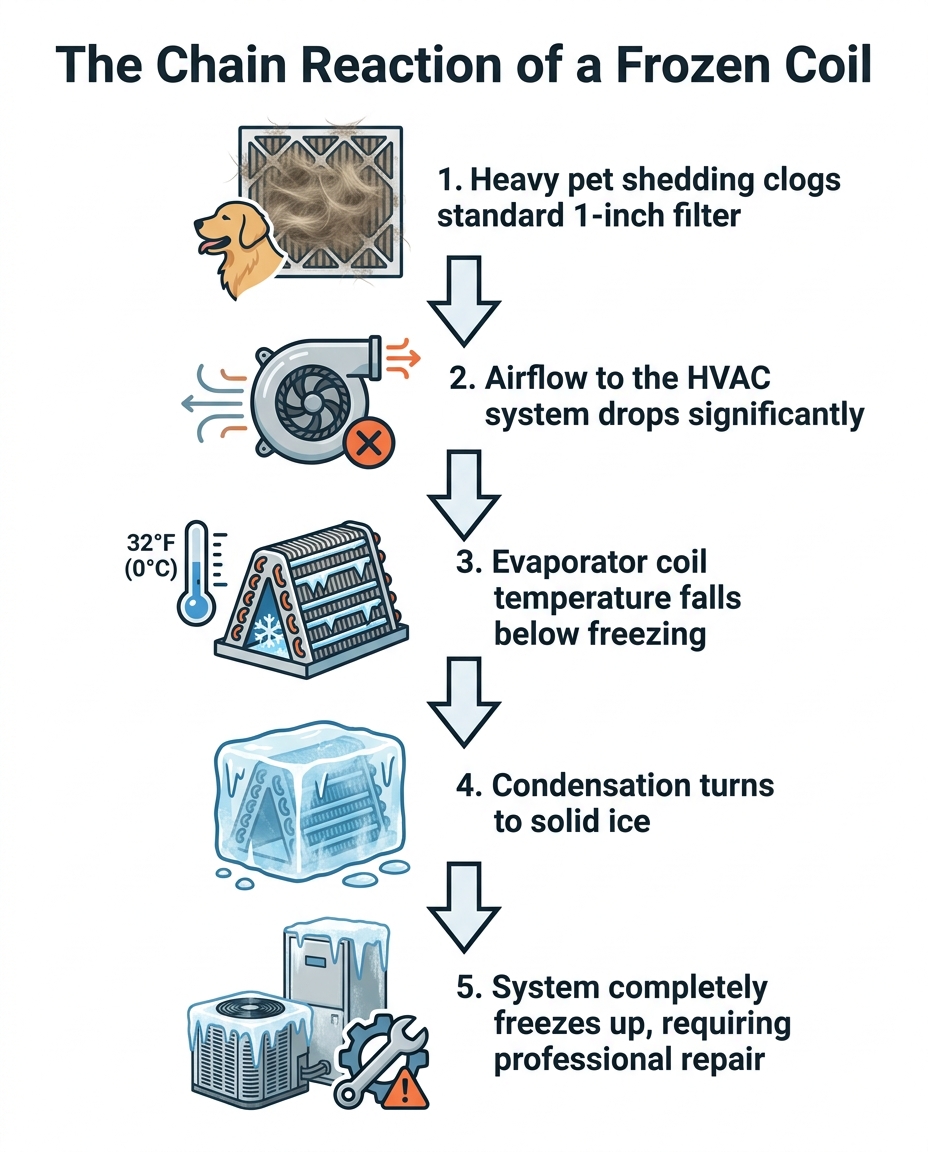
The Chain Reaction: How Pet Hair Leads to a Frozen Evaporator Coil
To understand why a clogged filter is so dangerous, you have to look at the physics inside your indoor unit. The evaporator coil is a series of copper tubes and aluminum fins responsible for removing heat and humidity from your indoor air. It gets incredibly cold during operation. Under normal conditions, warm air from your house blows over this cold coil, transferring its heat and allowing the refrigerant inside to do its job.
When a thick mat of pet hair coats your air filter, it severely restricts the necessary airflow over this coil. Without enough warm air blowing across the metal fins to keep the temperature balanced, the physics of the system break down. The coil drops below freezing, and the normal condensation that drips off the coil suddenly turns into a solid block of ice.
This freeze-up can happen rapidly during hot weather when the system is working its hardest. Greenville's intense August heat and humidity require optimal, unrestricted airflow over the coil to manage the heavy moisture load. Any restriction quickly turns that pulled moisture into frost.
Our service team sees how fast this chain reaction happens in the field. Just last August, a local homeowner called us when their air-conditioning broke during hot weather—it was 89° outside and the house was heating up fast. Our technicians were at the customer's house within a couple of hours and successfully repaired the AC, discovering a completely frozen coil caused by severe airflow restriction. The culprit was a standard filter completely suffocated by a sudden wave of summer dog hair.

Why the Standard 30-Day Filter Rule Fails Pet Owners in August
Most standard advice tells you to change your air filter every 30 to 90 days. However, those manufacturer guidelines assume average conditions. They do not account for a household with three heavy-shedding pets during the August late-summer peak cooling season. Treating filter replacement as a rigid calendar chore during this window is a recipe for an August AC breakdown.
At Allegiance Heating & Air, our dispatch logs show that emergency service calls for completely frozen coils consistently peak in August, and the vast majority trace back to neglected, hair-clogged filters. Homeowners often tell us, "But I just changed it last month!" Unfortunately, the calendar doesn't dictate airflow—the conditions inside your home do.
Instead of relying on a date on the calendar, pet owners must switch to a dynamic, visual inspection routine. During peak shedding season, you should pull the filter out and look at it every 7 to 10 days. If it looks like a gray blanket is forming over the pleats, it needs to be replaced immediately, regardless of how long it has been installed.
You also have to consider how MERV (Minimum Efficiency Reporting Value) ratings interact with pet hair. Higher MERV filters capture more microscopic dander and allergens, which is great for your lungs. However, because their weave is much tighter, they can clog even faster when bombarded with large volumes of pet hair. If you use a high-MERV 1-inch filter, your margin of error for replacement shrinks dramatically.
Early Warning Signs Your AC Filter is Choking on Pet Hair
Waiting for your system to completely freeze over is a stressful and uncomfortable way to find out your filter is clogged. By paying attention to how your system behaves, you can catch airflow restrictions early. In our experience working on Greenville IN HVAC systems, catching these symptoms early can mean the difference between a quick filter swap and a sweltering weekend without air conditioning.
Watch for these distinct warning signs:
• Continuous cycling without cooling: The system runs constantly, but the house never actually reaches the temperature you set on the thermostat.
• Weak supply airflow: You feel weak or barely noticeable airflow coming from the supply registers when you hold your hand over the vent.
• Strange vent noises: Unusual hissing or whistling noises near the return vent indicate the blower motor is struggling and pulling air through a heavily restricted space.
• Visible ice formation: Visible frost or ice begins forming on the copper refrigerant lines outside your home or near the indoor cabinet.
• Spiking utility costs: A sudden, unexplained spike in energy consumption occurs as the system works overtime to push air through a wall of fur.
If you notice any of these symptoms, your very first step should be turning the system off entirely and checking the condition of your air filter.
Permanent Solutions: Moving Beyond Standard 1-Inch Filters
If you find yourself replacing filters every two weeks just to keep your system running, it is time to look at permanent upgrades. Standard 1-inch disposable filters have severe physical limitations when dealing with high volumes of pet hair. They simply lack the surface area required to hold a heavy load of debris without immediately choking off the air supply to the blower motor.
When our customers ask for a permanent fix, we typically recommend transitioning to a thicker media filter cabinet. These systems use 4-inch or 5-inch pleated filters. Because the pleats are incredibly deep, a 4-inch filter has exponentially more surface area than a 1-inch filter. This allows it to capture massive amounts of dog and cat hair while still allowing plenty of air to flow through the clean sections of the pleats. A media filter can easily last several months, even in a home with multiple pets during the August late-summer peak cooling season.
For homeowners who want to completely eliminate pet odors, dander, and hair issues, a dedicated air purifier installation provides a permanent defense. Whole-home air purifiers are integrated directly into your ductwork. They use advanced filtration technology to capture microscopic dander and large hair without restricting the vital HVAC airflow your system needs to survive.
These advanced systems do more than just protect the AC equipment from freezing; they simultaneously improve the home's overall air quality, ensuring your family isn't breathing in the dander your pets leave behind.
Protecting Your Cooling System Before the Back-to-School Rush
Your filter strategy is the first line of defense, but it is deeply connected to your broader system health. If a standard filter has been repeatedly clogged with pet hair over the summer, the pressure buildup often causes the cardboard frame to buckle. When this happens, unfiltered air bypasses the filter entirely. This means pet hair, dust, and dander have likely coated the indoor coil or the delicate blades of the blower motor.
Simply putting in a clean filter won't fix a system that is already internally dirty. A blower motor caked in pet dander has to work twice as hard to move air, and a coil insulated by a layer of fur cannot absorb heat properly. This internal buildup drastically increases the risk of a breakdown right as the back-to-school transition begins.
Our technicians see the extreme end of this frequently during the back-to-school rush. Another customer lost their AC entirely during the hottest week of August. While we promptly took care of replacing the old system with a new one, many premature failures can be delayed with proactive, professional care. A healthy air conditioning system is essential for surviving the hottest weeks of August without emergency breakdowns.
To ensure your equipment survives the Golden Retriever Effect, we highly recommend enrolling in an ongoing HVAC maintenance plan. Routine professional oversight ensures the system is thoroughly cleaned, internally inspected, and calibrated to handle heavy shedding loads year after year.
The Hidden Cost of Bypassed Pet Hair
Hair that slips past a buckling filter sticks directly to the wet, condensation-covered evaporator coil. Once it dries, it forms a felt-like barrier over the metal fins. Homeowners cannot clean this themselves. Professional cleaning is required to safely remove this debris without bending or damaging the delicate aluminum fins, which would permanently ruin the coil's efficiency.
Keep Your Home Cool and Your Air Clear This August
Surviving the Golden Retriever Effect requires abandoning the calendar and checking your filters dynamically based on your home's actual conditions. In Greenville IN homes, protecting the AC from sudden influxes of pet hair is the single most effective way to prevent frozen coils, weak airflow, and uncomfortable late-summer breakdowns.
Don't let peak shedding season dictate your comfort. Keep a close eye on your return vents, stock up on the right filters, and consider exploring advanced filtration options to permanently solve your late-summer shedding challenges and keep your air clear all year long.
Frequently Asked Questions
Can pet hair really cause my AC to freeze up?
Yes, an excessive buildup of pet hair acts like a blanket over your air filter. This severe restriction prevents warm air from reaching the evaporator coil. Without that warm air, the coil drops below freezing, turning normal condensation into a solid block of ice.
How often should I change my AC filter in the summer if I have dogs?
During peak summer months with heavy-shedding dogs, you should visually inspect your filter every 7 to 10 days. While the packaging might say it lasts 90 days, continuous AC run times combined with pet hair can fully clog a standard 1-inch filter in as little as two to three weeks.
Why does my AC freeze up specifically in August?
August combines maximum cooling demand with a secondary shedding phase for many pets. Because your system is running almost continuously to fight the heat, it pulls a massive volume of air—and newly shed hair—through the return vents, accelerating the clogging process.
What is the best MERV rating for filtering pet dander?
A MERV rating between 8 and 11 is generally ideal for capturing pet dander without overly restricting airflow. However, higher MERV filters have tighter weaves, meaning they will clog with large pet hair much faster and require more frequent monitoring.
Will a 4-inch media filter last longer with heavy pet shedding?
Absolutely. A 4-inch or 5-inch media filter has deep pleats that provide significantly more surface area than a standard 1-inch filter. This allows it to capture large volumes of pet hair while still maintaining enough open space for proper airflow, often lasting several months even with pets.
How do I know if pet hair has already damaged my HVAC system?
If you install a brand-new filter but still experience weak airflow, continuous cycling, or rising energy bills, pet hair has likely bypassed the filter frame. This means fur and dander are heavily coating your blower motor or evaporator coil, requiring professional cleaning to restore performance.
Contact Us Or Schedule Expert Service
Other Blogs
ready to transform your home?
Discover our exceptional home services tailored to meet your needs and enhance your living space.
WHAT OUR CLIENTS HAVE TO SAY ABOUT US

We had a complete HVAC system and a hot water heater installed. The guys were professional, well mannered, and completed the work in a timely manner. Would definitely use them again.
I was nervous at first because my AC broke in the middle of 80 degree weather which is strange for April, but Allegiance Heating and Air was incredibly prompt and professional. The technician arrived within an hour, explained the problem clearly, and completed the repair. The technician , Mr. Garrett Moon was a very nice and courteous young man. He found the problem and fixed it within a timely manner. I highly recommend them for any heating or cooling needs. I’ll definitely give them a call again should I ever have another issue, but hopefully not. Knock on wood 😁. Give them a call… you won’t be disappointed!
From the moment I called to schedule a service, the team was quick to respond and arrived right on time. The technician was professional, friendly, and clearly knowledgeable about my heating system. He explained the repair options in plain language and completed the job efficiently. I appreciated the reliable service and the fact that the work was done the same day. I would definitely recommend Allegiance Heating and Air for any residential HVAC needs.
5/5 stars – I was very impressed with the efficient, affordable and timely service from Allegiance Heating and Air. The technician arrived on time, and performed the service quickly, no repairs needed at this time. Communication was clear and the whole experience felt hassle‑free. I would definitely recommend them for any residential HVAC needs.
Knowledgeable, experienced individual.
Explains Allegiance Heating and Air was incredibly reliable, professional and affordable. They arrived right on time, kept the work area clean and finished the furnace repair quickly. The technician explained everything clearly and the price was a great value. If happiness had a location on Google Maps, it would be here.
Gilbert had to go above and beyond because York is no longer making the part for my furnace. But he was able to find a way to construct a housing bracket for my furnace. Ingenuity, determination and integrity is what finally got my furnace fixed. Gilbert is truly a one of a kind technician.
Thank you for always going the extra mile. Gilbert is always respectful and helpful with any concerns.
"Great service, most knowledgeable and capable HVAC business in Kentuckiana!! Pete Flemming and Bryan the owner, are HVAC encyclopedias. They have the highest integrity of any HVAC business I have ever used. Allegiance has put numerous units in for me over the last 17 years. I will continue to use and trust them."
"Fast response from Allegiance when our heat was out on New Year’s day! Service technician was friendly and efficient. He took the time to explain the problem, tell us about the temporary fix and the plan for permanent repair. We were impressed!"
"Love Allegiance! Their technicians, in particular Benjamin, explain everything. Fast and thorough. A/C was out on a Sunday. Called Allegiance and within a few hours Benjamin arrived. Such a comfort as he was the one who last serviced our units. He quickly replaced part and cooling is restored!"
"My heat pump went out and I had to call after hours. The technician (Garrett) was outstanding and thorough. He got my system up and working until Monday and gave me several options of units. Also took the time to explain the issue to my Home warranty company. I highly recommend this company."
"Right on time :) respectful, fast, and polite. Even gave my fur babies some attention."
"Had Garrett out today to fix our AC. Fantastic tech. He showed up exactly when he said he would and kept us informed of what he was checking and what he found. Highly recommend!"
"Lucas with Allegiance showed up on time as promised, was professional and extremely patient and responsive with all my questions. He took care of the issue, and I feel he was trustworthy! He had us back to cool and comfortable on one of the hottest days of the year."
"Lucas did a great job! Very professional and expedient. Explained the process very well and represented Allegiance as a truly professional and reputable company."
"Arrived on time and work diligently to fix issue. These guy are great. Worked quickly to resolve my issues."
"Lucas was great - he spent a lot of time trying to figure out what was going on and explained everything he was doing. I trust Allegiance and wouldn’t want anyone else working on/in my house!!"

RELATED ARTICLES

New Furnace in Indiana? Find Your Installer Here!
Responding Effectively to HVAC Emergencies
