Why the Family Owned vs Corporate HVAC Company Comparison Matters for Greenville Homeowners
When it comes to choosing who services your home's heating and cooling system, the family owned vs corporate HVAC company comparison is one of the most important decisions you'll make as a homeowner in Greenville, IN.
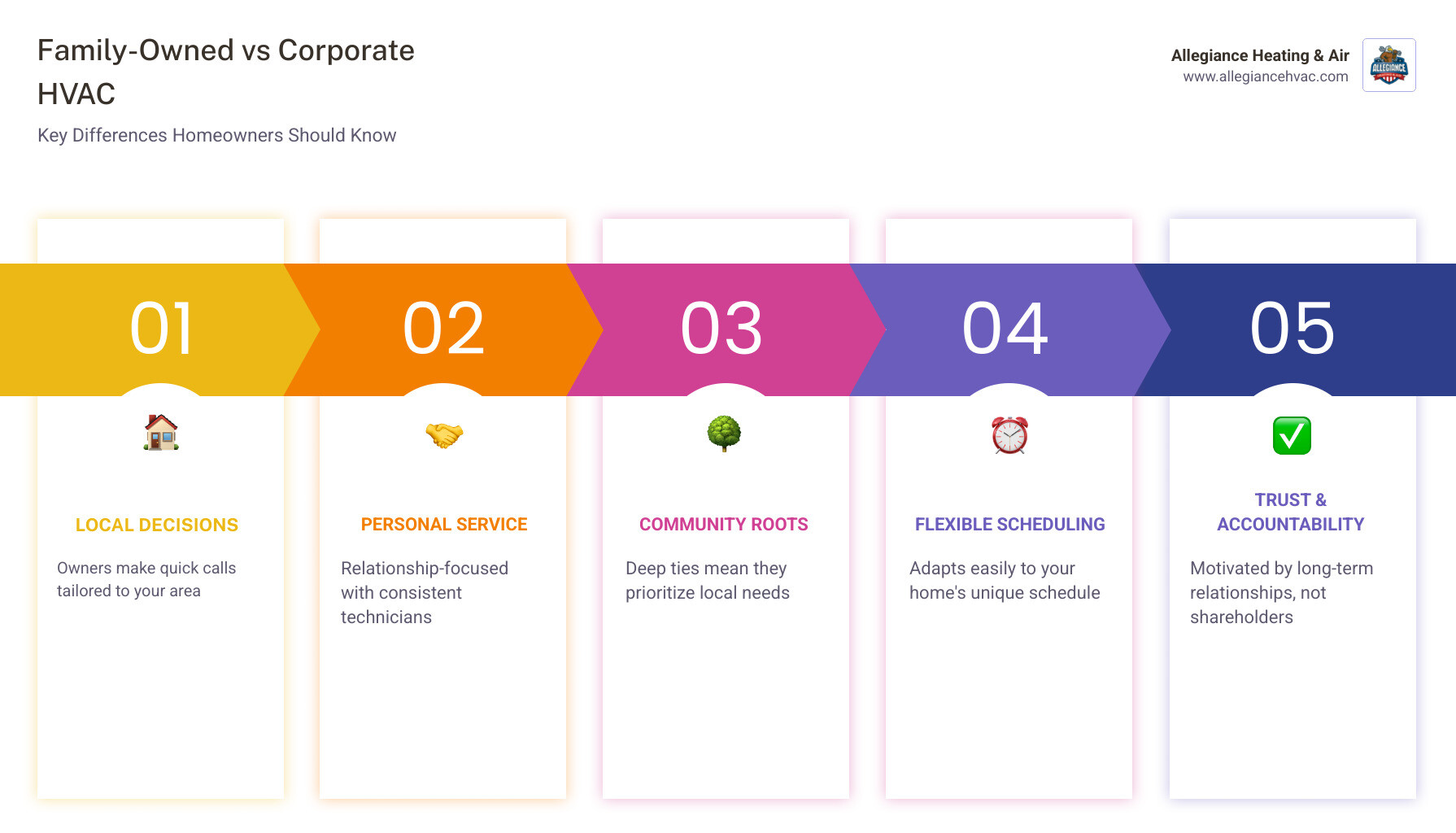
Here's a quick breakdown of the key differences:
• Decision-making — Family-Owned HVAC: Owner makes fast, local calls — Corporate HVAC: Centralized, often out-of-state
• Customer service — Family-Owned HVAC: Personal, relationship-driven — Corporate HVAC: Standardized, ticket-based
• Pricing motivation — Family-Owned HVAC: Long-term trust — Corporate HVAC: Profit margins and investor returns
• Community ties — Family-Owned HVAC: Deep local roots — Corporate HVAC: National brand, limited local stake
• Technician consistency — Family-Owned HVAC: Same tech, knows your home — Corporate HVAC: Rotating staff
• Flexibility — Family-Owned HVAC: High — adapts to your schedule — Corporate HVAC: Lower — follows corporate policy
• Scale and resources — Family-Owned HVAC: Focused on local needs — Corporate HVAC: Broader reach, larger infrastructure
The bottom line: family-owned companies tend to prioritize your long-term comfort and trust, while corporate providers may offer broader resources but often at the cost of personal attention.
Most homeowners in Greenville and surrounding areas — who want a reliable technician they recognize, honest recommendations, and someone who actually knows the local climate — find that a locally owned HVAC business is the better fit for residential needs.
That said, both models have real strengths. This guide breaks it all down so you can choose with confidence.
Family businesses make up around 59% of U.S. GDP — roughly $5.5 trillion — and the HVAC industry is no exception. Across the country, owner-operated HVAC companies have built strong reputations by treating neighbors like, well, neighbors. But large corporate and private equity-backed HVAC firms have also grown rapidly, offering technology, scale, and round-the-clock availability that smaller shops sometimes can't match.
So which is better for your home? It depends on what you value most — and we'll walk through every angle below.
Defining the Models: Family-Owned vs. Corporate HVAC
When we talk about the family owned vs corporate HVAC company comparison, we are really looking at who holds the reins and what drives their daily operations. The ownership structure of an HVAC provider isn't just a legal detail; it dictates how they treat you when your furnace quits on a freezing January night in Floyds Knobs or when your AC struggles during a humid July afternoon in Jeffersonville.
Corporate entities are often part of a larger national franchise or backed by private equity firms. These firms typically acquire local brands and consolidate them. While the name on the truck might stay the same, the decisions are often made in boardrooms hundreds of miles away. On the other hand, independent contractors and family-run shops operate with a much leaner governance structure. To learn more about how we stay grounded in our local community, you can read About Us.
What defines a family-owned HVAC company?
A family-owned HVAC company is usually characterized by a generational legacy and deep local roots. These businesses are often owner-operated, meaning the person who owns the company is likely the same person you might see inspecting a job site or answering the phone during a busy stretch.
In these models, the business is more than just a source of revenue; it is a family's name and reputation. We believe that "Taking Home Comfort Under Our Wing" is a promise that comes from this personal investment. You can see how this philosophy started by visiting Our Story. Decision-making is fast because there is no corporate ladder to climb for approvals. If a customer has a unique need, the owner can make a call right then and there to fix it.
What defines a corporate HVAC entity?
Corporate HVAC entities often prioritize shareholder focus and centralized management. These companies may be publicly traded or owned by private equity groups that expect a specific return on investment. Because of this, their primary accountability is often to investors rather than the local neighborhood.
These organizations use national branding to create a sense of scale and reliability. They rely on "corporate playbooks"—standardized sets of rules that every branch must follow, regardless of whether they are in the snowy Midwest or the desert Southwest. While this ensures a consistent look and feel, it can sometimes lead to a "one-size-fits-all" approach that doesn't account for the specific needs of an HVAC system in our specific climate.
Key Advantages of a Family Owned vs Corporate HVAC Company Comparison
When comparing these two models, the differences in service values and accountability become clear. Family-owned businesses often rely on word-of-mouth and repeat business to survive. This creates a natural incentive for high-quality work and honest recommendations.
• Accountability — Family-Owned Approach: Owner's reputation is on the line — Corporate Approach: Accountability is to a manager or board
• Relationship — Family-Owned Approach: Long-term neighborly trust — Corporate Approach: Transactional service calls
• Staffing — Family-Owned Approach: Low turnover, familiar faces — Corporate Approach: Higher turnover, rotating techs
• Community — Family-Owned Approach: Money stays in the local economy — Corporate Approach: Profits often leave the state
Personalized service is the hallmark of the local shop. When you Meet The Team, you are meeting people who live in the same towns you do, from New Albany to Sellersburg.
Residential Benefits: A Family Owned vs Corporate HVAC Company Comparison
For residential customers, the "neighborly approach" is a significant factor. When a technician enters your home, you want to feel a sense of trust. Family-owned companies often send the same technician to your house year after year. This familiarity means the tech knows your specific system's quirks and your home's layout.
In areas like Clarksville, homeowners often search for What are the top rated family owned HVAC businesses near me in Clarksville Indiana because they value that personal connection. A family-owned business isn't just trying to close a ticket; they are trying to ensure your family stays comfortable for the long haul.
Flexibility and Responsiveness in Greenville and Clarksville
Local climate expertise is something you can't teach in a national training seminar. A technician who has worked in Southern Indiana for twenty years understands how our humidity levels affect Air Conditioning performance differently than someone following a manual written for a different region.
Family-owned businesses also offer superior flexibility. If you have an emergency that doesn't fit into a standard 9-to-5 window, a local owner is often more willing to shift schedules or go the extra mile to help a neighbor in need. Quick decisions are made on the spot, without waiting for a regional manager's approval.
Understanding Corporate HVAC Strengths and Limitations
While family-owned businesses excel at personalization, corporate HVAC companies bring a different set of strengths to the table, primarily revolving around resources and scale. These companies often have massive budgets for marketing and infrastructure, which can translate to 24/7 call centers and large fleets of trucks.
If you are looking for a specific type of Heating solution, a large corporation might have a wider variety of units in stock due to their massive purchasing power. However, this scale can also lead to bureaucratic hurdles that make it difficult for them to provide the "human touch" that local residents often crave.
Technological Adoption and Software Integration
One area where corporations often lead is in the use of advanced software like ServiceTitan. Over 7,500 contractors use ServiceTitan to manage their businesses, and switching to such platforms has been shown to increase average revenue by 21% in the first two years for many. These tools allow for automated scheduling, real-time technician tracking, and digital invoicing.
While these Services are convenient, many family-owned businesses are now adopting the same high-end technology to stay competitive. This allows local shops to offer the "best of both worlds"—the high-tech convenience of a corporation with the heart and soul of a local business.
Scalability for Large Commercial Projects
Corporate HVAC models are often very well-suited for massive commercial projects. Think of hospitals, large retail centers, or industrial complexes. These jobs require modular systems and specialized equipment like chillers and cooling towers.
Commercial HVAC technicians often earn more than residential technicians because the work is highly complex, involving building automation systems (BAS) and large-scale ventilation requirements. For a homeowner looking for a Heat Pump installation, the massive scale of a corporation might be overkill, but for a factory in Louisville, that resource depth is a major asset.
Succession Planning and Business Continuity
A challenge for a family-owned business is succession planning. For a business to survive across generations, there must be a clear plan for who takes over when the founder retires. This generational transfer is vital for stability. When done right, it ensures that the values of the company remain intact for decades.
Corporate entities don't have this problem in the same way; they simply hire a new CEO or regional manager. However, this can lead to a lack of continuity in company culture. In a family business, the "legacy" is the driving force. At Allegiance, we view our business as a long-term commitment to the community. You can read more about our commitment on our About Us page.
Making the Choice: Your Family Owned vs Corporate HVAC Company Comparison
When it comes down to making the choice, consider what matters most for your specific project. Are you looking for a technician who will remember your name and the history of your home? Or are you looking for a national brand with a massive call center?
Local expertise and community impact are powerful reasons to choose family-owned. When you spend money with a local business, that money circulates back into the community—supporting local schools, parks, and other small businesses. This "economic multiplier" effect is a key part of our Our Story.
Frequently Asked Questions about HVAC Ownership
How does ownership affect my customer service experience?
Ownership dictates the primary motivation of the company. In a family-owned business, the primary goal is often reputation and community standing. This leads to higher accountability. If something goes wrong, you can usually talk directly to the owner. In a corporate structure, you are often dealing with a "ticket number," and resolving a complex issue may require navigating several layers of management.
Are corporate HVAC companies better for commercial projects?
They certainly have advantages in that sector. Corporate firms often have the resource depth to handle massive, multi-phase projects that require specialized equipment and large crews. However, many family-owned businesses also have robust commercial divisions that offer a more tailored, responsive experience for local business owners.
Why do homeowners in Greenville prefer family-owned businesses?
Trust is the number one factor. Greenville is a community where people know each other. Homeowners prefer honest recommendations over high-pressure sales tactics. Because family-owned businesses don't have to answer to out-of-state investors, they can focus on what the customer actually needs rather than meeting a monthly sales quota.
Conclusion
Choosing between a family-owned and a corporate HVAC provider is a personal decision, but for most residential needs in Greenville, IN, the local touch wins out. At Allegiance Heating & Air, we are proud to be a family-owned business that has served this region since 2005. Our technicians are not just employees; they are trusted professionals dedicated to your satisfaction.
We live in the communities we serve—from the streets of New Albany to the neighborhoods of Clarksville and beyond. Our mission is simple: "Taking Home Comfort Under Our Wing." We invite you to experience the difference that local accountability and professional expertise can make for your home. To learn more about our team and our values, please visit our About Us page. We look forward to keeping your family comfortable for many years to come.
Contact Us Or Schedule Expert Service
Other Blogs
ready to transform your home?
Discover our exceptional home services tailored to meet your needs and enhance your living space.
WHAT OUR CLIENTS HAVE TO SAY ABOUT US

We had a complete HVAC system and a hot water heater installed. The guys were professional, well mannered, and completed the work in a timely manner. Would definitely use them again.
I was nervous at first because my AC broke in the middle of 80 degree weather which is strange for April, but Allegiance Heating and Air was incredibly prompt and professional. The technician arrived within an hour, explained the problem clearly, and completed the repair. The technician , Mr. Garrett Moon was a very nice and courteous young man. He found the problem and fixed it within a timely manner. I highly recommend them for any heating or cooling needs. I’ll definitely give them a call again should I ever have another issue, but hopefully not. Knock on wood 😁. Give them a call… you won’t be disappointed!
From the moment I called to schedule a service, the team was quick to respond and arrived right on time. The technician was professional, friendly, and clearly knowledgeable about my heating system. He explained the repair options in plain language and completed the job efficiently. I appreciated the reliable service and the fact that the work was done the same day. I would definitely recommend Allegiance Heating and Air for any residential HVAC needs.
5/5 stars – I was very impressed with the efficient, affordable and timely service from Allegiance Heating and Air. The technician arrived on time, and performed the service quickly, no repairs needed at this time. Communication was clear and the whole experience felt hassle‑free. I would definitely recommend them for any residential HVAC needs.
Knowledgeable, experienced individual.
Explains Allegiance Heating and Air was incredibly reliable, professional and affordable. They arrived right on time, kept the work area clean and finished the furnace repair quickly. The technician explained everything clearly and the price was a great value. If happiness had a location on Google Maps, it would be here.
Gilbert had to go above and beyond because York is no longer making the part for my furnace. But he was able to find a way to construct a housing bracket for my furnace. Ingenuity, determination and integrity is what finally got my furnace fixed. Gilbert is truly a one of a kind technician.
Thank you for always going the extra mile. Gilbert is always respectful and helpful with any concerns.
"Great service, most knowledgeable and capable HVAC business in Kentuckiana!! Pete Flemming and Bryan the owner, are HVAC encyclopedias. They have the highest integrity of any HVAC business I have ever used. Allegiance has put numerous units in for me over the last 17 years. I will continue to use and trust them."
"Fast response from Allegiance when our heat was out on New Year’s day! Service technician was friendly and efficient. He took the time to explain the problem, tell us about the temporary fix and the plan for permanent repair. We were impressed!"
"Love Allegiance! Their technicians, in particular Benjamin, explain everything. Fast and thorough. A/C was out on a Sunday. Called Allegiance and within a few hours Benjamin arrived. Such a comfort as he was the one who last serviced our units. He quickly replaced part and cooling is restored!"
"My heat pump went out and I had to call after hours. The technician (Garrett) was outstanding and thorough. He got my system up and working until Monday and gave me several options of units. Also took the time to explain the issue to my Home warranty company. I highly recommend this company."
"Right on time :) respectful, fast, and polite. Even gave my fur babies some attention."
"Had Garrett out today to fix our AC. Fantastic tech. He showed up exactly when he said he would and kept us informed of what he was checking and what he found. Highly recommend!"
"Lucas with Allegiance showed up on time as promised, was professional and extremely patient and responsive with all my questions. He took care of the issue, and I feel he was trustworthy! He had us back to cool and comfortable on one of the hottest days of the year."
"Lucas did a great job! Very professional and expedient. Explained the process very well and represented Allegiance as a truly professional and reputable company."
"Arrived on time and work diligently to fix issue. These guy are great. Worked quickly to resolve my issues."
"Lucas was great - he spent a lot of time trying to figure out what was going on and explained everything he was doing. I trust Allegiance and wouldn’t want anyone else working on/in my house!!"

RELATED ARTICLES
Who's the Hottest? Finding the Best Heat Pump Repair in Louisville, KY

How Neglecting Furnace Maintenance Can Lead to Expensive Repairs