Is It Worth Fixing an Old Furnace or AC? Here's the Quick Answer
Is it worth fixing an old furnace or AC comes down to five factors: the system's age, the repair cost, how often it breaks down, how efficient it still runs, and whether any safety risks are present. Here's a fast summary to help you decide right now:
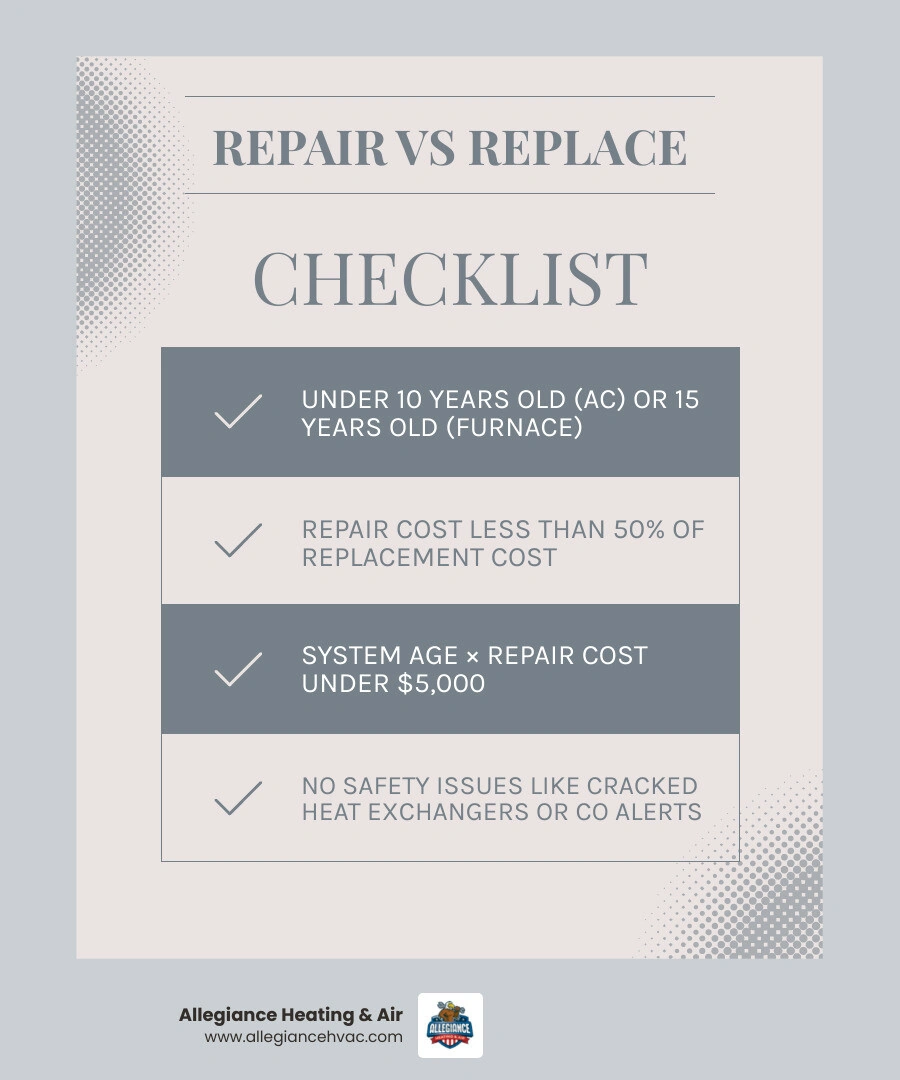
Lean toward repair if:
- The system is under 10 years old (AC/heat pump) or under 15 years old (furnace)
- The repair cost is less than 50% of what a new system would cost
- The system age multiplied by the repair cost is under $5,000
- Breakdowns have been rare and maintenance has been consistent
- No safety issues like cracked heat exchangers or carbon monoxide alerts
Lean toward replacement if:
- The system is 15+ years old (furnace) or 12+ years old (AC)
- Repair cost exceeds 50% of a new system's cost
- System age × repair cost exceeds $5,000
- You've had 2 or more unplanned repairs in the past 24 months
- The system uses R-22 refrigerant (phased out and increasingly expensive)
- A cracked heat exchanger or failed compressor has been diagnosed
Your furnace or central AC quietly runs thousands of hours every year keeping your home comfortable through Greenville, IN's cold winters and humid summers. Most homeowners don't think much about it — until something breaks. Then the stress hits fast: is this a quick fix, or are you about to pour money into a system that's already on its way out? That question gets complicated quickly, especially when a repair technician is standing in your utility room with a quote in hand. This guide walks you through every factor that matters so you can make a clear, confident decision without second-guessing yourself.
Understanding HVAC Lifespans: When Is It Worth Fixing an Old Furnace or AC?

Every mechanical system has a natural expiration date, no matter how meticulously you care for it. In our corner of southern Indiana—from the rolling hills of Floyds Knobs to the historic streets of New Albany and our home base in Greenville—our heating and cooling systems work hard. They endure freezing January blizzards and muggy July heatwaves.
To determine if your unit is nearing the end of its journey, we first look at typical lifespans for different types of residential HVAC equipment:
- Gas Furnaces: Typically last 15 to 20 years. Because they rely on combustion to generate heat, the constant expansion and contraction of metal components eventually causes wear.
- Electric Furnaces: Can last 20 to 30 years. Without combustion, they experience less chemical stress, though heating elements and blowers still degrade over time.
- Central Air Conditioners: Typically last 12 to 15 years. Outdoor units are exposed directly to rain, snow, debris, and extreme temperature swings, which accelerates wear on electrical and mechanical parts.
- Heat Pumps: Typically last 10 to 15 years. Because a heat pump handles both heating and cooling duties, it runs almost year-round, accumulating double the operating hours of a standalone AC.
If your system is under 10 years old, it is generally considered to be in its mid-life phase. At this point, a breakdown is usually an isolated incident rather than a sign of systemic failure. However, once a system crosses into double digits, it enters its golden years. To dive deeper into how different types of equipment age, you can check out our guide on How Old is Too Old for an HVAC System.
How to Determine Your System's Exact Age
You might have bought your home recently and have no idea when the heating and cooling systems were installed. Luckily, your equipment carries its birth certificate right on its metal cabinet.
To find the exact age:
- Locate the manufacturer's data plate on the side of the outdoor condenser or the indoor furnace cabinet.
- Look for a clear "Manufacture Date" or "MFR DATE" printed on the label.
- If you only see a serial number, write it down. Most manufacturers hide the year and week of production inside this number. For example, a serial number starting with "1204" often indicates the unit was built in the 4th week of 2012. You can search the manufacturer’s website or ask one of our technicians to decode it for you.
When Minor Repairs Make Sense for Mid-Life Systems
If your system is in its mid-life phase, investing in a repair is almost always the smartest move. Simple mechanical and electrical failures do not mean the entire system is ready for retirement.
Common and highly affordable repairs that are well worth fixing include:
- Capacitor Replacement: The capacitor acts like a battery to help your AC start up. They fail frequently due to summer heat, but replacing them is a routine, fast fix.
- Ignitor Replacement: In a furnace, the hot-surface ignitor lights the gas burners. These naturally wear out over time, much like a lightbulb filament.
- Thermostat Calibration or Replacement: Sometimes a system that won't turn on simply needs a modern thermostat or a fresh set of batteries.
- Contactor or Relay Replacements: These small electrical switches wear out from constant clicking but are simple to replace.
When these minor parts fail on an otherwise healthy, well-maintained system, a quick repair will easily restore full performance and keep your home comfortable for years to come. For more help evaluating these mid-life scenarios, read our article on When to Repair vs. Replace Your HVAC System.
The Mathematical Rules of Thumb for HVAC Decisions
When you are facing a significant repair recommendation, emotions can cloud your judgment. That is why professional HVAC technicians and financial planners rely on objective mathematical formulas to remove the guesswork.
| Decision Rule | How It Works | Best Used For | When to Replace |
|---|---|---|---|
| The 50% Rule | Compares the repair quote directly to the price of a brand-new system. | Major single-component failures (compressors, heat exchangers). | If the repair cost is 50% or more of a new unit's cost. |
| The Age-Repair Multiplier | Multiplies the exact age of the system by the active repair quote to get a score. | Systems in their late-life phase (10+ years old) facing moderate repairs. | If the calculated score is greater than 5,000. |
Using these structured frameworks helps you avoid the "sunk cost fallacy"—the tendency to keep pouring money into an old system just because you already paid for repairs in the past. To understand how these rules fit into your overall home comfort budget, explore our resource on How to Decide Between HVAC Repair and Replacement.
Applying the 50% Rule to Major Component Failures
The 50% rule is simple: if a single repair quote exceeds half the cost of a complete system replacement, you should choose replacement.
This rule is particularly relevant when dealing with "terminal" components. These are the hearts of your systems—parts that require intensive labor, heavy equipment, and specialized calibration to replace.
The three primary terminal components are:
- The AC Compressor: The pump that circulates refrigerant. When it fails on an old system, replacing it is rarely wise because the surrounding copper lines, coils, and electrical components are already worn and acidic from the failure.
- The Furnace Heat Exchanger: The chamber where gas is burned. A failure here is not only expensive to fix but also represents a severe safety hazard.
- The Indoor Blower Motor: Especially on older variable-speed models, replacing this motor can represent a massive chunk of the system's total value.
If you are facing a major component failure, we highly recommend reading about the Signs Your HVAC Needs Replacing Not Just Fixing to help weigh your options.
Calculating the Age-Repair Multiplier: Is It Worth Fixing an Old Furnace or AC?
The age-repair multiplier rule (frequently called the $5,000 rule) is an incredibly reliable tool for borderline decisions.
To use this formula:$$\text{System Age (Years)} \times \text{Repair Quote (Dollars)} = \text{Score}$$
If your score is under 5,000, go ahead and repair the system. If the score is over 5,000, replacement is almost always the more sensible long-term financial choice.
Let's look at two real-world examples:
- Scenario A: Your central air conditioner is 6 years old, and the fan motor has failed. The repair quote is $450.$$6 \times 450 = 2,700$$Since 2,700 is well below the 5,000 threshold, repairing the unit is a smart, cost-effective decision.
- Scenario B: Your furnace is 14 years old, and the main control board has failed. The repair quote is $600.$$14 \times 600 = 8,400$$Because 8,400 is far higher than 5,000, investing that money into a 14-year-old furnace is risky. That money would be much better spent as a down payment on a modern, reliable heating system.
If your air conditioner is the unit causing mathematical headaches, take a look at our guide on the Time to Replace Old AC.
Efficiency Gains, Environmental Regulations, and Safety Risks
Deciding whether is it worth fixing an old furnace or ac is about more than just the immediate repair bill. Older systems cost significantly more to run every single month, and in some cases, they can pose physical dangers to your family. Our team takes these factors incredibly seriously because your safety and comfort are our top priorities. If you are starting to plan a system upgrade, our Heating System Replacement Guide is a fantastic place to start.
Safety Red Flags: Cracked Heat Exchangers and Carbon Monoxide
With aging gas furnaces, safety is the single most important factor. During a winter heating cycle, gas burners ignite inside a metal chamber called the heat exchanger. This chamber keeps toxic combustion byproducts—including carbon monoxide (CO)—completely separate from the clean air circulating through your home's vents.
Over 15 to 20 years of heating and cooling, this metal constantly expands and contracts. Eventually, rust and stress can cause the metal to crack.
A cracked heat exchanger is an immediate safety emergency because:
- It can leak carbon monoxide—an odorless, colorless, and potentially lethal gas—directly into your home's breathing air.
- It cannot be patched, welded, or easily repaired. The entire heat exchanger must be replaced, which requires dismantling the entire furnace.
- If a technician discovers a cracked heat exchanger during a combustion analysis or visual inspection, they are legally and professionally obligated to shut off the gas supply to the unit to protect your household.
If your old furnace has a cracked heat exchanger, do not hesitate. Read why Furnace Replacement is Necessary and prioritize your family's safety.
The R-22 Refrigerant Phase-Out and Modern SEER2 Standards
If your air conditioner was installed before 2010, it likely uses R-22 (often called Freon). Because R-22 is an ozone-depleting substance, the EPA completely phased out its production and import.
In 2026, finding R-22 to repair a leak is incredibly difficult and extraordinarily expensive. Furthermore, the industry is currently undergoing a secondary transition, phasing down R-410A in favor of next-generation, environmentally friendly refrigerants like R-454B and R-32. Trying to patch a refrigerant leak on an old R-22 or early R-410A system is like trying to find parts for a vintage car—it is a temporary, expensive band-aid.
Additionally, upgrading to a modern system brings massive monthly energy bill savings:
- Heating Efficiency (AFUE): A 20-year-old furnace might have an Annual Fuel Utilization Efficiency (AFUE) rating of just 60% to 70%, meaning 30% to 40% of the gas you buy is wasted up the chimney. Modern high-efficiency furnaces reach up to 95% to 98% AFUE, converting nearly every dollar of fuel directly into warmth.
- Cooling Efficiency (SEER2): Upgrading from an old SEER 10 or SEER 13 air conditioner to a modern SEER2 16 or 18+ model can slash your summer cooling energy consumption by 30% to 50%.
To learn more about how modern standards save you money and protect the planet, check out our article on Air Conditioner Replacement Importance.
Strategic Replacement: When to Upgrade Both Systems Simultaneously
When one half of your HVAC system fails, it is highly tempting to replace only the broken unit to keep things simple. However, your furnace and air conditioner are not independent appliances like a refrigerator and a microwave. They are designed to operate as a single, integrated system.
Choosing to replace both units at the same time is often the most financially responsible decision you can make. If you are considering an air conditioner upgrade, read about our Professional AC Replacement Services to see how we handle these installations.
Why Mismatched HVAC Systems Underperform
Your central air conditioner relies on the furnace's indoor blower fan to push cool air through your ductwork. If you pair a brand-new, high-efficiency outdoor AC condenser with an old, inefficient, single-speed furnace blower, you create a mismatched system.
Mismatched systems suffer from several severe issues:
- Reduced Efficiency: A new AC cannot achieve its rated SEER2 efficiency if it is forced to work with an outdated, weak indoor blower coil.
- Premature Wear: Mismatched components can cause improper refrigerant pressures, putting massive strain on your new AC compressor and leading to early failure.
- Voided Warranties: Many manufacturers will not honor their full parts warranty if their brand-new outdoor unit is hooked up to an old, incompatible indoor coil.
Replacing both units together ensures perfect system compatibility, maximum energy efficiency, and total warranty protection. Plus, because our technicians are already at your home dismantling the system, combining the installations saves you a massive amount of labor costs compared to scheduling two separate visits years apart.
Evaluating Home Resale Value and Buyer Perception
If you plan to sell your home in the southern Indiana or Louisville metro area in the next few years, the condition of your HVAC system will be a major focal point for buyers and home inspectors.
A new, matched HVAC system is an incredibly attractive selling point:
- Resale Value Boost: A new heating and cooling system can increase your home's resale value by 5% to 7%.
- Buyer Confidence: Buyers are often willing to pay a premium knowing they won't have to face an emergency HVAC replacement right after moving in.
- Smooth Inspections: An old, rusty furnace or an AC unit using obsolete R-22 refrigerant is a massive red flag on home inspection reports, often leading to buyers demanding thousands of dollars in price concessions before closing.
Frequently Asked Questions About HVAC Repair and Replacement
Is it worth fixing an old furnace or ac if it only needs a minor part?
Yes, if the system is under 12 to 15 years old, has been regularly maintained, and the repair is a simple, non-terminal part like a capacitor, ignitor, or contactor. However, if the system is past its expected lifespan and has a history of frequent breakdowns, even a minor repair might just be throwing good money after bad. To explore our heating repair options, take a look at our Furnace Replacement Services.
How many repairs in a year indicate that my system is failing?
If you have experienced two or more unplanned repairs in a 24-month period, your system is likely entering a "repair spiral." This frequency of breakdowns indicates systemic wear rather than isolated component failures. At this stage, continuing to repair the unit is rarely a sound investment.
What local rebates or incentives are available in 2026 for new systems?
In 2026, homeowners in southern Indiana can take advantage of excellent incentives to offset the cost of high-efficiency upgrades. Local utility companies, such as Duke Energy, frequently offer rebates for installing high-efficiency heat pumps and central air conditioners. Additionally, state-administered programs and federal tax credits (such as those for qualified heat pump installations) can significantly reduce your net investment.
Conclusion
Deciding whether is it worth fixing an old furnace or ac can feel overwhelming, but you don't have to make the decision alone. At Allegiance Heating & Air, LLC, we have been "Taking Home Comfort Under Our Wing" since 2005. As a family-owned business based in Greenville, IN, we are proud to serve our neighbors across southern Indiana—including Clarksville, Jeffersonville, Floyds Knobs, Corydon, and Louisville.
Our licensed, insured, and highly trained technicians are committed to providing honest, transparent advice. We never pressure you into replacements you don't need, and we never recommend band-aid repairs on systems that are genuinely unsafe or economically unfeasible. Whether you need a simple tune-up, a complex repair, or a complete system replacement, you can count on us for reliable, year-round comfort.
Schedule a professional HVAC evaluation with Allegiance Heating & Air today, and let us help you find the absolute best, most cost-effective path forward for your home.
Contact Us Or Schedule Expert Service
Other Blogs
ready to transform your home?
Discover our exceptional home services tailored to meet your needs and enhance your living space.
WHAT OUR CLIENTS HAVE TO SAY ABOUT US

We had a complete HVAC system and a hot water heater installed. The guys were professional, well mannered, and completed the work in a timely manner. Would definitely use them again.
I was nervous at first because my AC broke in the middle of 80 degree weather which is strange for April, but Allegiance Heating and Air was incredibly prompt and professional. The technician arrived within an hour, explained the problem clearly, and completed the repair. The technician , Mr. Garrett Moon was a very nice and courteous young man. He found the problem and fixed it within a timely manner. I highly recommend them for any heating or cooling needs. I’ll definitely give them a call again should I ever have another issue, but hopefully not. Knock on wood 😁. Give them a call… you won’t be disappointed!
From the moment I called to schedule a service, the team was quick to respond and arrived right on time. The technician was professional, friendly, and clearly knowledgeable about my heating system. He explained the repair options in plain language and completed the job efficiently. I appreciated the reliable service and the fact that the work was done the same day. I would definitely recommend Allegiance Heating and Air for any residential HVAC needs.
5/5 stars – I was very impressed with the efficient, affordable and timely service from Allegiance Heating and Air. The technician arrived on time, and performed the service quickly, no repairs needed at this time. Communication was clear and the whole experience felt hassle‑free. I would definitely recommend them for any residential HVAC needs.
Knowledgeable, experienced individual.
Explains Allegiance Heating and Air was incredibly reliable, professional and affordable. They arrived right on time, kept the work area clean and finished the furnace repair quickly. The technician explained everything clearly and the price was a great value. If happiness had a location on Google Maps, it would be here.
Gilbert had to go above and beyond because York is no longer making the part for my furnace. But he was able to find a way to construct a housing bracket for my furnace. Ingenuity, determination and integrity is what finally got my furnace fixed. Gilbert is truly a one of a kind technician.
Thank you for always going the extra mile. Gilbert is always respectful and helpful with any concerns.
"Great service, most knowledgeable and capable HVAC business in Kentuckiana!! Pete Flemming and Bryan the owner, are HVAC encyclopedias. They have the highest integrity of any HVAC business I have ever used. Allegiance has put numerous units in for me over the last 17 years. I will continue to use and trust them."
"Fast response from Allegiance when our heat was out on New Year’s day! Service technician was friendly and efficient. He took the time to explain the problem, tell us about the temporary fix and the plan for permanent repair. We were impressed!"
"Love Allegiance! Their technicians, in particular Benjamin, explain everything. Fast and thorough. A/C was out on a Sunday. Called Allegiance and within a few hours Benjamin arrived. Such a comfort as he was the one who last serviced our units. He quickly replaced part and cooling is restored!"
"My heat pump went out and I had to call after hours. The technician (Garrett) was outstanding and thorough. He got my system up and working until Monday and gave me several options of units. Also took the time to explain the issue to my Home warranty company. I highly recommend this company."
"Right on time :) respectful, fast, and polite. Even gave my fur babies some attention."
"Had Garrett out today to fix our AC. Fantastic tech. He showed up exactly when he said he would and kept us informed of what he was checking and what he found. Highly recommend!"
"Lucas with Allegiance showed up on time as promised, was professional and extremely patient and responsive with all my questions. He took care of the issue, and I feel he was trustworthy! He had us back to cool and comfortable on one of the hottest days of the year."
"Lucas did a great job! Very professional and expedient. Explained the process very well and represented Allegiance as a truly professional and reputable company."
"Arrived on time and work diligently to fix issue. These guy are great. Worked quickly to resolve my issues."
"Lucas was great - he spent a lot of time trying to figure out what was going on and explained everything he was doing. I trust Allegiance and wouldn’t want anyone else working on/in my house!!"

RELATED ARTICLES
How to Tell if Your AC Compressor Is Failing: 5 Key Symptoms
Everything You Need to Know About NATE Certification