Pre-School Year Allergy Defense: Upgrading Your Greenville Home's Filtration Before September
Late-summer Indiana ragweed spikes just as kids head back to the classroom. Upgrading from standard filters to a robust media cabinet helps protect your family's indoor air for the new year.

Back-to-School Preparation Meets Peak Allergy Season
According to the Environmental Protection Agency (EPA), indoor air can be two to five times more polluted than the air outside, which is why focusing on Pre-School Year Allergy Defense: Upgrading Your Greenville Home's Filtration Before September is a critical step for local families. As the summer winds down, the back-to-school transition brings a shift in daily routines, earlier bedtimes, and a desperate need for a healthy, restful home environment. At Allegiance Heating & Air, we see firsthand how this exact transition coincides with one of the most challenging times of the year for respiratory health in the Midwest. Late-summer agricultural dust and natural allergens peak just as children are preparing to head back to the classroom, severely compromising the air quality inside your home.
To tackle these invisible airborne threats, exploring professional indoor air quality solutions is the best place to start.
For families in Greenville IN and surrounding Floyd County, this creates a distinct concrete problem. The air your family breathes while sleeping, studying, and recovering from the day is heavily infiltrated by microscopic irritants. In our years of serving this community, we've found homeowners face an important decision point: continue relying on standard, basic air filters that only catch large debris, or invest in robust filtration upgrades designed to capture micro-allergens. Making the right choice before the school year begins ensures that your home remains a safe, clean-air sanctuary, reducing allergy flare-ups and helping your children get the uninterrupted sleep they need for academic success.
Understanding Floyd County's Late-Summer Air Quality Challenges
The ragweed timeline: The window from mid-August through September marks the absolute peak for ragweed pollen across the Midwest. A single ragweed plant can produce up to a billion grains of pollen per season, and these microscopic grains travel easily on the wind. By late-summer August (ragweed peak in Indiana), this pollen blankets the region, making it nearly impossible to avoid outdoors. When your children come inside, they bring these invisible hitchhikers on their clothes, shoes, and hair.
Agricultural harvest dust: Compounding the natural pollen count is the reality of living in a beautiful, rural-adjacent region. Southern Indiana's agricultural harvest kicks up massive amounts of soil, dried plant matter, and fertilizer dust. Our technicians drive these county roads daily, and we watch this particulate matter mix with the ragweed pollen, creating a heavy, irritating smog of allergens that drifts through neighborhoods and settles around your property.
The Impact of High Humidity on Indoor Air
The climate plays a massive role in how these allergens behave. Southern Indiana is notorious for its late-summer high humidity. This thick, moisture-laden air actually exacerbates the suspension and circulation of regional ragweed and agricultural dust. Instead of falling harmlessly to the ground, high humidity keeps these particles suspended in the air for longer periods. When you open a door, crack a window, or run an HVAC system with poorly sealed ductwork, this humid, allergen-heavy air is pulled directly into your living spaces.
Creating a clean-air sanctuary: As a local, family-owned business, Allegiance Heating & Air understands the exact seasonal air quality challenges Greenville families face because we breathe the same air and service the systems battling it. We know that creating a healthy indoor environment is about more than just comfort; it is about ensuring your children can rest and recover without waking up to congestion, itchy eyes, or asthma flare-ups before the morning school bell rings.
The Limitations of Basic 1-Inch Fiberglass Filters
The true purpose of standard filters: When our technicians inspect residential systems, we often find homes equipped with standard 1-inch fiberglass filters, usually purchased in bulk from the local hardware store. A common misconception we hear is that these filters are designed to purify the air you breathe. In reality, basic fiberglass filters exist for one primary reason: to protect the internal components of your HVAC equipment from large debris like pet hair, heavy dust bunnies, and lint. They are not engineered to protect human health or improve indoor air quality.
If you want to truly eliminate microscopic irritants, upgrading your home's air filtration is a necessary step.
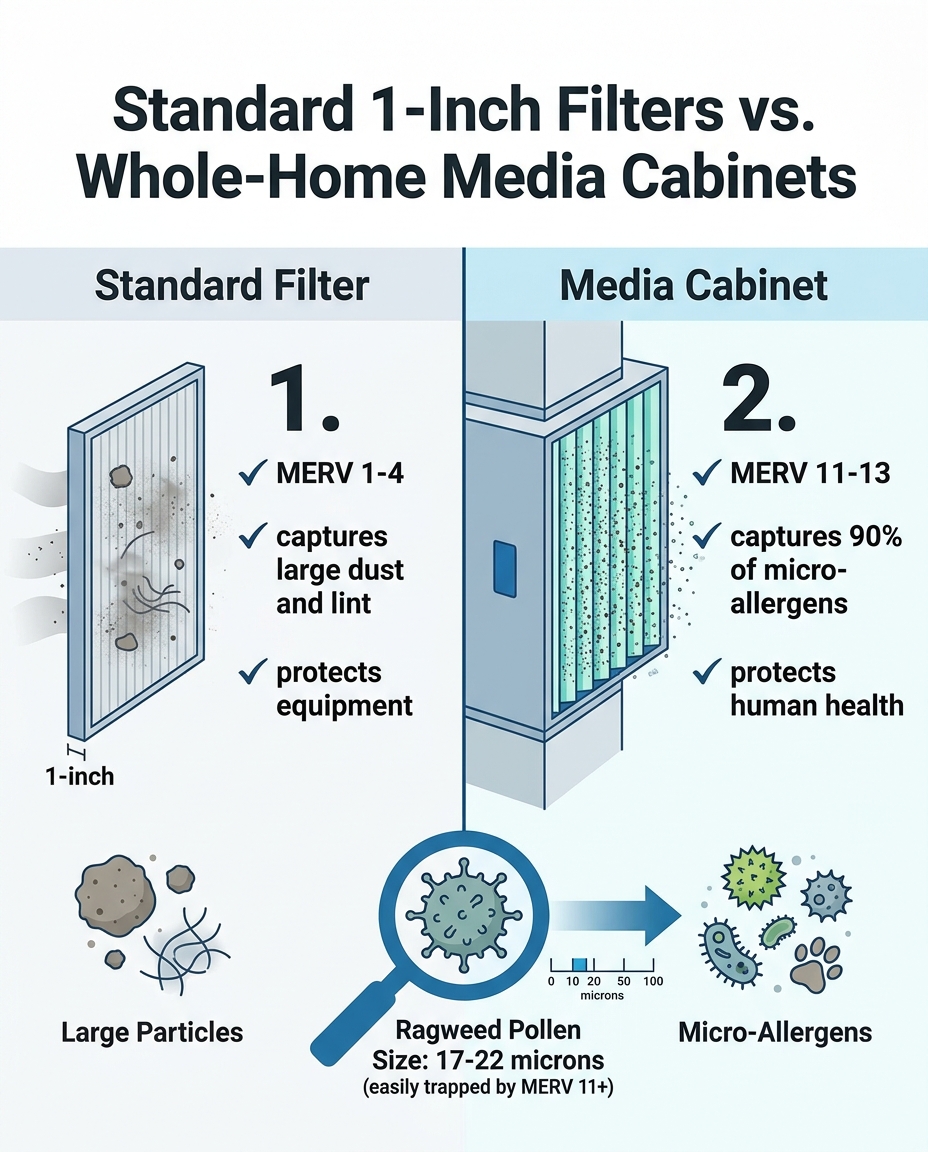
The micro-allergen bypass: Micro-allergens like ragweed pollen and harvest dust are incredibly small—often measuring between 10 and 20 microns in diameter. The porous, spun-glass material of a basic 1-inch filter is simply too loose to catch particles of this size. The allergens pass right through the fiberglass web, travel through your ductwork, and are blown directly into your bedrooms and living areas.
Why frequent changes aren't enough: Many homeowners tell us they believe that simply changing a cheap 1-inch filter more frequently during August will solve the problem. While keeping a clean filter is essential for airflow, swapping out a clean fiberglass filter for another clean fiberglass filter does not change the physical limitations of the material. It will still allow micro-allergens to pass through unhindered.
• 1-Inch Fiberglass — Primary Function: Protects HVAC blower motor — Particle Capture Size: Large dust, lint, hair — Allergy Defense Level: Very Low
• 1-Inch Pleated — Primary Function: Basic residential filtration — Particle Capture Size: Moderate dust, some pollen — Allergy Defense Level: Low to Moderate
• Whole-Home Media Cabinet — Primary Function: Protects human respiratory health — Particle Capture Size: Micro-allergens, ragweed, smog — Allergy Defense Level: High
Transitioning away from these basic filters to higher-tier filtration solutions is the only definitive way to establish a true allergy defense system in your home.
How High-Efficiency Media Cabinets Capture Micro-Allergens
Decoding MERV ratings: The effectiveness of an air filter is measured by its Minimum Efficiency Reporting Value (MERV). The higher the MERV rating, the smaller the particles the filter can trap. Basic fiberglass filters usually sit between MERV 1 and MERV 4. For residential allergy defense, our team typically recommends MERV 11 to 13 filters as the absolute sweet spot. Data from the Asthma and Allergy Foundation of America (AAFA) highlights that filters in this range are highly effective at capturing micro-particles, including pollen, pet dander, and dust mites.
The physical advantage of media cabinets: A whole-home media cabinet is fundamentally different from a standard filter slot. Instead of a 1-inch depth, a media cabinet houses a deeply pleated filter that is typically 4 to 5 inches thick. In our experience retrofitting systems across Greenville IN and surrounding Floyd County, this design offers massive advantages:
1. Vastly increased surface area: The deep pleats unfold to reveal square footage of filtration material that dwarfs a standard filter. This allows it to trap thousands of times more micro-allergens before becoming clogged.
2. Reduced airflow restriction: Because the surface area is so large, air can flow through the filter easily, even though the material itself is dense enough to catch ragweed pollen. This protects your blower motor from overworking.
3. Extended lifespan: While 1-inch filters need replacing every 30 days during late-summer August (ragweed peak in Indiana), a 4-inch media filter can often last 6 to 12 months depending on household conditions.
The need for professional assessment: It is vital to understand that you cannot simply cram a 4-inch filter into a 1-inch slot. As licensed professionals, our technicians must modify your ductwork slightly to retrofit a media cabinet. More importantly, we always assess your HVAC blower motor to ensure it can handle the static pressure requirements of a higher MERV rating without burning out.

Beyond Filtration: Comprehensive Whole-Home Air Purification
Passive vs. active defense: While upgrading to a media cabinet is a massive leap forward, it remains a passive form of defense. A filter simply sits in the ductwork and traps particles as they happen to float by. For the ultimate back-to-school allergy defense, you need to look toward active air purification. Active systems do not just trap particles; they actively neutralize biological contaminants, neutralize odors, and force ultra-fine particles to clump together so they can be caught more easily.
Integrating a whole-home system through professional air purifier installation is vastly superior to buying portable, single-room units. Portable units only clean the air in their immediate vicinity. If your child walks from the bedroom to the kitchen, they leave the clean air zone and are immediately exposed to allergens again.
Complete home coverage: When a whole-home air purifier is installed directly into your HVAC ductwork, every single cubic foot of air that is heated or cooled by your system is treated. This ensures that the air in the living room is just as clean as the air in the bedrooms. These systems operate silently in the background, requiring no daily maintenance, and provide continuous, whole-house defense during peak allergy season. By the time the air reaches your living spaces, it has been scrubbed of the agricultural dust and ragweed pollen that trigger severe seasonal allergies.
Protecting Your HVAC Equipment Through the Harvest Season
The toll of heavy allergen loads: Indoor air quality and HVAC system health are deeply connected. High volumes of agricultural dust and pollen do more than irritate your sinuses; they can quickly clog standard filters, severely restricting the airflow your system needs to function. When airflow drops, your AC compressor is forced to work substantially harder to pull air through the system.
The risk of system failure: During late-summer heatwaves, this added strain can be disastrous. A clogged filter can cause the evaporator coil to freeze solid, which in turn can lead to a burnt-out compressor or total system failure right when you need cooling the most. Just last August, our team at Allegiance Heating & Air responded to a frantic call where a local homeowner experienced this exact scenario. Their AC had struggled to keep up during a period of heavy agricultural dust. When our technician arrived promptly, we diagnosed that restricted airflow from a clogged 1-inch filter had caused the unit to fail, and we were able to fix the AC unit the very same day to restore comfort.
The role of routine care: To prevent these breakdowns, we constantly remind our customers that keeping up with a routine HVAC maintenance plan is essential. Our professional check-ups ensure the system is thoroughly clean, the blower motor is calibrated, and the equipment is ready to handle both high heat and high filtration demands. A clean, well-maintained system is an absolute prerequisite for effective indoor air quality management. If your ductwork and blower are coated in years of dust, even the best air purifier will struggle to keep your home's air pristine.
Greenville Homeowners' Guide to Seasonal Air Filtration
What MERV rating is best for ragweed?
Our technicians highly recommend a rating of MERV 11 to MERV 13 for trapping ragweed pollen effectively. These ratings are capable of capturing up to 90% of large airborne particles without overly restricting residential airflow. Going above MERV 13 in a standard residential system can sometimes cause too much static pressure, so it is important to consult a professional before upgrading.
Do whole house air purifiers help with seasonal allergies?
Yes, we find them to be incredibly effective because they treat the entire volume of air in the home rather than just a single room. Whole-house systems capture and neutralize micro-allergens that easily bypass standard 1-inch filters. This continuous, silent operation provides a massive reduction in the airborne triggers that cause congestion, sneezing, and watery eyes.
How often should I change my HVAC filter in the summer?
Standard 1-inch fiberglass or pleated filters should be checked monthly and changed every 30 to 90 days under normal conditions. However, during the peak harvest and ragweed season in August and September, monthly changes are strongly advised. If you upgrade to a 4-inch media cabinet, the lifespan extends significantly, often requiring replacement only every 6 to 12 months.
Can high humidity make indoor allergies worse?
Yes, high humidity can suspend particles in the air for much longer periods and promote the growth of dust mites and other biological irritants. Proper HVAC operation naturally helps dehumidify the air while filtering it. Maintaining indoor humidity between 30% and 50% is ideal for minimizing airborne allergens.
Steps to Prepare Your Greenville HVAC for Late-Summer Allergies
• Schedule a late-summer system inspection: Let our team ensure your blower motor and coils are clean and operating at peak efficiency.
• Upgrade to a MERV 11-13 media cabinet: Ditch the 1-inch fiberglass filters for a deep-pleated system that actually traps micro-allergens.
• Consider whole-home air purification integration: Add active purification to neutralize biological contaminants and ultra-fine particles.
• Keep windows closed on high pollen days: Rely on your newly upgraded HVAC filtration to bring in clean, conditioned air rather than inviting ragweed directly inside.
Secure Healthier Indoor Air Before the First Bell Rings
Upgrading your home's filtration system is one of the most proactive steps you can take to protect your family's health this fall. The transition back to school is stressful enough without the added burden of severe seasonal allergies disrupting your children's sleep and focus. Because the late-summer ragweed peak is already setting in across Greenville IN and surrounding Floyd County, acting quickly is vital.
By moving beyond basic 1-inch filters and exploring high-efficiency media cabinets or whole-home purification, you can create a genuine clean-air sanctuary. We encourage you to consult with our local HVAC experts at Allegiance Heating & Air to find the perfect filtration balance for your specific system, ensuring your family breathes easier and stays healthier all year long.
Contact Us Or Schedule Expert Service
Other Blogs
ready to transform your home?
Discover our exceptional home services tailored to meet your needs and enhance your living space.
WHAT OUR CLIENTS HAVE TO SAY ABOUT US

We had a complete HVAC system and a hot water heater installed. The guys were professional, well mannered, and completed the work in a timely manner. Would definitely use them again.
I was nervous at first because my AC broke in the middle of 80 degree weather which is strange for April, but Allegiance Heating and Air was incredibly prompt and professional. The technician arrived within an hour, explained the problem clearly, and completed the repair. The technician , Mr. Garrett Moon was a very nice and courteous young man. He found the problem and fixed it within a timely manner. I highly recommend them for any heating or cooling needs. I’ll definitely give them a call again should I ever have another issue, but hopefully not. Knock on wood 😁. Give them a call… you won’t be disappointed!
From the moment I called to schedule a service, the team was quick to respond and arrived right on time. The technician was professional, friendly, and clearly knowledgeable about my heating system. He explained the repair options in plain language and completed the job efficiently. I appreciated the reliable service and the fact that the work was done the same day. I would definitely recommend Allegiance Heating and Air for any residential HVAC needs.
5/5 stars – I was very impressed with the efficient, affordable and timely service from Allegiance Heating and Air. The technician arrived on time, and performed the service quickly, no repairs needed at this time. Communication was clear and the whole experience felt hassle‑free. I would definitely recommend them for any residential HVAC needs.
Knowledgeable, experienced individual.
Explains Allegiance Heating and Air was incredibly reliable, professional and affordable. They arrived right on time, kept the work area clean and finished the furnace repair quickly. The technician explained everything clearly and the price was a great value. If happiness had a location on Google Maps, it would be here.
Gilbert had to go above and beyond because York is no longer making the part for my furnace. But he was able to find a way to construct a housing bracket for my furnace. Ingenuity, determination and integrity is what finally got my furnace fixed. Gilbert is truly a one of a kind technician.
Thank you for always going the extra mile. Gilbert is always respectful and helpful with any concerns.
"Great service, most knowledgeable and capable HVAC business in Kentuckiana!! Pete Flemming and Bryan the owner, are HVAC encyclopedias. They have the highest integrity of any HVAC business I have ever used. Allegiance has put numerous units in for me over the last 17 years. I will continue to use and trust them."
"Fast response from Allegiance when our heat was out on New Year’s day! Service technician was friendly and efficient. He took the time to explain the problem, tell us about the temporary fix and the plan for permanent repair. We were impressed!"
"Love Allegiance! Their technicians, in particular Benjamin, explain everything. Fast and thorough. A/C was out on a Sunday. Called Allegiance and within a few hours Benjamin arrived. Such a comfort as he was the one who last serviced our units. He quickly replaced part and cooling is restored!"
"My heat pump went out and I had to call after hours. The technician (Garrett) was outstanding and thorough. He got my system up and working until Monday and gave me several options of units. Also took the time to explain the issue to my Home warranty company. I highly recommend this company."
"Right on time :) respectful, fast, and polite. Even gave my fur babies some attention."
"Had Garrett out today to fix our AC. Fantastic tech. He showed up exactly when he said he would and kept us informed of what he was checking and what he found. Highly recommend!"
"Lucas with Allegiance showed up on time as promised, was professional and extremely patient and responsive with all my questions. He took care of the issue, and I feel he was trustworthy! He had us back to cool and comfortable on one of the hottest days of the year."
"Lucas did a great job! Very professional and expedient. Explained the process very well and represented Allegiance as a truly professional and reputable company."
"Arrived on time and work diligently to fix issue. These guy are great. Worked quickly to resolve my issues."
"Lucas was great - he spent a lot of time trying to figure out what was going on and explained everything he was doing. I trust Allegiance and wouldn’t want anyone else working on/in my house!!"

RELATED ARTICLES
Common HVAC Problems During High Summer Temperatures in New Albany
The Complete Guide to How Humidity Affects Your HVAC and Comfort