When Total System Failure Strikes During a Heatwave
July extreme heat is already settling over the valley, and navigating 24/7 emergency AC dispatch times in Austin and Northern Kentuckiana is the last thing you want to worry about when your system completely shuts down. The oppressive humidity and extreme temperatures typical of the Ohio River Valley in peak summer can turn a comfortable home into a dangerous environment in a matter of hours. When your air conditioner stops blowing cold air—or stops running altogether—the physical discomfort is immediately followed by the stress of wondering how long you will have to wait for a technician to arrive.
If you are currently experiencing a total breakdown, you can find comprehensive air conditioning services information on our site, or you can contact our emergency dispatch team right now for immediate assistance.
The unfortunate reality of peak summer weather is that simultaneous regional breakdowns cause unexpected delays across the entire HVAC industry. When the heat index spikes, you are likely not the only homeowner in the area dealing with a failing compressor or a blown capacitor. This sudden surge in service requests makes it absolutely crucial to understand how emergency triage works. While wait times can induce anxiety, especially as the indoor temperature creeps higher, local professionals utilize methodical, highly structured dispatch protocols to reach you safely and efficiently. You have not been forgotten; your request is simply being processed through a system designed to handle high-volume crises.
The Reality of Simultaneous AC Breakdowns in the Ohio River Valley
To understand why wait times fluctuate during a heatwave, you have to look at the sheer mechanical strain placed on local cooling infrastructure. July heat index averages in Southern Indiana frequently exceed 95 degrees, accompanied by thick, heavy humidity. According to standard HVAC design limits established by organizations like ASHRAE, most residential air conditioning systems are sized to maintain indoor comfort up to a specific outdoor temperature threshold. When the weather pushes past those design limits for days on end, your system is forced to run continuously without its normal resting cycles.
This continuous operation creates a domino effect across the region. When a severe heatwave hits, aging systems throughout the valley tend to fail at the exact same time. Compressors overheat, electrical components burn out, and drain lines clog from excessive condensation. This sudden, massive influx of service requests severely impacts local logistical capacity and dispatch queues. Every available technician is out on the road, moving from one overheated home to the next.
During these peak periods, the queue is simply processing an extraordinary volume of simultaneous crises. It is completely normal to feel frustrated when an ETA stretches into the afternoon, but knowing the region-wide context helps set realistic expectations. The entire local grid is under strain, and service teams are working at maximum capacity to restore comfort to the community.
How Heat Index Overloads Aging Compressors
The mechanical strain on older units during continuous operation cannot be overstated. A compressor is the heart of your air conditioning system, responsible for pumping refrigerant through the lines to absorb and release heat. When the unit runs for 12 to 16 hours a day without a break, the compressor motor generates immense internal heat. In older systems with worn bearings or degraded electrical components, this sustained heat often leads to catastrophic failure.
Furthermore, the extreme humidity of the Ohio River Valley forces your air conditioner to work twice as hard. Before an AC unit can effectively lower the air temperature, it must first remove the heavy moisture from the indoor air. This dehumidification process demands significant energy and runtime. If your system is already struggling with age or lack of maintenance, the added burden of pulling gallons of water out of the humid summer air is often the final straw that triggers a breakdown.
Defining a True HVAC Emergency vs. Standard Repair
When you call for service during a heatwave, the way you describe your system's symptoms directly impacts how your ticket is categorized. Dispatchers rely on your accurate reporting to manage expectations and route technicians effectively across Northern Kentuckiana service areas. Understanding the difference between a life-safety emergency and a standard urgent repair ensures the entire community gets service based on actual risk levels.
• Life-Safety Emergency — Common Symptoms: Total system failure in 95°+ heat, sparking, electrical burning smells, or vulnerable occupants (elderly, infants) in the home. — Dispatch Priority: Highest Priority. Rerouted ahead of standard maintenance and minor repairs.
• Urgent Non-Emergency — Common Symptoms: System is running but blowing lukewarm air, strange mechanical noises, or minor water pooling near the indoor unit. — Dispatch Priority: High Priority. Placed in the standard daily queue for the next available technician.
• Standard Repair — Common Symptoms: Thermostat display issues, slightly reduced airflow in one room, or preventive maintenance requests. — Dispatch Priority: Normal Priority. Scheduled for the next available open appointment slot.
A life-safety emergency typically involves a complete failure of the cooling system during extreme heat, especially when the home houses vulnerable occupants. Electrical issues, such as sparking at the condenser or the smell of burning wires near the furnace, also constitute immediate emergencies because they pose a fire risk. In these scenarios, dispatchers act quickly to mitigate danger.
In contrast, an urgent but non-emergency issue might involve a system that is struggling but still partially functioning. If your AC is blowing warm air but the fan is still running, or if you notice a minor condensate leak, the situation is certainly urgent, but it does not immediately threaten the safety of the household. Accurately reporting these specific symptoms to the dispatcher ensures your call is categorized correctly in the system. Honest reporting prevents the queue from bottlenecking and allows technicians to reach the most dangerous situations first.
Behind the Scenes: How HVAC Triage Prioritizes Your Call
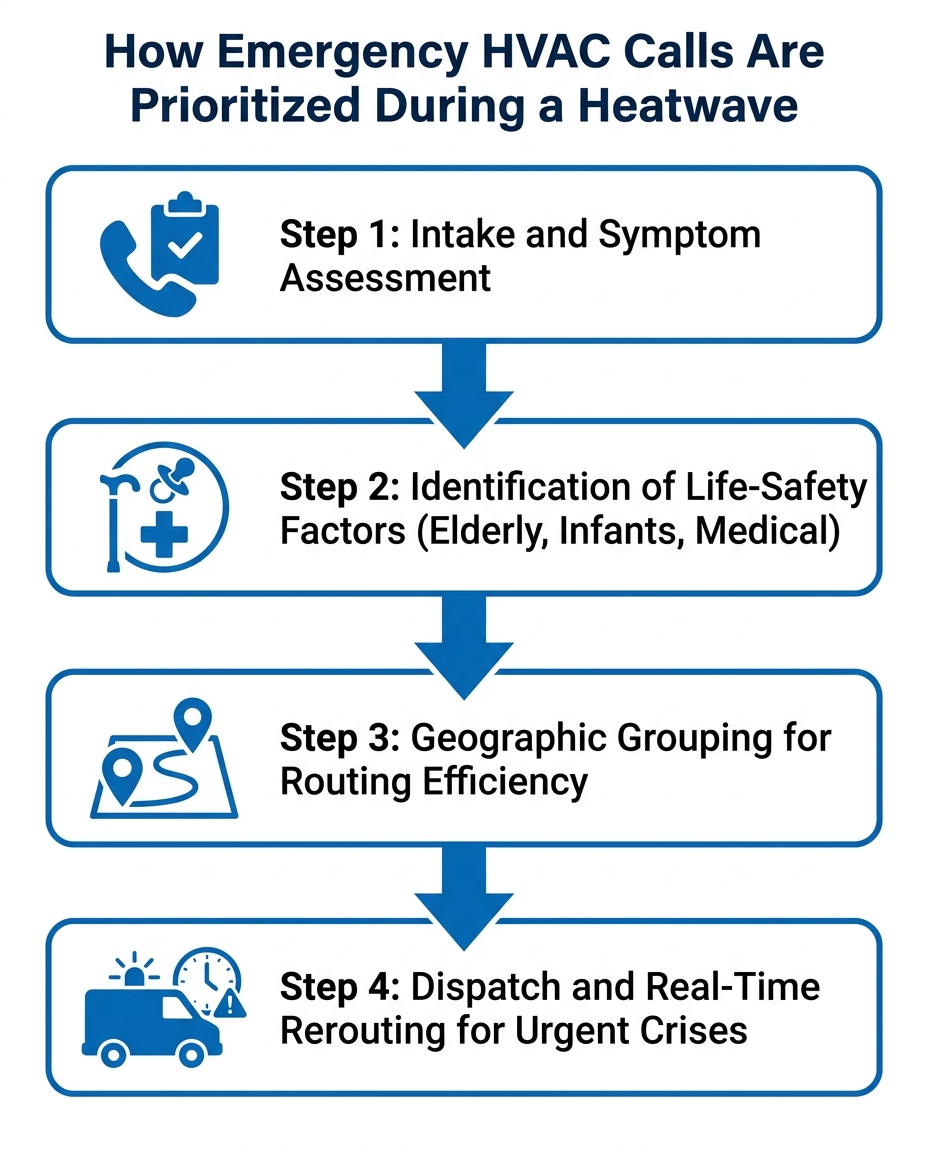
When dozens of calls flood in on a hot July morning, dispatchers do not simply assign tickets in the exact order they were received. Instead, they use intelligent triage protocols to route emergency calls based on severity and risk. This behind-the-scenes process is what separates local, family-owned dispatching from national chain algorithms. A national call center might treat every ticket the same, strictly following a first-come-first-served model. A local dispatcher uses intelligent, compassionate triage to protect the community.
1. Identifying Vulnerable Households: The absolute highest priority is given to households with elderly residents, infants, or documented medical conditions that are exacerbated by extreme heat. If a home cannot safely sustain a temperature spike, that ticket is moved to the top of the board.
2. Monitoring Indoor Temperature Thresholds: Dispatchers will often ask what your thermostat currently reads. A home sitting at 88 degrees with a broken AC takes precedence over a home that is currently at 76 degrees but experiencing strange noises.
3. Evaluating Electrical and Safety Risks: Any mention of smoke, electrical burning smells, or continuous breaker tripping elevates the call to an immediate safety hazard, requiring swift intervention to prevent property damage.
4. Human-Led Dynamic Routing: Unlike rigid software algorithms, local dispatchers constantly monitor the board. If a technician finishes a job early, they are dynamically rerouted to the nearest high-priority call, rather than driving all the way across town for a lower-priority issue.
This methodical approach means that even late-night or weekend calls are processed with urgency and personal attention when the situation demands it. For example, one local homeowner experienced a total system failure late on a weekend. Because of intelligent triage, the situation was flagged for immediate review. The owner responded personally and performed the repair, proving that a human-led system actively looks out for the well-being of the customer.

Travel Times and Logistical Routing Across Southern Indiana
Managing expectations during a heatwave also requires an understanding of the geographical challenges involved in dispatching. The service area spans a wide, diverse landscape, ranging from tight suburban grids with heavy traffic to more dispersed rural routes where homes are miles apart. Reaching all northern Kentuckiana service areas efficiently during peak demand is a massive logistical undertaking.
This is where the advantage of a local dispatcher truly shines. A dispatcher who knows the roads, the seasonal traffic patterns, and the rural routes of Southern Indiana can route a fleet far better than an outsourced call center relying solely on GPS. To maximize the number of households a single technician can restore in one shift, dispatchers group calls geographically. If a technician is already working in a specific neighborhood, the dispatcher will attempt to assign them to other broken-down units in that exact same zip code before sending them across the river.
Because of this dynamic routing, you might find that an estimated time of arrival (ETA) shifts slightly as the day progresses. If a technician is en route to your home for a standard repair but a life-threatening emergency is called in just two streets over, they may be temporarily rerouted to secure that emergency first. This geographic grouping and flexible routing ensure that the maximum number of people get their cooling restored as quickly as humanly possible.
What to Do While Waiting for Your Technician
Once you are in the queue and waiting for a technician to arrive, your primary focus should be staying safe and protecting your equipment from further damage. July extreme heat can make a home incredibly uncomfortable within hours, but taking a few proactive steps can help you manage the environment while you wait.
• Shut off the system at the thermostat: If your AC is making grinding noises, blowing warm air, or struggling to turn on, turn the thermostat to the "off" position immediately. Forcing a failing compressor to keep running will only cause more extensive, permanent damage.
• Check the air filter: A severely clogged air filter can restrict airflow so badly that the evaporator coil freezes solid. Checking and replacing a dirty filter is a safe, non-technical step that might actually resolve a minor airflow issue before the tech even arrives.
• Inspect the circuit breaker: Sometimes a power surge or a temporary overload will trip the dedicated breaker for your AC unit. Check your electrical panel to see if the switch has flipped to the neutral position. If it has, reset it once. If it trips again immediately, leave it alone and wait for the professional.
• Block out the sun: Close all blinds, curtains, and shades, particularly on south- and west-facing windows. Blocking radiant heat from entering the home will significantly slow down the indoor temperature rise.
• Minimize heat-generating appliances: Avoid using the oven, stove, or dryer while your AC is down. Stick to microwave meals or cold food to keep internal heat generation to an absolute minimum.
• Utilize ceiling fans strategically: Ceiling fans do not lower the room temperature, but they do create a wind-chill effect on your skin. Keep them running in the rooms you are actively occupying to stay comfortable.
If you want to understand more about how your equipment functions under normal conditions, reviewing a comprehensive air conditioning guide can provide valuable insights into your system's operation and maintenance needs.
Preventing the Panic: Why Proactive Care Beats Emergency Calls
The best way to handle an emergency dispatch situation is to prevent it from happening in the first place. Most peak-season breakdowns are not sudden, unpredictable events; they are the result of cumulative wear and tear that goes completely unnoticed during the milder spring months. When the system is finally pushed to its limits in July, those minor, hidden issues escalate into total system failures.
Routine inspections are designed to catch these exact problems. A thorough tune-up can identify a failing capacitor, a slow refrigerant leak, or a blanket of dirt over the condenser coils long before they cause a total shutdown. By addressing these minor points of friction when the weather is mild, you ensure the system has the strength to endure the brutal summer heat without faltering.
Furthermore, if your equipment is approaching the end of its lifespan, replacing an aging, inefficient unit during the off-season prevents the intense stress of a mid-August emergency replacement. Consider a situation from last summer: a household lost their cooling entirely during the hottest week in August. Because they reached out immediately, a technician was dispatched promptly to replace the old system. However, securing a planned replacement in April or October is always less stressful than navigating an unexpected installation in 95-degree heat.
To secure priority service and ensure optimal efficiency year-round, enrolling in a preventative maintenance plan is one of the smartest investments a homeowner can make. These plans keep your equipment clean, calibrated, and ready for whatever the Ohio River Valley weather brings.
Frequently Asked Questions About Emergency AC Service
What is considered an AC emergency during a heatwave?
An AC emergency is typically defined as a complete system failure when outdoor temperatures are dangerously high, particularly if vulnerable individuals live in the home. It also includes any situation involving electrical burning smells, sparking, or smoke coming from the equipment. If your system is blowing warm air but still running, it is urgent, but generally classified just below a life-safety emergency.
How do HVAC companies prioritize calls during a heatwave?
Dispatchers prioritize calls using a triage system that focuses on safety first. Homes with elderly residents, infants, or documented medical conditions are moved to the top of the list. From there, dispatchers group calls geographically to minimize technician drive time, ensuring the highest number of homes get their cooling restored as efficiently as possible.
How long does emergency AC repair typically take?
The duration of the actual repair depends entirely on the specific component that failed, but most standard emergency repairs are completed within one to two hours of the technician arriving. However, the wait time for the technician to arrive can range from a few hours to a full day during peak July heatwaves, depending on regional call volume and triage priority.
What should I do while waiting for AC repair in July?
The most important step is to turn your thermostat to the "off" position so you do not cause further damage to a struggling compressor. After that, close all your blinds and curtains to block out radiant heat, turn on your ceiling fans, and avoid using heat-generating appliances like ovens or dryers until the system is fixed.
Does turning my AC off and back on reset the system?
Turning the system off at the thermostat and resetting the circuit breaker can clear minor electrical glitches or allow a frozen evaporator coil to begin thawing. However, if the system trips the breaker a second time after being reset, you should leave it off entirely. Repeatedly forcing a reset on a failing system can permanently destroy the compressor.
Why do so many air conditioners break down at the same time?
Air conditioners across the region experience the exact same severe weather conditions and high heat indexes simultaneously. When temperatures exceed the standard design limits of the equipment, systems run continuously without resting. This sustained mechanical strain causes aging parts across the entire valley to overheat and fail at roughly the same time.
Get Reliable Support When You Need It Most
Navigating 24/7 emergency AC dispatch times in Austin and Northern Kentuckiana requires patience, but understanding the process brings peace of mind. While waiting for an AC repair in a hot house is undeniably uncomfortable, knowing that the dispatch process is designed to handle true emergencies methodically should reassure you that you are in good hands. The triage system exists to protect the most vulnerable and to route technicians as efficiently as possible across the region.
When you work with a local team, you get the reassurance of dispatchers and technicians who understand the specific regional demands of the Ohio River Valley and prioritize your safety above all else. If your system is failing and you need immediate assistance, do not wait for the situation to worsen. Please contact our emergency dispatch team today to get your service request properly triaged, scheduled, and resolved.
Contact Us Or Schedule Expert Service
Other Blogs
ready to transform your home?
Discover our exceptional home services tailored to meet your needs and enhance your living space.
WHAT OUR CLIENTS HAVE TO SAY ABOUT US

We had a complete HVAC system and a hot water heater installed. The guys were professional, well mannered, and completed the work in a timely manner. Would definitely use them again.
I was nervous at first because my AC broke in the middle of 80 degree weather which is strange for April, but Allegiance Heating and Air was incredibly prompt and professional. The technician arrived within an hour, explained the problem clearly, and completed the repair. The technician , Mr. Garrett Moon was a very nice and courteous young man. He found the problem and fixed it within a timely manner. I highly recommend them for any heating or cooling needs. I’ll definitely give them a call again should I ever have another issue, but hopefully not. Knock on wood 😁. Give them a call… you won’t be disappointed!
From the moment I called to schedule a service, the team was quick to respond and arrived right on time. The technician was professional, friendly, and clearly knowledgeable about my heating system. He explained the repair options in plain language and completed the job efficiently. I appreciated the reliable service and the fact that the work was done the same day. I would definitely recommend Allegiance Heating and Air for any residential HVAC needs.
5/5 stars – I was very impressed with the efficient, affordable and timely service from Allegiance Heating and Air. The technician arrived on time, and performed the service quickly, no repairs needed at this time. Communication was clear and the whole experience felt hassle‑free. I would definitely recommend them for any residential HVAC needs.
Knowledgeable, experienced individual.
Explains Allegiance Heating and Air was incredibly reliable, professional and affordable. They arrived right on time, kept the work area clean and finished the furnace repair quickly. The technician explained everything clearly and the price was a great value. If happiness had a location on Google Maps, it would be here.
Gilbert had to go above and beyond because York is no longer making the part for my furnace. But he was able to find a way to construct a housing bracket for my furnace. Ingenuity, determination and integrity is what finally got my furnace fixed. Gilbert is truly a one of a kind technician.
Thank you for always going the extra mile. Gilbert is always respectful and helpful with any concerns.
"Great service, most knowledgeable and capable HVAC business in Kentuckiana!! Pete Flemming and Bryan the owner, are HVAC encyclopedias. They have the highest integrity of any HVAC business I have ever used. Allegiance has put numerous units in for me over the last 17 years. I will continue to use and trust them."
"Fast response from Allegiance when our heat was out on New Year’s day! Service technician was friendly and efficient. He took the time to explain the problem, tell us about the temporary fix and the plan for permanent repair. We were impressed!"
"Love Allegiance! Their technicians, in particular Benjamin, explain everything. Fast and thorough. A/C was out on a Sunday. Called Allegiance and within a few hours Benjamin arrived. Such a comfort as he was the one who last serviced our units. He quickly replaced part and cooling is restored!"
"My heat pump went out and I had to call after hours. The technician (Garrett) was outstanding and thorough. He got my system up and working until Monday and gave me several options of units. Also took the time to explain the issue to my Home warranty company. I highly recommend this company."
"Right on time :) respectful, fast, and polite. Even gave my fur babies some attention."
"Had Garrett out today to fix our AC. Fantastic tech. He showed up exactly when he said he would and kept us informed of what he was checking and what he found. Highly recommend!"
"Lucas with Allegiance showed up on time as promised, was professional and extremely patient and responsive with all my questions. He took care of the issue, and I feel he was trustworthy! He had us back to cool and comfortable on one of the hottest days of the year."
"Lucas did a great job! Very professional and expedient. Explained the process very well and represented Allegiance as a truly professional and reputable company."
"Arrived on time and work diligently to fix issue. These guy are great. Worked quickly to resolve my issues."
"Lucas was great - he spent a lot of time trying to figure out what was going on and explained everything he was doing. I trust Allegiance and wouldn’t want anyone else working on/in my house!!"

RELATED ARTICLES

Who’s Hot? The Best Furnace Installers in Greenville, IN

6 Reasons Kentuckiana Homeowners Choose Local Root HVAC