


The Upstairs Bedroom Dilemma: Adding a Window Unit vs. Fixing Your Home's Air Balancing
A hot second-floor bedroom often forces a choice between immediate relief and permanent solutions. Evaluate the true costs of a window unit versus professional ductwork balancing.

Sweating Through Another Night: The Second-Floor Cooling Dilemma
Your central AC is running nonstop, but you are still facing The Upstairs Bedroom Dilemma: Adding a Window Unit vs. Fixing Your Home's Air Balancing. You walk downstairs and the living room feels like a refrigerator, yet the moment you climb the stairs, the air grows thick, stagnant, and uncomfortably warm. At Allegiance Heating & Air, our team hears from countless homeowners living in Greenville IN two-story homes who face this frustrating temperature imbalance as a nightly struggle during the summer months. You are paying high utility bills to cool your entire house, but the rooms where you actually sleep remain completely untouched by the relief.
When faced with this situation, you stand at a common crossroads. Do you make a quick trip to the hardware store, buy a window air conditioning unit, and wrestle it into the bedroom frame for immediate, localized relief? Or do you contact a professional to diagnose and correct the underlying airflow issue that is causing the problem in the first place? Both paths offer cooling, but they come with vastly different implications for your energy usage, your home's security, and the lifespan of your primary cooling equipment.
Making the right choice requires looking past the immediate symptom of a hot room. By understanding how your home manages air, you can evaluate short-term band-aids against permanent comfort improvements. If you are tired of sleeping in a sauna while the first floor freezes, exploring professional airflow and air quality solutions is the first step toward restoring whole-home comfort.
Diagnosing the Root Cause of a Hot Upstairs
Before you can permanently solve a second-floor cooling issue, you have to understand why the heat is trapped there in the first place. Most homeowners assume their air conditioner is simply too small or failing, but if the first floor is freezing while the second floor is sweltering, the equipment is usually producing enough cold air. The real issue is airflow distribution. Your system is creating the cooling, but the ductwork is failing to deliver it to the furthest reaches of the house.
This distribution failure is heavily compounded by physics, specifically the stack effect. Heat naturally rises. During the day, the sun beats down on your roof, superheating the attic space. Greenville's hot, humid summers exacerbate this stack effect, trapping dense moisture and rising heat on the second floor. If your ductwork is poorly designed, undersized, or leaking, the weak airflow simply cannot overcome that heavy blanket of rising thermal energy. The cold air falls to the first floor, while the hot air remains locked in your bedrooms during July peak heat.
Common culprits behind poor upstairs airflow:
• Inadequate return vents: If the upstairs lacks sufficient return grilles, the hot air has no way to escape and be pulled back to the HVAC unit for cooling.
• Leaky ductwork: Conditioned air escapes into the walls or attic before it ever reaches the bedroom registers.
• Undersized duct runs: The pipes carrying air to the second floor are simply too narrow to deliver the volume of air required.
• Closed or blocked registers: Furniture or rugs blocking vents disrupt the carefully calibrated pressure of the entire system.
Sometimes, the root cause traces back to previous modifications. Our technicians at Allegiance Heating & Air saw this exact pattern with a local homeowner during a recent summer remodel. They had an incorrectly installed heat pump system left over from the previous homeowner, combined with brutally hot attic conditions that were suffocating the equipment. Once our professionals properly diagnosed the airflow restrictions and offered a targeted solution, the repairs were completed ahead of schedule—fixing the distribution issue entirely. If you suspect your home has underlying ductwork flaws, consulting a comprehensive air conditioning guide can help you understand how air is supposed to move through your specific floor plan.
The Quick Fix: Pros and Cons of Window AC Units
When the temperature in your bedroom is climbing past eighty degrees at midnight, a window air conditioning unit looks incredibly appealing. It offers an immediate, localized blast of cold air exactly where you need it. You can purchase one in the afternoon and have it running by evening. However, while window units provide rapid relief for Greenville IN two-story homes, they introduce a host of secondary problems that our team notices homeowners often overlook until it is too late.
Window units are inherently a compromise. You are sacrificing the integrity of your home's exterior envelope to accommodate a heavy, vibrating appliance. This creates immediate security vulnerabilities, as the window must remain unlocked and partially open to hold the unit. Aesthetically, they block natural light and alter the exterior appearance of your home. Furthermore, the Department of Energy consistently notes the lower efficiency of room air conditioners compared to properly functioning central systems. They also struggle significantly with dehumidification, often leaving the bedroom feeling cold but clammy.
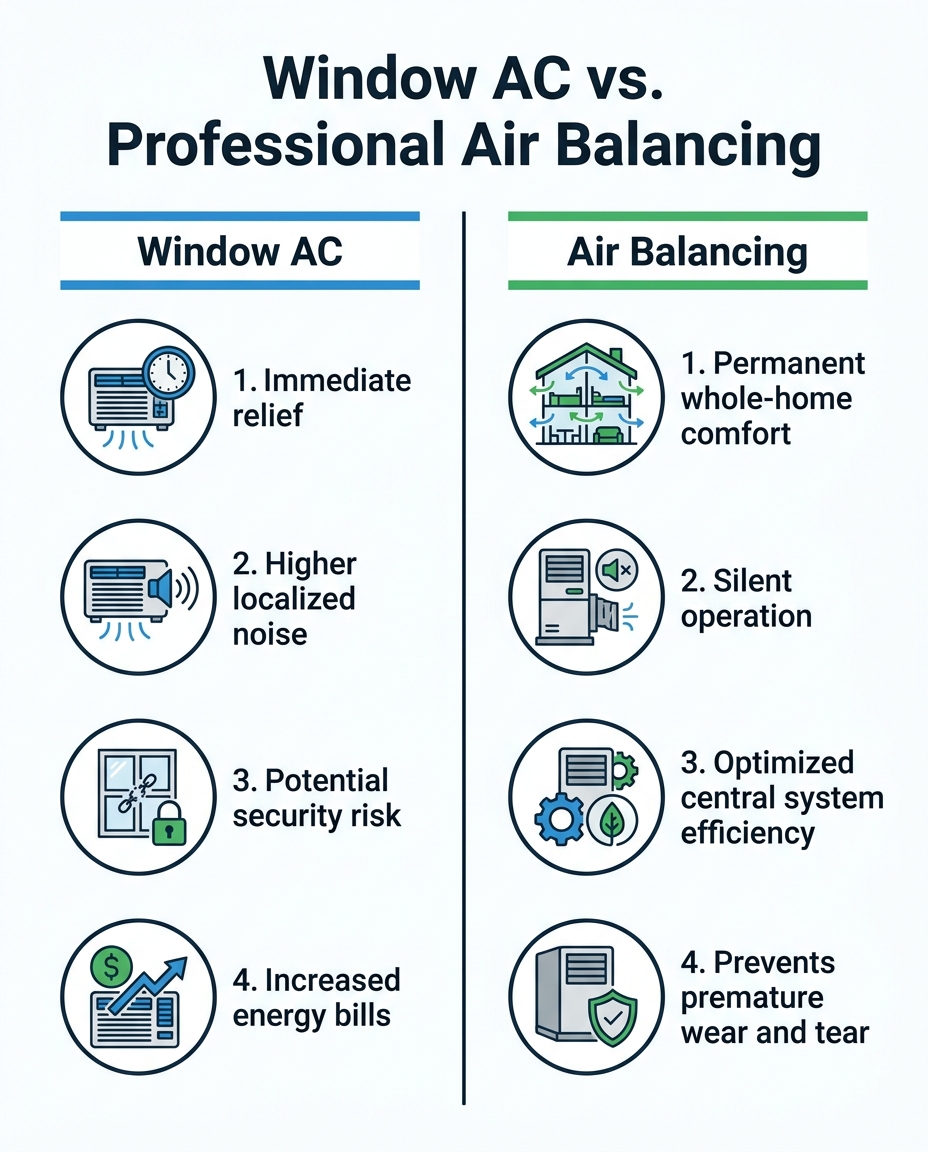
• Installation Speed — Window AC Unit: Immediate (DIY friendly) — Balanced Central Air: Requires professional scheduling
• Noise Levels — Window AC Unit: Loud (compressor is in the room) — Balanced Central Air: Silent (equipment is outside/basement)
• Security — Window AC Unit: High risk (unlocked, open window) — Balanced Central Air: Secure (windows remain locked)
• Humidity Control — Window AC Unit: Poor to moderate — Balanced Central Air: Excellent whole-home dehumidification
• Aesthetics — Window AC Unit: Blocks view, visible from street — Balanced Central Air: Invisible (uses existing vents)
The Hidden Energy Drain
The most significant drawback of adding a window unit is the hidden toll it takes on your utility bills. When you run a window unit in the bedroom while the central AC is running downstairs, you are paying to cool the same house twice. The window unit only addresses the air in that specific room, leaving the central system completely blind to the localized cooling.
Because the central thermostat is usually located on the first floor, it continues to read the ambient temperature of the hallway or living room. The downstairs remains cool, so the thermostat shuts off the central system, leaving the rest of the upstairs rooms to bake. Alternatively, if you crank the central thermostat down to try and force air upstairs, the downstairs turns into an icebox while the window unit guzzles electricity up above. It is a highly inefficient tug-of-war that drives up your monthly energy usage without ever solving the structural airflow problem.

How Unbalanced Airflow Damages Your Primary HVAC System
Ignoring a hot upstairs does more than disrupt your sleep; it actively damages your primary cooling equipment. Heating and cooling systems are engineered to operate under specific, balanced pressure conditions. When ductwork is unbalanced, undersized, or leaking, it creates high static pressure. You can think of static pressure as the blood pressure of your HVAC system. When it is too high, the blower motor has to work incredibly hard to push air through restrictive pathways.
By relying on a window unit, you are merely masking this symptom. The central system is still struggling against that high static pressure every time it turns on. During July peak heat, an unbalanced system will run continuously in a desperate attempt to satisfy the thermostat, overworking the compressor and overheating the blower motor. This constant, strained operation accelerates the wear and tear on vital components, drastically shortening the lifespan of the equipment.
Our service teams frequently see the fallout of ignored airflow restrictions. We recently helped a local customer with an older unit who experienced a complete system failure during the hottest week of the summer because the equipment had been straining against poor airflow for years. While our technician was able to respond quickly the same day to provide options and install a robust new unit, the premature failure could have been delayed with proper system equilibrium. If you want to protect your equipment from early breakdowns, keeping up with a routine HVAC maintenance plan is essential, as technicians can spot pressure imbalances before they destroy the compressor.
The Permanent Solution: What is Professional Air Balancing?
The true, permanent fix for a sweltering second floor is professional HVAC air balancing. This is not a hardware store purchase or a weekend DIY project. Air balancing is a precise, diagnostic process where a licensed professional measures and adjusts the airflow delivery to every single room in your home, ensuring the entire house reaches equilibrium.
Because ductwork adjustments directly impact the static pressure and safety of your HVAC equipment, this work requires specialized tools and training. Attempting to balance a system yourself—such as indiscriminately closing vents or blocking returns—can easily blow a blower motor or freeze an evaporator coil. A professional approach ensures the system operates exactly as the manufacturer intended.
The professional air balancing process typically involves:
1. Comprehensive Airflow Measurement: Technicians use specialized hoods to measure exactly how much cubic feet per minute (CFM) of air is coming out of every register in the home.
2. Static Pressure Testing: Probes are inserted into the ductwork to measure the resistance the blower motor is facing, identifying hidden blockages or undersized runs.
3. Damper Adjustments: Professionals adjust inline dampers (valves hidden inside the ductwork, not the grilles in your floor) to direct more air toward the second floor and less toward the already-cold first floor.
4. Ductwork Modifications: If the existing ducts are simply too small, technicians may install larger supply lines or add dedicated return vents to the hottest bedrooms to pull the stagnant air out.
5. Blower Speed Calibration: The system's fan speeds are adjusted to match the newly balanced ductwork, optimizing energy efficiency.
At Allegiance Heating & Air, our team's focus is always on whole-home diagnostics and permanent root-cause solutions rather than temporary band-aids. By addressing the actual physics of your home's airflow, you restore comfort to every room. Additionally, choosing permanent, high-efficiency ductwork and system modifications may qualify for general federal tax credits or local utility incentives, making the long-term investment even more practical for Greenville IN two-story homes.
Comparing Long-Term Value: Efficiency, Comfort, and Home ROI
When making a mid-funnel decision about your home's comfort, it is vital to look past the initial weekend setup and evaluate the long-term return on investment. A window unit offers a fast transaction, but professional air balancing delivers compounding value year over year.
The ongoing energy costs of running dual systems (a central unit fighting a window unit) will steadily drain your wallet every summer. In contrast, an optimized, balanced central system uses less energy to cool the entire house evenly. Furthermore, the quality of comfort is vastly different. Balanced airflow provides silent, invisible cooling that maintains a consistent temperature and humidity level. A window unit provides a loud, localized blast of cold air that cycles on and off disruptively throughout the night.
• Energy Efficiency — Supplemental Window Units: Low (running redundant systems) — Professional Air Balancing: High (optimizes central system output)
• Comfort Quality — Supplemental Window Units: Drafty, loud, localized cooling — Professional Air Balancing: Even, silent, whole-home consistency
• Equipment Lifespan — Supplemental Window Units: Central AC continues to strain and overwork — Professional Air Balancing: Reduces wear and tear on primary HVAC
• Home Resale Value — Supplemental Window Units: Often viewed negatively by buyers — Professional Air Balancing: Adds value via verified whole-home comfort
Finally, consider your home's overall value. If you ever plan to sell, prospective buyers walking into a primary bedroom with a window unit hanging out the frame will immediately assume the home's HVAC system is defective. A properly balanced home that stays cool during July peak heat speaks for itself. If you are ready to evaluate your home's long-term potential, you can request a free estimate to see exactly what a permanent solution looks like for your floor plan.
Make the Right Call for Lasting Second-Floor Comfort
A hot upstairs bedroom is a solvable problem, not a permanent condition you just have to live with. While a window unit might seem like the easiest way out of a sweaty night, it ultimately treats the symptom while ignoring the disease. By choosing to address the airflow distribution, you protect your primary HVAC equipment, lower your overall energy waste, and reclaim the comfort of your entire home.
Before you commit to blocking your window and running up your electric bill with supplemental hardware, get a professional evaluation of your ductwork and system static pressure. The experts can pinpoint exactly where the air is getting trapped. Take the next step toward permanent relief and reach out to our team for professional air conditioning services to diagnose your Greenville IN two-story home today.
Frequently Asked Questions
Why is my upstairs so much hotter than my downstairs?
The upstairs gets hotter due to a combination of the stack effect (heat naturally rising) and poor airflow distribution. During the summer, the sun superheats the attic, pressing heat down into the second floor. If your ductwork is undersized, leaking, or lacks adequate return vents, the central air conditioner simply cannot push enough cold air upstairs to overcome that rising heat, leaving the cold air trapped on the first floor.
Does a window AC use more electricity than central air?
Room air conditioners are generally less efficient at cooling large spaces than modern central air systems. While a single window unit uses less power than a whole-house compressor, running a window unit in addition to your central AC means you are paying to cool the same house twice. The most energy-efficient approach is to repair the ductwork so the central system can cool the entire home evenly without supplemental help.
What does residential HVAC air balancing do?
HVAC air balancing is a diagnostic process that measures and adjusts the airflow delivery to every room in your house. A professional technician uses specialized hoods and pressure gauges to locate blockages or design flaws in the ductwork. They then adjust inline dampers, modify duct sizes, or alter blower speeds to ensure every room receives the precise amount of conditioned air required for even temperatures.
Can you fix a hot upstairs without adding a window unit?
Yes, resolving the underlying ductwork and airflow issues will fix a hot upstairs permanently. Solutions often include installing larger supply ducts to the second floor, adding return air vents to pull hot air out of the bedrooms, and adjusting the system's internal dampers. These professional modifications restore whole-home comfort without the noise, security risks, or aesthetic drawbacks of a window unit.
Is it safe to close downstairs vents to push air upstairs?
Closing downstairs vents is not safe and can cause severe damage to your HVAC system. Your heating and cooling equipment is designed to operate with a specific amount of airflow; closing vents increases the static pressure inside the ductwork. This restriction forces the blower motor to work harder, reduces overall system efficiency, and can cause the air conditioner's evaporator coil to freeze over entirely.
Contact Us Or Schedule Expert Service
Other Blogs
ready to transform your home?
Discover our exceptional home services tailored to meet your needs and enhance your living space.
WHAT OUR CLIENTS HAVE TO SAY ABOUT US

We had a complete HVAC system and a hot water heater installed. The guys were professional, well mannered, and completed the work in a timely manner. Would definitely use them again.
I was nervous at first because my AC broke in the middle of 80 degree weather which is strange for April, but Allegiance Heating and Air was incredibly prompt and professional. The technician arrived within an hour, explained the problem clearly, and completed the repair. The technician , Mr. Garrett Moon was a very nice and courteous young man. He found the problem and fixed it within a timely manner. I highly recommend them for any heating or cooling needs. I’ll definitely give them a call again should I ever have another issue, but hopefully not. Knock on wood 😁. Give them a call… you won’t be disappointed!
From the moment I called to schedule a service, the team was quick to respond and arrived right on time. The technician was professional, friendly, and clearly knowledgeable about my heating system. He explained the repair options in plain language and completed the job efficiently. I appreciated the reliable service and the fact that the work was done the same day. I would definitely recommend Allegiance Heating and Air for any residential HVAC needs.
5/5 stars – I was very impressed with the efficient, affordable and timely service from Allegiance Heating and Air. The technician arrived on time, and performed the service quickly, no repairs needed at this time. Communication was clear and the whole experience felt hassle‑free. I would definitely recommend them for any residential HVAC needs.
Knowledgeable, experienced individual.
Explains Allegiance Heating and Air was incredibly reliable, professional and affordable. They arrived right on time, kept the work area clean and finished the furnace repair quickly. The technician explained everything clearly and the price was a great value. If happiness had a location on Google Maps, it would be here.
Gilbert had to go above and beyond because York is no longer making the part for my furnace. But he was able to find a way to construct a housing bracket for my furnace. Ingenuity, determination and integrity is what finally got my furnace fixed. Gilbert is truly a one of a kind technician.
Thank you for always going the extra mile. Gilbert is always respectful and helpful with any concerns.
"Great service, most knowledgeable and capable HVAC business in Kentuckiana!! Pete Flemming and Bryan the owner, are HVAC encyclopedias. They have the highest integrity of any HVAC business I have ever used. Allegiance has put numerous units in for me over the last 17 years. I will continue to use and trust them."
"Fast response from Allegiance when our heat was out on New Year’s day! Service technician was friendly and efficient. He took the time to explain the problem, tell us about the temporary fix and the plan for permanent repair. We were impressed!"
"Love Allegiance! Their technicians, in particular Benjamin, explain everything. Fast and thorough. A/C was out on a Sunday. Called Allegiance and within a few hours Benjamin arrived. Such a comfort as he was the one who last serviced our units. He quickly replaced part and cooling is restored!"
"My heat pump went out and I had to call after hours. The technician (Garrett) was outstanding and thorough. He got my system up and working until Monday and gave me several options of units. Also took the time to explain the issue to my Home warranty company. I highly recommend this company."
"Right on time :) respectful, fast, and polite. Even gave my fur babies some attention."
"Had Garrett out today to fix our AC. Fantastic tech. He showed up exactly when he said he would and kept us informed of what he was checking and what he found. Highly recommend!"
"Lucas with Allegiance showed up on time as promised, was professional and extremely patient and responsive with all my questions. He took care of the issue, and I feel he was trustworthy! He had us back to cool and comfortable on one of the hottest days of the year."
"Lucas did a great job! Very professional and expedient. Explained the process very well and represented Allegiance as a truly professional and reputable company."
"Arrived on time and work diligently to fix issue. These guy are great. Worked quickly to resolve my issues."
"Lucas was great - he spent a lot of time trying to figure out what was going on and explained everything he was doing. I trust Allegiance and wouldn’t want anyone else working on/in my house!!"

RELATED ARTICLES
Preventive Maintenance: The Fountain of Youth for Your Heating and Cooling
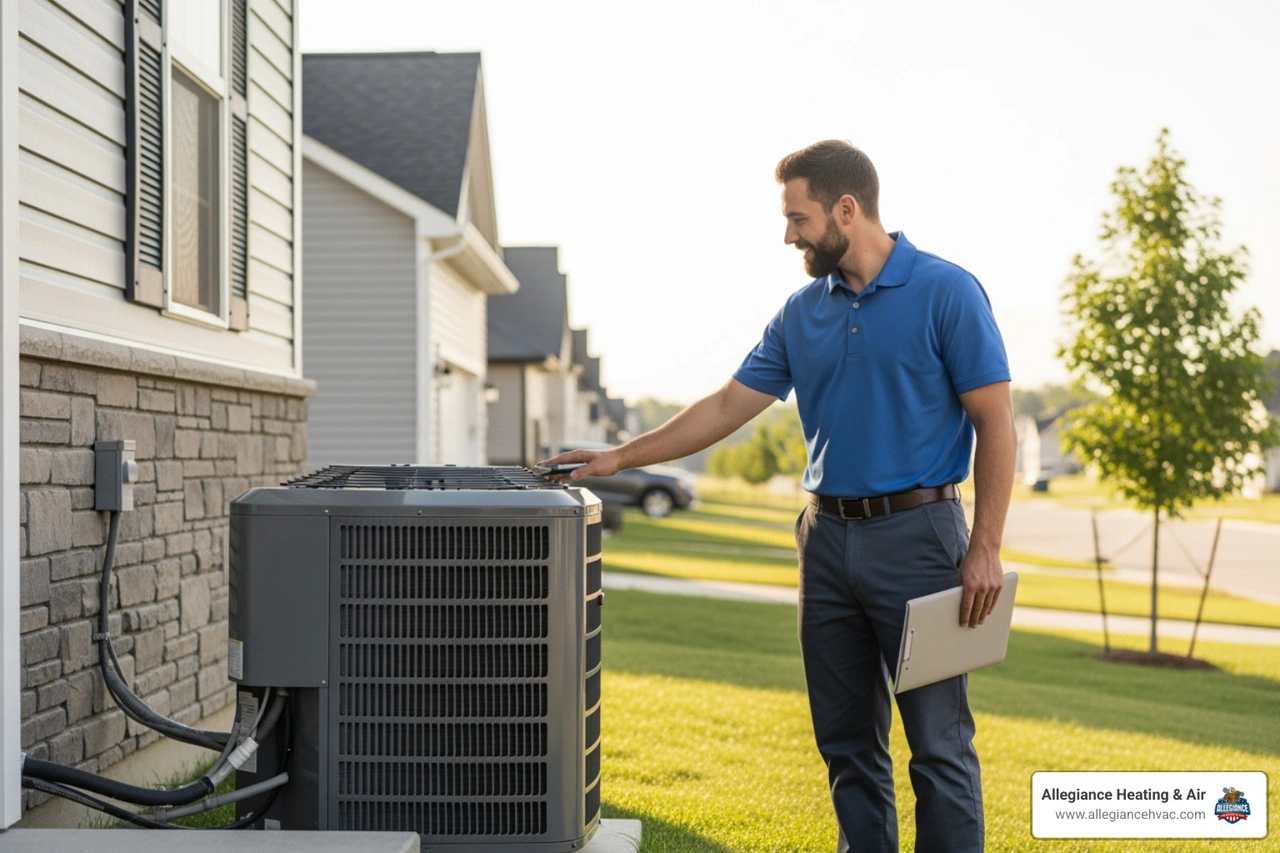
Find air conditioning service providers in Marysville, IN.
